
Wisconsin manuscript
George Gibbs IV (manuscript volume, ms p. 101) · 1856 (Olympia) and later additions
Canoes (construction). Northern canoes carry crew and "their whole worldly property"; one seen at Victoria "carried three masts and was estimated at not less than seventy feet in length"; usual method of construction: cut or burn the tree down and into a suitable length, rough hew the outside, "cut out the inside with a hatchet and chisel or hand adze", turn it over and hew the outside to correspond; then filled with water "boiled by means of hot stones, a fire being made all round the canoe on the outside" to spread the hull, which is too narrow for its depth, thwarts put in and secured by cords through small holes; the prow of the Chinook canoe and other projecting parts too large to cut from the single tree "are mortised in and secured by cords in like manner"; knots or defects cut out and a patch "firmly sewed with twine" and plugged; "The seam is caulked with pitch and cedar bark, scraped to the consistence of tow"; when finished the outside is slightly charred "and painted with coal made from rushes"
Wisconsin Historical Society, Gibbs Family Papers, U.S. Mss Y, Micro 1117
Reel 2, frames 3743
Reel 2, frame 3743
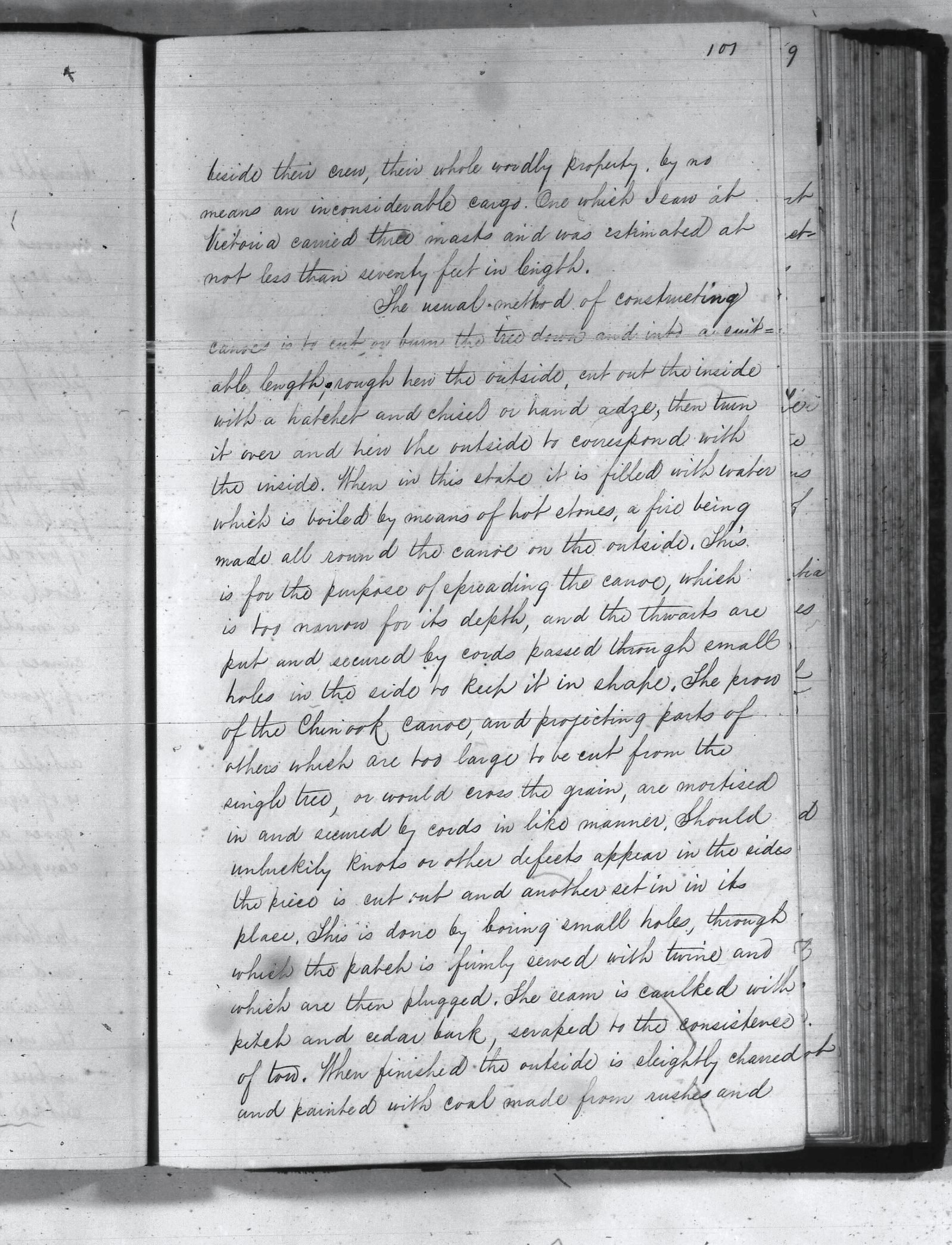
Read beside the scan
AI first transcription from the evidence pack; not independently verified. Compare with the scan.
beside their crew, their whole wordly[?] property, by no
means an inconsiderable cargo. One which I saw at
Victoria carried three masts and was estimated at
not less than seventy feet in length.
The usual method of constructing
canoes is to cut or burn the tree down and into a suit=
able length, rough hew the outside, cut out the inside
with a hatchet and chisel or hand adze, then turn
it over and hew the outside to correspond with
the inside. When in this state it is filled with water
which is boiled by means of hot stones, a fire being
made all round the canoe on the outside. This
is for the purpose of spreading the canoe, which
is too narrow for its depth, and the thwarts are
put and secured by cords passed through small
holes in the side to keep it in shape. The prow
of the Chinook canoe, and projecting parts of
others which are too large to be cut from the
single tree, or would cross the grain, are mortised
in and secured by cords in like manner. Should
unluckily knots or other defects appear in the sides
the piece is cut out and another set in in its
place. This is done by boring small holes, through
which the patch is firmly sewed with twine and
which are then plugged. The seam is caulked with
pitch and cedar bark, scraped to the consistence
of tow. When finished the outside is slightly chared[?] [illegible]
and painted with coal made from rushes and
Citation and provenance
Gibbs, G., IV. (1856). [Manuscript volume, ms p. 101]. Gibbs Family Papers, 1763-1918 (U.S. Mss Y, Micro 1117, Reel 2, frame 3743). Wisconsin Historical Society Archives, Madison, WI, United States.
Citation details need editorial review.
Historical sources retain their individual rights and credits. A scan’s presence here does not establish unrestricted reuse.
People identified in the source catalog
These are catalog labels. Individual identities and relationships have not all been reviewed.
Where the book uses this document
No quotation has yet been assigned directly to this catalog record. Its individual frames may have separate connections.