
Wisconsin manuscript
George Gibbs IV (manuscript volume, ms p. 98) · 1856 (Olympia) and later additions
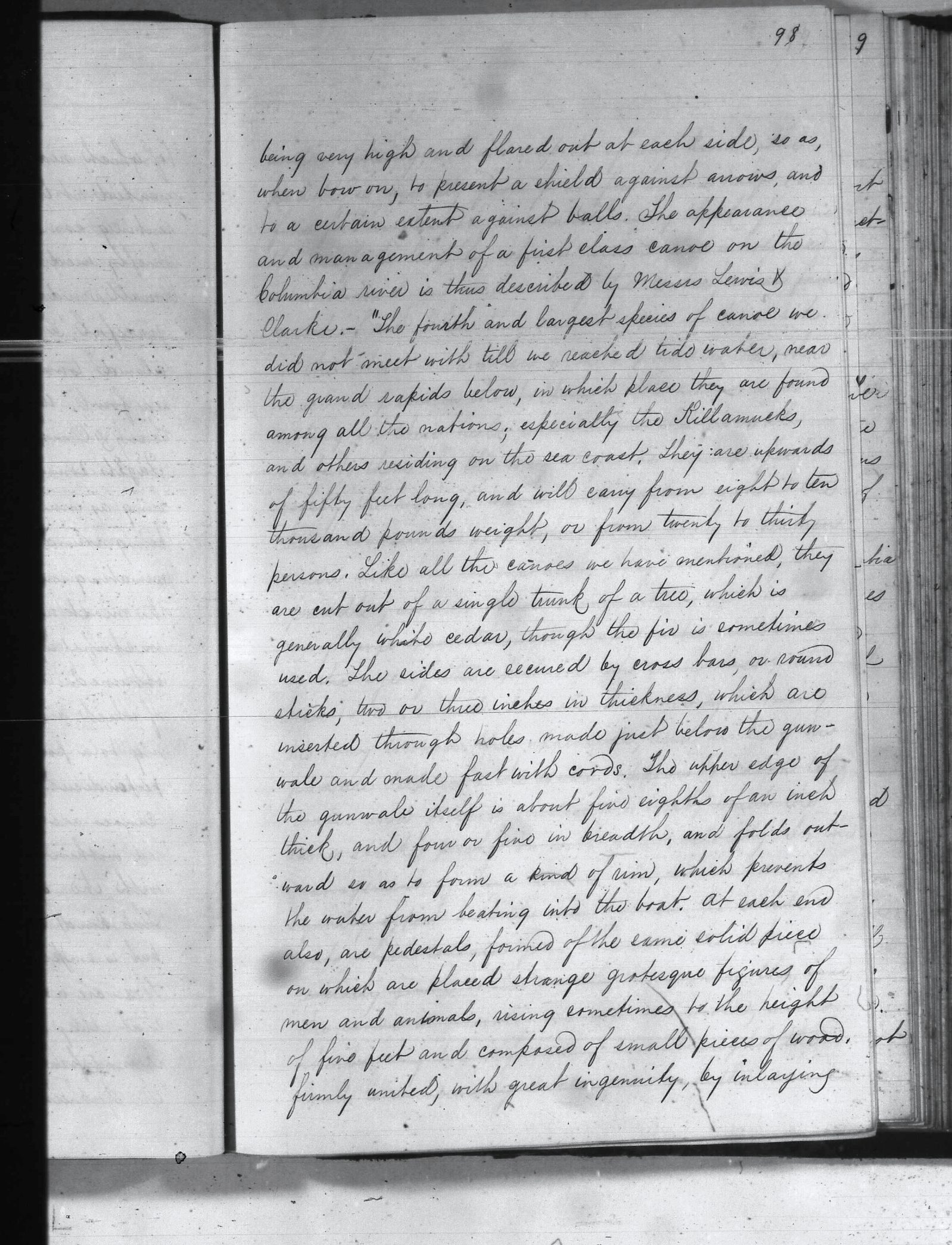
Canoes. War canoe beak "being very high and flared out at each side, so as, when bow on, to present a shield against arrows, and to a certain extent against balls"; then a long block quotation from "Messrs Lewis & Clarke" on "The fourth and largest species of canoe", not met till tide water near the grand rapids, found "among all the nations, especially the Killamucks, and others residing on the sea coast", "upwards of fifty feet long", carrying eight to ten thousand pounds or twenty to thirty persons, cut from a single trunk "generally white cedar, though the fir is sometimes used", sides secured by cross bars of round sticks two or three inches thick through holes below the gunwale and lashed with cords, gunwale five eighths of an inch thick and four or five in breadth folding outward as a rim to keep out water, pedestals at each end bearing "strange grotesque figures of men and animals, rising sometimes to the height of five feet" built of small pieces of wood inlaid
Wisconsin Historical Society, Gibbs Family Papers, U.S. Mss Y, Micro 1117
Reel 2, frames 3740
Reel 2, frame 3740
Read beside the scan
AI first transcription from the evidence pack; not independently verified. Compare with the scan.
being very high and flared out at each side, so as,
when bow on, to present a shield against arrows, and
to a certain extent against balls. The appearance
and management of a first class canoe on the
Columbia river is thus described by Messrs Lewis &
Clarke. - "The fourth and largest species of canoe we
did not meet with till we reached tide water, near
the grand rapids below, in which place they are found
among all the nations, especially the Killamucks,
and others residing on the sea coast. They are upwards
of fifty feet long, and will carry from eight to ten
thousand pounds weight, or from twenty to thirty
persons. Like all the canoes we have mentioned, they
are cut out of a single trunk of a tree, which is
generally white cedar, though the fir is sometimes
used. The sides are secured by cross bars, or round
sticks; two or three inches in thickness, which are
inserted through holes made just below the gun-
wale and made fast with cords. The upper edge of
the gunwale itself is about five eighths of an inch
thick, and four or five in breadth, and folds out-
ward so as to form a kind of rim, which prevents
the water from beating into the boat. At each end
also, are pedestals, formed of the same solid piece
on which are placed strange grotesque figures of
men and animals, rising sometimes to the height
of five feet and composed of small pieces of wood.
firmly united, with great ingenuity, by inlaying
Citation and provenance
Gibbs, G., IV. (1856). [Manuscript volume, ms p. 98]. Gibbs Family Papers, 1763-1918 (U.S. Mss Y, Micro 1117, Reel 2, frame 3740). Wisconsin Historical Society Archives, Madison, WI, United States.
Citation details need editorial review.
Historical sources retain their individual rights and credits. A scan’s presence here does not establish unrestricted reuse.
People identified in the source catalog
These are catalog labels. Individual identities and relationships have not all been reviewed.
Where the book uses this document
No quotation has yet been assigned directly to this catalog record. Its individual frames may have separate connections.