
From your reading · 11-002
Follow these words to their source
You are exploring 102 Broadway, New York in The Brevet War. Compare the words used in the book with the source and the context around them.
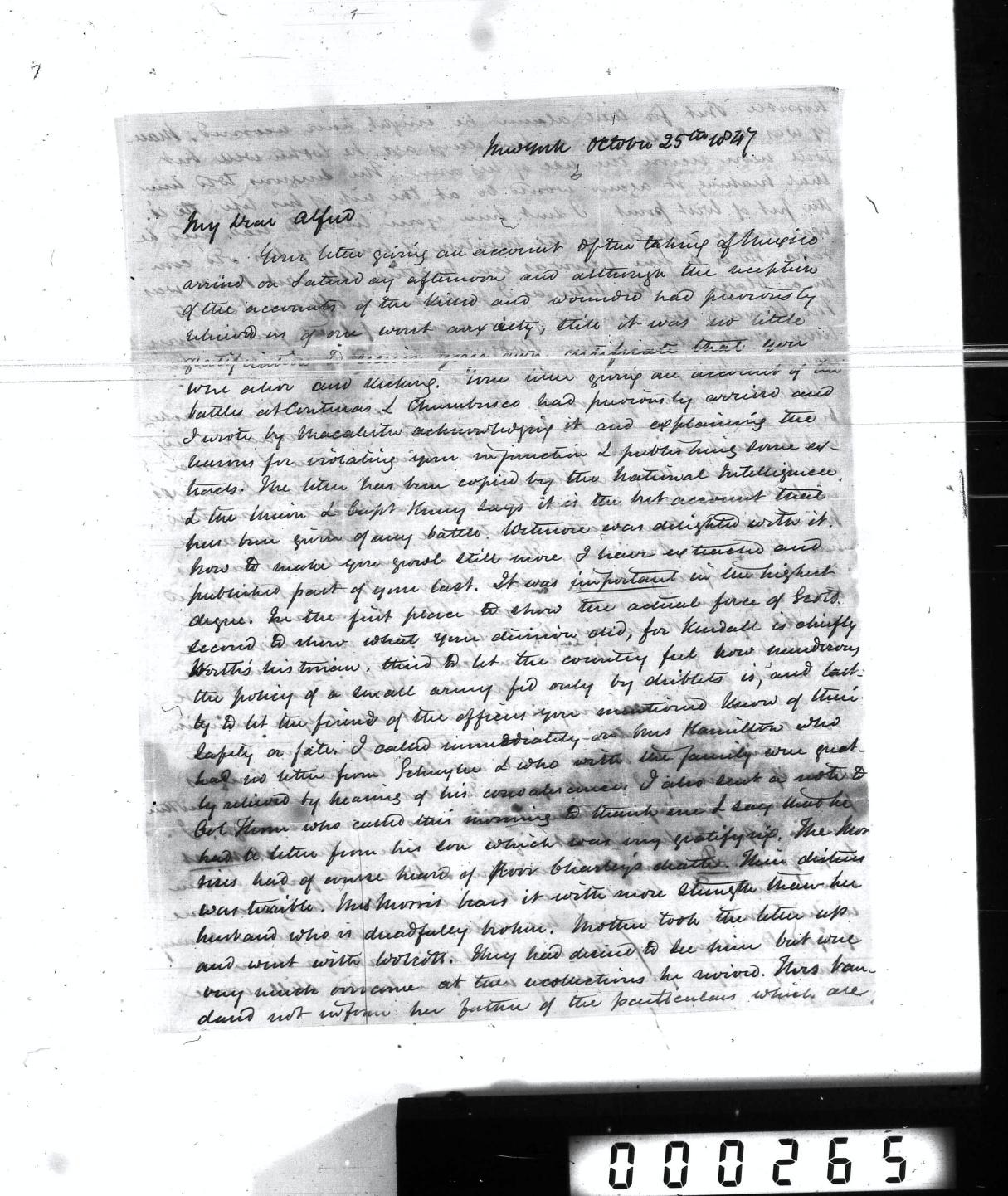
Now to make you growl still more I have extracted and published part of your last.
Source inferred, check against scan
See how the book uses these words
Alfred had written his account of Contreras and Churubusco for the family alone, and said so. George published it. On the thirteenth of October
1847 it ran in the *Daily National Intelligencer* in Washington, unsigned, and other papers picked it up. George confessed by the next mail. He had,
he wrote, already explained "the reasons for violating your injunction & publishing some extracts." And the
The connected source
George Gibbs -> Alfred Gibbs · 1847 Oct 25
Wisconsin manuscript · Reel 2, frame 1319
placed by the scan that precedes it on the page that transcribes it (check against the scan). A text match or page placement does not establish that the scan has been reviewed.
Questions to bring to the source
Who wrote this, and who was meant to read it? Is the writer describing an event they witnessed, reporting news from someone else, or remembering it later? Read the surrounding lines and compare dates, names and uncertain words.
Begin with the source page
Read beside the scan
AI first transcription from the evidence pack; not independently verified. Compare with the scan.
New York October 25th 1847
My Dear Alfred
Your letter giving an account of the taking of Mexico
arrived on Saturday afternoon and although the reception
of the accounts of the killed and wounded had previously
relieved us of our worst anxiety, still it was no little
gratification to receive your own certificate that you
were alive and kicking. Your letter giving an account of the
battle at Contreras & Churubusco had previously arrived and
I wrote by Macalister[?] acknowledging it and explaining the
reasons for violating your injunction & publishing some ex-
tracts. The letter has been copied by the National Intelligencer
& the Union & Capt Kenny[?] says it is the best account that
has been given of any battle. Wetmore was delighted with it.
Now to make you good still more I have extracted and
published part of your last. It was important in the highest
degree. In the first place to show the actual force of Scott.
Second to show what your division did, for Kendall is chiefly
Worth's historian. third to let the country feel how murderous
the policy of a small army fed only by driblets is, and last-
ly to let the friends of the officers you mentioned know of their
safety or fate. I called immediately on Mrs Hamilton who
had no letter from Schuyler & who with the family were great-
ly relieved by hearing of his convalescence. I also sent a note to
Col Hone[?] who called this morning to thank me & say that he
had a letter from his son which was very gratifying. The Mor-
rises had of course heard of poor Charley's death. Their distress
was terrible. Mrs Morris bears it with more strength than her
husband who is dreadfully broken. Mother took the letter up
and went with Wolcott. They had desired to see him but were
very much overcome at the recollections he revived. Mrs Van-
…
Read the research account used for this passage
The book catalog explicitly points to these preserved site pages. Read the account and follow its reproduced documents and citations. A research account is an intermediary, not automatically the original evidence.
Continue your learning journey
Explore the sources behind The Brevet War →
Follow the people in this chapter →
Return to The Brevet War and its quotation ledger →
to let the friends of the officers you mentioned know of their safety or fate. →
All West Point was in a blaze at the letter as I published it, →