The book is finished. GIBBS: The Forgotten Warrior of the First New York Dragoons, by Garland H. Green Jr. How to order is coming soon; you can reserve a copy now. Reserve a copy →
Alfred GibbsThe research archive
Menu

The evidence behind your reading · The Steady Hand and the Cavalier

Read the records behind this chapter

Follow a letter, report, recollection or family record beyond the passage in the book. Each source below shows where the chapter uses it and what to examine. Open it here, compare its pages, and return without losing your chapter.

Begin with a question: How should we weigh a hostile witness and a defender?

Go beyond the book · The Steady Hand and the Cavalier

Read a disagreement about character as an argument

The Barnitzes’ descriptions of Gibbs are memorable, and Garland challenges how those descriptions have shaped his reputation. This chapter invites examination of witnesses and interpretation.

New to these records? A little context.

A research account can combine historical documents, later recollections, images, and the author’s interpretation. Start with its source notes and captions. Ask who made each item, when it was made, and what kind of question it can answer.

How should we weigh a hostile witness and a defender?
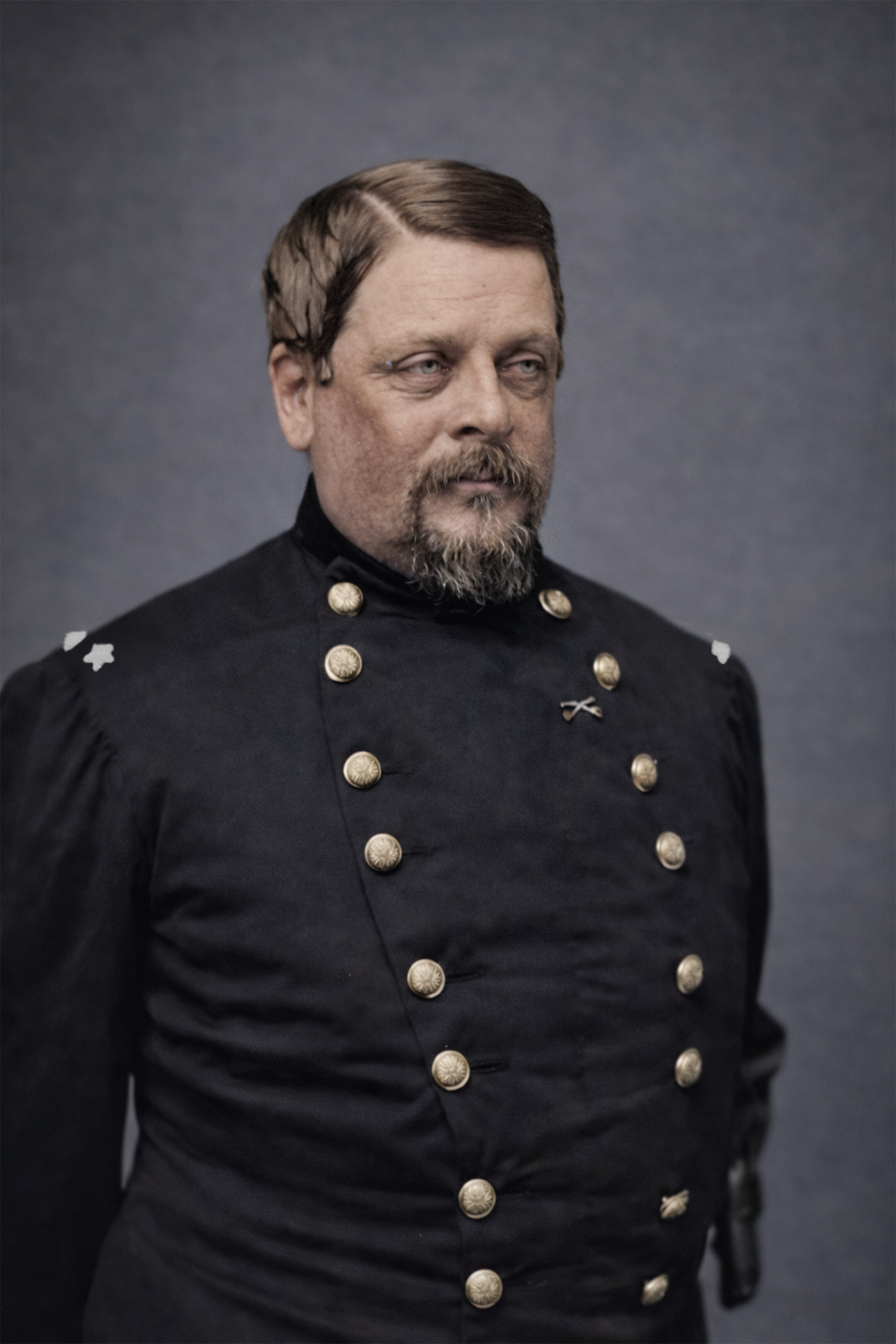
General alfred gibbs colorized and enhanced
General alfred gibbs colorized and enhanced · From the linked account. Its original credits and image status are preserved there.

Read the source exhibit & its explanation

Garland’s response to the Barnitz accounts

Garland’s essay explicitly states its advocacy and contrasts diaries and letters with service, medical, and regimental evidence. Its declared position is part of what readers should assess.

What to examine: Separate quoted passages from Garland’s interpretation. Identify the date, speaker, and circumstances of each criticism before comparing it with the counterevidence.

Keep this distinction in mind: This essay is an argument, not an impartial verdict. Some quotations have no verified page locator; retain that limitation when citing them.

Follow this question into The first witness →

Keep your question in view as you explore. The reading tray retains The Steady Hand and the Cavalier. Close it to return to this point, or deliberately choose to explore outside the chapter.

2 distinct source records · Page 1 of 1

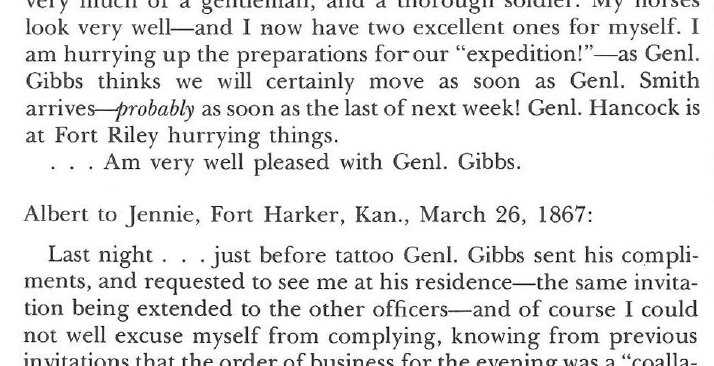
Excerpt, p. 18 (copyrighted book; the passage only, shown under fair use)
Excerpt, p. 18 (copyrighted book; the passage only, shown under fair use) · Supplied page connection.

Modern book (edited historical diaries and letters)

Utley, R. M. (Ed.). (1977). Life in Custer's Cavalry: Diaries and letters of Albert and Jennie Barnitz, 1867-1868. Yale University Press. First edition, as scanned by Garland (Life_in_Custers_Cavalry_Merged.pdf).

This modern volume publishes historical diaries and letters. Identify the writer and date, and distinguish the Barnitz accounts from editorial commentary. The full volume is cited, not reproduced; the linked access edition is a reprint whose pagination needs checking.

Your passage · The first witness

Am very well pleased with Genl. Gibbs,

Albert or Jennie Barnitz (diary or letter), as printed; p. 18. Read the surrounding record before drawing a conclusion.

· Page references are recorded with each quotation.

Where this chapter uses this source · 29 passages

The first witness

Am very well pleased with Genl. Gibbs,

Albert or Jennie Barnitz (diary or letter), as printed; p. 18

Examine quotation 37-001 →

The first witness

He is always genial, and reliable,

Albert or Jennie Barnitz (diary or letter), as printed; p. 53

Examine quotation 37-003 →

The first witness

not a martinet, like Custer,

Albert or Jennie Barnitz (diary or letter), as printed; p. 53

Examine quotation 37-004 →

The first witness

too old to stand hard service.

Albert or Jennie Barnitz (diary or letter), as printed; p. 53

Examine quotation 37-006 →

Big Creek

I have spent the afternoon with Mrs. Gibbs.

Albert or Jennie Barnitz (diary or letter), as printed; p. 55

Examine quotation 37-014 →

Big Creek

Mrs. Gibbs brought me potatoes for dinner.

Albert or Jennie Barnitz (diary or letter), as printed; p. 55

Examine quotation 37-015 →

Big Creek

The camp was aroused, guns were fired, bugles sounded, & after a great deal of excitement they were found all safe. Gen Gibbs was so intoxicated he could not give an order, scarcely walk. Oh! it is dr…

Albert or Jennie Barnitz (diary or letter), as printed; p. 56

Examine quotation 37-016 →

Big Creek

at random & in every direction.

Albert or Jennie Barnitz (diary or letter), as printed; p. 56

Examine quotation 37-017 →

Big Creek

Tonight we were invited to Gen Gibbs. The Gen. was drunk, as usual!

Albert or Jennie Barnitz (diary or letter), as printed; p. 56

Examine quotation 37-018 →

Big Creek

Poor health, the result of an Apache lance wound sustained near Cooke's Spring, N.M., in March 1857, kept him in garrison more than the field.

Utley's editorial text (biographical appendix, entry for Alfred Gibbs); p. 259

Examine quotation 37-020 →

Fire and water

selected by Maj. Alfred Gibbs.

Utley's editorial text (his note on the Fort Hays site); p. 285

Examine quotation 37-028 →

His band

Genl. Gibbs is in command, and of course, the first thing that he thought of, when I rode in, a mile or so ahead of the command, and reported, was his band! Nothing would do but he must send out the b…

Albert or Jennie Barnitz (diary or letter), as printed; p. 103

Examine quotation 37-029 →

His band

mounted on grey horses,

Albert or Jennie Barnitz (diary or letter), as printed; p. 103

Examine quotation 37-030 →

His band

in a complete suit of Navy flannel, with heavy gold watch guard, majors shoulder straps, of his own unique pattern, with the two silver stars of a (Brevet) Major General between the leaves.

Albert or Jennie Barnitz (diary or letter), as printed; p. 103

Examine quotation 37-031 →

His band

Mrs. Genl. Gibbs appears to be having all her silver ware put in the very best possible order.

Albert or Jennie Barnitz (diary or letter), as printed; p. 108

Examine quotation 37-032 →

The silly old man

as he and Genl. Gibbs will be quartered together.

Albert or Jennie Barnitz (diary or letter), as printed; p. 125

Examine quotation 37-033 →

The silly old man

The silly old man! He made himself appear ridiculous subsequenty on parade, by his over-solicitude to have everything done exactly right (according to his variable notions of propriety!) which resulte…

Albert or Jennie Barnitz (diary or letter), as printed; p. 129

Examine quotation 37-035 →

The grudge

an immense amount of style,

Barnitz letter; the bracket identifying Mrs. Gibbs nearby is Utley's; p. 15

Examine quotation 37-037 →

The grudge

I never liked Mrs. Gibbs so well before.

Jennie Barnitz's words, quoted within Utley's linking text; p. 131

Examine quotation 37-038 →

The grudge

Genl. Gibbs is quite ill,

Albert or Jennie Barnitz (diary or letter), as printed; p. 135

Examine quotation 37-040 →

The grudge

was patronizing to Genl. Gibbs and the Adjutant.

Albert or Jennie Barnitz (diary or letter), as printed; p. 142

Examine quotation 37-041 →

The grudge

that same cold, unfeeling look and manner which is so characteristic of her, and which is chilling, even to think of.

Albert or Jennie Barnitz (diary or letter), as printed; p. 149

Examine quotation 37-042 →

The grudge

I am quite surprised at Gen. Gibbs' thoughtfulness.

Albert or Jennie Barnitz (diary or letter), as printed; p. 164

Examine quotation 37-043 →

The grudge

the little grudge I have against him.

Albert or Jennie Barnitz (diary or letter), as printed; p. 164

Examine quotation 37-044 →

The grudge

the most complete example of a petty tyrant that I have ever seen.

Albert or Jennie Barnitz (diary or letter), as printed; p. 50

Examine quotation 37-045 →

The grudge

a thorough soldier and a polished gentleman

Albert or Jennie Barnitz (diary or letter), as printed; p. 30

Examine quotation 37-046 →

The grudge

crafty, scheming, envious, selfish, malicious.

Albert or Jennie Barnitz (diary or letter), as printed; p. 156

Examine quotation 37-047 →

The grudge

I am not at all anxious to see him.

Albert or Jennie Barnitz (diary or letter), as printed; p. 195

Examine quotation 37-050 →

The grudge

I become very much exasperated occasionally, when I think of the old gentleman, and wish him all manner of unhappiness!

Albert or Jennie Barnitz (diary or letter), as printed; p. 202

Examine quotation 37-051 →

Open the record and its pages →

40 catalogued pages. Transcription and image availability are shown on the document view.

Citation and source credit

Barnitz, A., & Barnitz, J. (1977). Life in Custer's cavalry: Diaries and letters of Albert and Jennie Barnitz, 1867-1868 (R. M. Utley, Ed.). Yale University Press.

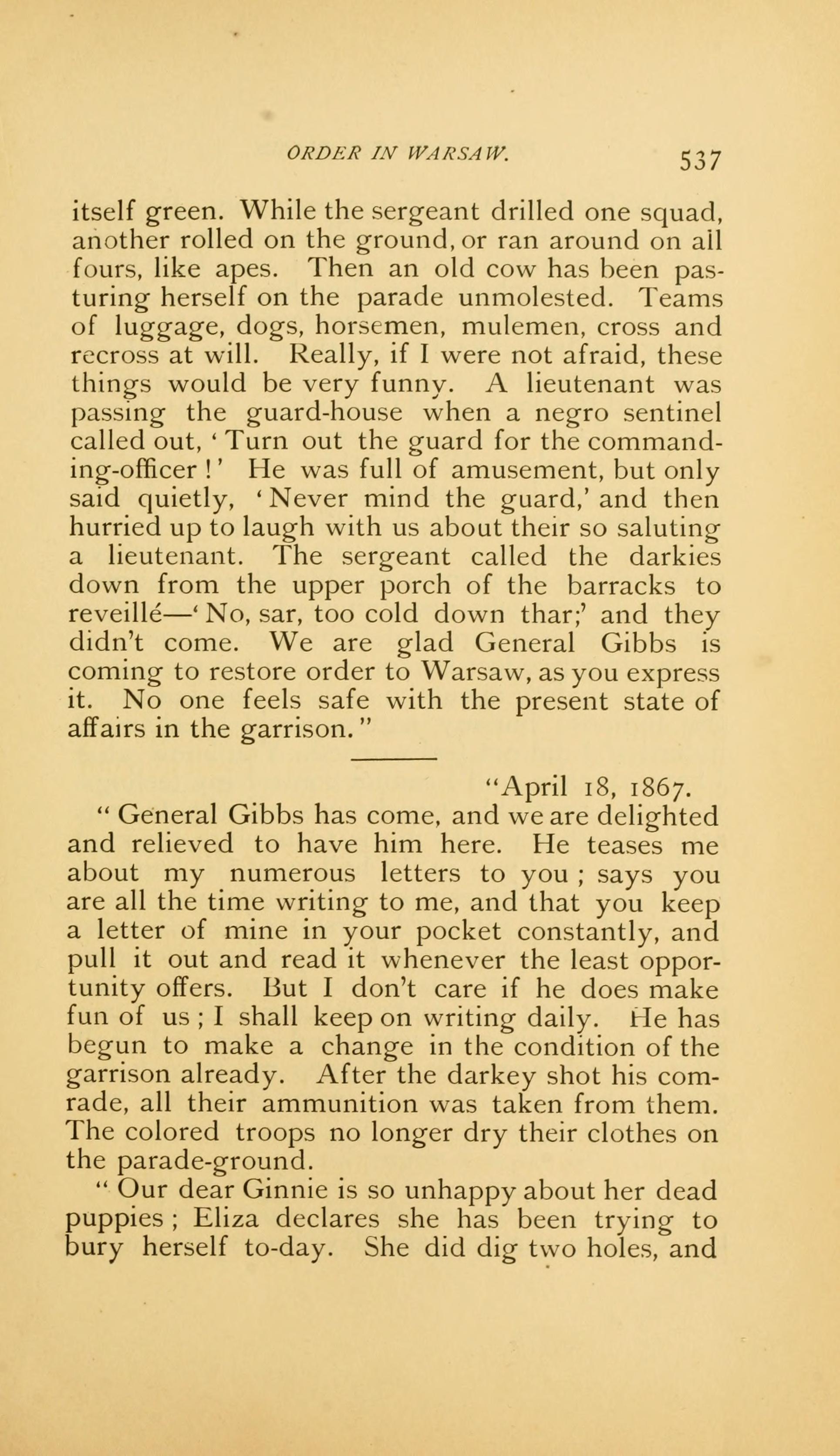
Printed page 537 · Internet Archive scan
Printed page 537 · Internet Archive scan · Supplied page connection.

Printed book

Custer, E. B. (1887). Tenting on the plains. Charles L. Webster. archive.org tentingonplains00cust (djvu text saved research/seventh/tenting1887.txt). Joined across lines; page headers removed; obvious OCR errors corrected. Chapter XIII (General Etiquette) is on Garland's page 30386.

Identify the author and publication date before weighing this account. A later recollection and a contemporary document answer different questions. Read the cited page and its surrounding passage.

Your passage · Evenings at Fort Riley

He teases me about my numerous letters to you,

Page connection supplied; check matching method. Read the surrounding record before drawing a conclusion.

· pp. 368-370

Where this chapter uses this source · 13 passages

Evenings at Fort Riley

He teases me about my numerous letters to you,

Page connection supplied; check matching method

Examine quotation 37-007 →

Evenings at Fort Riley

But I don't care if he does make fun of us.

Page connection supplied; check matching method

Examine quotation 37-008 →

Evenings at Fort Riley

The Gibbs boys, Alfred and Blair, are the dearest, most captivating children.

Page connection supplied; check matching method

Examine quotation 37-009 →

Evenings at Fort Riley

Each boy had placed one hand on the mother's shoulder. We said they were her brevets.

Page connection supplied; check matching method

Examine quotation 37-010 →

Evenings at Fort Riley

Mother, what is a brevet; is it a make-believe soldier?

Page connection supplied; check matching method

Examine quotation 37-011 →

Evenings at Fort Riley

General Gibbs finds garrison duty so dull he would far rather be on the campaign, but he tries to enliven our evenings.

Page connection supplied; check matching method

Examine quotation 37-012 →

Evenings at Fort Riley

I cannot induce General Gibbs to let me set out for Hays to-night. He considers it dangerous.

Page connection supplied; check matching method

Examine quotation 37-013 →

Fire and water

Mrs. Gibbs gathered her two boys closer to her,

Page connection supplied; check matching method

Examine quotation 37-022 →

Fire and water

a broad strip of flame separating her from her children.

Page connection supplied; check matching method

Examine quotation 37-023 →

Fire and water

ran like an antelope to where the fire-band narrowed, leaped the flame, seized the little men,

Page connection supplied; check matching method

Examine quotation 37-024 →

Fire and water

Mrs. Gibbs and her two boys, Alphie and Blair, Diana and I, were driven across the plain

Page connection supplied; check matching method

Examine quotation 37-025 →

Fire and water

We dropped down in heaps, we were so exhausted for want of sleep.

Page connection supplied; check matching method

Examine quotation 37-026 →

Fire and water

Mrs. Gibbs and her boys, Diana drenched and limp as to clothes, and I decidedly moist, were fished out of our watery camp-beds.

Page connection supplied; check matching method

Examine quotation 37-027 →

Open the record and its pages →

17 catalogued pages. Transcription and image availability are shown on the document view.

Citation and source credit

Custer, E. B. (1887). Tenting on the plains. Charles L. Webster. archive.org tentingonplains00cust (djvu text saved research/seventh/tenting1887.txt). Joined across lines; page headers removed; obvious OCR errors corrected. Chapter XIII (General Etiquette) is on Garland's page 30386.

Citation details need review.

← Continue your chapter journey · Follow the people in this chapter →

Your chapter stays open
Your book journey · The Steady Hand and the CavalierExplore the evidence

Compare the original with its transcription and citation.

Explore outside this journey ↗

This chapter’s source collection as JSON