The book is finished.GIBBS: The Forgotten Warrior of the First New York Dragoons, by Garland H. Green Jr. How to order is coming soon; you can reserve a copy now. Reserve a copy →
The evidence behind your reading · The Regiment Gibbs Built
Read the records behind this chapter
Follow a letter, report, recollection or family record beyond the passage in the book. Each source below shows where the chapter uses it and what to examine. Open it here, compare its pages, and return without losing your chapter.
Begin with a question: What does building a regiment look like on paper?
Go beyond the book · The Regiment Gibbs Built
You are reading The Hancock march · March and April 1867. The guided starting point below explores Order at Fort Riley. Evidence for this particular section has not yet been separately assembled; chapter references remain available below.
See how a regiment was built through ordinary orders
The Seventh Cavalry took shape through assignments, company changes, returns, and officers reporting for duty. Gibbs’s administrative work becomes visible when those small acts are read together.
New to these records? A little context.
A docket is an office’s summary or filing note; it may be on a wrapper rather than in the letter. An endorsement is another official’s response or forwarding note. Read each voice and date separately. A transcription is a reading of a document, with uncertain words marked where the exhibit provides them.
What does building a regiment look like on paper?
What does building a regiment look like on paper?
Research preview · An invitation into the written account, not a reproduction of an original document.
Read the source exhibit & its explanation
The Seventh Cavalry’s company assignments
The account reconstructs company assignments from Gibbs’s orders and links dates to the documents. It lets readers test an organizational claim against individual decisions.
What to examine: Pick one officer and follow the dated order into the scan and transcription. Identify what the order changes and compare it with the table’s summary.
Keep this distinction in mind: Later fame or a later battlefield death does not explain an 1867 assignment by itself. Avoid reading the Little Bighorn backward into every administrative choice.
Keep your question in view as you explore. The reading tray retains The Regiment Gibbs Built → The Hancock march. Close it to return to this point, or deliberately choose to explore outside the chapter.
Identify the author and publication date before weighing this account. A later recollection and a contemporary document answer different questions. Read the cited page and its surrounding passage.
Your passage · The Hancock march
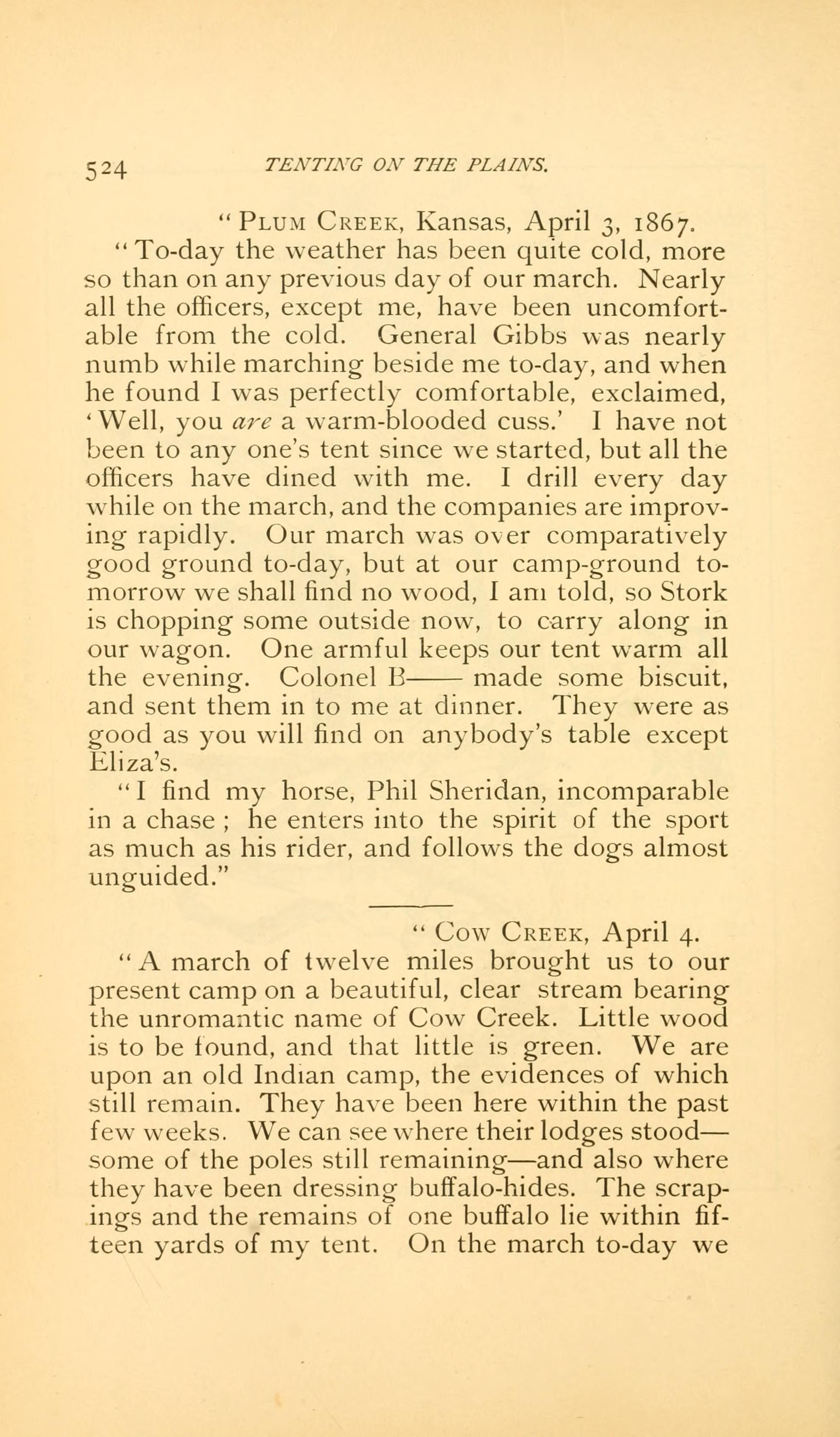
General Gibbs was nearly numb while marching beside me to-day, and when he found I was perfectly comfortable, exclaimed, 'Well, you are a warm-blooded cuss.'
Page connection supplied; check matching method. Read the surrounding record before drawing a conclusion.
· pp. 368-370
Where this chapter uses this source · 6 passages
The Hancock march
General Gibbs was nearly numb while marching beside me to-day, and when he found I was perfectly comfortable, exclaimed, 'Well, you are a warm-blooded cuss.'
I said, 'It's a pretty thing that a man cannot write to his wife without being disturbed,' and the General replied, 'Any man who writes to his wife once a day deserves to be disturbed.'
17 catalogued pages. Transcription and image availability are shown on the document view.
Citation and source credit
Custer, E. B. (1887). Tenting on the plains. Charles L. Webster. archive.org tentingonplains00cust (djvu text saved research/seventh/tenting1887.txt). Joined across lines; page headers removed; obvious OCR errors corrected. Chapter XIII (General Etiquette) is on Garland's page 30386.