The book is finished. GIBBS: The Forgotten Warrior of the First New York Dragoons, by Garland H. Green Jr. How to order is coming soon; you can reserve a copy now. Reserve a copy →
Alfred GibbsThe research archive
Menu

The evidence behind your reading · The Regiment Gibbs Built

Read the records behind this chapter

Follow a letter, report, recollection or family record beyond the passage in the book. Each source below shows where the chapter uses it and what to examine. Open it here, compare its pages, and return without losing your chapter.

Begin with a question: What does building a regiment look like on paper?

Go beyond the book · The Regiment Gibbs Built

See how a regiment was built through ordinary orders

The Seventh Cavalry took shape through assignments, company changes, returns, and officers reporting for duty. Gibbs’s administrative work becomes visible when those small acts are read together.

New to these records? A little context.

A docket is an office’s summary or filing note; it may be on a wrapper rather than in the letter. An endorsement is another official’s response or forwarding note. Read each voice and date separately. A transcription is a reading of a document, with uncertain words marked where the exhibit provides them.

What does building a regiment look like on paper?
Research preview · An invitation into the written account, not a reproduction of an original document.

Read the source exhibit & its explanation

The Seventh Cavalry’s company assignments

The account reconstructs company assignments from Gibbs’s orders and links dates to the documents. It lets readers test an organizational claim against individual decisions.

What to examine: Pick one officer and follow the dated order into the scan and transcription. Identify what the order changes and compare it with the table’s summary.

Keep this distinction in mind: Later fame or a later battlefield death does not explain an 1867 assignment by itself. Avoid reading the Little Bighorn backward into every administrative choice.

Follow this question into Order at Fort Riley →

Keep your question in view as you explore. The reading tray retains The Regiment Gibbs Built. Close it to return to this point, or deliberately choose to explore outside the chapter.

16 distinct source records · Page 2 of 3

West Point scan 548
West Point scan 548 · Supplied page connection.

West Point manuscript

Mitchell to A. J. Smith, Fort Leavenworth, 8 January 1867 (page 5 of 7)

Begin with who made this record, when and for whom. Compare the book’s words with the scan and the surrounding transcription. Distinguish what the writer observed from a request, opinion or later interpretation.

Your passage · The other report

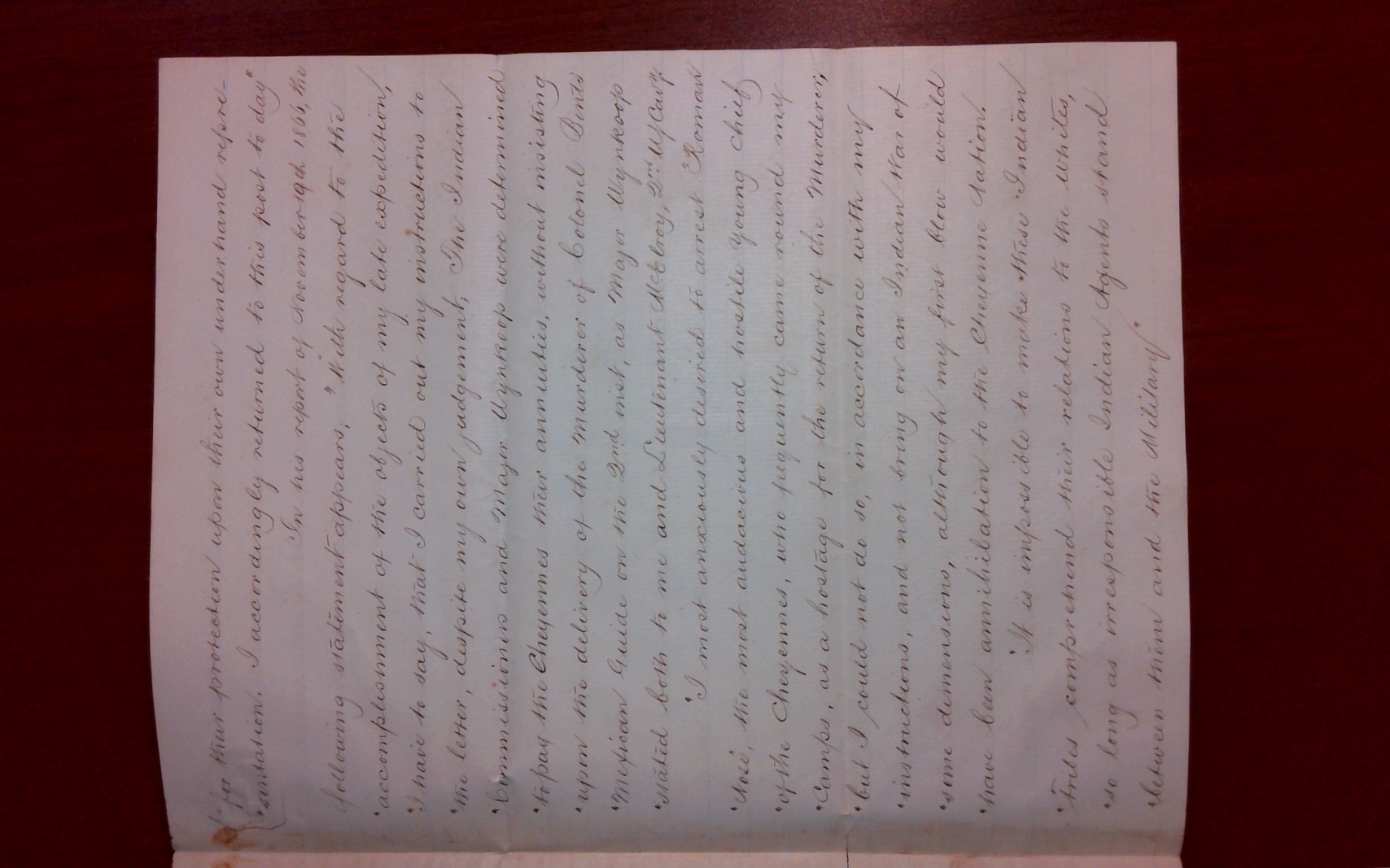
I most anxiously desired to arrest 'Roman Nose', the most audacious and hostile young chief of the Cheyennes, who frequently came round my camps, as a hostage for the return of the…

Page connection supplied; check matching method. Read the surrounding record before drawing a conclusion.

· West Point scan 548

Where this chapter uses this source · 2 passages

The other report

I most anxiously desired to arrest 'Roman Nose', the most audacious and hostile young chief of the Cheyennes, who frequently came round my camps, as a hostage for the return of the Murderer.

Page connection supplied; check matching method

Examine quotation 36-029 →

The other report

an Indian War of some dimensions, although my first blow would have been annihilation to the Cheyenne Nation.

Page connection supplied; check matching method

Examine quotation 36-030 →

Open the record and its pages →

1 catalogued pages. Transcription and image availability are shown on the document view.

Citation and source credit

Mitchell, W. G. (1867, January 8). [Letter, by direction of Maj. Gen. W. S. Hancock, to Bvt. Maj. Gen. A. J. Smith on Gibbs's reports of 16 and 19 November 1866; page 5 of 7]. Alfred Gibbs papers (CU #1313), Manuscripts Collection, U.S. Military Academy Library, West Point, NY. Scans by Garland H. Green Jr., November 2024.

Citation details need review.

West Point scan 603
West Point scan 603 · Supplied page connection.

West Point manuscript

Mitchell to A. J. Smith, Fort Leavenworth, 8 January 1867 (page 3 of 7)

Begin with who made this record, when and for whom. Compare the book’s words with the scan and the surrounding transcription. Distinguish what the writer observed from a request, opinion or later interpretation.

Your passage · The other report

the arrest of the murderer in this case, or the seizure of hostages from the Cheyennes.

Page connection supplied; check matching method. Read the surrounding record before drawing a conclusion.

· West Point scan 603

Where this chapter uses this source · 1 passage

The other report

the arrest of the murderer in this case, or the seizure of hostages from the Cheyennes.

Page connection supplied; check matching method

Examine quotation 36-033 →

Open the record and its pages →

1 catalogued pages. Transcription and image availability are shown on the document view.

Citation and source credit

Mitchell, W. G. (1867, January 8). [Letter, by direction of Maj. Gen. W. S. Hancock, to Bvt. Maj. Gen. A. J. Smith on Gibbs's reports of 16 and 19 November 1866; page 3 of 7]. Alfred Gibbs papers (CU #1313), Manuscripts Collection, U.S. Military Academy Library, West Point, NY. Scans by Garland H. Green Jr., November 2024.

Citation details need review.
West Point scan 640
West Point scan 640 · Document preview; the quoted page may differ.

West Point manuscript

Mitchell to A. J. Smith, Fort Leavenworth, 8 January 1867 (page 4 of 7)

Begin with who made this record, when and for whom. Compare the book’s words with the scan and the surrounding transcription. Distinguish what the writer observed from a request, opinion or later interpretation.

Your passage · The other report

require this matter to be reopened.

Words matched in source text. Read the surrounding record before drawing a conclusion.

· West Point scan 640

Where this chapter uses this source · 1 passage

The other report

require this matter to be reopened.

Words matched in source text

Examine quotation 36-035 →

Open the record and its pages →

1 catalogued pages. Transcription and image availability are shown on the document view.

Citation and source credit

Mitchell, W. G. (1867, January 8). [Letter, by direction of Maj. Gen. W. S. Hancock, to Bvt. Maj. Gen. A. J. Smith on Gibbs's reports of 16 and 19 November 1866; page 4 of 7]. Alfred Gibbs papers (CU #1313), Manuscripts Collection, U.S. Military Academy Library, West Point, NY. Scans by Garland H. Green Jr., November 2024.

Citation details need review.
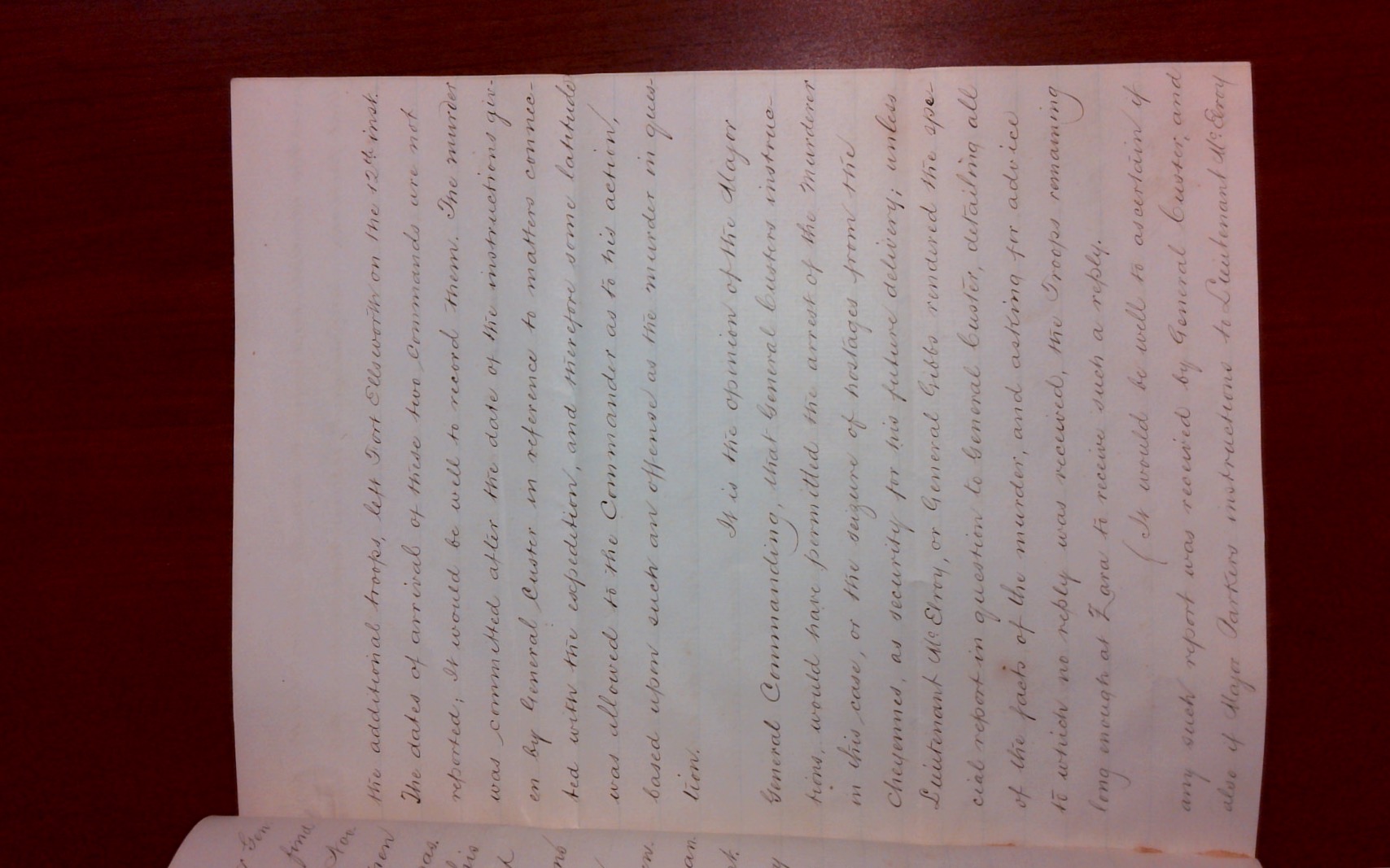
West Point scan 726
West Point scan 726 · Supplied page connection.

West Point manuscript

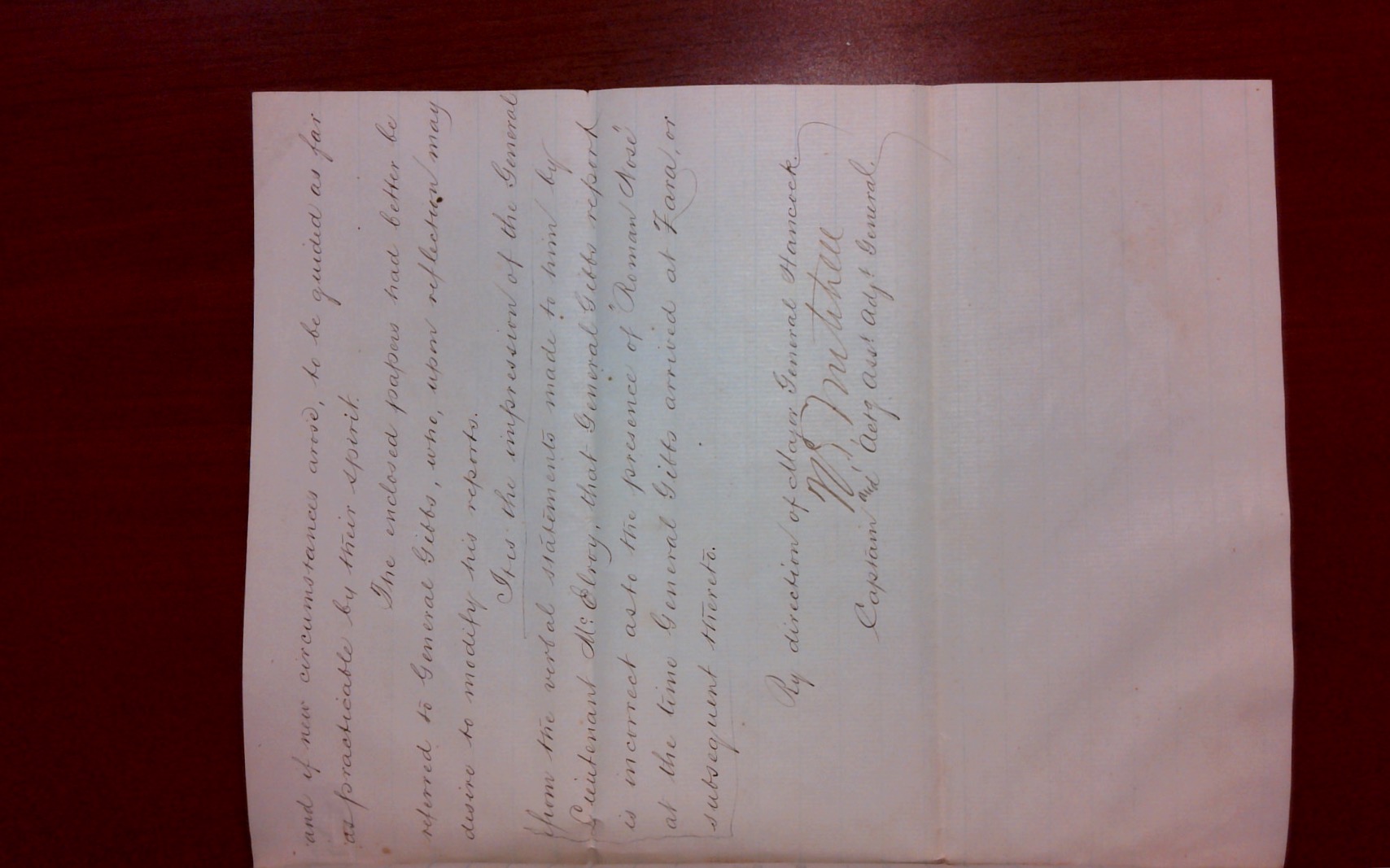
Mitchell to A. J. Smith, Fort Leavenworth, 8 January 1867 (page 7 of 7)

Begin with who made this record, when and for whom. Compare the book’s words with the scan and the surrounding transcription. Distinguish what the writer observed from a request, opinion or later interpretation.

Your passage · The other report

who, upon reflection, may desire to modify his reports.

Page connection supplied; check matching method. Read the surrounding record before drawing a conclusion.

· West Point scan 726

Where this chapter uses this source · 1 passage

The other report

who, upon reflection, may desire to modify his reports.

Page connection supplied; check matching method

Examine quotation 36-039 →

Open the record and its pages →

1 catalogued pages. Transcription and image availability are shown on the document view.

Citation and source credit

Mitchell, W. G. (1867, January 8). [Letter, by direction of Maj. Gen. W. S. Hancock, to Bvt. Maj. Gen. A. J. Smith on Gibbs's reports of 16 and 19 November 1866; page 7 of 7]. Alfred Gibbs papers (CU #1313), Manuscripts Collection, U.S. Military Academy Library, West Point, NY. Scans by Garland H. Green Jr., November 2024.

Citation details need review.
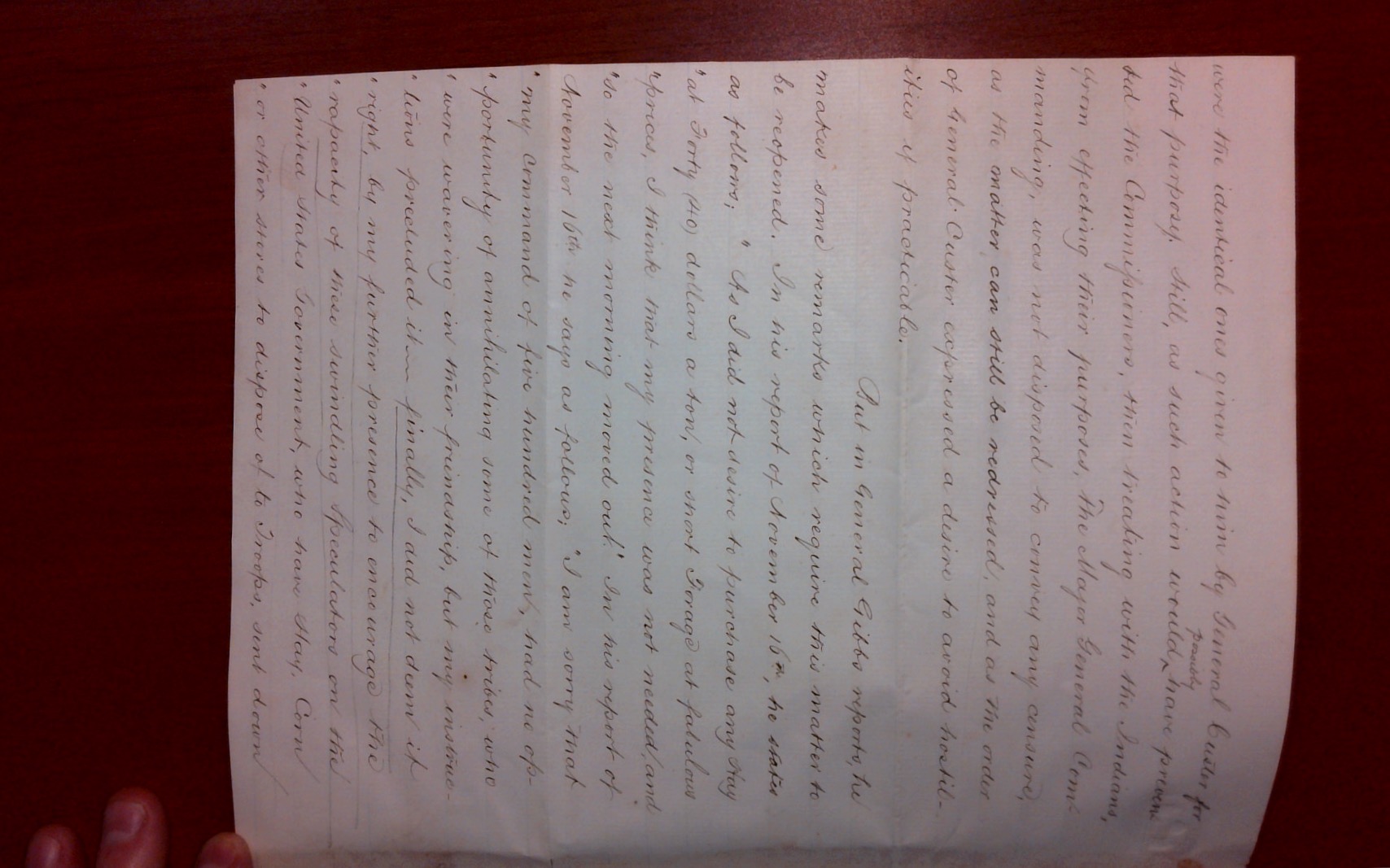
Printed page (archive.org leaf 455) · Internet Archive scan
Printed page (archive.org leaf 455) · Internet Archive scan · Document preview; the quoted page may differ.

Printed book

Custer, E. B. (1887). Tenting on the plains

Identify the author and publication date before weighing this account. A later recollection and a contemporary document answer different questions. Read the cited page and its surrounding passage.

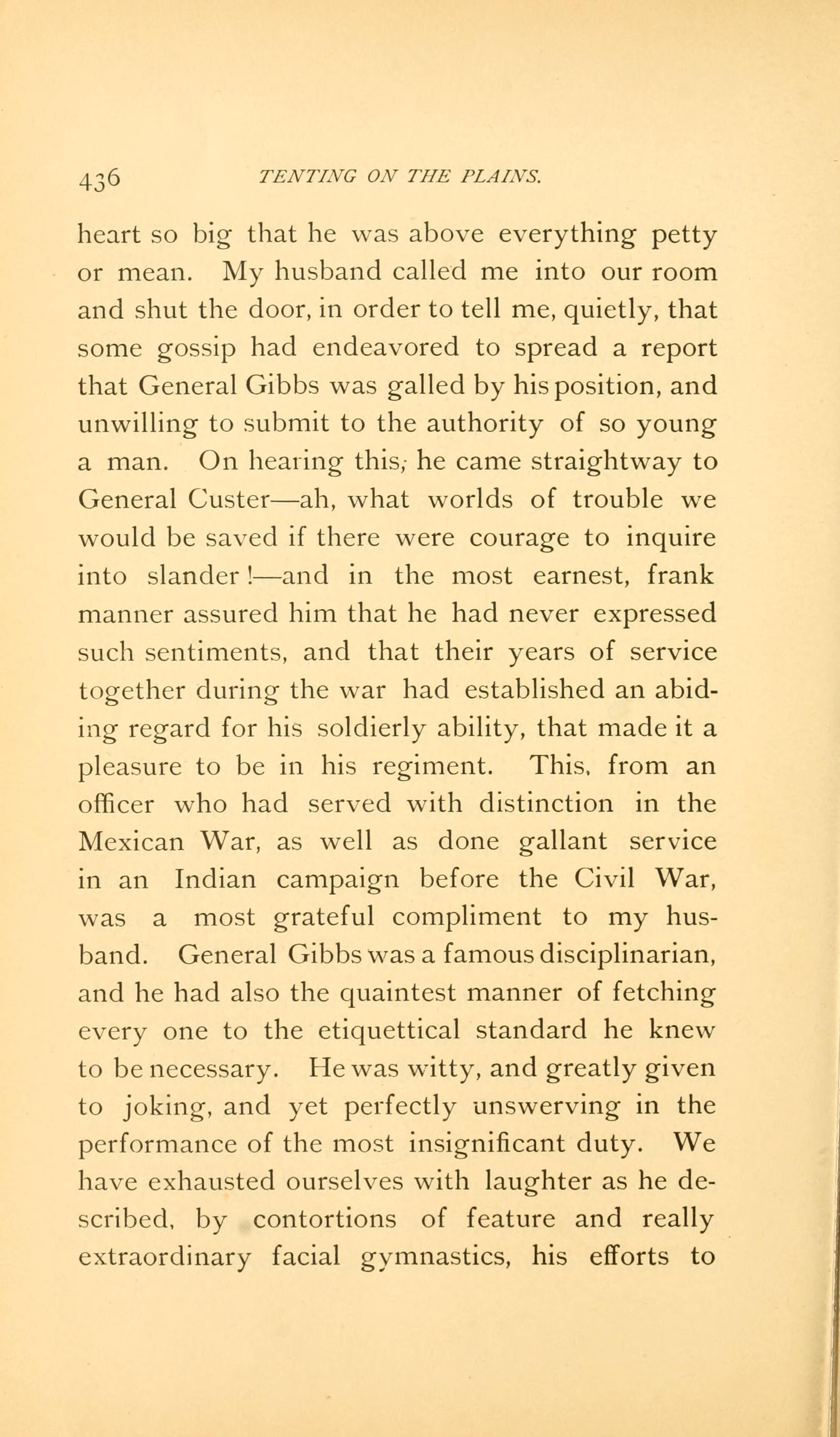
Your passage · General Etiquette

was galled by his position, and unwilling to submit to the authority of so young a man.

Source identified; supplied locator: p. 436. Read the surrounding record before drawing a conclusion.

· p. 436

Where this chapter uses this source · 10 passages

General Etiquette

was galled by his position, and unwilling to submit to the authority of so young a man.

Source identified; supplied locator: p. 436

Examine quotation 36-040 →

General Etiquette

On hearing this; he came straightway to General Custer—ah, what worlds of trouble we would be saved if there were courage to inquire into slander !—and in the most earnest, frank manner assured him th…

Source identified; supplied locator: p. 436

Examine quotation 36-041 →

General Etiquette

whose soul was so broad and his heart so big that he was above everything petty or mean.

Source identified; supplied locator: pp. 435-436

Examine quotation 36-042 →

General Etiquette

and he had also the quaintest manner of fetching every one to the etiquettical standard he knew to be necessary. He was witty, and greatly given to joking, and yet perfectly unswerving in the performa…

Page connection supplied; check matching method

Examine quotation 36-044 →

General Etiquette

exhausted ourselves with laughter as he described, by contortions of feature and really extraordinary facial gymnastics, his efforts to dislodge a venturesome and unmilitary fly.

Source identified; supplied locator: pp. 436-437 · Review flag: close match, not exact: check the wording against the scan

Examine quotation 36-046 →

General Etiquette

The way he came to know that this innovation must be suppressed, was by a request from General Gibbs to purchase it for his bandmaster.

Source identified; supplied locator: p. 437 · Review flag: close match, not exact: check the wording against the scan

Examine quotation 36-047 →

General Etiquette

begged General Custer to picture to himself the appearance of his entire regiment clad in long-tailed, ragged gowns modeled after that of their commanding officer!

Source identified; supplied locator: p. 439

Examine quotation 36-049 →

General Etiquette

His coats were marvelous fits,

Source identified; supplied locator: p. 438

Examine quotation 36-050 →

General Etiquette

and he tightly buckled in his increasing rotundity with a superb belt and clasp that had belonged to his grandfather, a Wolcott in the Revolutionary War.

Source identified; supplied locator: p. 438

Examine quotation 36-051 →

General Etiquette

He never drew distinctions between the old army and the new, as some were wont to do, and his influence in shaping our regiment in social as well as military affairs was felt in a marked manner, and w…

Source identified; supplied locator: p. 439

Examine quotation 36-052 →

Open the record and its pages →

4 catalogued pages. Transcription and image availability are shown on the document view.

Citation and source credit

Custer, E. B. (1887). Tenting on the plains

Citation details need review.

Excerpt, p. 259 (copyrighted book; the passage only, shown under fair use)
Excerpt, p. 259 (copyrighted book; the passage only, shown under fair use) · Supplied page connection.

Modern book (edited historical diaries and letters)

Utley, R. M. (Ed.). (1977). Life in Custer's Cavalry: Diaries and letters of Albert and Jennie Barnitz, 1867-1868. Yale University Press. First edition, as scanned by Garland (Life_in_Custers_Cavalry_Merged.pdf).

This modern volume publishes historical diaries and letters. Identify the writer and date, and distinguish the Barnitz accounts from editorial commentary. The full volume is cited, not reproduced; the linked access edition is a reprint whose pagination needs checking.

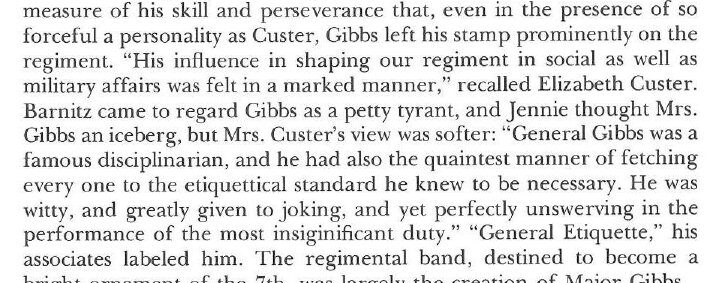
Your passage · General Etiquette

General Gibbs was a famous disciplinarian,

Elizabeth B. Custer's words, quoted by Utley in his editorial text; p. 259. Read the surrounding record before drawing a conclusion.

· Page references are recorded with each quotation.

Where this chapter uses this source · 1 passage

General Etiquette

General Gibbs was a famous disciplinarian,

Elizabeth B. Custer's words, quoted by Utley in his editorial text; p. 259

Examine quotation 36-043 →

Open the record and its pages →

40 catalogued pages. Transcription and image availability are shown on the document view.

Citation and source credit

Barnitz, A., & Barnitz, J. (1977). Life in Custer's cavalry: Diaries and letters of Albert and Jennie Barnitz, 1867-1868 (R. M. Utley, Ed.). Yale University Press.

← Continue your chapter journey · Follow the people in this chapter →

Your chapter stays open
Your book journey · The Regiment Gibbs BuiltExplore the evidence

Compare the original with its transcription and citation.

Explore outside this journey ↗

This chapter’s source collection as JSON