The book is finished. GIBBS: The Forgotten Warrior of the First New York Dragoons, by Garland H. Green Jr. How to order is coming soon; you can reserve a copy now. Reserve a copy →
Alfred GibbsThe research archive
Menu

The evidence behind your reading · The Regiment Gibbs Built

Read the records behind this chapter

Follow a letter, report, recollection or family record beyond the passage in the book. Each source below shows where the chapter uses it and what to examine. Open it here, compare its pages, and return without losing your chapter.

Begin with a question: What does building a regiment look like on paper?

Go beyond the book · The Regiment Gibbs Built

See how a regiment was built through ordinary orders

The Seventh Cavalry took shape through assignments, company changes, returns, and officers reporting for duty. Gibbs’s administrative work becomes visible when those small acts are read together.

New to these records? A little context.

A docket is an office’s summary or filing note; it may be on a wrapper rather than in the letter. An endorsement is another official’s response or forwarding note. Read each voice and date separately. A transcription is a reading of a document, with uncertain words marked where the exhibit provides them.

What does building a regiment look like on paper?
Research preview · An invitation into the written account, not a reproduction of an original document.

Read the source exhibit & its explanation

The Seventh Cavalry’s company assignments

The account reconstructs company assignments from Gibbs’s orders and links dates to the documents. It lets readers test an organizational claim against individual decisions.

What to examine: Pick one officer and follow the dated order into the scan and transcription. Identify what the order changes and compare it with the table’s summary.

Keep this distinction in mind: Later fame or a later battlefield death does not explain an 1867 assignment by itself. Avoid reading the Little Bighorn backward into every administrative choice.

Follow this question into Order at Fort Riley →

Keep your question in view as you explore. The reading tray retains The Regiment Gibbs Built. Close it to return to this point, or deliberately choose to explore outside the chapter.

16 distinct source records · Page 1 of 3

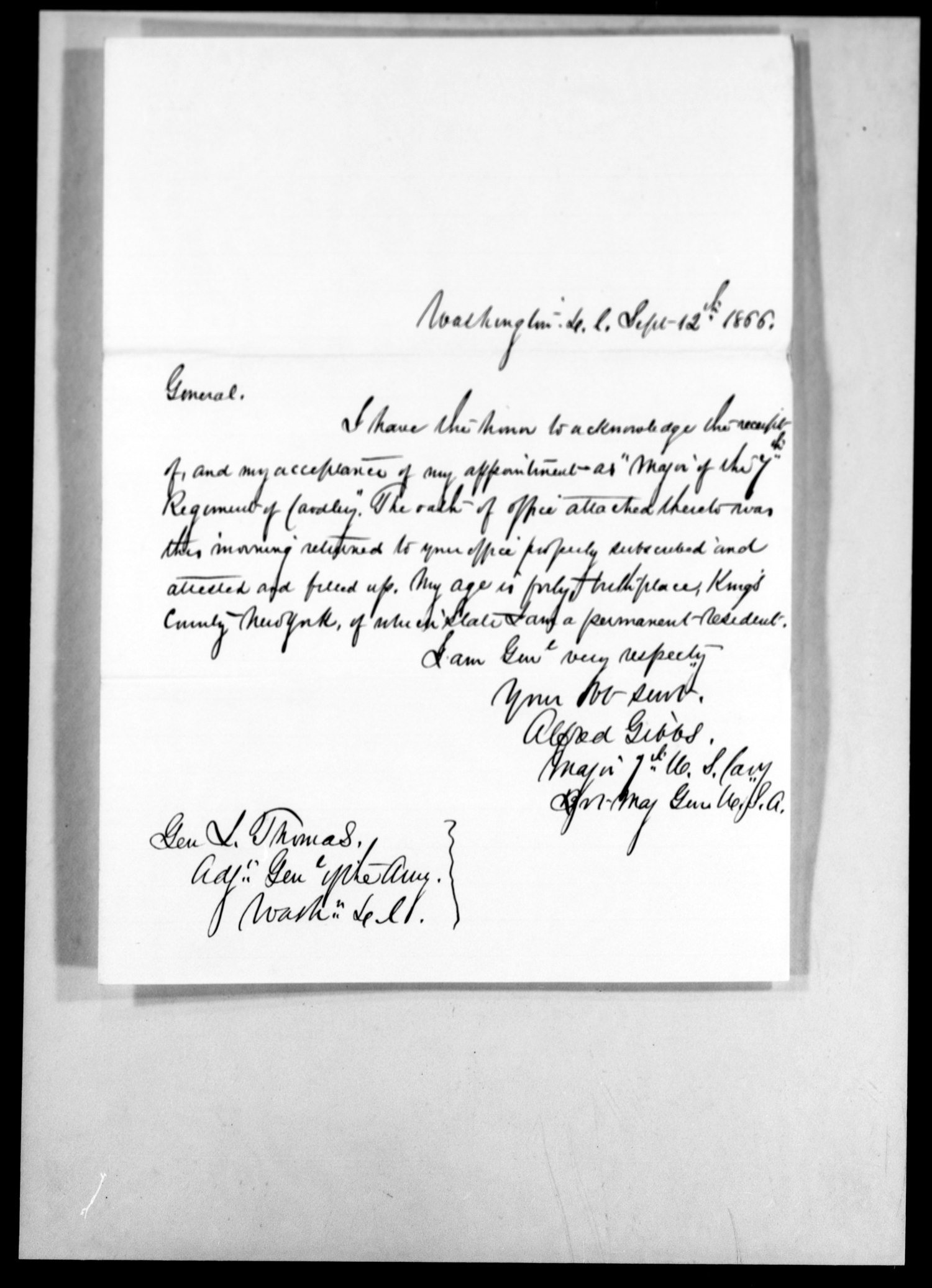
Alfred Gibbs personal file, G097
Alfred Gibbs personal file, G097 · Supplied page connection.

National Archives record

Personal file of Alfred Gibbs, G 92 C.B. 1869, document G097

Begin with who made this record, when and for whom. Compare the book’s words with the scan and the surrounding transcription. Distinguish what the writer observed from a request, opinion or later interpretation.

Your passage · July 28, 1866

My age is forty; birthplace, King's County, New York.

Source inferred, check against scan. Read the surrounding record before drawing a conclusion.

National Archives, Record Group 94 · Records of the Adjutant General's Office, Commission Branch, file G 92 C.B. 1869, document G097

Where this chapter uses this source · 1 passage

July 28, 1866

My age is forty; birthplace, King's County, New York.

Source inferred, check against scan

Examine quotation 36-001 →

Open the record and its pages →

3 catalogued pages. Transcription and image availability are shown on the document view.

Citation and source credit

Gibbs, A. (1866, September 12). [Acceptance of appointment as major of cavalry] (File G 498 C.B. 1866). Personal file of Alfred Gibbs (File G 92 C.B. 1869, document G097; naId 70516353). Records of the Adjutant General's Office, Commission Branch, Record Group 94. National Archives.

Alfred Gibbs personal file, G107
Alfred Gibbs personal file, G107 · Supplied page connection.

National Archives record

Personal file of Alfred Gibbs, G 92 C.B. 1869, document G107

Begin with who made this record, when and for whom. Compare the book’s words with the scan and the surrounding transcription. Distinguish what the writer observed from a request, opinion or later interpretation.

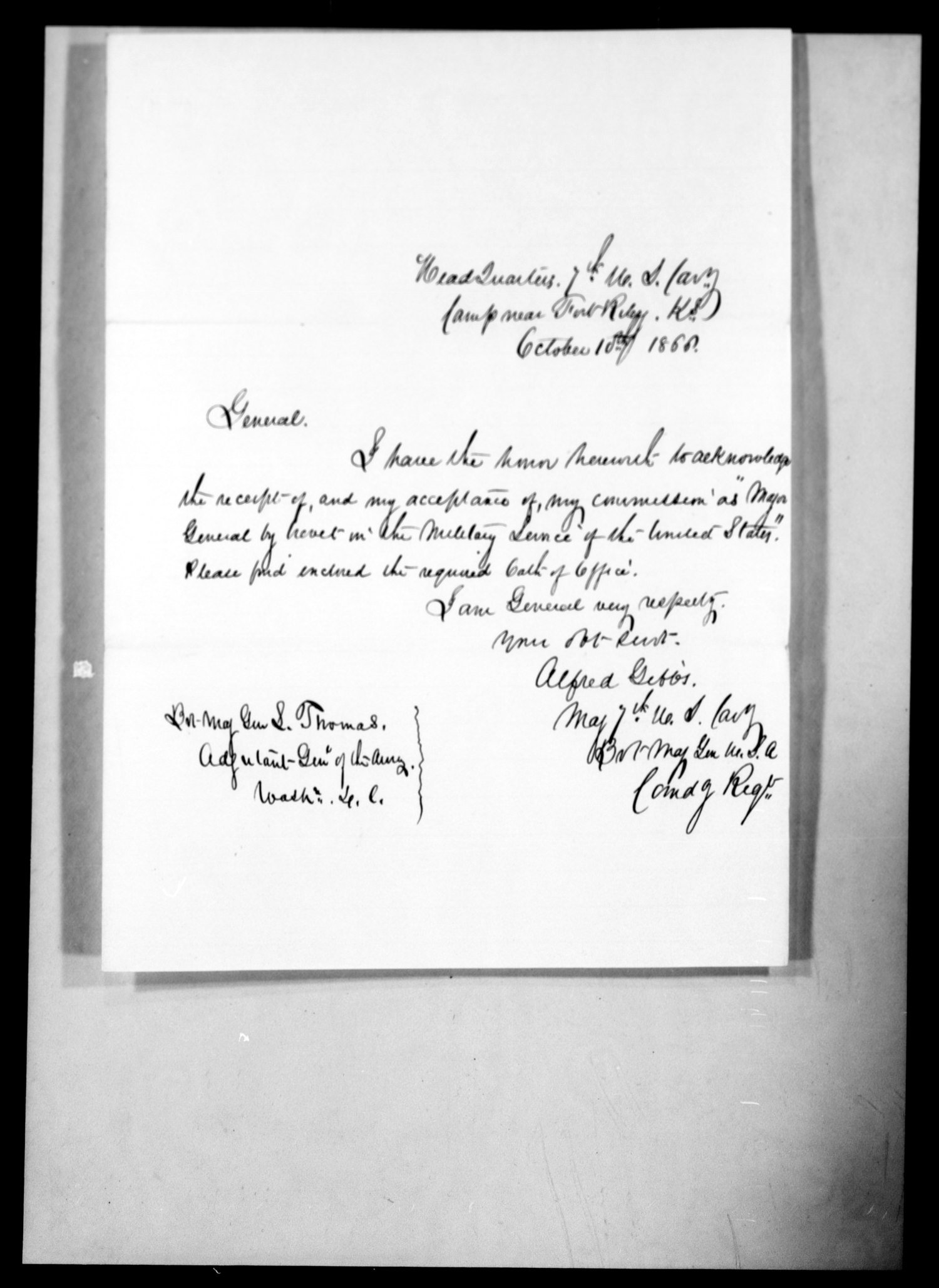
Your passage · Fort Riley, Kansas

Head Quarters. 7th U.S. Cavy (Camp near Fort Riley. Ks.),

Source inferred, check against scan. Read the surrounding record before drawing a conclusion.

National Archives, Record Group 94 · Records of the Adjutant General's Office, Commission Branch, file G 92 C.B. 1869, document G107

Where this chapter uses this source · 1 passage

Fort Riley, Kansas

Head Quarters. 7th U.S. Cavy (Camp near Fort Riley. Ks.),

Source inferred, check against scan

Examine quotation 36-002 →

Open the record and its pages →

2 catalogued pages. Transcription and image availability are shown on the document view.

Citation and source credit

Gibbs, A. (1866, October 10). [Acknowledgment of receipt of his commission as brevet major general, U.S. Army] (File G 690 C.B. 1866). Personal file of Alfred Gibbs (File G 92 C.B. 1869, document G107; naId 70516353). Records of the Adjutant General's Office, Commission Branch, Record Group 94. National Archives.

Printed page 369 · Internet Archive scan
Printed page 369 · Internet Archive scan · Document preview; the quoted page may differ.

Printed book

Custer, E. B. (1887). Tenting on the plains. Charles L. Webster. archive.org tentingonplains00cust (djvu text saved research/seventh/tenting1887.txt). Joined across lines; page headers removed; obvious OCR errors corrected. Chapter XIII (General Etiquette) is on Garland's page 30386.

Identify the author and publication date before weighing this account. A later recollection and a contemporary document answer different questions. Read the cited page and its surrounding passage.

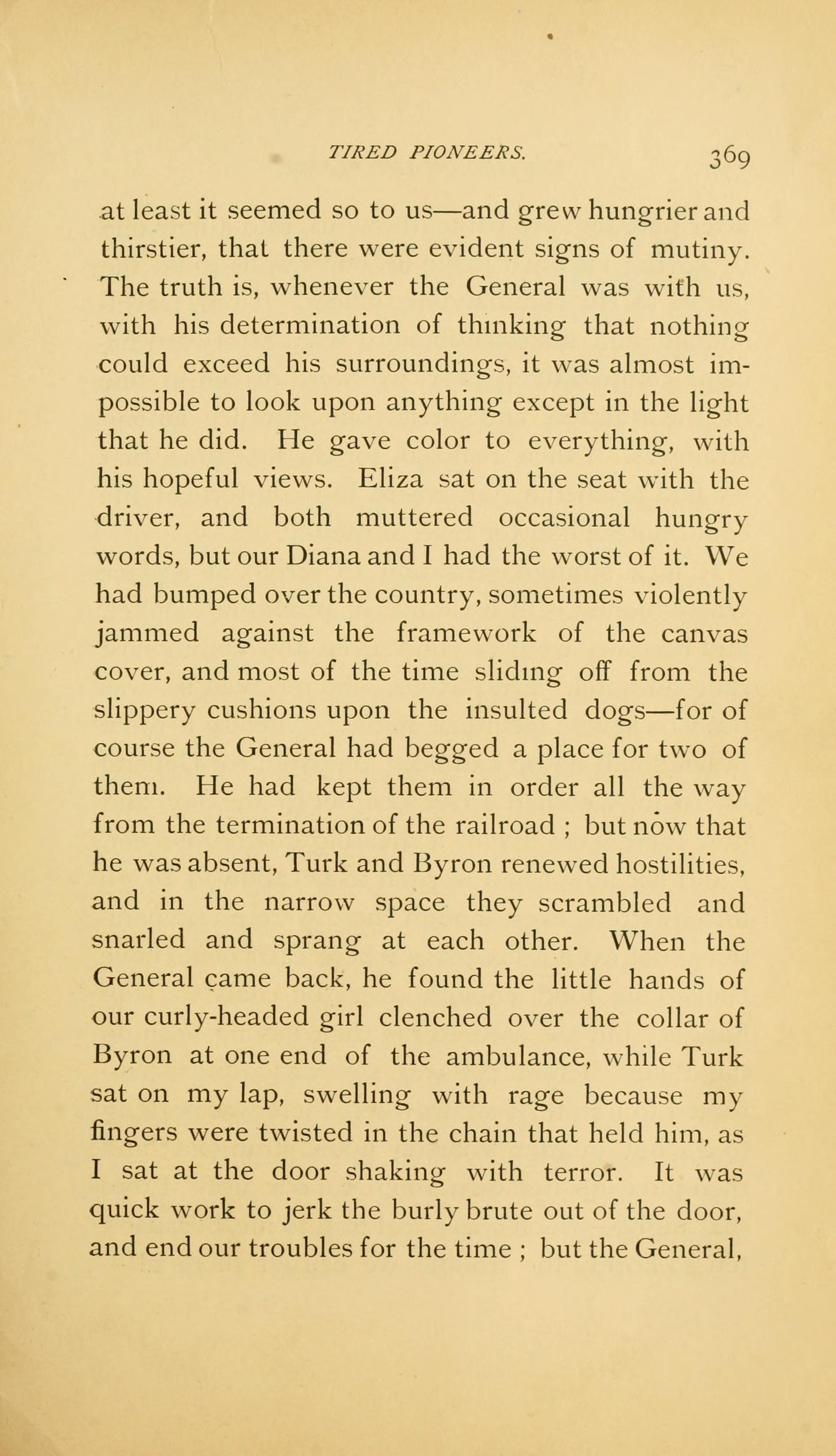
Your passage · Fort Riley, Kansas

evident signs of mutiny.

Page connection supplied; check matching method. Read the surrounding record before drawing a conclusion.

· pp. 368-370

Where this chapter uses this source · 19 passages

Fort Riley, Kansas

evident signs of mutiny.

Page connection supplied; check matching method

Examine quotation 36-004 →

Fort Riley, Kansas

Turk and Byron renewed hostilities, and in the narrow space they scrambled and snarled and sprang at each other.

Page connection supplied; check matching method

Examine quotation 36-005 →

Fort Riley, Kansas

clenched over the collar of Byron at one end of the ambulance,

Page connection supplied; check matching method

Examine quotation 36-006 →

Fort Riley, Kansas

swelling with rage because my fingers were twisted in the chain that held him, as I sat at the door shaking with terror.

Page connection supplied; check matching method

Examine quotation 36-007 →

Fort Riley, Kansas

and now there were five of us bearing down upon her.

Page connection supplied; check matching method

Examine quotation 36-008 →

Fort Riley, Kansas

was quite accustomed to a state of affairs where there was nothing to do but quarter yourself upon strangers.

Page connection supplied; check matching method

Examine quotation 36-009 →

Fort Riley, Kansas

gave up her own room to our use.

Page connection supplied; check matching method

Examine quotation 36-010 →

Fort Riley, Kansas

a friendship that has lasted through the darkest as well as the brightest hours.

Page connection supplied; check matching method

Examine quotation 36-011 →

The Hancock march

General Gibbs was nearly numb while marching beside me to-day, and when he found I was perfectly comfortable, exclaimed, 'Well, you are a warm-blooded cuss.'

Page connection supplied; check matching method

Examine quotation 36-053 →

The Hancock march

I said, 'It's a pretty thing that a man cannot write to his wife without being disturbed,' and the General replied, 'Any man who writes to his wife once a day deserves to be disturbed.'

Page connection supplied; check matching method

Examine quotation 36-054 →

The Hancock march

General Gibbs's eyes have troubled him so much, the last few days, that I do not consider it prudent for him to continue on the march,

Page connection supplied; check matching method

Examine quotation 36-055 →

The Hancock march

although the General, like the true soldier he is, persists in saying he is sufficiently well to do so.

Page connection supplied; check matching method

Examine quotation 36-056 →

The Hancock march

but it was finally decided that he go back to Riley to command that post temporarily, as things seemed to be going at loose ends there.

Page connection supplied; check matching method

Examine quotation 36-057 →

The Hancock march

If he does come there, 'order will reign in Warsaw.'

Page connection supplied; check matching method

Examine quotation 36-058 →

Order at Fort Riley

and the best disciplinarian of our regiment was immediately despatched to our relief.

Page connection supplied; check matching method

Examine quotation 36-059 →

Order at Fort Riley

He had been terribly wounded in the Indian wars before the Civil War, and was really unfit for hard service, but too soldierly to be willing to remain at the rear. In a week after his arrival at our p…

Page connection supplied; check matching method

Examine quotation 36-060 →

Order at Fort Riley

used as guards over Government property through the worst of the Indian country,

Page connection supplied; check matching method

Examine quotation 36-061 →

Order at Fort Riley

was put to the test by frequent attacks.

Page connection supplied; check matching method

Examine quotation 36-062 →

Order at Fort Riley

This is our first warm day, and the soldiers are holy-stoning our porch, while General Gibbs is staking the parade into walks, and planting grass-seed again.

Page connection supplied; check matching method

Examine quotation 36-066 →

Open the record and its pages →

17 catalogued pages. Transcription and image availability are shown on the document view.

Citation and source credit

Custer, E. B. (1887). Tenting on the plains. Charles L. Webster. archive.org tentingonplains00cust (djvu text saved research/seventh/tenting1887.txt). Joined across lines; page headers removed; obvious OCR errors corrected. Chapter XIII (General Etiquette) is on Garland's page 30386.

Citation details need review.

Reel 3, frame 172
Reel 3, frame 172 · Supplied page connection.

Wisconsin manuscript

Alfred Gibbs -> Oliver Wolcott Gibbs and "Joe" · 1866-11-29

Begin with who made this record, when and for whom. Compare the book’s words with the scan and the surrounding transcription. Distinguish what the writer observed from a request, opinion or later interpretation.

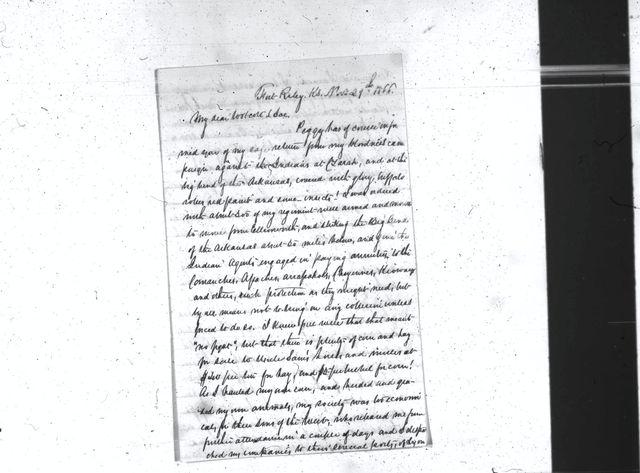
Your passage · The Big Bend of the Arkansas

by all means not to bring on any collision unless forced to do so.

Words matched in source text. Read the surrounding record before drawing a conclusion.

Wisconsin Historical Society, Gibbs Family Papers, U.S. Mss Y, Micro 1117 · Reel 3, frames 172, 173, 174, 175, 176

Where this chapter uses this source · 12 passages

The Big Bend of the Arkansas

by all means not to bring on any collision unless forced to do so.

Words matched in source text

Examine quotation 36-012 →

The Big Bend of the Arkansas

preparing for a general stampede.

Words matched in source text

Examine quotation 36-013 →

The Big Bend of the Arkansas

We rode up and said 'how', and shook hands, they appeared much relieved.

Words matched in source text

Examine quotation 36-014 →

The Big Bend of the Arkansas

a stiff beaver hat with ostrich feathers in it,

Words matched in source text

Examine quotation 36-015 →

The Big Bend of the Arkansas

a pair of captain's shoulder straps.

Words matched in source text

Examine quotation 36-016 →

The Big Bend of the Arkansas

much bueno for Americano, mucho bad for Comanche.

Source inferred, check against scan

Examine quotation 36-018 →

The Big Bend of the Arkansas

my bloodless campaign against the Indians at Zarah, and at the Big bend of the Arkansas, crowned with glory, buffalo robes, red paint and - insects!

Close text match, check differences

Examine quotation 36-019 →

The Big Bend of the Arkansas

Nothing but the bare walls of the officers' quarters, four sets of jacals for the men, no stables, no stockade, no shops, no nothing.

Source inferred, check against scan

Examine quotation 36-020 →

Thanksgiving

Peggy and Blair are playing checkers by my side, Alphy is reading 'the Man of the Sea' opposite, and Peggy says I am getting quite domestic.

Words matched in source text

Examine quotation 36-024 →

Thanksgiving

The great fault of our dinner was that we had enough for eight, and nobody to ask.

Words matched in source text

Examine quotation 36-025 →

Thanksgiving

The idea of me taking $2000 for our share of the Perry farm! They might as well give the whole property away!

Source inferred, check against scan

Examine quotation 36-026 →

Thanksgiving

When the estate is sold and I can afford it, I shall leave the Army, and come and live among you all.

Words matched in source text

Examine quotation 36-027 →

Open the record and its pages →

5 catalogued pages. Transcription and image availability are shown on the document view.

Citation and source credit

Gibbs, A. (1866, November 29). [Letter to Oliver Wolcott Gibbs and "Joe"]. Gibbs Family Papers, 1763-1918 (U.S. Mss Y, Micro 1117, Reel 3, frames 172-176). Wisconsin Historical Society Archives, Madison, WI, United States.

ago-76939447-76939447_002.jpg
ago-76939447-76939447_002.jpg · Supplied page connection.

National Archives record

National Archives catalog 76939447

Begin with who made this record, when and for whom. Compare the book’s words with the scan and the surrounding transcription. Distinguish what the writer observed from a request, opinion or later interpretation.

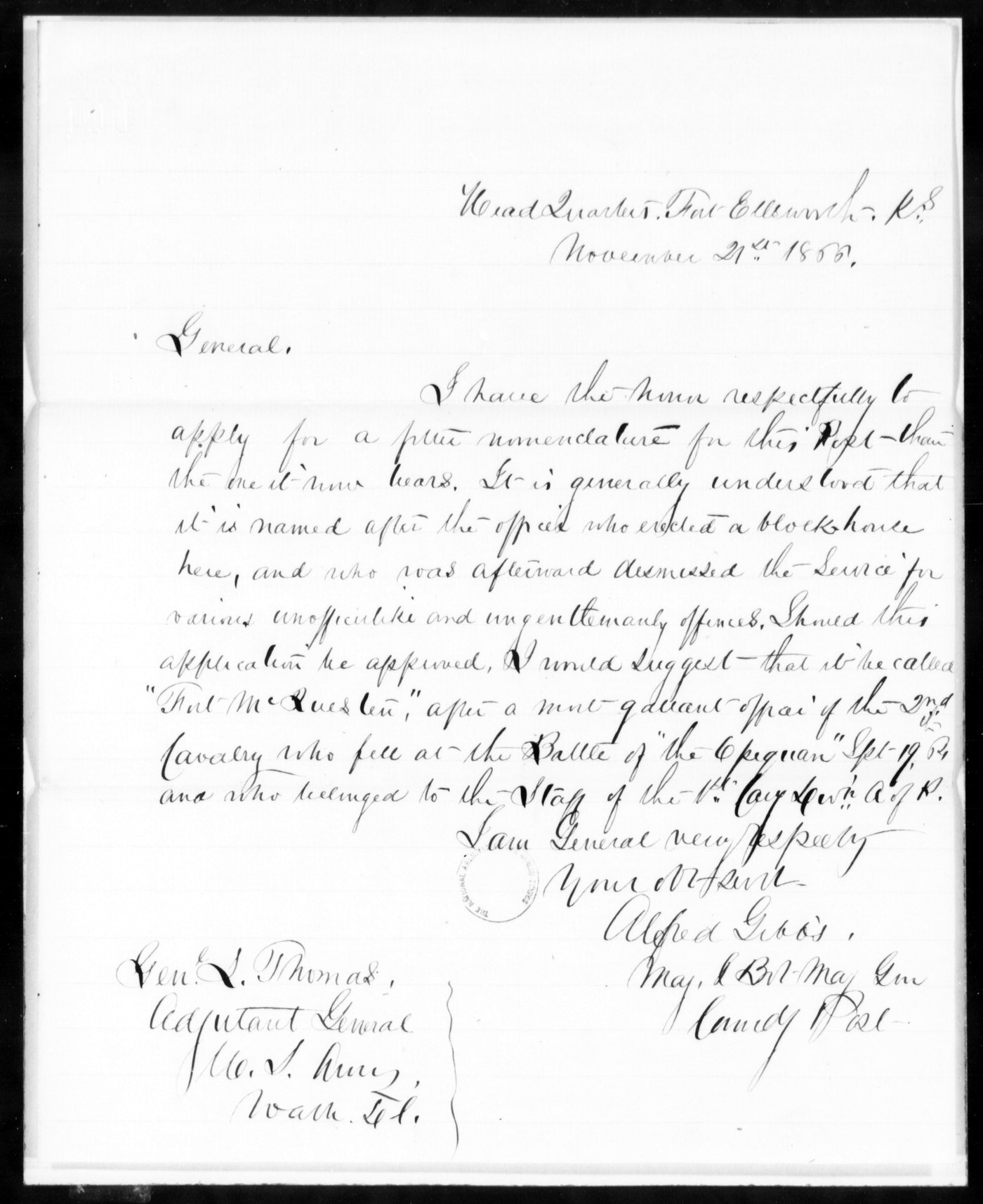
Your passage · The Big Bend of the Arkansas

the officer who erected a block-house here, and who was afterward dismissed the Service for various unofficerlike and ungentlemanly offences.

Page connection supplied; check matching method. Read the surrounding record before drawing a conclusion.

·

Where this chapter uses this source · 2 passages

The Big Bend of the Arkansas

the officer who erected a block-house here, and who was afterward dismissed the Service for various unofficerlike and ungentlemanly offences.

Page connection supplied; check matching method

Examine quotation 36-021 →

The Big Bend of the Arkansas

a most gallant officer of the 2nd Cavalry,

Page connection supplied; check matching method

Examine quotation 36-023 →

Open the record and its pages →

1 catalogued pages. Transcription and image availability are shown on the document view.

Citation and source credit

Gibbs, A. (1866). [Letter received] (File G 663, 1866; naId 76939447). Letters Received, Records of the Adjutant General's Office, Record Group 94. National Archives.

Citation details need review.

Page 5 of 7 · West Point scan (catalog 548)
Page 5 of 7 · West Point scan (catalog 548) · Supplied page connection.

West Point manuscript

Mitchell to A. J. Smith, Fort Leavenworth, 8 January 1867 (7 pages)

Begin with who made this record, when and for whom. Compare the book’s words with the scan and the surrounding transcription. Distinguish what the writer observed from a request, opinion or later interpretation.

Your passage · The other report

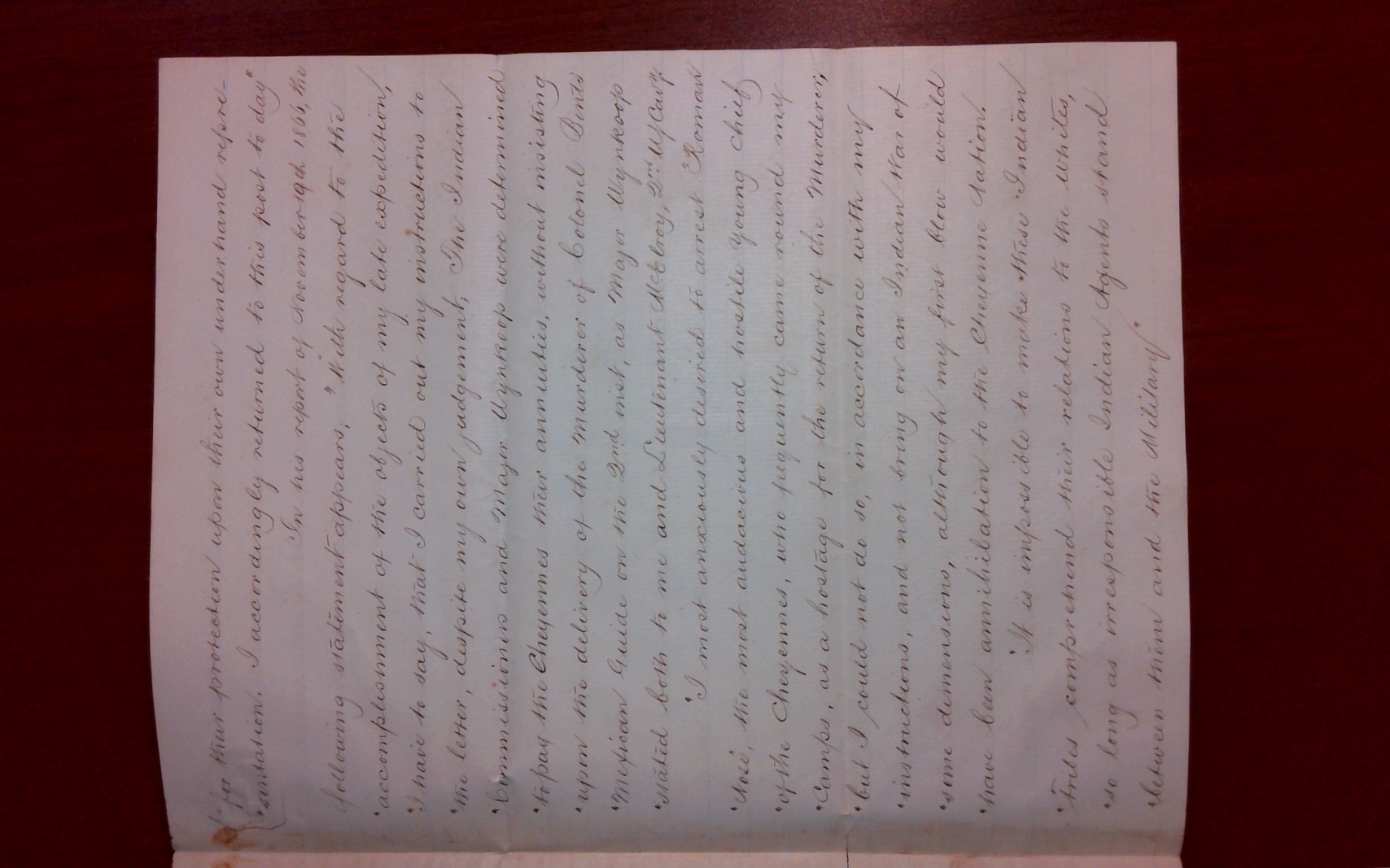
I carried out my instructions to the letter, despite my own judgment,

Page connection supplied; check matching method. Read the surrounding record before drawing a conclusion.

·

Where this chapter uses this source · 5 passages

The other report

I carried out my instructions to the letter, despite my own judgment,

Page connection supplied; check matching method

Examine quotation 36-028 →

The other report

I am sorry that my command of five hundred men, had no opportunity of annihilating some of those tribes, who were wavering in their friendship, but my instructions precluded it.

Page connection supplied; check matching method

Examine quotation 36-031 →

The other report

the rapacity of these swindling Speculators on the United States Government,

Page connection supplied; check matching method

Examine quotation 36-032 →

The other report

not disposed to convey any censure.

Page connection supplied; check matching method

Examine quotation 36-034 →

The other report

if any officer is sent on an expedition by superior authority, it is not in his province to criticize the motives of said expedition.

Page connection supplied; check matching method

Examine quotation 36-038 →

Open the record and its pages →

8 catalogued pages. Transcription and image availability are shown on the document view.

Citation and source credit

Mitchell, W. G. (1867, January 8). [Letter, by direction of Maj. Gen. W. S. Hancock, to Bvt. Maj. Gen. A. J. Smith on Gibbs's reports of 16 and 19 November 1866; 7 pages]. Alfred Gibbs papers (CU #1313), Manuscripts Collection, U.S. Military Academy Library, West Point, NY. Scans by Garland H. Green Jr., November 2024.

Citation details need review.

← Continue your chapter journey · Follow the people in this chapter →

Your chapter stays open
Your book journey · The Regiment Gibbs BuiltExplore the evidence

Compare the original with its transcription and citation.

Explore outside this journey ↗

This chapter’s source collection as JSON