The book is finished.GIBBS: The Forgotten Warrior of the First New York Dragoons, by Garland H. Green Jr. How to order is coming soon; you can reserve a copy now. Reserve a copy →
Your book journey: Beaufort, South Carolina · December 6, 2013.
What would you like to explore in Camp Lawton?
Your chapter journey · Camp Lawton → Beaufort · Following the burial record
One name, two cemeteries, and a disputed grave number
The Camp Lawton chapter follows a death whose record was difficult to recover. This journey takes you from a printed list of graves at Millen to the Beaufort interment ledger. Compare the entries before accepting the number repeated in a family account.
New to these people and records? Start here.
Camp Lawton was a Confederate prisoner-of-war camp near Millen, Georgia. A later burial list was compiled from surviving grave information; a reinterment register recorded burials at another cemetery. Neither is the camp’s lost death register, and blanks matter as much as filled columns.
How do we test whether the family found the right grave?
Roll of Honor No. XIV (1868), p. 298, entries around row 154. Crop of the printed page.
Begin with the name in the Millen burial list
Row 154 records Green, L. D., with Company K, 1st United States artillery, Section B, Grave 23. That unit differs from Levi’s Dragoons service, so the discrepancy must remain visible rather than be silently corrected.
Look for: Find row 154. Follow the line across to the unit, section, and grave. Open the complete page to check the column headings and the blanks where a death date might otherwise appear.
Beaufort Record of Interments, p. 2, graves 47–50. National Archives, RG 92, Vol. 94.
Follow the name into the Beaufort interment ledger
The handwritten ledger places Green, L. D., at Grave 49. The name and recorded artillery affiliation can be compared with the earlier printed entry, while the grave number belongs to a different cemetery.
Look for: Locate Green’s row between graves 48 and 50. Check the ditto marks against the rows above, then open the complete page to see the column headings. A ditto mark copies information; it is not an empty field.
Beaufort Record of Interments, p. 17, graves 547–550. National Archives, RG 92, Vol. 94.
Test the competing number rather than explaining it away
The family account had repeated Grave 549. Checking that number produces a different soldier: John O. Parsons. This is a concrete way to test an inherited piece of information.
Look for: Read the name opposite 549 and compare the adjacent numbers. Then return to Green’s row at 49. Do not treat the extra digit as a harmless variation until you have checked what it identifies.
The Millen list and Beaufort ledger repeat the name and recorded unit but use different grave numbers in different cemeteries. The separate entry for Parsons tests the family’s earlier number 549. Garland’s wider investigation connects these records with Levi’s military record and later cemetery confirmation. Read that argument as an identification supported by several records, not as an identity proven by initials alone. The exact date of Levi’s death remains unresolved.
Prepared after reading the chapter’s research account and visually inspecting the three reproduced record crops. The full pages are linked for comparison. This does not establish every claim in the larger investigation.
Follow a life beyond the page
People you meet here
The book brings you into these lives. Follow a person to the family, service and research records available here. Pension material is identified separately from biography and recollection.
1 connected person in this section · Showing 1 to 1
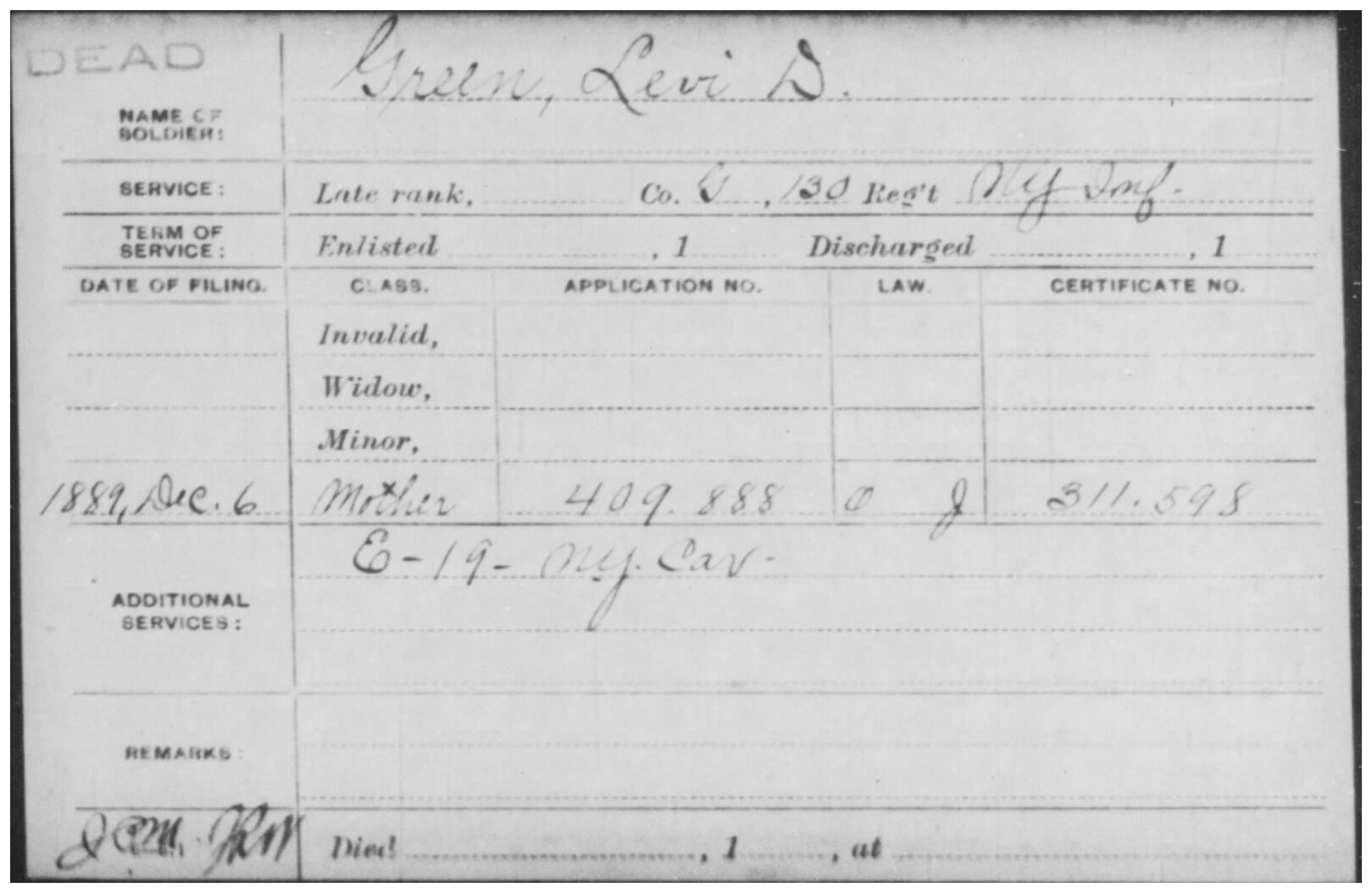
Letters, captivity records and a disputed-looking burial trail reveal different parts of Levi's life. Follow the evidence used to distinguish L. D. Green from another man buried nearby, and the pension records connected to his mother.
These connections come from the v172 manuscript and existing subject pages. A pension not connected here may still exist elsewhere. Namesakes and uncertain identities are not silently joined.
Follow the words into the evidence
What caught your attention?
Find a line from your reading, then follow its document and the record around it. Matching words helps locate evidence; checking who wrote them, when, and why helps you understand it.
Beaufort, South Carolina · 7 entries · Page 1 of 1
Text from your reading
My son found Marvin in California, I knew where John is resting, so we had two out of…