The book is finished.GIBBS: The Forgotten Warrior of the First New York Dragoons, by Garland H. Green Jr. How to order is coming soon; you can reserve a copy now. Reserve a copy →
Follow a letter, report, recollection or family record beyond the passage in the book. Each source below shows where the chapter uses it and what to examine. Open it here, compare its pages, and return without losing your chapter.
Begin with a question: How do we connect a personal recollection to a service record?
Go beyond the book · Gibbs Station
Find the young bugler behind a remembered kindness
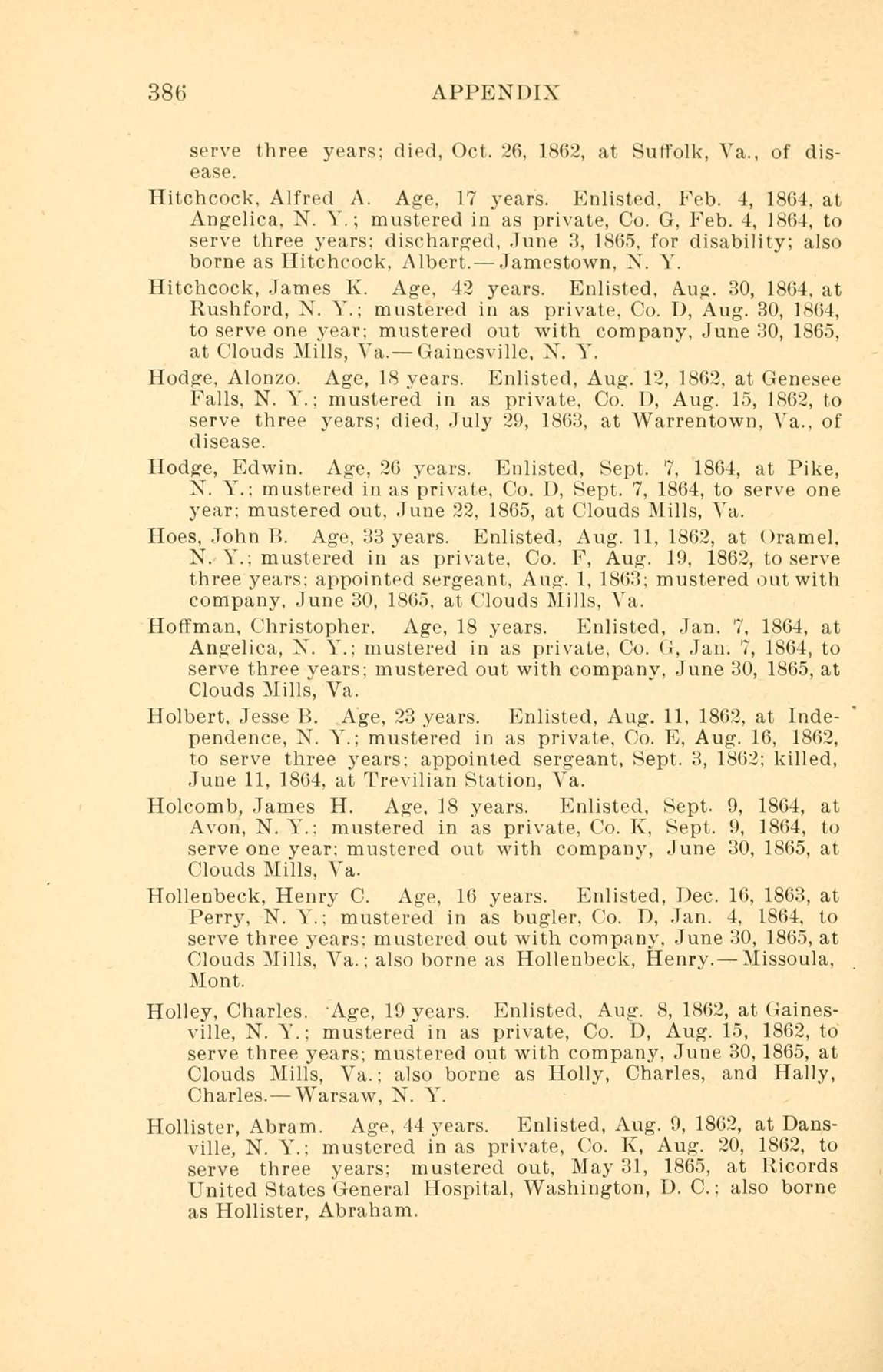
The winter-quarter stories introduce Henry Hollenbeck as a young recruit. His service entry gives that remembered voice a company, an age, and a place in the regiment.
New to these records? A little context.
A research account can combine historical documents, later recollections, images, and the author’s interpretation. Start with its source notes and captions. Ask who made each item, when it was made, and what kind of question it can answer.
How do we connect a personal recollection to a service record?
Bowen (1900), Regimental History of the First New York Dragoons — roster appendix, page 386 · From the linked account. Its original credits and image status are preserved there.
Read the source exhibit & its explanation
Henry Hollenbeck: the service record
The person page identifies Hollenbeck’s enlistment and bugler’s role, with a roster scan and county-history reference. These help establish identity before reading the reminiscence.
What to examine: Compare the name variants in the register and the postwar location. Then return to the chapter’s account of his experiences with Gibbs.
Keep this distinction in mind: A muster entry establishes service details; it does not independently prove every later anecdote. Keep a memoir and a roster distinct.
Keep your question in view as you explore. The reading tray retains Gibbs Station. Close it to return to this point, or deliberately choose to explore outside the chapter.
8 entries · Page 1 of 2
Mitchell's Station, VirginiaPhrase or author’s lineLabeled text illustration, not a scan.
29-009
General Etiquette.
Short phrase or author line
The Seventh Cavalry's nickname for Gibbs (E. B. Custer, Tenting on the Plains, 1887, ch. XIII, 'our General Etiquette'), on Garland's page 30331
Headquarters, Cavalry Reserve BrigadePhrase or author’s lineLabeled text illustration, not a scan.
29-022
Gibbs did not ride with them. He did not need to. The men he had trained drove in the enemy at Stannardsville going out and covered the fighting retreat coming back.
Short phrase or author line
Review answer, 8 November 2026: Garland's own words. Garland's own essay, "The Steady Hand: Alfred Gibbs and George Armstrong Custer" (AlfredGibbs.com).