The book is finished. GIBBS: The Forgotten Warrior of the First New York Dragoons, by Garland H. Green Jr. How to order is coming soon; you can reserve a copy now. Reserve a copy →
Alfred GibbsThe research archive
Menu

The evidence behind your reading · Stop That Ducking

Read the records behind this chapter

Follow a letter, report, recollection or family record beyond the passage in the book. Each source below shows where the chapter uses it and what to examine. Open it here, compare its pages, and return without losing your chapter.

Begin with a question: What did becoming a cavalryman require in daily life?

Go beyond the book · Stop That Ducking

You are reading Mosby · September 1863. The guided starting point below explores The camp of instruction, Manassas Junction. Evidence for this particular section has not yet been separately assembled; chapter references remain available below.

Watch infantrymen learn to be cavalrymen

New horses, new equipment, and a changing regimental designation made the transition a daily learning process. Levi’s September letter records it before its outcome was settled.

New to these records? A little context.

A transcription records the words of a letter. A typescript is a typed copy, which may survive even when the handwritten original is not on display. The linked account identifies the version it preserves; later explanatory paragraphs are not part of the letter.

What did becoming a cavalryman require in daily life?
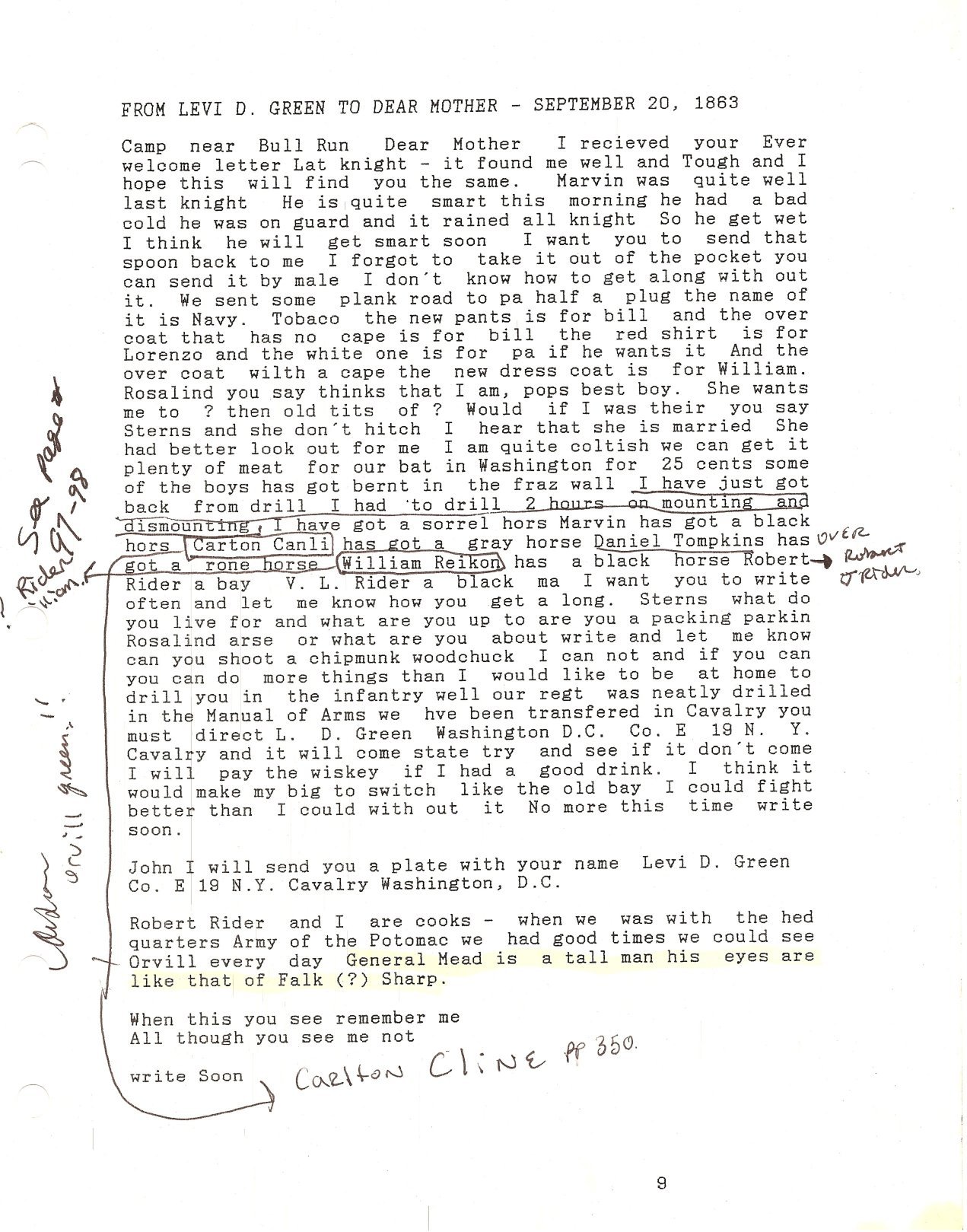
Green Family Letters, Marjorie Kuski typescript, page 09
Green Family Letters, Marjorie Kuski typescript, page 09 · From the linked account. Its original credits and image status are preserved there.

Read the source exhibit & its explanation

Levi to his mother, September 20, 1863

He writes about mounting and dismounting drill, identifies his and Marvin’s horses, and still asks for a spoon left at home. The change becomes practical rather than just organizational.

What to examine: Compare the regiment’s name in the letter with the article’s chronology. Look for the hours of drill and the named horses before following the campaign accounts.

Keep this distinction in mind: The same regiment appears under different designations. A changed number or name does not necessarily identify a different group of men.

Keep your question in view as you explore. The reading tray retains Stop That Ducking → Mosby. Close it to return to this point, or deliberately choose to explore outside the chapter.

5 distinct source records · Page 1 of 1

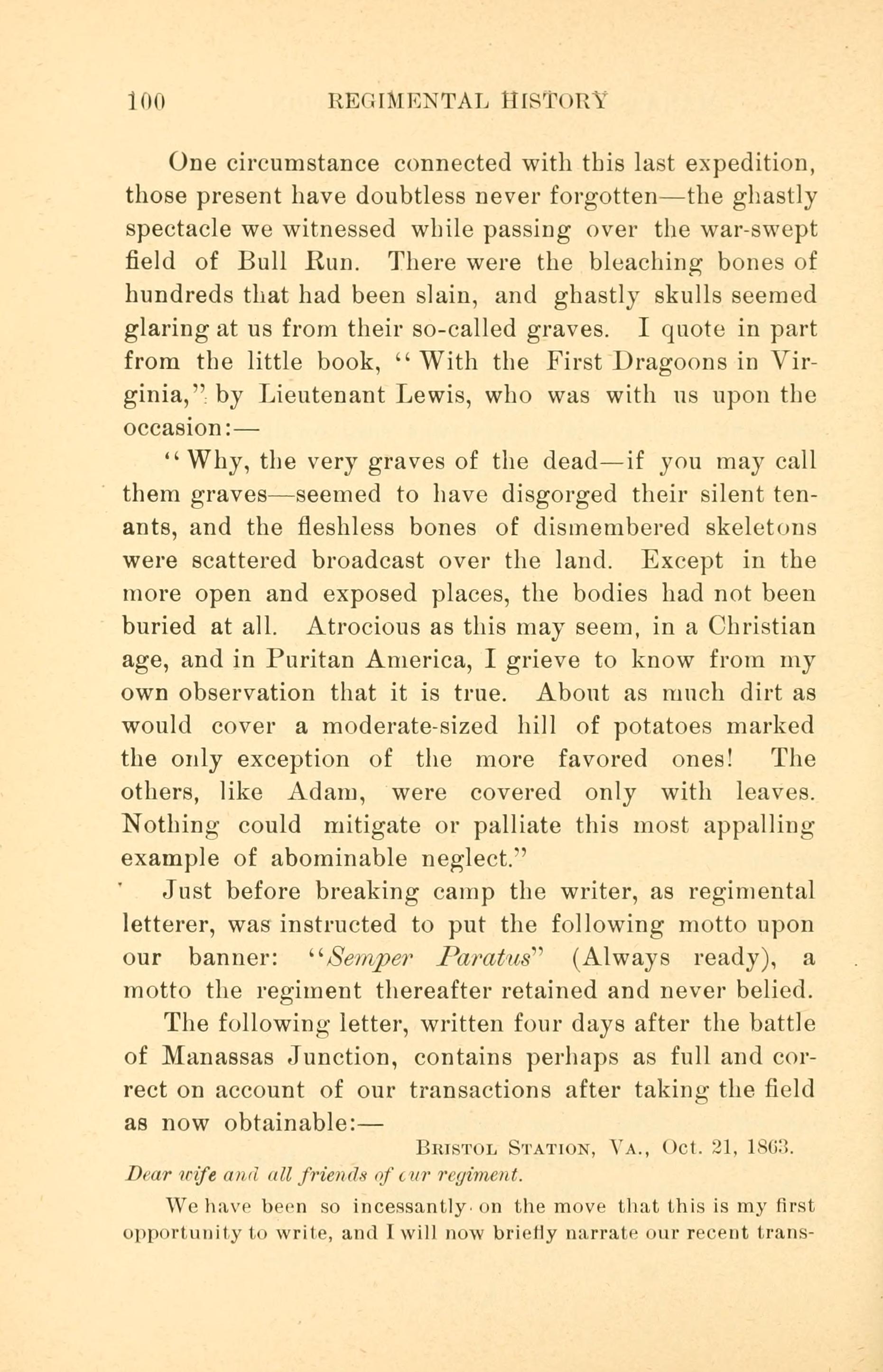
Printed page 100 · Internet Archive scan
Printed page 100 · Internet Archive scan · Document preview; the quoted page may differ.

Printed book

Bowen, J. R. (1900). Regimental history of the First New York Dragoons

Identify the author and publication date before weighing this account. A later recollection and a contemporary document answer different questions. Read the cited page and its surrounding passage.

Your passage · Mosby

Why, the very graves of the dead, if you may call them graves, seemed to have disgorged their silent tenants, and the fleshless bones of dismembered skeletons were scattered broadc…

Close text match, check differences. Read the surrounding record before drawing a conclusion.

· p. 100

Where this chapter uses this source · 2 passages

Mosby

Why, the very graves of the dead, if you may call them graves, seemed to have disgorged their silent tenants, and the fleshless bones of dismembered skeletons were scattered broadcast over the land.

Close text match, check differences

Examine quotation 27-037 →

Mosby

Nothing could mitigate or palliate this most appalling example of abominable neglect.

Words matched in source text

Examine quotation 27-038 →

Open the record and its pages →

2 catalogued pages. Transcription and image availability are shown on the document view.

Citation and source credit

Bowen, J. R. (1900). Regimental history of the First New York Dragoons

Citation details need review.

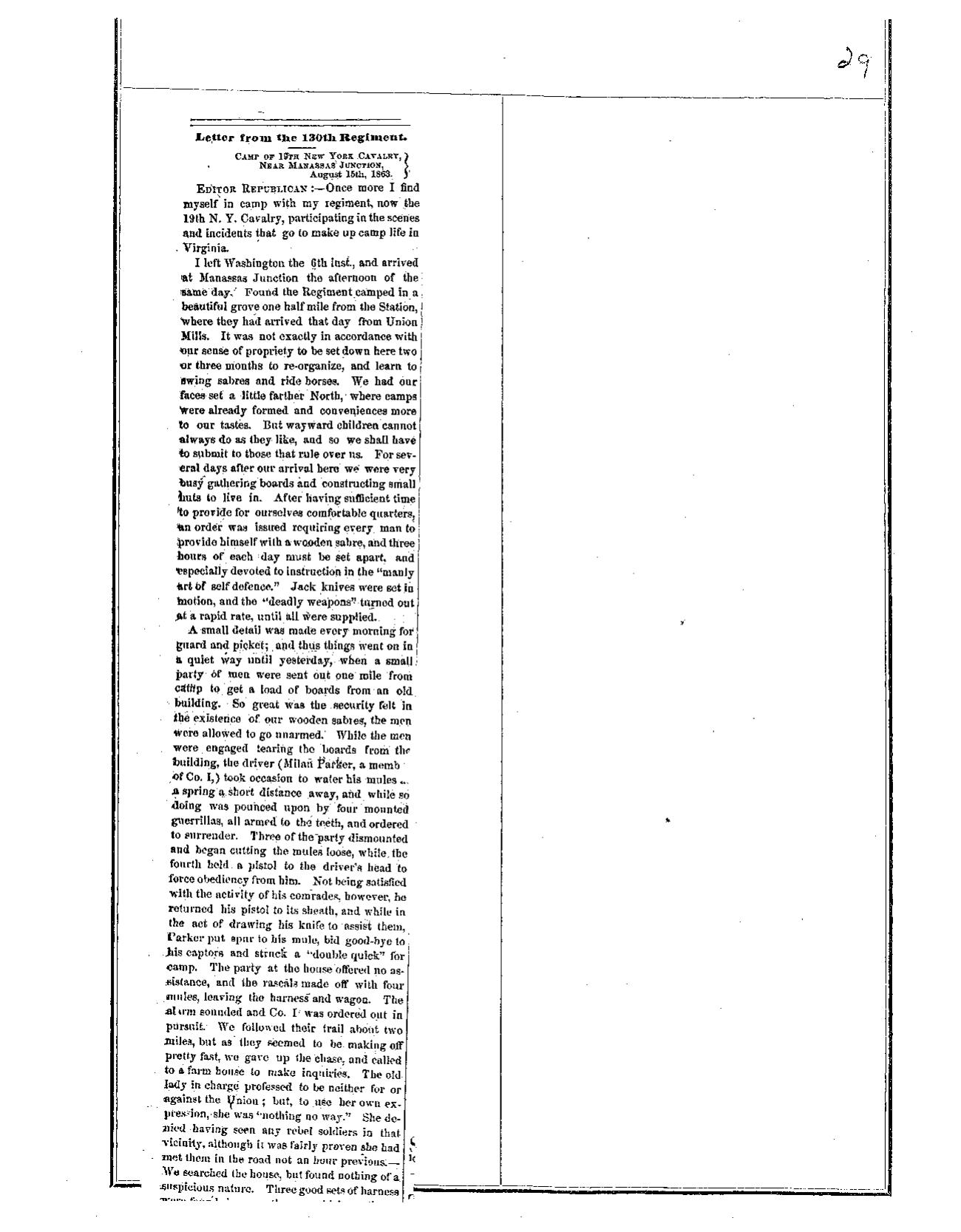
Clippings scrapbook, file p2202, page 6 · New York State Military Museum
Clippings scrapbook, file p2202, page 6 · New York State Military Museum · Supplied page connection.

Newspaper

Civil War newspaper clippings: 1st Dragoons Regiment (New York State Military Museum)

Check the newspaper title and issue date. Who supplied the report, how soon after the event was it printed, and what could the writer know?

Your passage · Mosby

so great was the security felt in the existence of our wooden sabres,

Page connection supplied; check matching method. Read the surrounding record before drawing a conclusion.

·

Where this chapter uses this source · 2 passages

Mosby

so great was the security felt in the existence of our wooden sabres,

Page connection supplied; check matching method

Examine quotation 27-035 →

Mosby

put spur to his mule, bid good-bye to his captors and struck a 'double quick' for camp.

Page connection supplied; check matching method

Examine quotation 27-036 →

Open the record and its pages →

9 catalogued pages. Transcription and image availability are shown on the document view.

Citation and source credit

New York State Military Museum and Veterans Research Center. (n.d.). Civil war newspaper clippings: 1st Dragoons Regiment [Scrapbook of clippings from the county press, with transcriptions]. https://museum.dmna.ny.gov/unit-history/cavalry/1st-dragoons-regiment/civil-war-newspaper-clippings

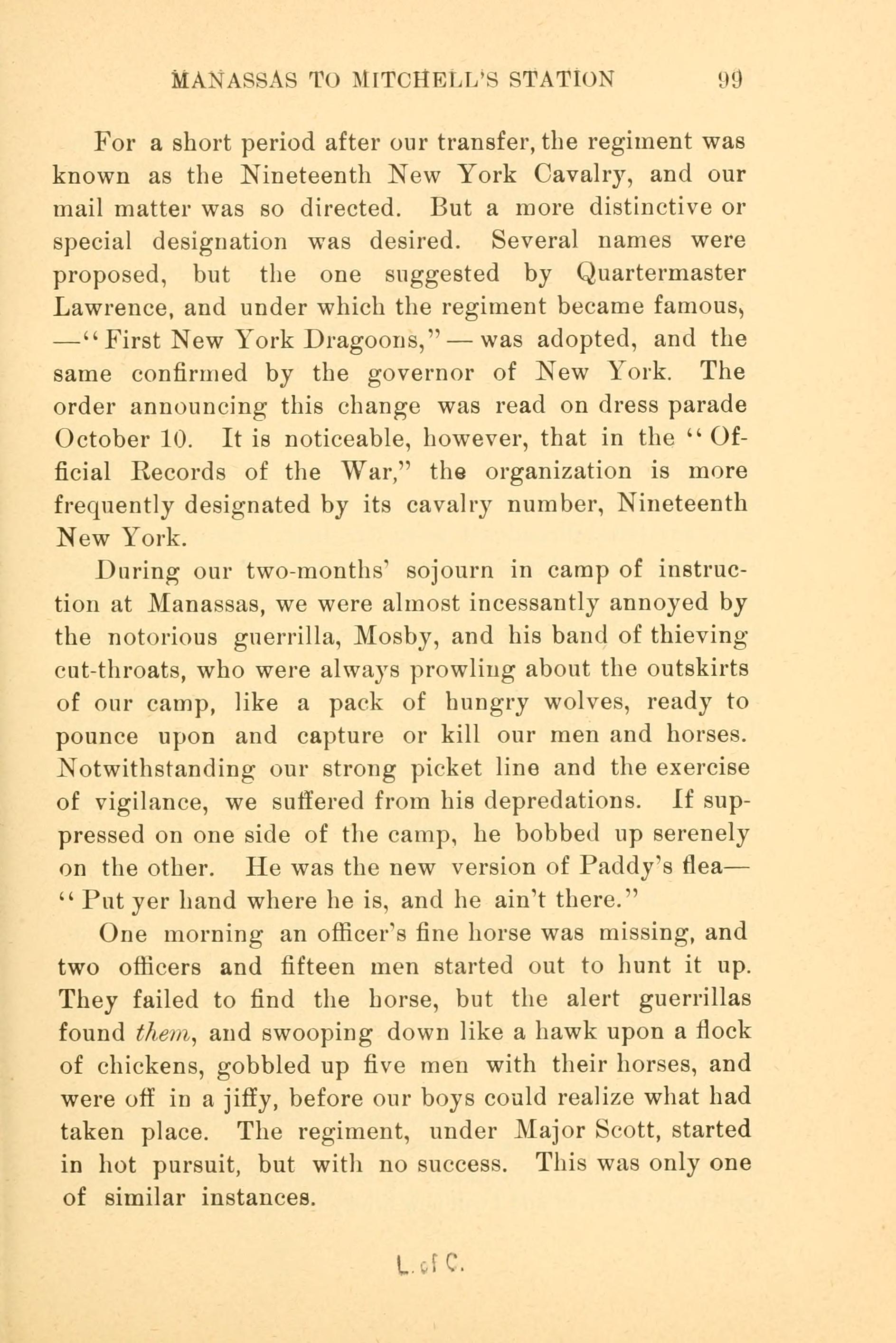
Printed page 99 · Internet Archive scan
Printed page 99 · Internet Archive scan · Document preview; the quoted page may differ.

Printed book

Bowen, J. R. (1900). Regimental history of the First New York Dragoons

Identify the author and publication date before weighing this account. A later recollection and a contemporary document answer different questions. Read the cited page and its surrounding passage.

Your passage · Mosby

During our two-months' sojourn in camp of instruction at Manassas,

Close text match, check differences. Read the surrounding record before drawing a conclusion.

· p. 99

Where this chapter uses this source · 4 passages

Mosby

During our two-months' sojourn in camp of instruction at Manassas,

Close text match, check differences

Examine quotation 27-029 →

Mosby

we were almost incessantly annoyed by the notorious guerrilla, Mosby, and his band of thieving cut-throats.

Words matched in source text

Examine quotation 27-030 →

Mosby

If suppressed on one side of the camp, he bobbed up serenely on the other. He was the new version of Paddy's flea, 'Put yer hand where he is, and he ain't there.'

Close text match, check differences

Examine quotation 27-031 →

Mosby

One morning an officer's fine horse was missing, and two officers and fifteen men started out to hunt it up. They failed to find the horse, but the alert guerrillas found them, and swooping down like …

Words matched in source text

Examine quotation 27-032 →

Open the record and its pages →

1 catalogued pages. Transcription and image availability are shown on the document view.

Citation and source credit

Bowen, J. R. (1900). Regimental history of the First New York Dragoons

Citation details need review.

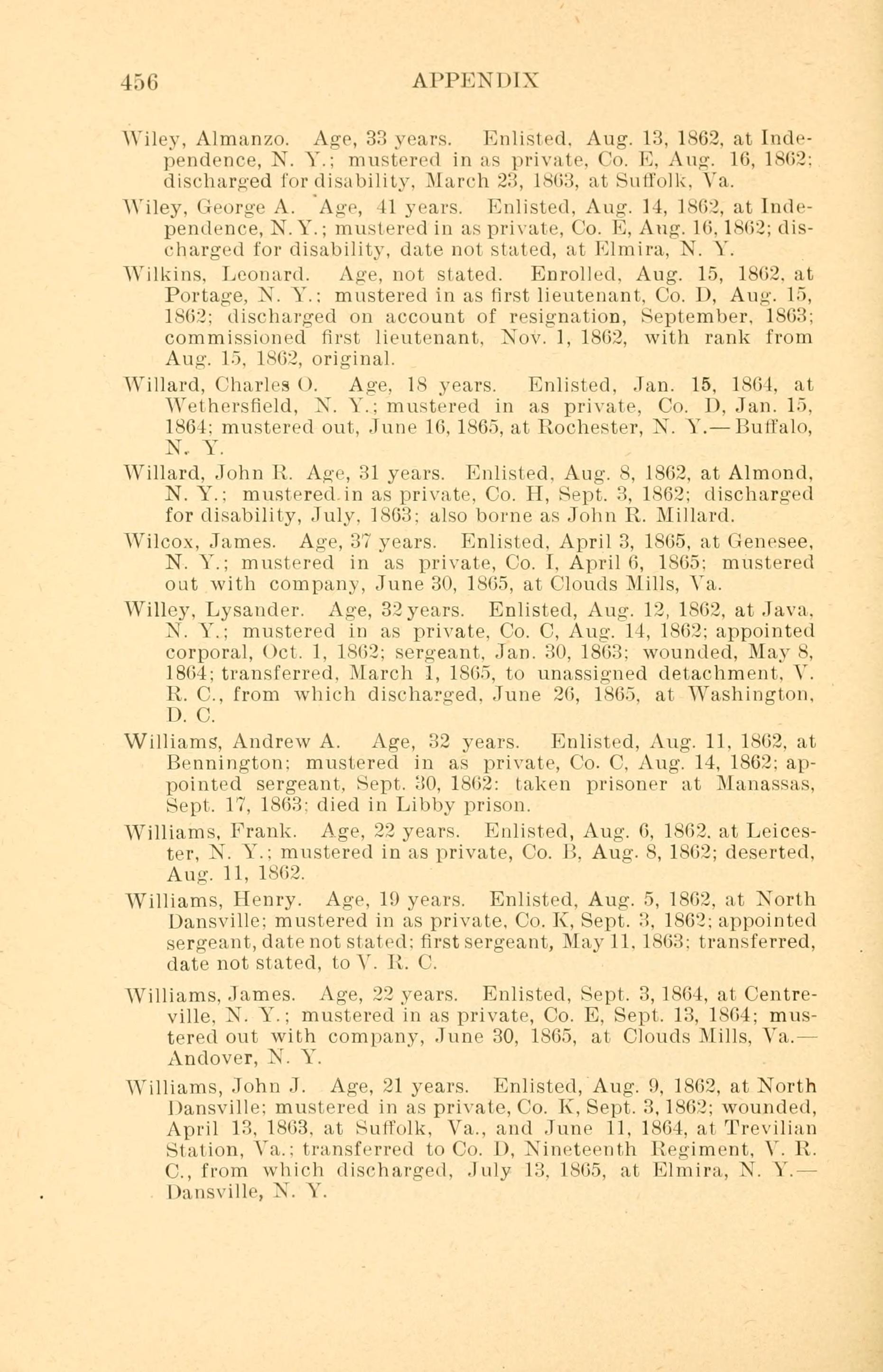
Printed page 456 · Internet Archive scan
Printed page 456 · Internet Archive scan · Document preview; the quoted page may differ.

Printed book

Bowen, J. R. (1900). Regimental history of the First New York Dragoons

Identify the author and publication date before weighing this account. A later recollection and a contemporary document answer different questions. Read the cited page and its surrounding passage.

Your passage · Mosby

taken prisoner at Manassas, Sept. 17, 1863

Words matched in source text. Read the surrounding record before drawing a conclusion.

· p. 456

Where this chapter uses this source · 1 passage

Mosby

taken prisoner at Manassas, Sept. 17, 1863

Words matched in source text

Examine quotation 27-033 →

Open the record and its pages →

1 catalogued pages. Transcription and image availability are shown on the document view.

Citation and source credit

Bowen, J. R. (1900). Regimental history of the First New York Dragoons

Citation details need review.

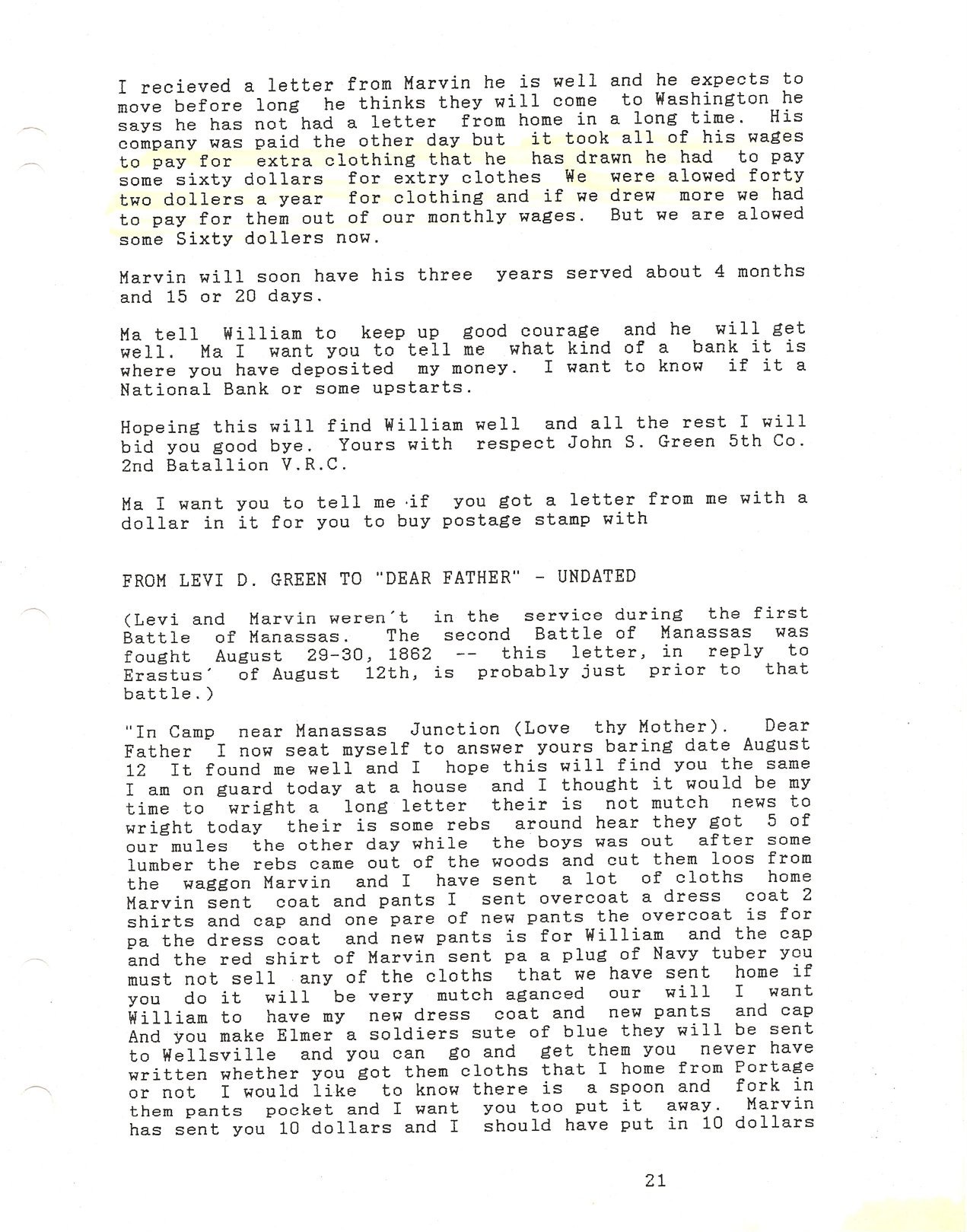
Kuski typescript, page 21
Kuski typescript, page 21 · Supplied page connection.

Green family letter

Levi D. Green to Dear Mother, September 20, 1863

Begin with who made this record, when and for whom. Compare the book’s words with the scan and the surrounding transcription. Distinguish what the writer observed from a request, opinion or later interpretation.

Your passage · Mosby

their is some rebs around hear they got 5 of our mules the other day while the boys was out after some lumber the rebs came out of the woods and cut them loos from the waggon.

Source inferred, check against scan. Read the surrounding record before drawing a conclusion.

Original letters held by the extended Green family; transcripts given to Garland H. Green Jr.; one letter is a photocopy held by the National Archives · Green family letters (transcripts of the originals, which are in family hands)

Where this chapter uses this source · 1 passage

Mosby

their is some rebs around hear they got 5 of our mules the other day while the boys was out after some lumber the rebs came out of the woods and cut them loos from the waggon.

Source inferred, check against scan

Examine quotation 27-034 →

Open the record and its pages →

4 catalogued pages. Transcription and image availability are shown on the document view.

Citation and source credit

Green, L. D. (1863, September 20). [Letter addressed "Dear Mother, September 20"]. Green family letters (typescript of the originals, held by the extended Green family; transcripts given to Garland H. Green Jr.).

← Continue your chapter journey · Follow the people in this chapter →

Your chapter stays open
Your book journey · Stop That Ducking · MosbyExplore the evidence

Compare the original with its transcription and citation.

Explore outside this journey ↗

This chapter’s source collection as JSON