The book is finished. GIBBS: The Forgotten Warrior of the First New York Dragoons, by Garland H. Green Jr. How to order is coming soon; you can reserve a copy now. Reserve a copy →
Alfred GibbsThe research archive
Menu

The evidence behind your reading · A Most Vital Start

Read the records behind this chapter

Follow a letter, report, recollection or family record beyond the passage in the book. Each source below shows where the chapter uses it and what to examine. Open it here, compare its pages, and return without losing your chapter.

Begin with a question: How did family networks become organized wartime relief?

Go beyond the book · A Most Vital Start

You are reading The Cooper Institute · Monday, April 29, 1861. The guided starting point below explores The New York Infirmary for Women. Evidence for this particular section has not yet been separately assembled; chapter references remain available below.

Follow the women’s work beyond the battlefield

The war also required organized relief, nursing, and supplies. Alfred’s sister Laura’s research page connects this chapter to women whose work crossed the boundary between household and public institution.

New to these records? A little context.

A research account can combine historical documents, later recollections, images, and the author’s interpretation. Start with its source notes and captions. Ask who made each item, when it was made, and what kind of question it can answer.

How did family networks become organized wartime relief?
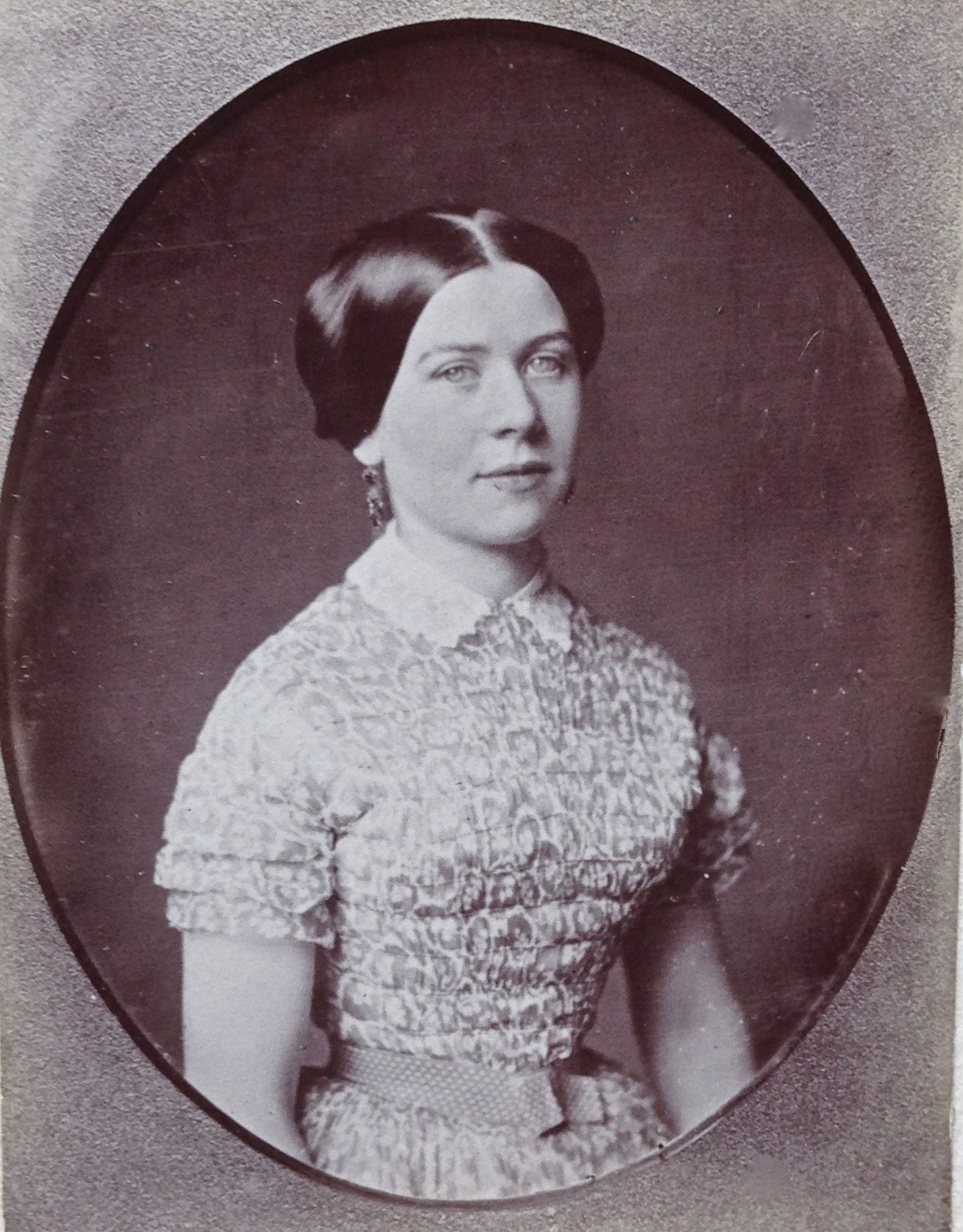
Laura Wolcott Gibbs d'Oremieulx, undated photograph (Newport Historical Society)
Laura Wolcott Gibbs d'Oremieulx, undated photograph (Newport Historical Society) · From the linked account. Its original credits and image status are preserved there.

Read the source exhibit & its explanation

Laura d’Oremieulx and organized wartime relief

The account identifies Laura d’Oremieulx’s role in the Women’s Central Relief Association and nurse training. It also preserves corrections about the images used to represent her.

What to examine: Find the relief work in the biography and distinguish this Laura from her mother. Compare the photograph’s provenance with the older painting’s attribution note.

Keep this distinction in mind: The family contains repeated names. An appealing portrait is not sufficient identification; the page explicitly rejects an older likeness.

Keep your question in view as you explore. The reading tray retains A Most Vital Start → The Cooper Institute. Close it to return to this point, or deliberately choose to explore outside the chapter.

3 distinct source records · Page 1 of 1

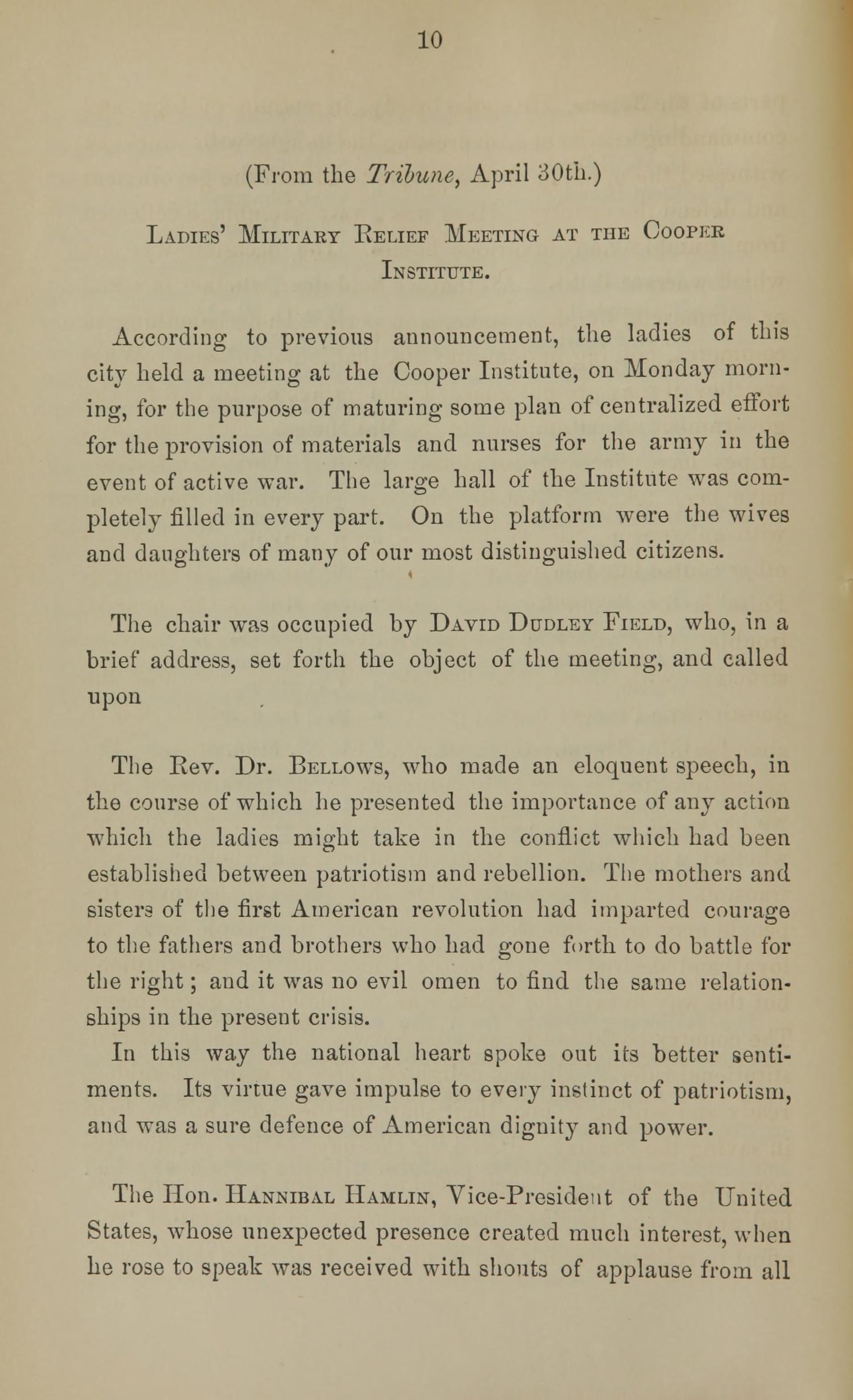
Printed page (archive.org leaf 9) · Internet Archive scan
Printed page (archive.org leaf 9) · Internet Archive scan · Document preview; the quoted page may differ.

Printed book

Report concerning the Woman's Central Association of Relief at New York (Sanitary Commission Doc. No. 32, 1861)

Identify the author and publication date before weighing this account. A later recollection and a contemporary document answer different questions. Read the cited page and its surrounding passage.

Your passage · The Cooper Institute

The large hall of the Institute was completely filled in every part.

Words matched in source text. Read the surrounding record before drawing a conclusion.

· p. 10

Where this chapter uses this source · 2 passages

The Cooper Institute

The large hall of the Institute was completely filled in every part.

Words matched in source text

Examine quotation 20-007 →

The Cooper Institute

The mothers and sisters of the first American revolution had imparted courage to the fathers and brothers who had gone forth to do battle for the right; and it was no evil omen to find the same relati…

Words matched in source text

Examine quotation 20-008 →

Open the record and its pages →

1 catalogued pages. Transcription and image availability are shown on the document view.

Citation and source credit

United States Sanitary Commission. (1861). Report concerning the Woman's Central Association of Relief at New York, to the U.S. Sanitary Commission at Washington, Oct. 12, 1861 (Sanitary Commission Document No. 32, p. 10). Wm. C. Bryant & Co. https://archive.org/details/101524679.nlm.nih.gov

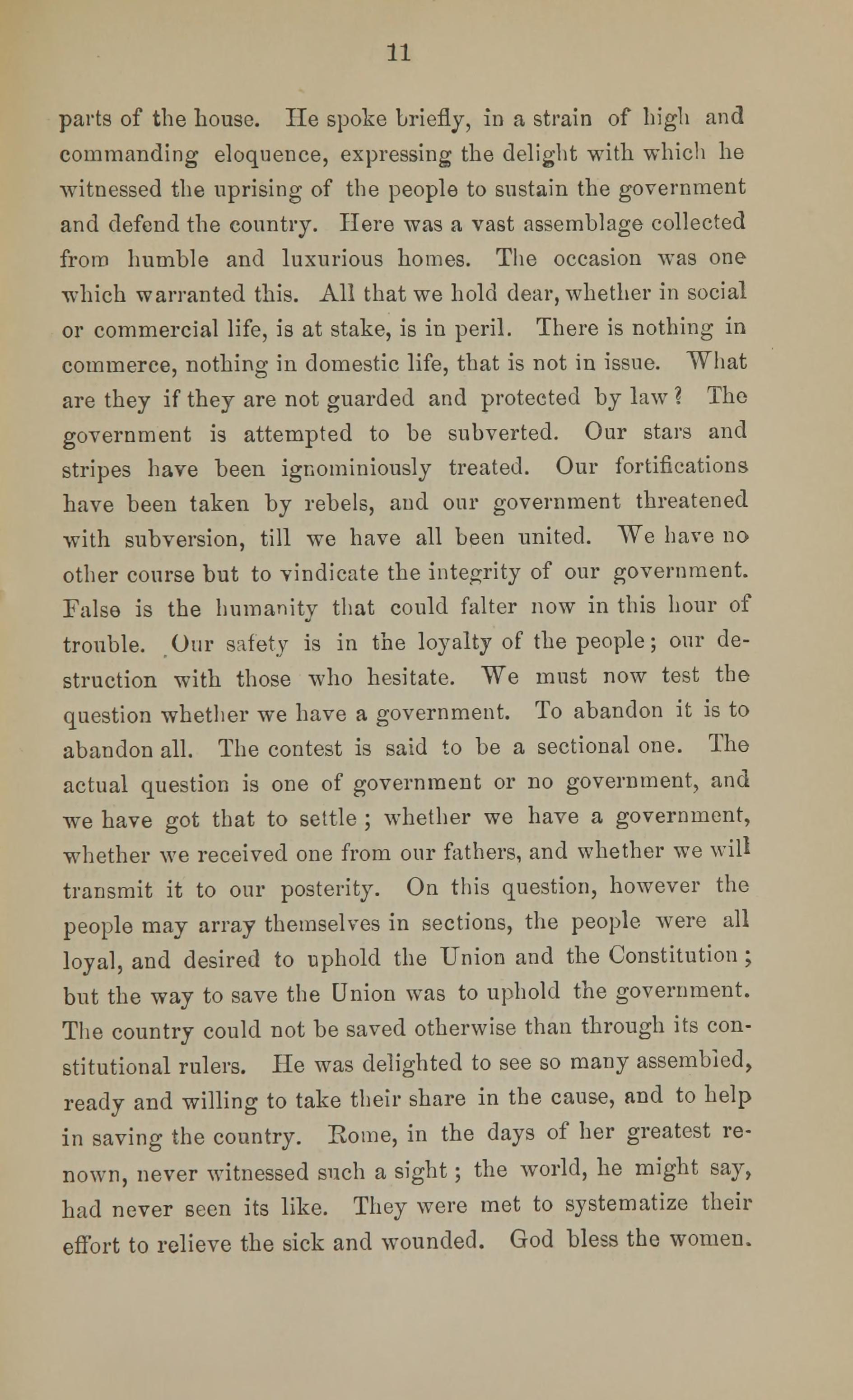
Printed page 10 (archive.org leaf 9) · Internet Archive scan
Printed page 10 (archive.org leaf 9) · Internet Archive scan · Supplied page connection.

Printed book

U.S. Sanitary Commission (1861). Report concerning the Woman's Central Association of Relief (Doc. No. 32), reprinting the New-York Tribune, 30 Apr 1861

Identify the author and publication date before weighing this account. A later recollection and a contemporary document answer different questions. Read the cited page and its surrounding passage.

Your passage · The Cooper Institute

received with shouts of applause from all parts of the house.

Source identified; supplied locator: pp. 11-12; archive.org/details/101524679.nlm.nih.gov; sources/external/wcar1861_101524679.txt. Read the surrounding record before drawing a conclusion.

· pp. 11-12; archive.org/details/101524679.nlm.nih.gov; sources/external/wcar1861_101524679.txt

Where this chapter uses this source · 1 passage

The Cooper Institute

received with shouts of applause from all parts of the house.

Source identified; supplied locator: pp. 11-12; archive.org/details/101524679.nlm.nih.gov; sources/external/wcar1861_101524679.txt

Examine quotation 20-009 →

Open the record and its pages →

1 catalogued pages. Transcription and image availability are shown on the document view.

Citation and source credit

U.S. Sanitary Commission (1861). Report concerning the Woman's Central Association of Relief (Doc. No. 32), reprinting the New-York Tribune, 30 Apr 1861

Citation details need review.

Printed page (archive.org leaf 10) · Internet Archive scan
Printed page (archive.org leaf 10) · Internet Archive scan · Document preview; the quoted page may differ.

Printed book

Report concerning the Woman's Central Association of Relief at New York (Sanitary Commission Doc. No. 32, 1861)

Identify the author and publication date before weighing this account. A later recollection and a contemporary document answer different questions. Read the cited page and its surrounding passage.

Your passage · The Cooper Institute

whether we have a government, whether we received one from our fathers, and whether we will transmit it to our posterity.

Words matched in source text. Read the surrounding record before drawing a conclusion.

· p. 11

Where this chapter uses this source · 2 passages

The Cooper Institute

whether we have a government, whether we received one from our fathers, and whether we will transmit it to our posterity.

Words matched in source text

Examine quotation 20-010 →

The Cooper Institute

They were met to systematize their effort to relieve the sick and wounded. God bless the women.

Words matched in source text

Examine quotation 20-011 →

Open the record and its pages →

1 catalogued pages. Transcription and image availability are shown on the document view.

Citation and source credit

United States Sanitary Commission. (1861). Report concerning the Woman's Central Association of Relief at New York, to the U.S. Sanitary Commission at Washington, Oct. 12, 1861 (Sanitary Commission Document No. 32, p. 11). Wm. C. Bryant & Co. https://archive.org/details/101524679.nlm.nih.gov

← Continue your chapter journey · Follow the people in this chapter →

Your chapter stays open
Your book journey · A Most Vital Start · The Cooper InstituteExplore the evidence

Compare the original with its transcription and citation.

Explore outside this journey ↗

This chapter’s source collection as JSON