The book is finished. GIBBS: The Forgotten Warrior of the First New York Dragoons, by Garland H. Green Jr. How to order is coming soon; you can reserve a copy now. Reserve a copy →
Alfred GibbsThe research archive
Menu

The evidence behind your reading · Packing for the Road

Read the records behind this chapter

Follow a letter, report, recollection or family record beyond the passage in the book. Each source below shows where the chapter uses it and what to examine. Open it here, compare its pages, and return without losing your chapter.

Begin with a question: What did moving an army household involve?

Go beyond the book · Packing for the Road

See a frontier move from Peggy’s side

The road out of Fort Fillmore required clothes, food, packing, and a small child’s care. Peggy’s October 1857 letter makes those preparations visible beyond the military itinerary.

New to these records? A little context.

A transcription records the words of a letter. A typescript is a typed copy, which may survive even when the handwritten original is not on display. The linked account identifies the version it preserves; later explanatory paragraphs are not part of the letter.

What did moving an army household involve?
Research preview · An invitation into the written account, not a reproduction of an original document.

Read the source exhibit & its explanation

Peggy’s Fort Fillmore letter, October 24, 1857

The preserved transcription describes half-packed trunks, sewing for the road, provisions, and homesickness. It brings domestic labor into a chapter otherwise full of assignments and movement.

What to examine: Follow the references to clothing, food, and the child, then find the instructions about mail. Build a list of tasks the official marching order would not describe.

Keep this distinction in mind: The page states that the transcription came from a descendant and had not been checked against a museum scan. No original has been substituted for the missing manuscript here.

Follow this question into Fort Fillmore, October 24, 1857 →

Keep your question in view as you explore. The reading tray retains Packing for the Road. Close it to return to this point, or deliberately choose to explore outside the chapter.

8 distinct source records · Page 2 of 2

West Point scan 43
West Point scan 43 · Supplied page connection.

West Point manuscript

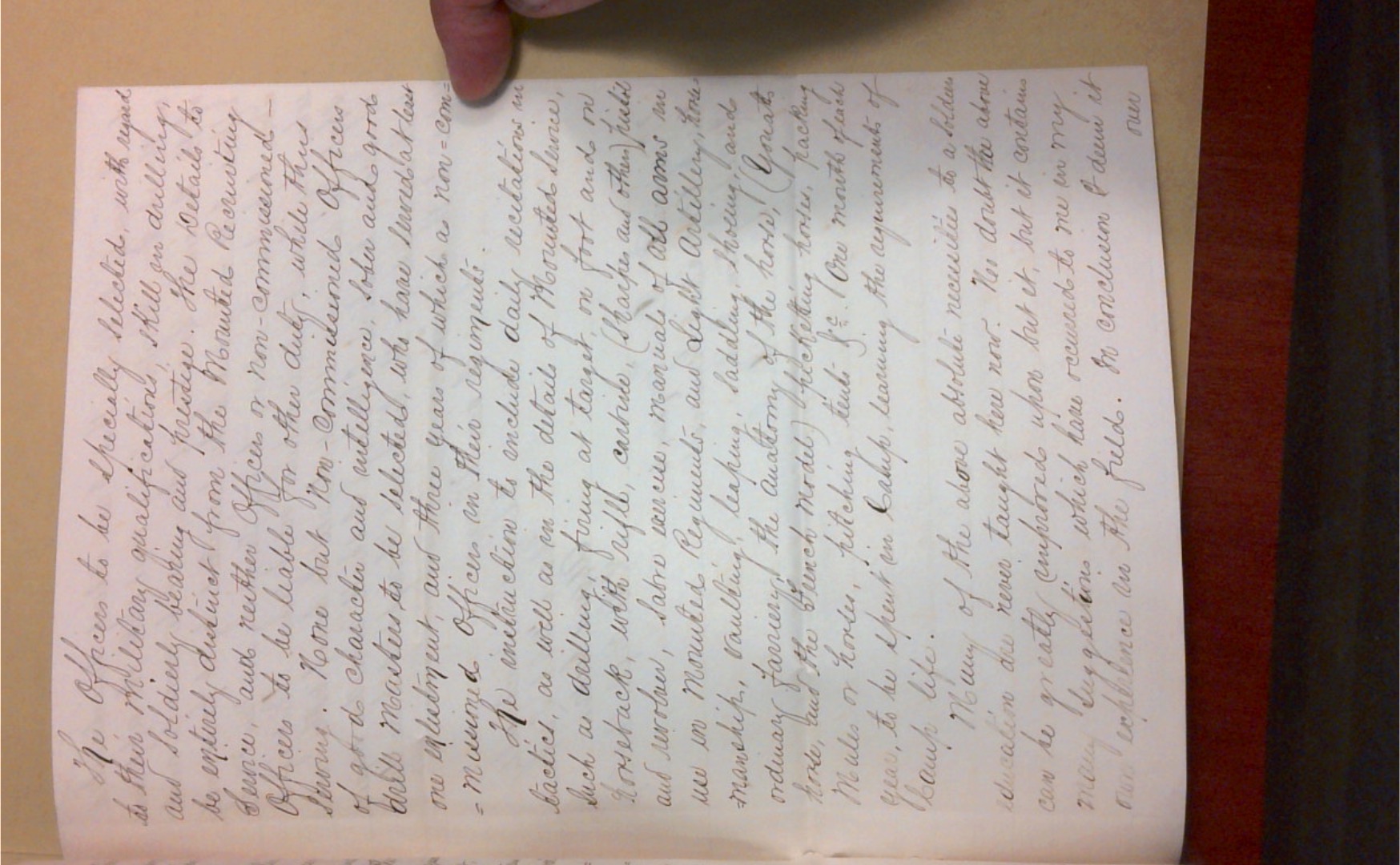
Gibbs's plan to reorganize the Cavalry School of Practice, Carlisle Barracks, 9 October 1859 (page)

Begin with who made this record, when and for whom. Compare the book’s words with the scan and the surrounding transcription. Distinguish what the writer observed from a request, opinion or later interpretation.

Your passage · Carlisle Barracks, Pennsylvania

horsemanship, vaulting, leaping, saddling, shoeing, and ordinary farriery, the anatomy of the horse.

Source identified; supplied locator: West Point scan 43. Read the surrounding record before drawing a conclusion.

· West Point scan 43

Where this chapter uses this source · 1 passage

Carlisle Barracks, Pennsylvania

horsemanship, vaulting, leaping, saddling, shoeing, and ordinary farriery, the anatomy of the horse.

Source identified; supplied locator: West Point scan 43

Examine quotation 16-020 →

Open the record and its pages →

1 catalogued pages. Transcription and image availability are shown on the document view.

Citation and source credit

Gibbs, A. (1859, October 9). [Plan to reorganize the Cavalry School of Practice, Carlisle Barracks, Pa., forwarded to Maj. E. D. Townsend; page with the course of instruction]. Alfred Gibbs papers (CU #1313), Manuscripts Collection, U.S. Military Academy Library, West Point, NY. Scans by Garland H. Green Jr., November 2024. Another copy: Letters Received, Records of the Adjutant General's Office, Record Group 94, National Archives, NAID 28686883.

Citation details need review.

ago-85311054-85311054_010.jpg
ago-85311054-85311054_010.jpg · Supplied page connection.

National Archives record

National Archives catalog 85311054

Begin with who made this record, when and for whom. Compare the book’s words with the scan and the surrounding transcription. Distinguish what the writer observed from a request, opinion or later interpretation.

Your passage · New York

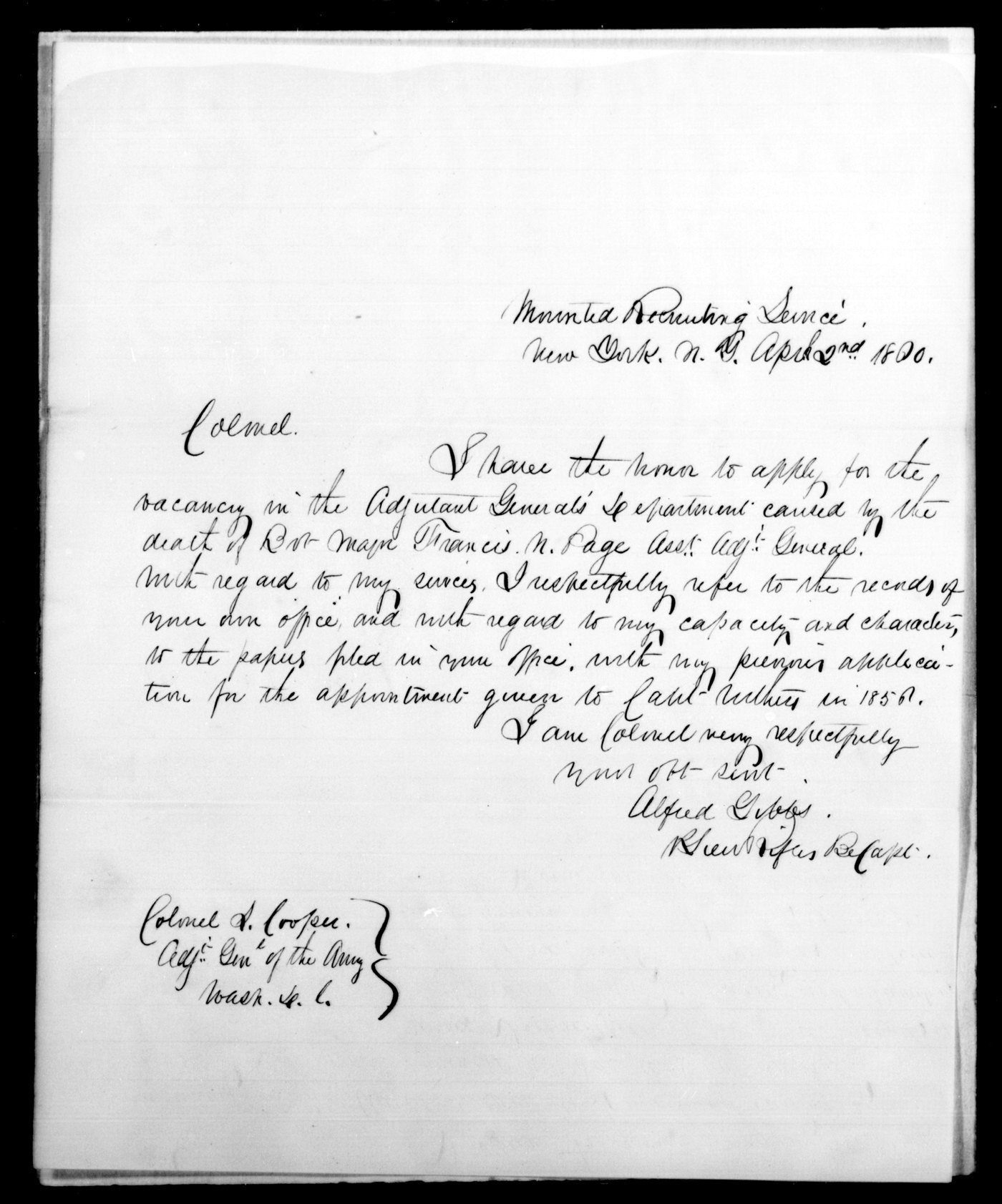
the papers filed in your Office, with my previous application for the appointment given to Capt. Withers in 1856.

Page connection supplied; check matching method. Read the surrounding record before drawing a conclusion.

·

Where this chapter uses this source · 2 passages

New York

the papers filed in your Office, with my previous application for the appointment given to Capt. Withers in 1856.

Page connection supplied; check matching method

Examine quotation 16-024 →

New York

Many of Gibbs' friends here would like to see him promoted to that place.

Page connection supplied; check matching method

Examine quotation 16-025 →

Open the record and its pages →

5 catalogued pages. Transcription and image availability are shown on the document view.

Citation and source credit

Gibbs, A. (1855, September 15). [Application to Jefferson Davis, Secretary of War, for appointment in the Adjutant General's Department, with endorsement by P. F. Smith] (naId 85311054). Letters Received, Records of the Adjutant General's Office, Record Group 94. National Archives.

← Continue your chapter journey · Follow the people in this chapter →

Your chapter stays open
Your book journey · Packing for the RoadExplore the evidence

Compare the original with its transcription and citation.

Explore outside this journey ↗

This chapter’s source collection as JSON