The book is finished. GIBBS: The Forgotten Warrior of the First New York Dragoons, by Garland H. Green Jr. How to order is coming soon; you can reserve a copy now. Reserve a copy →
Alfred GibbsThe research archive
Menu

The evidence behind your reading · The Class of 1846

Read the records behind this chapter

Follow a letter, report, recollection or family record beyond the passage in the book. Each source below shows where the chapter uses it and what to examine. Open it here, compare its pages, and return without losing your chapter.

Begin with a question: What did West Point actually measure?

Go beyond the book · The Class of 1846

Read a cadet’s record without knowing his future

Before Gibbs and his classmates became famous officers, the Academy ranked them by subject and conduct. The registers allow comparisons without assuming later military reputations were already visible.

New to these records? A little context.

The Academy’s annual register lists cadets and their standings. Order of merit is a ranking; demerits record conduct. Compare like columns, and check which year and class the table describes.

What did West Point actually measure?
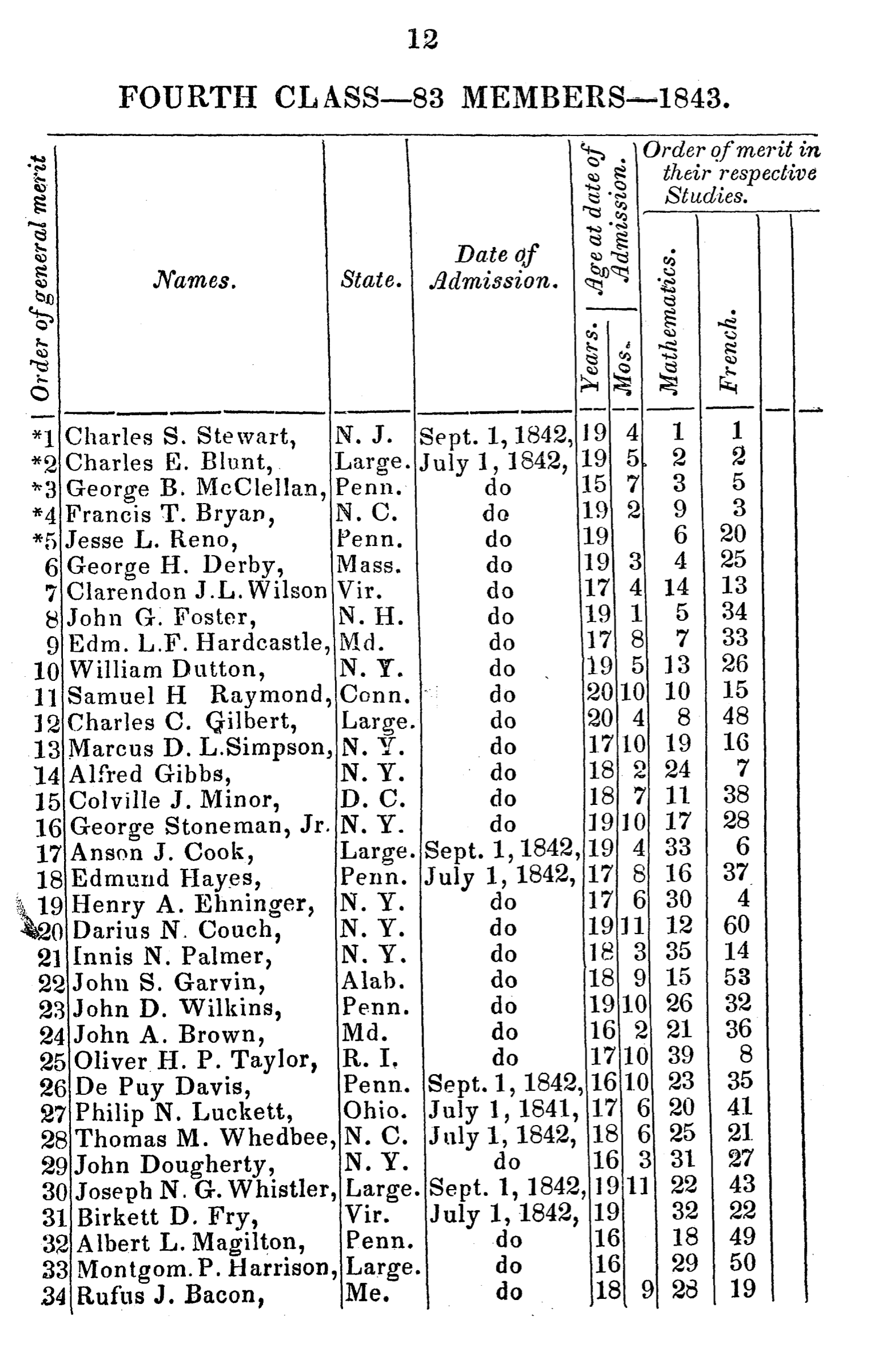
Official Register 1843, page 12: Fourth Class order of merit
Official Register 1843, page 12: Fourth Class order of merit · From the linked account. Its original credits and image status are preserved there.

Read the source exhibit & its explanation

Class standings and conduct rolls, 1843–1846

Deborah Anthony Dodge’s compilation is presented alongside register scans and a correction to a comparison figure. It distinguishes general standing, subject standing, and demerits.

What to examine: Choose one year and compare the same column across cadets. Then check that row against the original register rather than mixing academic position with the conduct roll.

Keep this distinction in mind: Lower academic rank numbers mean higher standing; demerits measure something different. A school ranking is not a prediction of battlefield leadership.

Follow this question into West Point, New York →

Keep your question in view as you explore. The reading tray retains The Class of 1846. Close it to return to this point, or deliberately choose to explore outside the chapter.

10 distinct source records · Page 1 of 2

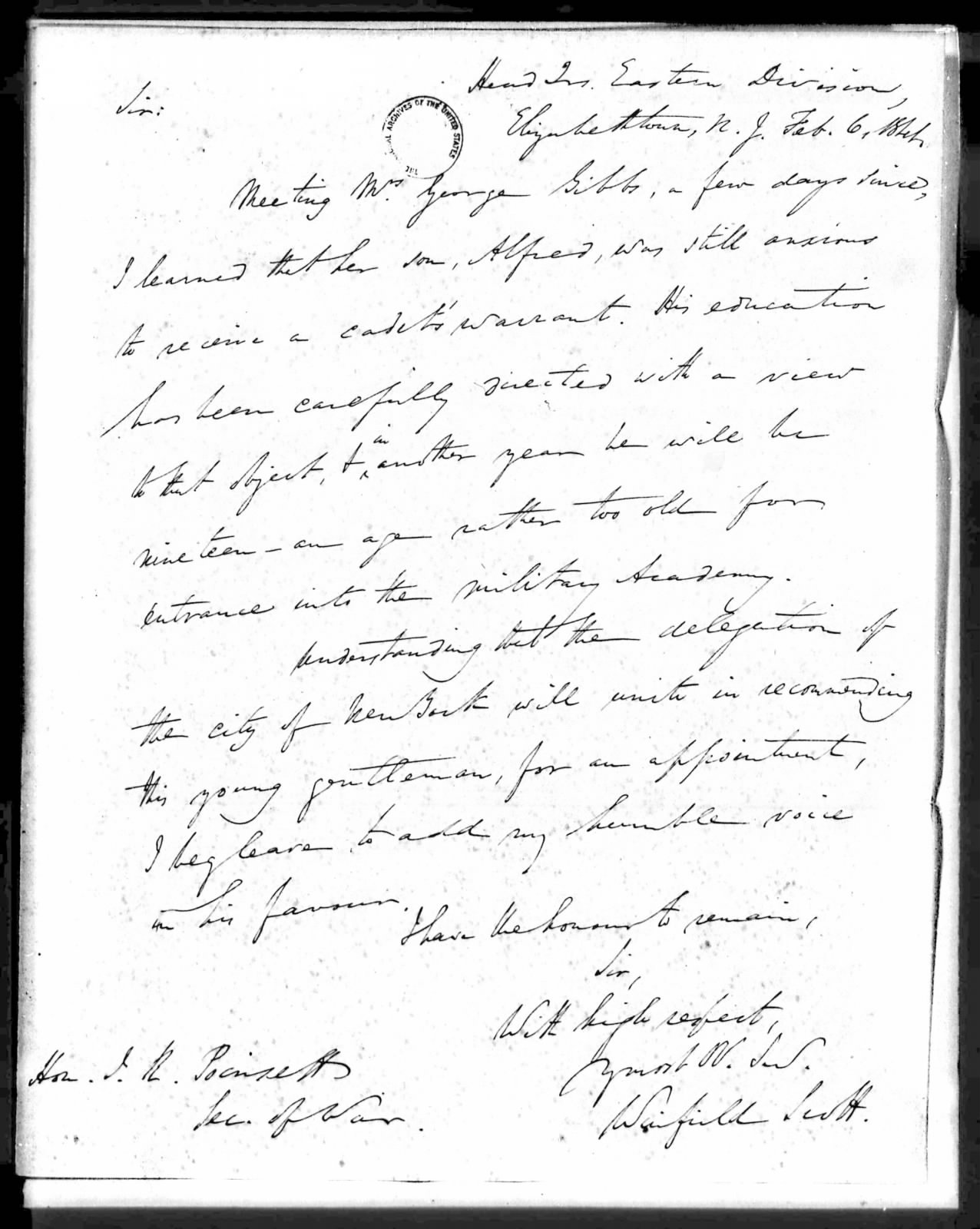
National Archives Microfilm Publication M688, roll 126, file 1840/129, page 21
National Archives Microfilm Publication M688, roll 126, file 1840/129, page 21 · Supplied page connection.

National Archives record

Cadet application file 1840/129, Alfred Gibbs, page 21 (WINFIELD SCOTT recommendation 1841-02-06)

Begin with who made this record, when and for whom. Compare the book’s words with the scan and the surrounding transcription. Distinguish what the writer observed from a request, opinion or later interpretation.

Your passage · West Point, New York

an age rather too old for entrance into the military Academy.

Page connection supplied; check matching method. Read the surrounding record before drawing a conclusion.

National Archives, Record Group 94; accessed via Fold3 · National Archives Microfilm Publication M688, roll 126, file 1840/129, page 21

Where this chapter uses this source · 1 passage

West Point, New York

an age rather too old for entrance into the military Academy.

Page connection supplied; check matching method

Examine quotation 07-002 →

Open the record and its pages →

2 catalogued pages. Transcription and image availability are shown on the document view.

Citation and source credit

Scott, W. (1841, February 6). [Letter to J. R. Poinsett recommending Alfred Gibbs]. https://www.fold3.com/image/505217048

Citation details need review.

Modern book (secondary)

Page references are recorded with each quotation.

Labeled document illustration, not a scan. Local scan not connected.

Modern book (secondary)

Waugh, J. C. (1994/1999). The class of 1846

Read the historian’s argument in its published context. This is secondary interpretation, not an original eyewitness record. Copyrighted text is not reproduced here.

Your passage · The Plain

Two hundred demerits in a year was all the system would tolerate,

Source identified; supplied locator: p. 31; archive.org/details/classof1846fromw00john, full-text search. Read the surrounding record before drawing a conclusion.

· Page references are recorded with each quotation.

Where this chapter uses this source · 1 passage

The Plain

Two hundred demerits in a year was all the system would tolerate,

Source identified; supplied locator: p. 31; archive.org/details/classof1846fromw00john, full-text search

Examine quotation 07-010 →

Open the record and its pages →

0 catalogued pages. Transcription and image availability are shown on the document view.

Citation and source credit

Waugh, J. C. (1994/1999). The class of 1846

Citation details need review.

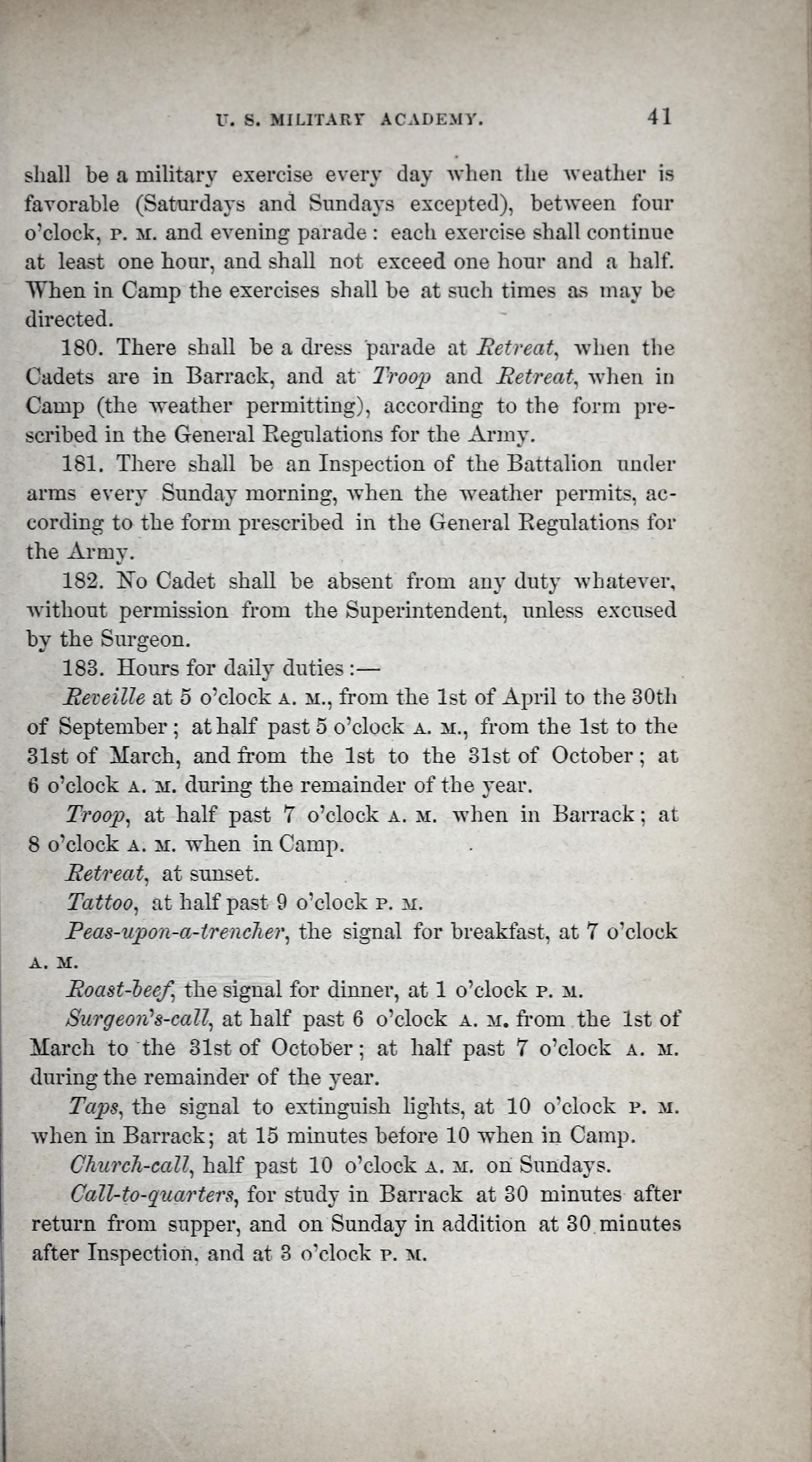
Printed page 41 · Internet Archive scan
Printed page 41 · Internet Archive scan · Document preview; the quoted page may differ.

Printed book

Regulations for the U.S. Military Academy at West Point (1853)

Identify the author and publication date before weighing this account. A later recollection and a contemporary document answer different questions. Read the cited page and its surrounding passage.

Your passage · A Cadet's Day

Peas-upon-a-trencher.

Words matched in source text. Read the surrounding record before drawing a conclusion.

· p. 41

Where this chapter uses this source · 1 passage

A Cadet's Day

Peas-upon-a-trencher.

Words matched in source text

Examine quotation 07-011 →

Open the record and its pages →

1 catalogued pages. Transcription and image availability are shown on the document view.

Citation and source credit

Regulations for the U.S. Military Academy at West Point (1853)

Citation details need review.

Modern book (secondary)

Page references are recorded with each quotation.

Labeled document illustration, not a scan. Local scan not connected.

Modern book (secondary)

Ambrose, S. E. (1966/1999). Duty, honor, country: A history of West Point

Read the historian’s argument in its published context. This is secondary interpretation, not an original eyewitness record. Copyrighted text is not reproduced here.

Your passage · A Cadet's Day

debts, demerits, and grades

Source identified; supplied locator: archive.org/details/dutyhonorcountry00ambr; same words in Ambrose's American Heritage article (archive.org/details/americanheritage29junamer). Read the surrounding record before drawing a conclusion.

· Page references are recorded with each quotation.

Where this chapter uses this source · 1 passage

A Cadet's Day

debts, demerits, and grades

Source identified; supplied locator: archive.org/details/dutyhonorcountry00ambr; same words in Ambrose's American Heritage article (archive.org/details/americanheritage29junamer)

Examine quotation 07-013 →

Open the record and its pages →

0 catalogued pages. Transcription and image availability are shown on the document view.

Citation and source credit

Ambrose, S. E. (1966/1999). Duty, honor, country: A history of West Point

Citation details need review.

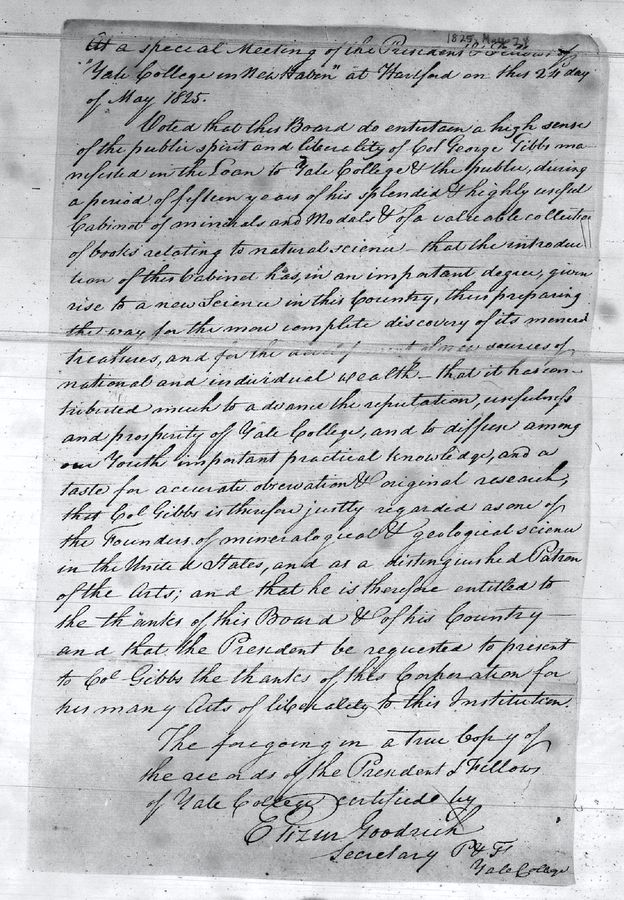
Reel 1, frame 559
Reel 1, frame 559 · Supplied page connection.

Wisconsin manuscript

Yale College Corporation (Secretary Goodrich) -> Col. George Gibbs · 24 May 1825

Begin with who made this record, when and for whom. Compare the book’s words with the scan and the surrounding transcription. Distinguish what the writer observed from a request, opinion or later interpretation.

Your passage · A Cadet's Day

one of the Founders of mineralogical & geological science in the United States.

Words matched in source text. Read the surrounding record before drawing a conclusion.

Wisconsin Historical Society, Gibbs Family Papers, U.S. Mss Y, Micro 1117 · Reel 1, frames 559

Where this chapter uses this source · 1 passage

A Cadet's Day

one of the Founders of mineralogical & geological science in the United States.

Words matched in source text

Examine quotation 07-014 →

Open the record and its pages →

1 catalogued pages. Transcription and image availability are shown on the document view.

Citation and source credit

Corporation, Y. C. (1825, May 24). [Letter to Col. George Gibbs]. Gibbs Family Papers, 1763-1918 (U.S. Mss Y, Micro 1117, Reel 1, frame 559). Wisconsin Historical Society Archives, Madison, WI, United States.

Citation details need review.

Modern book (secondary)

Page references are recorded with each quotation.

Labeled document illustration, not a scan. Local scan not connected.

Modern book (secondary)

Waugh, J. C. (1999). The class of 1846

Read the historian’s argument in its published context. This is secondary interpretation, not an original eyewitness record. Copyrighted text is not reproduced here.

Your passage · The Class

purely by the logic of the alphabet.

Source identified; supplied locator: p. 25; archive.org/details/classof1846fromw00john. Read the surrounding record before drawing a conclusion.

· Page references are recorded with each quotation.

Where this chapter uses this source · 3 passages

The Class

purely by the logic of the alphabet.

Source identified; supplied locator: p. 25; archive.org/details/classof1846fromw00john

Examine quotation 07-015 →

The Class

a dozen had been lost,

Source identified; supplied locator: p. 40; archive.org/details/classof1846fromw00john

Examine quotation 07-016 →

The Class

It was West Point's grim reaper,

Source identified; supplied locator: p. 26; archive.org/details/classof1846fromw00john

Examine quotation 07-017 →

Open the record and its pages →

0 catalogued pages. Transcription and image availability are shown on the document view.

Citation and source credit

Waugh, J. C. (1999). The class of 1846

Citation details need review.

← Continue your chapter journey · Follow the people in this chapter →

Your chapter stays open
Your book journey · The Class of 1846Explore the evidence

Compare the original with its transcription and citation.

Explore outside this journey ↗

This chapter’s source collection as JSON