
Table of Contents
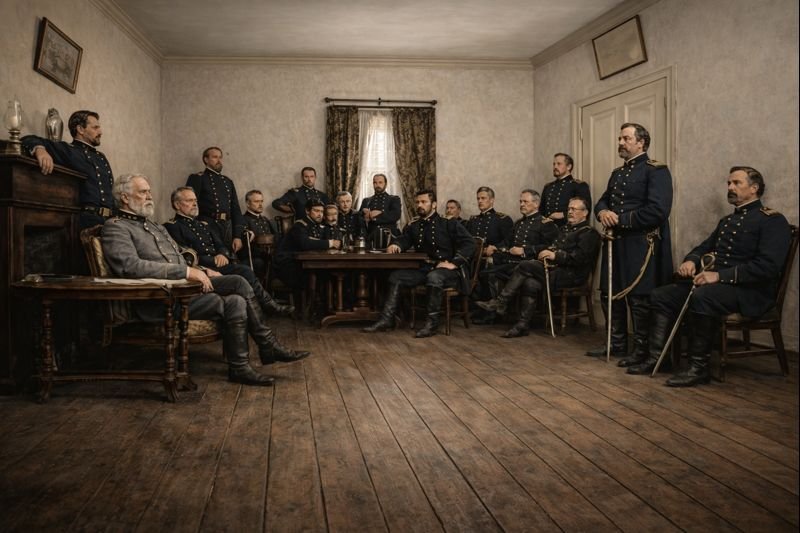
Appomattox Courthouse, Va. (Lee’s surrender), April 9, 1865
On April 9, 1865, General Robert E. Lee surrendered the Army of Northern Virginia to Lieutenant General Ulysses S. Grant in the parlor of Wilmer McLean’s house at Appomattox Court House, Virginia, effectively ending the Civil War in Virginia. The First New York Dragoons were present that morning as part of Sheridan’s cavalry, drawn up for a final charge when the white flag appeared. This page replaces an earlier version that contained fabricated quotations falsely attributed to Bowen and to a non-existent 1980 National Park Service publication; those invented citations have been removed and the genuine record restored.
Background
After abandoning Petersburg and Richmond on April 2–3, 1865, Lee’s army marched west in a desperate attempt to escape and join Joseph E. Johnston in North Carolina. Sheridan’s cavalry, with the First New York Dragoons in Brigadier General Thomas C. Devin’s First Cavalry Division, raced ahead to cut off the retreat—a strategy Bowen contrasted with the slower pursuit favored by General Meade. After Sailor’s Creek (April 6) and Appomattox Station (April 8), the Union cavalry seized the roads west of Appomattox Court House, trapping Lee’s remnant between Sheridan’s troopers and the infantry of the Army of the James coming up behind.
The Final Morning
On the morning of April 9, Lee made one last attempt to break through the cavalry screen, but the arrival of Union infantry—General Ord’s Twenty-fourth Corps and the Fifth Corps—sealed his fate. Bowen describes the moment from the saddle, as the dismounting cavalry was relieved by the infantry and massed for a charge:
Relieved by the infantry, the whole cavalry force was drawn up for a mounted charge. The rebel army was at our mercy. Our artillery had opened upon them, and in five minutes more the troopers would have swooped down upon them as we did at Winchester and Cedar Creek; but a white flag is seen hurrying forward in token of surrender.
Bowen, Regimental History of the First New York Dragoons (1900)
That afternoon Lee, in full dress uniform, and Grant, in a mud-spattered field coat, met at the McLean House. Lee arrived about 1:00 p.m.; Grant came up a short time later. Grant’s written terms—under 200 words—paroled Lee’s men, let officers keep their sidearms, horses, and baggage, and permitted the soldiers to go home. The surrender document stated that each officer and man “will be allowed to return to their homes, not to be disturbed by United States authority so long as they observe their paroles and the laws in force where they may reside.” Roughly 28,000 Confederate soldiers were ultimately paroled. By Grant’s order, Union troops were forbidden to celebrate or taunt their defeated foes.
The First New York Dragoons
The Dragoons witnessed the surrender from the field. Bowen recalled Grant himself riding past the regiment on his way to meet Lee, and the news of the surrender spreading down the lines:
While still drawn up in line of battle, awaiting the turn of events, some one shouted, “There comes General Grant!” Passing close to our regiment on his momentous errand, we could not but notice his plain, rough, mud-bespattered garb. His conference with Lee was of short duration, and soon the glorious news that the army of northern Virginia had surrendered spread like wildfire among the troops, when cheer upon cheer from thousands of throats rent the air.
Bowen, Regimental History of the First New York Dragoons (1900)
Bowen describes blue and gray soldiers afterward mingling and sharing rations, and the regiment going into camp that Sabbath night “in sight of the rebel army, with no picket firing, and all hostilities ended.” Of the formal proceedings he declined to elaborate, writing simply that “the details of Lee’s surrender, and the magnanimity of General Grant in his treatment of the humiliated Confederates, are too well known to be repeated here.”
Aftermath and Muster-Out
The cavalry began its return march toward Petersburg the next day. On April 16 the army learned of President Lincoln’s assassination, and the regiment was briefly ordered toward North Carolina to cooperate with Sherman before Johnston’s surrender made the movement unnecessary. While the regiment lay near Petersburg, Colonel Thomas J. Thorp rejoined it after his long captivity. The First New York Dragoons were mustered out of service on June 30, 1865, at Cloud’s Mills, Virginia, then traveled by way of Baltimore to Rochester, New York, where the men were paid off and the regiment finally disbanded by July 18, 1865.
Sources
- James R. Bowen, Regimental History of the First New York Dragoons (1900), chapters “Appomattox Campaign—The Final Battles” and “Looking Homeward.” archive.org/details/regimentalhistor00bowe
- “Battle of Appomattox Court House,” American Battlefield Trust. battlefields.org
- “Articles of Agreement Relating to the Surrender of the Army of Northern Virginia (1865),” U.S. National Archives. archives.gov
- “Appomattox, Surrender at,” Encyclopedia Virginia. encyclopediavirginia.org
- “Battle of Appomattox Court House,” Wikipedia. en.wikipedia.org/wiki/Battle_of_Appomattox_Court_House
Views: 63
Explore the evidence
View this article’s connected sources and media →
About this page
This article was brought over from AlfredGibbs.com. Its preserved text, media and citations remain available for comparison.