
October 20, 1864 was not a day of battle so much as the morning after one. The evening before, at Cedar Creek, Sheridan’s army had turned a near-disaster into one of the great Union victories of the war, and the First New York Dragoons — in the very front of Merritt’s pursuit — had ridden past Strasburg in the darkness, capturing wagons, prisoners, and a long train of Early’s artillery. The 20th continued that pursuit: the cavalry pressed the beaten Confederates up the Valley pike as far as Woodstock before the regiment fell back, going into camp at Middletown on the 21st. The regiment carried “Woodstock, Va., Oct. 20, 1864” ever after on its roll of battles.
From Cedar Creek to Woodstock
The action at Woodstock cannot be separated from the battle that came before it. On October 19, at Cedar Creek, Early’s army had surprised and routed the Union camps at dawn, only to see Sheridan return from Winchester, rally his men, and shatter the Confederate line in a late-afternoon counterattack. Bowen, the regiment’s historian, gave the Dragoons a leading place in the climax: “no one regiment contributed more to the success of the battle, especially in the final charge and the gathering up of prisoners and trophies.” As night fell the pursuit began, and it did not stop at dark.
The Night Pursuit Beyond Strasburg
With Early’s army broken into “a desperate mass seeking refuge,” Merritt’s and Custer’s divisions drove the fugitives southward up the pike, the First New York Dragoons riding so far in the advance that they were repeatedly fired into and at one point feared being overwhelmed. In the darkness they overran abandoned guns and a great wagon train, jamming the road with “wagons, ambulances, cannon, caissons, and everything on wheels.” Captain R. A. Britton carried back word from Colonel Gibbs that the regiment had “captured every wheel from Early,” and reported to Sheridan in person having counted twenty-nine pieces of artillery. Devin afterward insisted that “no troops except my command went beyond Strasburg.” The work of hauling back the captured trophies continued until about midnight.
“I have no hesitation in asserting that no troops except my command went beyond Strasburg. My officers and men were repeatedly fired into after passing the railroad, and one man of the First New York Dragoons was killed.”— Brig. Gen. Thomas C. Devin, commanding the Second Brigade, quoted in Bowen’s regimental history (the pursuit of October 19–20, 1864).
Up the Valley — October 20
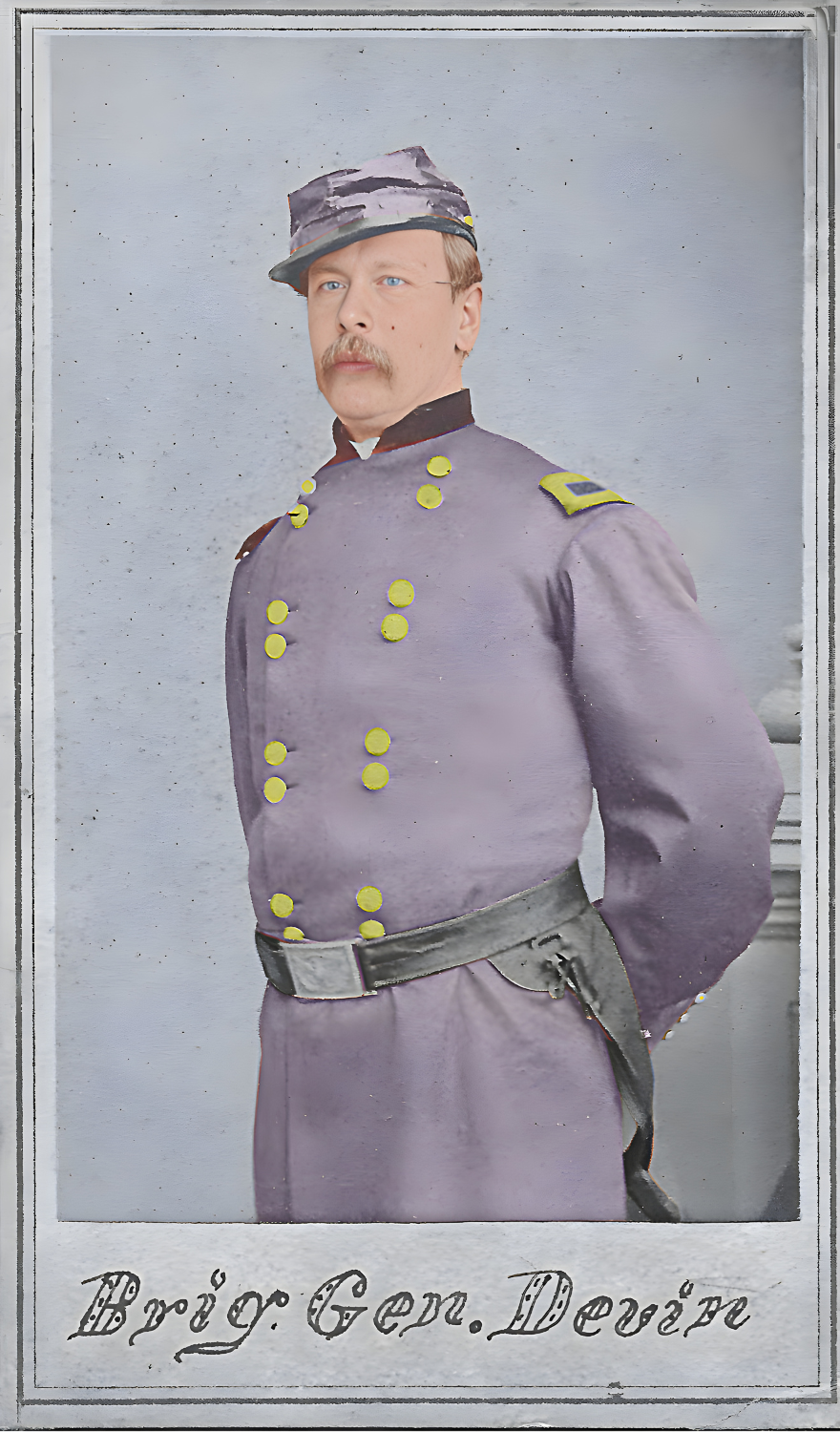
The pursuit that began on the night of the 19th carried into the 20th. With Early’s forces in flight, Sheridan’s cavalry pressed up the Valley pike toward Woodstock, securing the broken field behind them and keeping the enemy from any chance to reform. Bowen’s detailed narrative of this stretch is brief — the regiment’s own itinerary captures the day in a single line, “20, Woodstock,” set squarely between Cedar Creek on the 19th and the return to camp at Middletown on the 21st. It was, in the larger picture, the close of the fighting in the Valley: after Cedar Creek, as Bowen put it, “we were for some time only occasionally troubled” by Early, and the Shenandoah was firmly in Union hands.
Sources & Further Reading
- Primary James R. Bowen, Regimental History of the First New York Dragoons (1900), ch. XVII, “Battle of Cedar Creek,” pp. 250–262 — the regiment’s own historian, an eyewitness, whose narrative of the October 19–20 pursuit (and whose appendix itinerary, “20, Woodstock”) is the basis of this page. Full text: archive.org/details/regimentalhistor00bowe.
- Primary Brig. Gen. Thomas C. Devin, official report of operations following Cedar Creek, in U.S. War Dept., The War of the Rebellion: Official Records of the Union and Confederate Armies, Series I, Vol. 43, Pt. 1 (the source of the quotation on the pursuit beyond Strasburg).
- For the parent engagement — the Battle of Cedar Creek, October 19, 1864, of which this advance was the immediate aftermath — see the American Battlefield Trust: battlefields.org/learn/civil-war/battles/cedar-creek.
- Note on the record: the “Woodstock Races” of October 8–9, 1864 (the cavalry rout at Tom’s Brook) are a separate event with their own page and should not be conflated with this October 20 advance; on Tom’s Brook see the NPS / CWSAC summary (VA122): nps.gov/abpp/battles/va122.htm.
Views: 52
Explore the evidence
View this article’s connected sources and media →
About this page
This article was brought over from AlfredGibbs.com. Its preserved text, media and citations remain available for comparison.