
By the last week of September 1864 the First New York Dragoons were in the thick of Sheridan’s pursuit of Jubal Early’s beaten army up the Shenandoah Valley. On September 26 the regiment had been bloodied at the mouth of Brown’s Gap near Port Republic, where it ran into Kershaw’s infantry and lost three men killed. Two days later, on September 28, 1864, the Dragoons were detached to drive the enemy’s cavalry out of nearby McGaugheystown, and by the 30th the brigade had encamped at Cross Keys — the crossroads in Rockingham County whose name an earlier and much larger battle had made famous.
Brown’s Gap and Port Republic
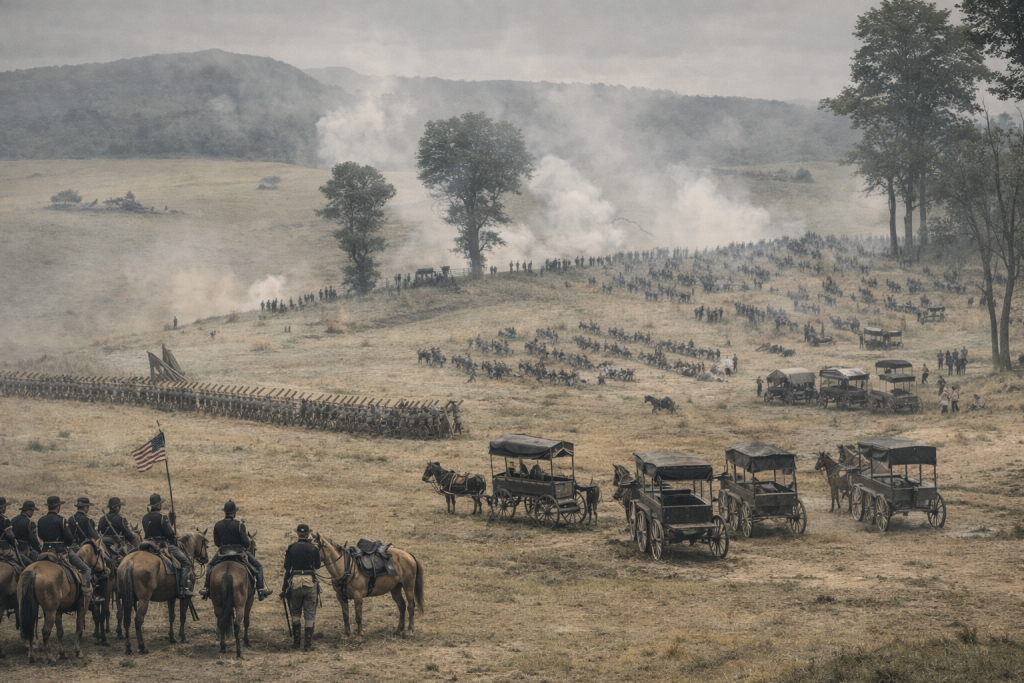
The events around Cross Keys cannot be separated from the running pursuit that produced them. After Fisher’s Hill on September 22, Sheridan drove Early south up the Valley, his cavalry snapping at the Confederate rear through New Market and Harrisonburg. Turning toward Port Republic and picking up squads of prisoners, the Dragoons pressed on until, as Bowen recalled, General Merritt “came up with the balance of the division, and we drove the enemy to the mouth of Brown’s Gap just in time to meet Kershaw’s division of infantry on its way to join Early.” The Confederates attacked at once. “A very lively battle occurred,” Bowen wrote, “in which the Dragoons lost three killed and some wounded; among them Major Scott, but he heroically remained on the field until the fight was over.” Bowen’s appendix dates this fight September 26 and files it as the engagement at Port Republic; the regimental roster records all three of the dead, and both of the wounded, as casualties of that day.
Cross Keys and McGaugheystown
The pursuit then settled into the grim work that would be remembered as “The Burning.” Bowen’s own itinerary lists an engagement at Cross Keys on September 27, and on the 28th the regiment had its sharpest moment of the stretch. Quoting Gen. Devin’s report, Bowen records that on that day “the First New York Dragoons were sent to McGaugheystown, and drove the enemy’s cavalry out of that place.” The next day the brigade swung around by Port Republic, Piedmont, and the Valley Pike to Mt. Crawford, putting the torch to barns, mills, and an iron furnace and driving off hundreds of cattle and sheep. On the 30th, the brigade encamped at Cross Keys — the only time the crossroads appears in the regiment’s record by name. While in this vicinity the men camped near Weyer’s Cave, and many of them, Bowen remembered, “paid a visit to this remarkable cavern, and were fascinated by its features of natural beauty and grandeur.”
“September 28 the First New York Dragoons were sent to McGaugheystown, and drove the enemy’s cavalry out of that place. On the 29th the brigade swung around by Port Republic, Piedmont, and Valley Pike, to Mt. Crawford, burning eighty-two barns containing hay and grain, seventy-two stacks of hay and grain, five flouring mills, two sawmills, an iron furnace, and drove in three hundred and twenty-one cattle and two hundred sheep, encamping at Cross Keys on the 30th.”— Brig. Gen. Thomas C. Devin, commanding the Second Brigade — the only mention of Cross Keys in Bowen’s regimental history.
What Cross Keys Was — and Was Not
There was no battle of Cross Keys in 1864 in any meaningful sense. For the Dragoons the days around the crossroads meant a successful cavalry sweep at McGaugheystown, a long march, an encampment, and a share in the destruction of the Valley’s harvest. The regiment’s real fighting and its real loss in this phase came two days earlier, at Brown’s Gap and Port Republic. A short, honest page serves the men better than a manufactured battle: the named dead below fell on September 26, and they deserve to be remembered for the fight they were actually in.
Roll of Loss — Brown’s Gap / Port Republic, September 26, 1864
The named casualties of the First New York Dragoons for this phase of the pursuit. Bowen’s regimental roster records every one of these men as killed or wounded on September 26, 1864, at Port Republic — the Brown’s Gap fight against Kershaw’s division — not in any action at Cross Keys.
| Outcome | Name | Rank | Company |
|---|---|---|---|
| Killed | Bush Adams | Corporal | Co. D |
| Killed | William C. Daniels | Corporal | Co. F |
| Killed | George M. Woodworth | Private | Co. H |
| Wounded | William H. McMaster | Private | Co. B |
| Wounded | William Sanderson | Private | Co. C |
Sources & Further Reading
- Primary James R. Bowen, Regimental History of the First New York Dragoons (1900), ch. XVI, “Battles of Fisher’s Hill and Woodstock Races,” pp. 241–243, with the regimental itinerary and roster in the Appendix — the regiment’s own eyewitness historian, quoting Gen. Devin’s report. Full text: archive.org/details/regimentalhistor00bowe.
- Primary Brig. Gen. Thomas C. Devin, official report of operations after Fisher’s Hill, in U.S. War Dept., The War of the Rebellion: Official Records of the Union and Confederate Armies, Series I, Vol. 43, Pt. 1 (the source of the September 28–30 report quoted above).
- American Battlefield Trust — Shenandoah Valley Campaign of 1864 and “The Burning”: battlefields.org/learn/civil-war/battles/fishers-hill.
- On the unrelated and far larger Battle of Cross Keys, June 8, 1862 (Frémont vs. Ewell during Jackson’s Valley Campaign), in which the Dragoons took no part, see the American Battlefield Trust: battlefields.org/learn/civil-war/battles/cross-keys, and Shenandoah at War: shenandoahatwar.org.
New Market · Third Winchester · The Shenandoah Valley Campaign
Views: 52
Explore the evidence
View this article’s connected sources and media →
About this page
This article was brought over from AlfredGibbs.com. Its preserved text, media and citations remain available for comparison.