
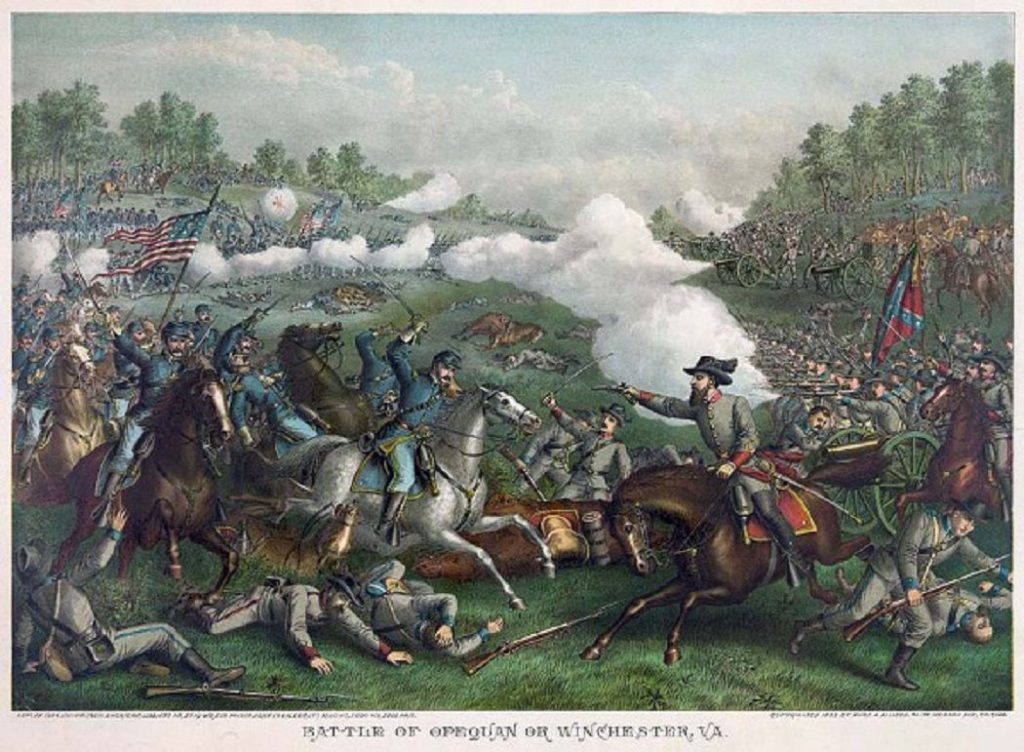
Long before daylight on September 19, 1864, the First New York Dragoons were in the saddle. While Sheridan’s infantry corps marched up the Berryville pike to grapple with Jubal Early’s veterans east of Winchester, the Dragoons — now part of General Devin’s brigade, under Colonel Alfred Gibbs — rode for the fords of the Opequon some seven miles to the northeast. The fight they made there, to force the river and drive the enemy back through three miles of broken country, is the action the regiment set down in its own roll as Opequon Mills — the opening movement of the day that ended in the first great Union victory in the Shenandoah Valley.
A New Brigade for the Battle
Ten days before the battle the regiment got news it had long wanted. On September 9, 1864 the First New York Dragoons were transferred out of the Reserve Brigade — severing, as Bowen put it, “our brigade relations with the obnoxious regulars” — and into the Second Brigade of Merritt’s First Cavalry Division, under Brig. Gen. Thomas C. Devin, “the old war-horse.” There was “great rejoicing” in the ranks. The brigade now stood: the 4th, 6th, 9th, and 19th New York (1st Dragoons), and the 17th Pennsylvania. Colonel Alfred Gibbs led the regiment into the fight. When Grant gave Sheridan his terse order — “Go in” — and intelligence smuggled out of Winchester by Rebecca Wright confirmed that Early had detached part of his force, “Little Phil” struck on the morning of the 19th.
Forcing the Fords
Sheridan’s plan, Bowen wrote, worked “somewhat like a wolf drive, with Winchester as the corral, or center, toward which we were all concentrating.” Five miles east of the town the Opequon Creek marked the eastern edge of a battlefield some forty square miles in extent. The Confederate cavalry were strung out from five to eight miles in front, “doing picket duty and guarding the fords of the Opequon.”
Leaving the infantry to its desperate contest along the Berryville pike, the Dragoons moved and “struck the rebel outposts at Sewer’s Ford on the Opequon, about seven miles northeast of Winchester.” Crossing the river with the rest of Devin’s brigade, they pushed nearly west for about three miles, contesting the whole distance with McCausland’s cavalry and Breckinridge’s infantry. It was a running series of sharp, minor engagements — what Bowen called “only a part of the one great battle” — that carried the brigade steadily toward the town as the morning wore on.
“I was suddenly attacked on my right flank by a column of the enemy’s infantry which I had broken through. My men were momentarily thrown into confusion, and the rebel cavalry, seizing the opportunity, rallied, charged, and forced us back. I immediately formed the First New York Dragoons across the road, and after a sharp fight, succeeded in checking them. It was here that the gallant Captain Thorp, of the First New York, was killed.”— Brig. Gen. Thomas C. Devin, commanding the Second Brigade, quoted verbatim in Bowen’s regimental history.
The Death of Captain Thorp
At one point the brigade broke through an enemy infantry column, only to be struck on the flank, thrown into momentary confusion, and forced back. Devin formed the First New York Dragoons across the road and, after a sharp fight, checked the attack. “It was here,” he reported, “that the gallant Captain Thorp, of the First New York, was killed.” The regiment was facing McCausland’s cavalry scarcely twenty rods off, drawn up across a deep railroad cut and keeping up a lively fusillade, until the Ninth New York charged them on the flank; the Dragoons then crossed the track and renewed the attack. Devin remembered how “the wild cheers and gleaming sabers of these gallant regiments… so dismayed them that they whirled and broke for the woods, leaving a lieutenant-colonel and other prisoners in our hands.”
Roll of Killed, Wounded & Lost — Opequon Mills / Third Winchester, Sept. 19, 1864
The named casualties of the First New York Dragoons recorded for September 19, 1864, compiled from the regimental records.
| Type | Name | Company | Rank |
|---|---|---|---|
| Killed | Lowe, Patrick | E | Private |
| Wounded | Luther, Frank C. | F | Private |
| Wounded | Morse, George | F | Private |
| Killed | Thorp, Alexander K. | F | Captain |
| Wounded | Totten, Andrew J. | G | Private |
| Killed | Callahan, John (also recorded as Calahan) | I | Private |
| Disease | Darling, Charles B. | D | Sergeant |
| Killed | Drake, Alexander | I | Private |
| Killed | Parkins, John | A | Sergeant |
| Killed | Place, Benjamin F. T. | H | Private |
| Killed | Smith, Tunis | D | Private |
| Disease | Sterling, Charles H. | A | Private |
Sources & Further Reading
- Primary James R. Bowen, Regimental History of the First New York Dragoons (1900), ch. XV, “Sweeping Victories and Decisive Battles — the Shenandoah Valley Regained,” pp. 224–231, and the engagement roll in the Appendix listing “Opequon Mills, Va., Sept. 19, 1864” — the regiment’s own historian, an eyewitness who rode in the fight. Full text: archive.org/details/regimentalhistor00bowe.
- Primary Brig. Gen. Thomas C. Devin, official report of operations on the Opequon and at Winchester, in U.S. War Dept., The War of the Rebellion: Official Records of the Union and Confederate Armies, Series I, Vol. 43, Pt. 1 (the source of the quotations on the morning fight and the death of Capt. Thorp).
- American Battlefield Trust — Third Battle of Winchester (Opequon): battlefields.org/learn/civil-war/battles/third-winchester.
- National Park Service / CWSAC Battle Summary, Third Winchester / Opequon (VA110): nps.gov/abpp/battles/va110.htm.
Third Winchester (Opequon) · The Shenandoah Valley Campaign · The Audiobook
Views: 227
Explore the evidence
View this article’s connected sources and media →
About this page
This article was brought over from AlfredGibbs.com. Its preserved text, media and citations remain available for comparison.