
On August 11, 1864, near the village of Newtown — now Stephens City — in Frederick County, the First New York Dragoons fought what their own historian called “the most desperate of all our fifty battles.” Far from a minor skirmish, it was a stand-up fight in which the regiment, dismounted and without a foot of breastwork, held at bay an entire division of Jubal Early’s veteran infantry. The Dragoons belonged to the Reserve Brigade of Merritt’s First Cavalry Division, commanded by their own Col. Alfred Gibbs, and the action came in the first days of Maj. Gen. Philip H. Sheridan’s campaign to wrest the Valley from the Confederacy.
Sheridan Takes the Field
Newtown was the Dragoons’ first real battle under Philip Sheridan, who had just taken command in the Valley. The same day the division crossed into Virginia it was off on a reconnaissance to Duffield’s Station and Shepherdstown, marching back in the night. Early on the morning of August 10 the men were in the saddle, moving southwest; as the advance entered Charlestown — the place of John Brown’s execution — they struck up the John Brown song, regiment after regiment taking it up until several thousand voices made “a grand chorus” such as Bowen said they never heard before or since. Pushing on through Berryville, they scattered a body of Confederates gathering grain near White Post — the regiment’s first engagement in the Shenandoah, but, as Bowen wrote, “mere boys’ play compared with our desperate battle of the day following.”
The Stand Against Gordon’s Division
On the 11th the rebel army was marching south up the Valley pike from Winchester while the Dragoons, in the advance, moved nearly opposite on the Front Royal road. Near Newtown the regiment was sent off to the left on a reconnaissance under Major Scott. At about three in the afternoon it struck the flankers of Gordon’s division of infantry, drove them back upon their support, and a spirited fight at once opened — Gordon halting his whole division to meet it. The Dragoons quickly found themselves face to face with a very heavy force, but the rapid fire of their seven-shooting Spencer carbines held the enemy back.
Strong reinforcements were thrown against both flanks. With woods to the front and right, and a large body of the enemy coming on the double-quick across an open field to the left, the regiment was soon nearly encircled, taking a direct front fire and an enfilading fire from both sides at once. The men fired so incessantly that the two company buglers could not keep the line supplied with cartridges, and Sergeant Jackson and several of his band were called up to help carry ammunition. “Notwithstanding a murderous fire was poured upon us,” Bowen wrote, “not a man flinched, nor was there any confusion” — a depleted regiment of dismounted cavalry, without the slightest protection from breastworks, holding at bay an entire division of veteran infantry.
“The battle of Newtown … was, so far as our particular regiment was concerned, the most desperate of all our fifty battles. … Not so at Newtown, where the First New York Dragoons, single-handed, met in terrible conflict an entire division of Early’s veterans.”— James R. Bowen, Regimental History of the First New York Dragoons (1900), ch. XIV, “With Sheridan in the Shenandoah Valley.”
The Rail Fence
At last, fearing the enemy’s overwhelming numbers might close in and capture the command, Major Scott ordered the line back about twenty rods to a rail fence. There the Dragoons held until the rest of the brigade came up, and after a few more volleys the battle ended. The cost was heavy for so small a force: twenty-nine killed and seriously wounded, besides several sunstrokes, for it was an unusually hot day. Major Scott himself was struck by an ounce ball that entered his back and fractured his shoulder blade, yet he came to the field hospital and stayed there cheerful, helping the surgeon and cheering the wounded, before he would let anyone look to his own hurt.
Robbed of the Credit
As so often happened, Generals Merritt and Torbert gave all the glory to the Reserve Brigade as a whole, the only notice of the Dragoons being the wounding of Major Scott. Merritt’s report said merely that “the enemy’s infantry was encountered about two miles from Newtown, and a battle fought by the Reserve Brigade … it was found impossible to dislodge them.” Sheridan’s report credited “General Merritt” with encountering Gordon’s division, repulsing its attack, and making “a bold push to get between the enemy and Strasburg” — though, as Bowen pointed out, it was the First New York Dragoons, alone and unaided, who had done it. A clear-headed rebel major Bowen met after the war put it more plainly: “Them Dragoons were the ugliest lot of Yankee fighters we ever met,” and remembered their defense at Newtown “as something remarkable.” It is little wonder that when, on September 9, the regiment was at last transferred out of the Reserve Brigade to Devin’s, there was “great rejoicing” in the ranks.
The Wounded — and the Aftermath
The roll of loss was filled with names the regiment would long remember. George W. Durfee of Co. I was shot clean through the body and the lung; no one supposed he could live an hour, yet he survived the war. The regiment’s own historian, then a bugler carrying cartridges along that bloody line, came as near death as he ever did: a glancing ball struck a thick package of letters in his breast pocket with such force that it sent him “whirling upon the ground,” and shock and sunstroke together carried him off the field. Captain Britton remembered “dismounting and taking the men into that bloody piece of oak timber … and that row of graves where we left our dead,” the regiment firing two hundred and forty rounds a man that day.
Two days later, early on August 13, Mosby’s guerrillas fell on the Reserve Brigade’s wagon train in park near Berryville, burned seventy-five wagons, and carried off two hundred prisoners; with the train went the regiment’s records and the men’s mail. Through the rest of August, Sheridan and Early maneuvered up and down the Valley like chess players, the cavalry almost constantly in motion, until Sheridan drew his army back toward Halltown — biding his time before the telling blow he would strike at Winchester in September.
Roll of Loss — Newtown, August 11, 1864
The named casualties of the First New York Dragoons recorded for the first battle of Newtown. The regiment’s total loss was twenty-nine killed and seriously wounded, besides several sunstrokes.
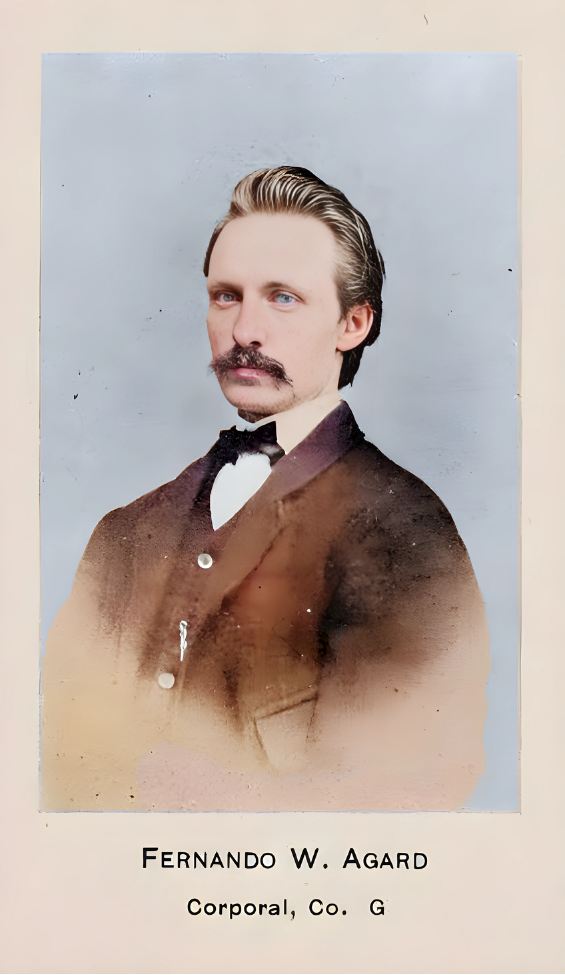
| Type | Name | Company | Rank |
|---|---|---|---|
| Wounded | Lawrence Powers | B | Private |
| Missing | Henry Schroeder | K | Private |
| Killed | Robert H. Sears | A | Sergeant |
| Killed | Calvin A. Shepard | G | Private |
| Wounded | Fernando W. Agard | G | Corporal |
| Wounded | Alphonzo J. Aldrich | F | Sergeant |
| Wounded | George N. Barrell | A | Corporal |
| Wounded | Henry Booher | B | Private |
| Wounded | James R. Bowen | I | Chief Musician |
| Wounded | Charles H. Brooker | A | Private |
| Wounded | David O. Bushnell | G | Private |
| Killed | Laoriston C. Crittenden | D | Sergeant |
| Wounded | George W. Durfee | I | Private |
| Wounded | Sullivan W. Gibson | D | Corporal |
| Killed | John Gothard | I | Private |
| Wounded | Edward P. Hunt | A | Private |
| Wounded | Aaron Lilly | G | Corporal |
| Wounded | Henry N. Schlick | K | Lieutenant |
Sources & Further Reading
- Primary James R. Bowen, Regimental History of the First New York Dragoons (originally the 130th N.Y. Vol. Infantry) (1900), ch. XIV, “With Sheridan in the Shenandoah Valley,” pp. 208–214 — the regiment’s own historian, an eyewitness who was himself wounded in this fight and who drew on the official reports and on comrades’ letters. Note: the printed heading misdates the action “June 11, 1864” (June 11 was Trevilian Station); the surrounding text, Capt. Britton’s and Dr. Kneeland’s recollections, and the regiment’s muster rolls all date it correctly to August 11, 1864. Full text: archive.org/details/regimentalhistor00bowe.
- Primary U.S. War Dept., The War of the Rebellion: Official Records of the Union and Confederate Armies, Series I, Vol. 43 — the reports of Sheridan and Merritt for the Shenandoah Valley operations of August 1864, both quoted by Bowen.
- American Battlefield Trust — Sheridan’s Shenandoah Valley Campaign of 1864 (overview of the August maneuvering that framed the fighting at Newtown): battlefields.org/learn/articles/shenandoah-valley-campaign-1864.
- Historical Marker Database — the Stephens City (Newtown) marker for the August 11, 1864 action: hmdb.org/m.asp?m=41658.
Third Winchester · The Shenandoah Valley Campaign · The Audiobook
Views: 71
Explore the evidence
View this article’s connected sources and media →
About this page
This article was brought over from AlfredGibbs.com. Its preserved text, media and citations remain available for comparison.