
Table of Contents
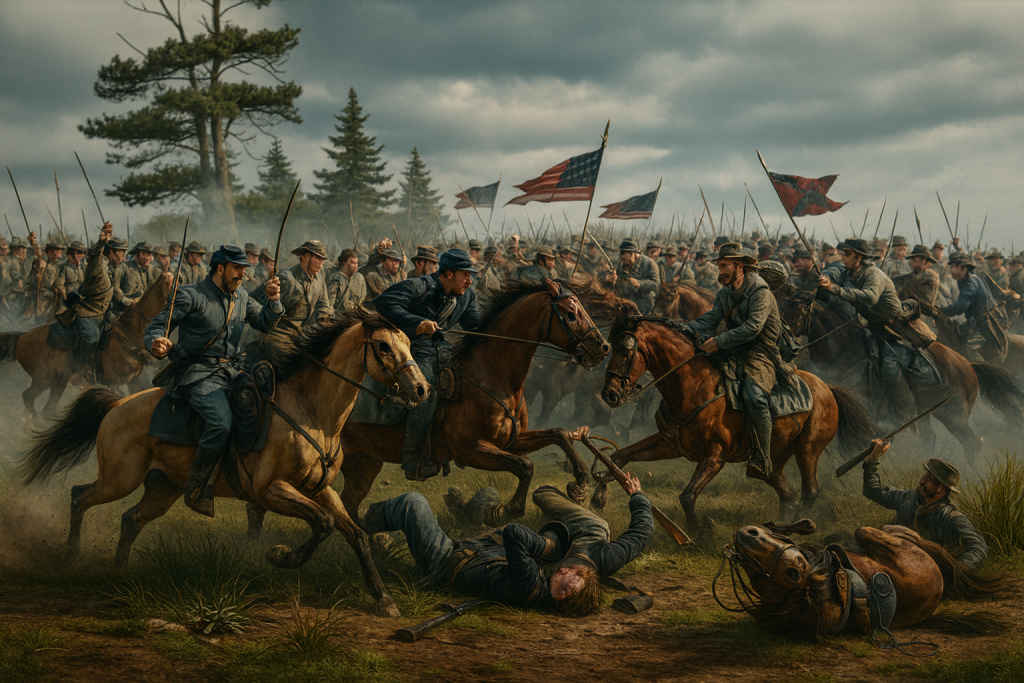
Yellow Tavern, May 11, 1864
The Battle of Yellow Tavern was a significant engagement during the American Civil War, fought on May 11, 1864, in Hanover County, Virginia. This battle became notable for several reasons, not least of which was the mortal wounding of Confederate General J.E.B. Stuart, one of the most famous cavalry commanders of the war. Yellow Tavern marked a decisive Union victory and signaled the decline of the Confederate cavalry’s dominance in the Eastern Theater. The battle was part of Philip Sheridan’s larger cavalry raid, aimed at weakening Confederate forces and disrupting supply lines in the lead-up to the Overland Campaign.
Background: Sheridan’s Raid
In early May 1864, the Army of Northern Virginia and the Army of the Potomac were engaged in a brutal series of confrontations at Spotsylvania Court House, following the bloody Battle of the Wilderness. With both sides entrenched and fighting to a standstill, Union Major General Philip H. Sheridan, commanding the Army of the Potomac’s cavalry, received permission from General Ulysses S. Grant to embark on an ambitious cavalry raid toward Richmond. Sheridan’s objectives were twofold: to draw Stuart’s Confederate cavalry away from Spotsylvania and to disrupt supply lines, communications, and infrastructure essential to the Confederate war effort.
Sheridan’s force consisted of three divisions, commanded by Brigadier Generals Wesley Merritt, David M. Gregg, and James H. Wilson. On May 9, 1864, Sheridan’s men set out southward toward Richmond, moving quickly along the Telegraph Road. Confederate General J.E.B. Stuart learned of Sheridan’s raid and immediately organized a pursuit. Stuart’s force included Fitzhugh Lee’s division, with brigades led by Lunsford Lomax and Williams C. Wickham, as well as James Gordon’s brigade, borrowed from Rooney Lee’s division.
The Battle Begins: Arrival at Yellow Tavern
On May 11, 1864, Stuart’s cavalry caught up with Sheridan near an old, abandoned inn known as Yellow Tavern, located just six miles north of Richmond. Yellow Tavern, once a wayside inn, was now in disrepair, its distinctive yellow siding giving the site its name. Stuart and his men, aware that Sheridan’s Union forces were fast approaching, deployed along the Telegraph Road and the nearby Mountain Road to intercept the Union advance.
Stuart positioned Lomax’s brigade along the Telegraph Road, with Lomax forming a battle line composed of the 6th Virginia Cavalry on the left, the 5th Virginia in the center, and the 15th Virginia on the right. Skirmishers were sent forward to delay the Union forces. Meanwhile, Wickham’s brigade, which had been delayed, was ordered to deploy on a ridge north of Lomax’s position to strike the Union flank. Stuart, confident in his position, expected to make a stand close to Richmond.
At approximately 8:00 a.m., Sheridan’s advance guard, led by Merritt, made contact with Stuart’s forces. Sheridan deployed Thomas Devin’s brigade on the right, Alfred Gibbs’ brigade in the center, and George Custer’s brigade on the left. As Union forces began advancing, Lomax’s Confederates erupted in musket and artillery fire, engaging the Federals in fierce skirmishes. Despite the strong Confederate defense, the Union forces began to gain ground, flanking Lomax’s troops along the Telegraph Road.
Intense Fighting and Stuart’s Mortal Wounding
As the battle intensified, Lomax’s brigade was forced to retreat. The 5th Virginia Cavalry, in particular, faced overwhelming pressure from Custer’s and Gibbs’ Union brigades. In an attempt to cover the Confederate retreat, the 5th Virginia re-formed in the road above their original position, but they were once again driven back by a determined Union assault.
At this critical juncture, Wickham’s brigade finally arrived on the battlefield. Wickham deployed the 1st Virginia Cavalry adjacent to the Telegraph Road, with additional Virginia cavalry regiments extending the line. Wickham’s arrival stabilized the Confederate position, but Sheridan was not deterred. He ordered Custer to lead a mounted charge to seize Griffin’s Baltimore Light Artillery, which had been supporting Wickham’s line.
Around 4:00 p.m., Custer’s 1st Michigan Cavalry stormed up the ridge toward the Confederate guns. As the 1st Michigan advanced, Stuart personally joined the fight, encouraging his men to hold their position. However, tragedy struck when Stuart was mortally wounded by a pistol shot from a dismounted Union trooper. The bullet entered Stuart’s stomach and exited his back, and he was quickly taken from the field. Command of the Confederate forces was handed over to Fitzhugh Lee, but the loss of Stuart dealt a severe blow to Confederate morale.
The Aftermath: A Union Victory
With Stuart incapacitated, the Confederate defense began to falter. Custer, supported by the 7th Michigan Cavalry and the 1st Vermont, continued pressing the attack. The Confederates, outnumbered and outflanked, were eventually forced to retreat. By the end of the day, Sheridan had achieved a tactical victory, pushing the Confederate forces from the field and further weakening their defensive capabilities.
Although Sheridan had successfully defeated Stuart’s cavalry at Yellow Tavern, he chose not to press an assault on Richmond. Instead, he continued his raid, destroying railroads and telegraph lines, while capturing vital Confederate supplies. His decision to avoid attacking Richmond directly was likely influenced by the proximity of Confederate reinforcements and the formidable defenses surrounding the city.
Stuart’s Death and the Decline of Confederate Cavalry
J.E.B. Stuart’s death at Yellow Tavern marked a turning point in the Civil War, as the Confederate cavalry, once the dominant force in the Eastern Theater, lost its most renowned leader. Stuart’s charismatic leadership and tactical brilliance had been key to the Confederate cavalry’s success throughout the war. Without him, the Confederate cavalry would never again operate with the same effectiveness, particularly against Sheridan’s aggressive Union forces.
Stuart was taken by ambulance to Richmond, where he died on May 12, 1864, at the home of his brother-in-law, Dr. Charles Brewer. His final words were said to be a call for his men to do their duty, even in the face of overwhelming odds. His wife, Flora Stuart, mourned her husband for the remainder of her life, and the legacy of J.E.B. Stuart as the ultimate Confederate cavalier became enshrined in Southern memory.
The Lost Battlefield: Modern-Day Yellow Tavern
Today, much of the Yellow Tavern battlefield has been lost to modern development. The construction of Interstate 295 in the 1980s, along with the growth of suburbs and commercial areas around Richmond, has obscured many of the original battle sites. The ground over which Custer’s Michigan cavalry charged and where Stuart was mortally wounded is now occupied by highways, car dealerships, gas stations, and residential neighborhoods.
Despite this, a few traces of the battlefield remain. Portions of the Telegraph Road and the Mountain Road still exist, offering a glimpse of the terrain where Union and Confederate forces clashed on that fateful day. A small monument to Stuart, located near the spot where he was shot, stands as a reminder of the events that unfolded at Yellow Tavern. The monument was unveiled on June 18, 1888, and has since been maintained by the United Daughters of the Confederacy. Stuart’s final moments are commemorated with the words “Fearless and faithful. Pure and powerful. Tender and true.”
Although much of the battlefield has been lost, the memory of Stuart’s final battle remains significant in Civil War history. The battle, while a Union victory, was more consequential for the symbolic death of Stuart than for its direct military outcome. Yellow Tavern marked the end of an era for Confederate cavalry and foreshadowed the eventual collapse of the Southern war effort in Virginia.
The Battle of Yellow Tavern, was a pivotal moment in the Overland Campaign and the Civil War. The battle’s importance lies not only in the tactical victory secured by Sheridan but also in the death of J.E.B. Stuart, a man whose leadership had defined Confederate cavalry operations. Stuart’s fall, combined with the Union’s growing dominance, signaled a shift in the balance of power in the Eastern Theater. Today, although much of the battlefield has been lost, the legacy of Yellow Tavern and the sacrifice of its participants live on through historical markers and monuments, ensuring that the events of May 1864 are not forgotten.
List of Captured, Wounded, Killed, or Deserted at Yellow Tavern, Va., May 11, 1864
| Type | Name | Company | Rank |
|---|---|---|---|
| Wounded | John Burkhardt | B | Private |
| Wounded | Milo C. Grover | G | Sergeant |
| Killed | Lyman R. Hanks | A | Private |
| Wounded | John A. Newville | G | Corporal |
| Wounded | Rufus Scott | Multiple | Major |
Views: 82
Explore the evidence
View this article’s connected sources and media →
About this page
This article was brought over from AlfredGibbs.com. Its preserved text, media and citations remain available for comparison.