
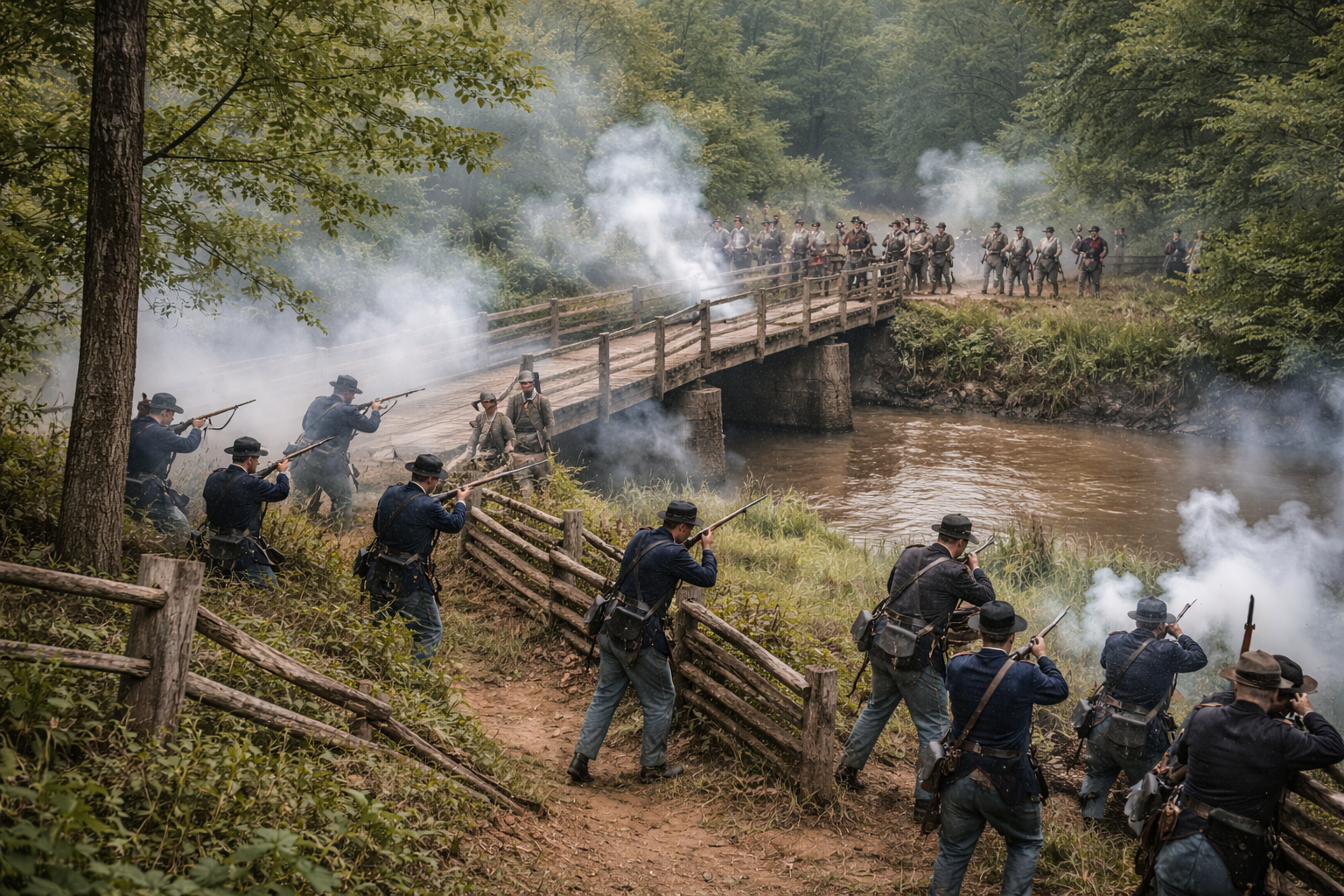
Anderson’s Bridge, May 10, 1864
The action at Anderson’s Bridge, fought on May 10, 1864, was a minor cavalry skirmish that occurred during the Spotsylvania phase of the Overland Campaign of the American Civil War. Though small in scale, the engagement illustrates the increasingly functional role of Union cavalry in 1864, focused less on spectacle and more on reconnaissance, screening, and the control of key terrain.
Context and Location
The skirmish took place near Anderson’s Bridge over the Ny River in Spotsylvania County, Virginia, during a period of intense maneuvering as Union and Confederate forces contested crossings, roads, and avenues of approach south of the Wilderness. At this stage of the campaign, General Ulysses S. Grant was pressing the Army of the Potomac toward Spotsylvania Court House, while Confederate forces under General Robert E. Lee sought to delay and disrupt Union movements through aggressive use of cavalry and terrain (War Department, 1880–1901).
Forces Engaged
The engagement involved Union cavalry elements of the Cavalry Corps, Army of the Potomac, operating under the overall command of Major General Philip H. Sheridan, and Confederate cavalry forces of the Army of Northern Virginia. While senior commanders directed operations across the theater, the fighting at Anderson’s Bridge was conducted at the brigade and regimental level, consistent with the decentralized nature of cavalry actions during the Overland Campaign (War Department, 1880–1901).
The Action at the Bridge
On May 10, Union cavalry units advanced toward the Ny River crossings as part of their broader mission to screen infantry movements and probe Confederate positions. Confederate cavalry contested these efforts, using the bridge and surrounding terrain to delay Union progress. The fighting consisted primarily of dismounted skirmishing, with carbines employed at close range, reflective of the tactical evolution of cavalry warfare by 1864.
Although brief, the engagement was sharp enough to force Confederate cavalry to withdraw from the immediate vicinity of the crossing, allowing Union forces to maintain momentum. As was typical of cavalry skirmishes of this nature, casualties were limited and not comprehensively recorded in surviving reports (War Department, 1880–1901).
Regimental Perspective
James R. Bowen’s Regimental History of the First New York Dragoons provides valuable context for cavalry operations during this period, particularly regarding river crossings and repeated encounters with Confederate cavalry while advancing southward. Bowen describes frequent skirmishing during these movements and emphasizes the importance of securing crossings to prevent delay and confusion within advancing columns (Bowen, 1914). While Bowen does not consistently identify Anderson’s Bridge by name, his account aligns with the documented pattern of cavalry actions along Virginia river lines during early May 1864.
Significance
The action at Anderson’s Bridge did not alter the course of the campaign in a strategic sense, nor was it treated as a standalone battle by contemporary commanders. Its importance lies instead in what it represents: the cumulative effect of small cavalry actions that shaped the operational environment at Spotsylvania. By contesting and securing river crossings, Union cavalry helped preserve the tempo of Grant’s advance and limited Confederate opportunities for surprise or delay.
Final Thoughts
The skirmish at Anderson’s Bridge stands as a representative example of the kind of fighting that characterized much of the Overland Campaign, brief, localized, and tactically focused, yet essential to the larger operational picture. Though modest in scale, such actions underscore the growing effectiveness of Union cavalry in 1864 and their critical role in sustaining pressure on Confederate forces during one of the war’s most grueling campaigns.
References
Bowen, J. R. (1914). Regimental history of the First New York Dragoons. New York, NY: Dalton Press.
Rhea, G. C. (2004). The battle of Spotsylvania Court House and the road to Yellow Tavern, May 7–12, 1864. Baton Rouge, LA: Louisiana State University Press.
War Department. (1880–1901). The War of the Rebellion: A compilation of the official records of the Union and Confederate armies (Series I, Vol. XXXVI, Pt. I). Washington, DC: Government Printing Office.
RESEARCHER’S NOTE: Anderson’s Bridge, as referenced in connection with events of May 10, 1864, refers to a local river crossing over the Ny River in Spotsylvania County, Virginia, and is associated with minor cavalry skirmishing during the Spotsylvania phase of the Overland Campaign. Contemporary military records do not identify this action as a formal battle; rather, it appears within operational reports as part of a series of cavalry engagements involving Union and Confederate forces maneuvering along key river crossings south of the Wilderness.
The engagement at Anderson’s Bridge involved elements of the Union Cavalry Corps, Army of the Potomac, operating within the broader command structure of Major General Philip H. Sheridan, and Confederate cavalry forces of the Army of Northern Virginia. The fighting consisted primarily of brief dismounted skirmishing as Confederate cavalry sought to delay Union movement across the Ny River. Casualties were limited and not comprehensively recorded, consistent with the nature of cavalry actions of this scale.
This Anderson’s Bridge should not be confused with locations associated with Swift Creek, which lies near Petersburg, Virginia, and was the site of a separate engagement on May 9, 1864, during the Bermuda Hundred Campaign involving forces under Major General Benjamin F. Butler and General P.G.T. Beauregard. The two events were geographically, operationally, and command-wise distinct, despite occurring within the same week.
While the skirmish at Anderson’s Bridge did not significantly influence the strategic outcome of the Overland Campaign, it illustrates the cumulative importance of small-scale cavalry actions in shaping movement, timing, and situational awareness during the operations around Spotsylvania Court House in May 1864.
Views: 39
Explore the evidence
View this article’s connected sources and media →
About this page
This article was brought over from AlfredGibbs.com. Its preserved text, media and citations remain available for comparison.