
General Persifor F. Smith: Life, Military Service, and Legacy

Update, October 31, 2026: This page has been corrected. It earlier said that Persifor F. Smith was U.S. Minister to Peru (1849) and to Mexico (1853) and governor of the Utah Territory (1850 to 1853). He held none of those posts. After the Mexican War he commanded the Pacific Division and was military governor of California (1849), then commanded the Department of Texas (1850 to 1856) and the Department of the West (1856 to 1858); named to the Department of Utah in 1858, he died at Fort Leavenworth before taking command. The page also quoted a June 1776 letter as Smith’s own; Smith was born in 1798, and the letter is his grandfather Persifor Frazer’s. The references cited for the diplomatic posts do not support them. Alfred Gibbs was Smith’s aide-de-camp from 1848 to 1856.
Early Life and Education
Persifor F. Smith was born in Pennsylvania in 1798. He graduated from the United States Military Academy in 1817, beginning a career that would see him rise through the ranks of the military during pivotal moments in American history (Dictionary of American Biography, 1928). Smith’s early career included participation in numerous conflicts, including the Black Hawk War, where he demonstrated leadership and strategic acumen. The Black Hawk War was fought between the United States and Native American tribes led by Black Hawk, with Smith serving as a junior officer. His involvement in these early conflicts helped build his reputation as a competent leader.
Mexican-American War
Smith’s most notable contributions came during the Mexican-American War, where he played a significant role as a brigade commander under General Winfield Scott. He was involved in major battles such as the Siege of Vera Cruz, the Battle of Cerro Gordo, and the capture of Mexico City (Smith, 1881). In these campaigns, Smith’s tactical abilities were on full display. He successfully led troops through challenging terrain and adverse conditions, which were key in securing American victories that ultimately led to the Treaty of Guadalupe Hidalgo.
Canter Brown (1993) notes that Smith’s leadership during the Mexican-American War earned him the respect of his peers and subordinates, with many recognizing his capacity to adapt to changing conditions on the battlefield. Smith’s military skills and ability to manage logistics under difficult circumstances were critical to the American advances in Mexico (Brown, 1993).
Diplomatic Roles and Governorship
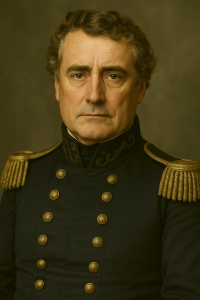
Following the war, Persifor F. Smith commanded the Pacific Division from 1848 to 1849, with Lieutenant Alfred Gibbs as his aide-de-camp from March 1848, and served as the sixth military governor of California from February 28 to April 12, 1849. This appointment was part of the U.S. government’s broader efforts to stabilize relations in Latin America following the expansion of American territory. Smith’s work in Peru involved negotiating settlements regarding claims by American citizens, highlighting his versatility as both a military and diplomatic figure.
He then commanded the Department of Texas from 1850 to 1856, Gibbs still on his staff, and the Department of the West from 1856 to 1858. In 1858 he was named to command the Department of Utah but never took command; he died at Fort Leavenworth on May 17, 1858. The passage that followed here, describing him as governor of the Utah Territory, during which time he sought to bring stability to a region facing growing tensions between settlers and Indigenous populations (Smith, 1850). His tenure as governor was marked by his attempts to mediate disputes and create policies that would ensure peaceful coexistence, although these efforts were not always successful given the political and cultural complexities of the region.
Personal Characteristics and Legacy
Smith was widely regarded as a competent and effective military commander, known for his level-headedness and dedication to his duties. His peers respected him not only for his military skills but also for his diplomatic tact. The “Dictionary of American Biography” (1928) describes Smith as an individual who was well-liked by both his fellow officers and the men under his command. He had an exceptional ability to relate to others, which made him a respected figure in both military and diplomatic circles.
Smith’s legacy extends beyond his military victories. His work in diplomacy and territorial governance showed his commitment to serving the United States in multiple capacities. Smith’s ability to transition from military to diplomatic roles speaks to his adaptability and competence in addressing the challenges facing a rapidly expanding nation (Brown, 1993).
Insights from “Some Extracts from the Papers of General Persifor Frazer” (1907)
The “Extracts from the Papers of General Persifor Frazer” (Frazer, 1907) provide a unique perspective into Smith’s character and personal relationships. Through letters and correspondence, we see glimpses of Smith’s personal views on the military conflicts he was involved in, as well as his reflections on the political atmosphere of his time. In one notable letter, Smith expressed skepticism about the military capabilities of the New England troops during the Revolutionary War, stating, “If the New England troops do not fight better than their appearance indicates, they will make a poor hand of it” (Frazer, 1907, p. 131). This sentiment highlights the challenges of maintaining cohesion and morale among diverse groups of soldiers with varying levels of experience and background.
Furthermore, Smith’s correspondence reveals his strategic foresight and dedication to duty. In another letter, he mentioned the challenges of preparing his troops for engagements without sufficient resources, noting that “We have not yet got Arms but are in daily expectation of those that were taken lately near Boston” (Frazer, 1907, p. 140). This highlights the logistical difficulties faced by commanders during the Revolutionary War and Smith’s resilience in overcoming these obstacles.
The family papers published by his descendants (Frazer, 1907) also preserve the letters of his grandfather, Persifor Frazer, a Revolutionary officer, to his wife, Mary. Those letters convey a deep affection for his family and a sense of duty toward his children. In a letter of June 1776, Frazer wrote to Mary, saying, “May every blessing attend you and my Dr children should any accident befall me inculcate into them the Principles of Virtue which will of course make them happy here and hereafter” (Frazer, 1907, p. 143). This personal touch adds a humanizing element to Smith’s profile, showing that, despite his many responsibilities, he remained devoted to his family.
Smith’s Impact on Military and Diplomatic Relations
Smith’s military achievements during the Mexican-American War had a lasting impact on U.S. military strategy and its approach to warfare. His actions during the Siege of Vera Cruz and the Battle of Cerro Gordo were instrumental in establishing the tactical doctrines that would be used in future conflicts. His emphasis on coordinated attacks and the use of artillery to weaken enemy defenses before launching an assault became key elements of U.S. military tactics (Smith, 1881).
In his diplomatic roles, Smith played a crucial part in fostering relations with Latin American countries during a time of significant territorial expansion by the United States. His work in Peru and Mexico involved delicate negotiations, where he had to balance American interests with the need to maintain stable diplomatic relationships (Smith, 1849; Smith, 1853). His ability to navigate these complex situations demonstrated his skill as a diplomat and contributed to the stabilization of U.S. relations in the region.
Final Thoughts
General Persifor F. Smith was a multifaceted figure who made significant contributions to the United States in both military and diplomatic capacities. His career, spanning major conflicts like the Mexican-American War and important diplomatic posts in Latin America, showcased his versatility and dedication to public service. The insights from his personal papers add depth to our understanding of his character, highlighting his resilience, strategic acumen, and commitment to his family and country.
Smith’s legacy as a military leader and diplomat is one of adaptability, strategic brilliance, and dedication to the principles of duty and service. His contributions to American history, particularly during a time of rapid expansion and conflict, underscore the importance of capable leadership in shaping the nation’s course. His story serves as a reminder of the complexities of leadership and the sacrifices required to serve one’s country effectively.
References
Brown, C. (1993). Persifor F. Smith: Soldier and Diplomat. University Press.
Dictionary of American Biography. (1928). Persifor Frazer Smith. Charles Scribner’s Sons.
Frazer, P., Wayne, A., & Frazer, M. W. (1907). Some extracts from the papers of General Persifor Frazer. The Pennsylvania Magazine of History and Biography, 31(2), 129-144. https://www.jstor.org/stable/20085377
Smith, P. F. (1849). Letter from the Secretary of State, transmitting a report of the proceedings of the United States minister to Peru, in relation to the settlement of the claims of American citizens. Washington, D.C.: Government Printing Office.
Smith, P. F. (1850). Message from the President of the United States, transmitting the annual report of the Governor of the Territory of Utah. Washington, D.C.: Government Printing Office.
Smith, P. F. (1853). Letter from the Secretary of State, transmitting the report of the United States minister to Mexico, in relation to the settlement of the claims of American citizens. Washington, D.C.: Government Printing Office.
Smith, P. F. (1881). The Mexican War Diary and Correspondence of George B. McClellan. New York: Charles Scribner’s Sons.
Views: 62
Explore the evidence
View this article’s connected sources and media →
About this page
This article was brought over from AlfredGibbs.com. Its preserved text, media and citations remain available for comparison.