
Watch · his story, in his own hand
There is a sheet in the Southern Historical Collection at Chapel Hill that carries no letter at all. It is blank but for four words, written in a larger, steadier hand than the rest of the bundle: George D. Benedicts letter. It is a docket, the note a person makes when they are sorting papers that matter and want to know whose they are without unfolding them. It was almost certainly written after his death, and quite possibly by his wife. Sarah kept the letters, with the envelopes he had addressed a hundred times, for the rest of her life. She kept the one that told her not to write again until she heard from him. She kept the one where he weighed himself and found he was heavier than he had ever been. She kept the one where he told their daughter that his life was at stake every day and asked the girl, in the plainest words he ever set down, to be someone who would remember him. And she kept the last one, the letter from a stranger, an Episcopal clergyman she had never met, who had visited her husband twice in a hospital at Fredericksburg and had written to tell her that he loved Christ, that he was comfortable, and that he was severely wounded in the shoulder and back. Her husband was dead eight days before she could have opened it. His own letters could not reach him. He had told her so himself.
We know a great deal about the regiment George Benedict served in. James R. Bowen wrote its history in 1900, thirty-five years after the guns fell silent, a fine and careful book compiled from muster rolls and reunion recollections by men who had lived to grow old and knew how it all came out. Bowen tells you what happened to the First New York Dragoons. He tells you the battles and the marches and the roll of the dead, arranged and settled and understood. What he cannot tell you, because no history written in comfort ever can, is what the war felt like from inside it, on the day, before anyone knew anything. For that you need a man who wrote by candlelight from a picket post on the Rapidan, who did not know that the great battle two hundred miles to the north had been won, who had been told three separate times that Vicksburg had fallen and had trained himself to disbelieve it at the exact moment it became true. You need George Benedict's letters, written at the moment, uncertain, alive. Bowen gives you the regiment's memory. Benedict gives you its pulse. This is a story about the difference, and about the ordinary, faithful, frightened, decent man whose pulse it was.
The man before the letters
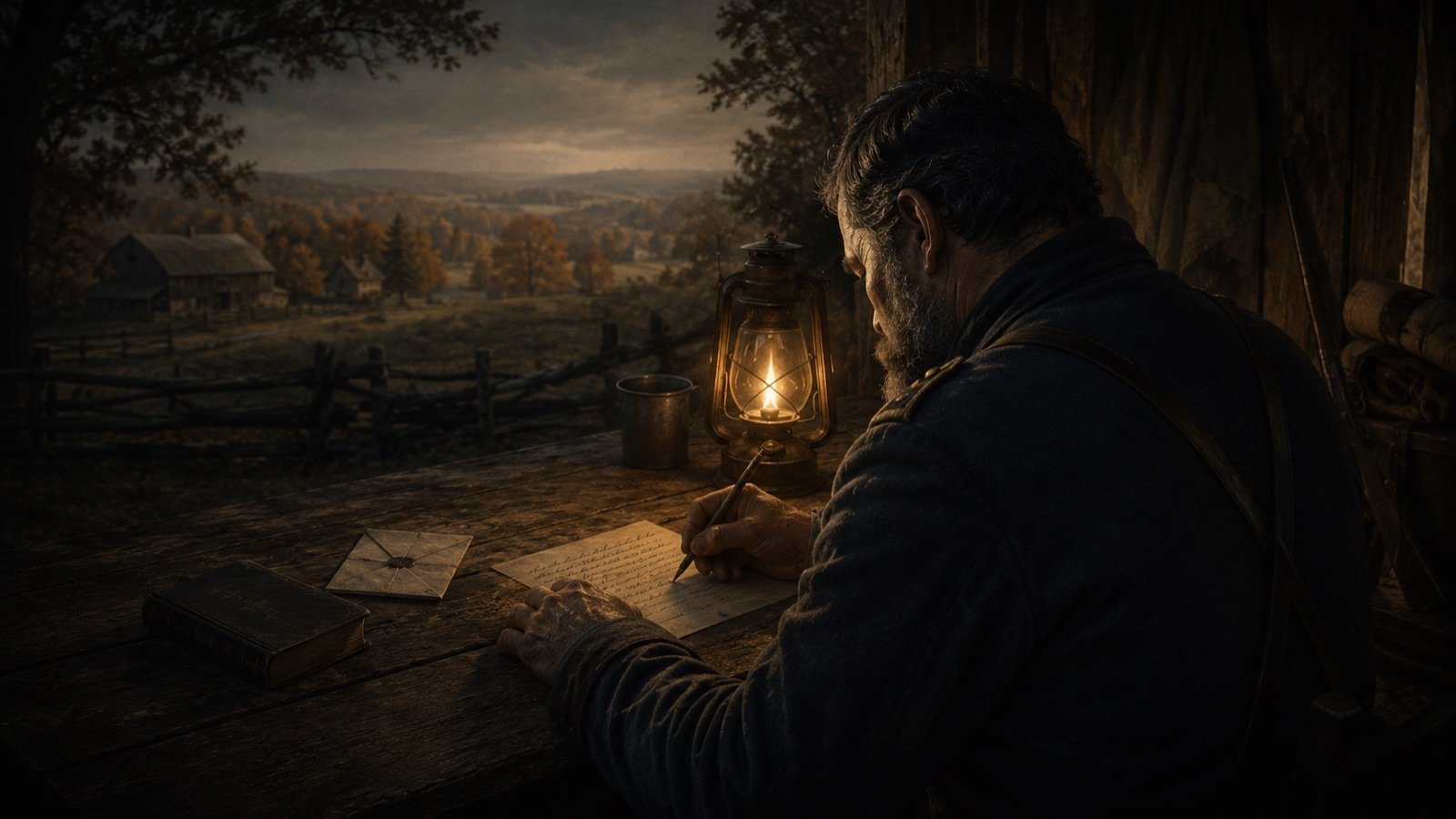
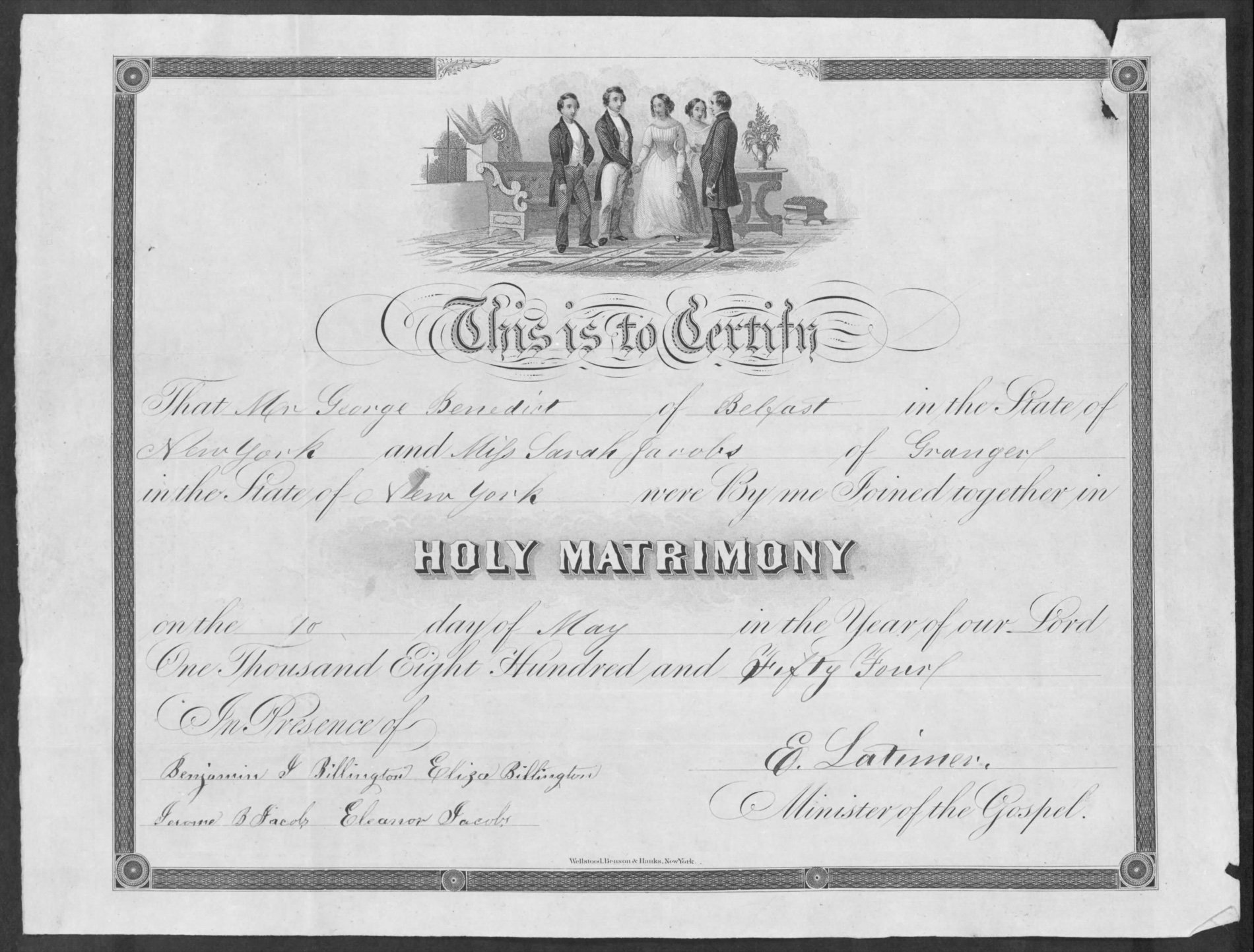
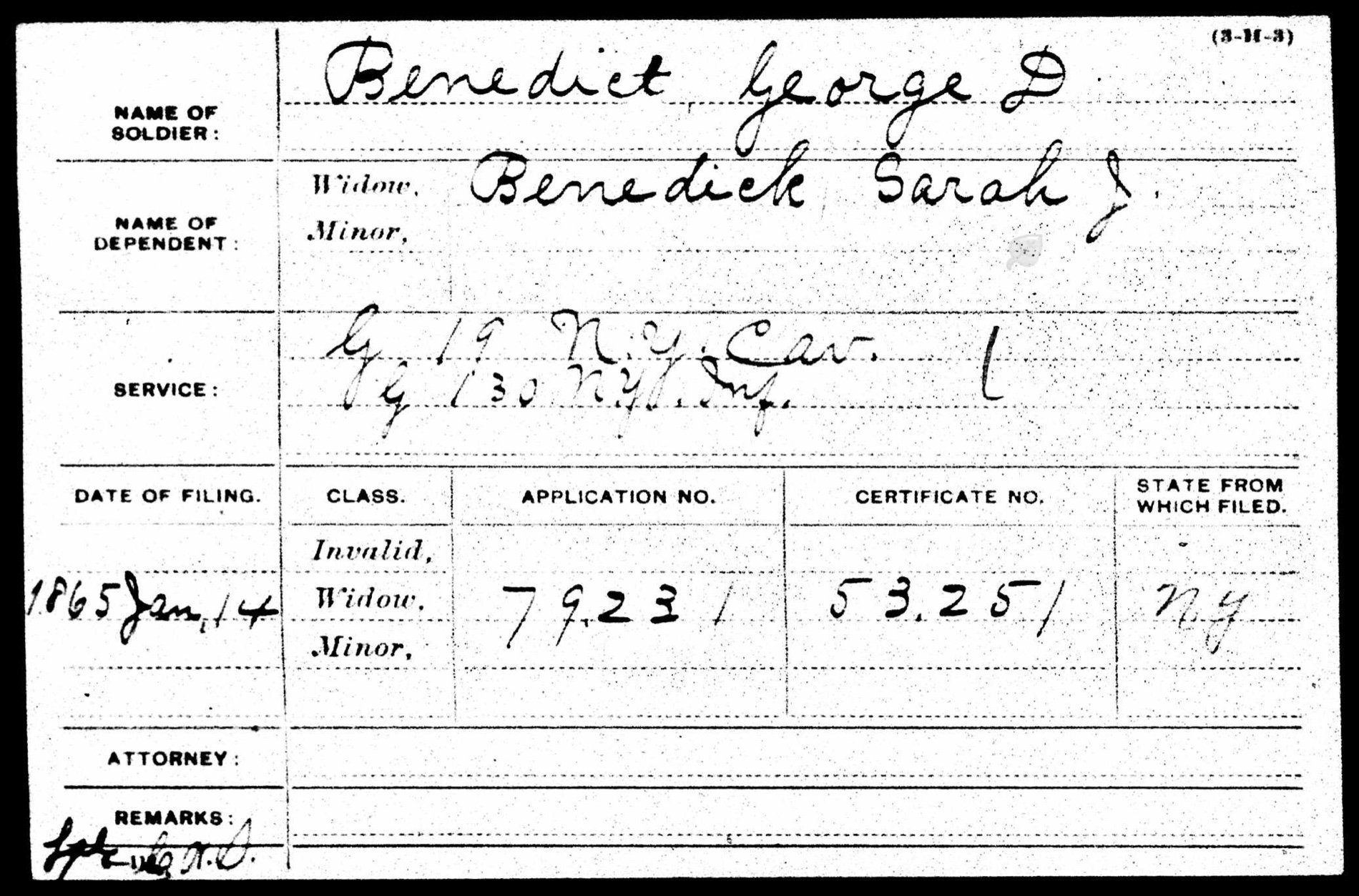
He was forty-two years old when he enlisted, which made him old for a private. Bowen's roster records it plainly: George D. Benedict, aged forty-two, of Amity, mustered into Company G of the 130th New York Volunteers in August 1862. His home was a farm at Belvidere, in Allegany County, up along the Genesee, in that corner of western New York where a handful of villages, Angelica and Belmont and Portage and Belfast, sent their men into the same regiment and then read each other's letters to find out what had become of them. His wife was Sarah A. Benedict. We know her middle initial only because one sheet in the collection carries nothing but her own careful signature, a hand quite unlike her husband's hurried pencil. We can now give her a fuller name than the letters ever do. Her marriage certificate, since recovered, records that she was born Sarah Jacobs, of Granger in Allegany County, and that George Benedict of Belfast married her on the tenth of May, 1854; it is reproduced further on, with the winter letters. [Update, July 2026: this sentence was added after the couple’s marriage certificate was located.] They had a daughter, Arvillia, and Benedict's own mother lived in the household, helping Sarah run the farm and the home while he was gone. He had two brothers, Samuel and Benjamin, who were also in the army, somewhere, and much of the ache in these letters is the ache of three brothers trying to find one another inside a machine that had swallowed half a million men.
No photograph of him survives, but he draws his own portrait without meaning to. In February 1864 he stepped on a scale and reported the result to Sarah with something close to wonder: he weighed a hundred and eighty pounds, twelve pounds heavier than he had ever been in his life. Set that beside the boots he kept ordering from home, large, broad toes, size eleven, and the picture is complete. He was a big, broad-footed, middle-aged farmer who had, of all the strange things the war did to men, grown heavier on army rations than he ever had at Belvidere. Whatever life on the farm had been, it had not been as well fed as a soldier's winter camp.
He spelled by ear, and he knew it. His letters are a phonetic country dialect set down at speed, and he apologized for them more than once. "Sarah I do not know whether you Can read my letter or not," he wrote from Frederick City in July 1863, marching hard with Lee's army twenty miles off, "it is So badly writen, but you must redd what you Can and guess at the rest, for it was done in great hast." When he wrote to his daughter to praise her handwriting, and he did that every single time he wrote to her, he added a warning that tells you everything about the man's honesty with himself: "you must not take patern after me because you have a better Chance to write than I do." A man who spelled sugar three ways in one letter, telling his child not to learn her letters from his.
And he was devout, plainly and without display. He thanks God in nearly every letter that he is alive and well, and he means it as a soldier means it, as a report on a specific danger survived. When Sarah wrote that she was afraid the army would change him, that a camp of twenty thousand men full of drink and cards and blasphemy would lead him astray, he did not dismiss her fear. He answered it. "You need not give yourself uneasiness about my being led astray," he wrote, "for I feel more firm than ever. I never hated Sin worse in my life than I do at the present time, and it is my daily prayer that God will Give me grace to Sustain me while in the army." Then he turned the prayer around and asked the same grace for her. That is the whole of a marriage in four lines, and it is the key to reading everything else he wrote, including his quarrel with the officers who ran his regiment.
Suffolk, and the first fighting he saw
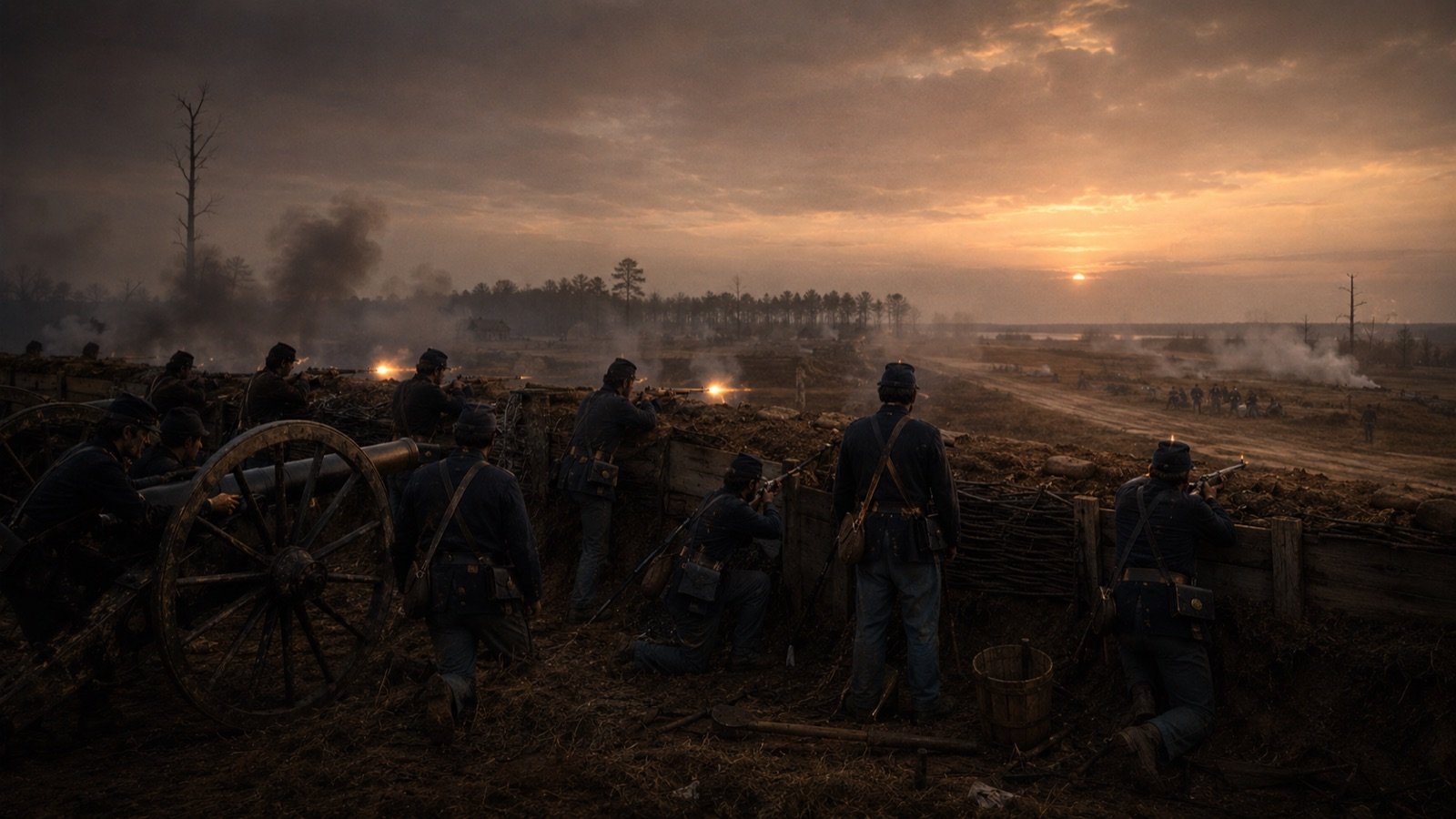
The regiment spent the winter and spring of 1862 and 1863 at Suffolk, in tidewater Virginia, as infantry, garrisoning the town's ring of forts. That spring Longstreet came up and laid siege to it, and it is at Suffolk that the letters begin in earnest, and where Benedict describes the only fighting in the whole collection that he watched with his own eyes.
On the second of May 1863 he saw the 99th New York sent out the Blackwater road to feel for the enemy, and driven back at the double into the rifle pits. He watched the Confederates follow too close and come into range of the guns in the forts, and watched the artillery open on them, in his phrase, "from 4 to 1 with Shell," and slaughter them. His own company was in it: "Co G Stood in the fourt and fired at them." This is eight months before the regiment ever mounted a horse, the men of the 130th New York serving the works of the Suffolk defenses as foot soldiers. Two days later the siege lifted overnight, Longstreet's men gone in the dark to reinforce Lee against Hooker at Chancellorsville, and Benedict recorded the news arriving hour by hour, the empty lines, the prisoners taken, and one small, terrible domestic detail: his own company crossed the river and found the body of a man named Sylvester, buried six inches under the ground, shot in the mouth, and went to take him up and bury him with the rest. He was Private Allington Sylvester of Company G, killed a fortnight before. His brother Christopher served in the same company and lived to muster out.
Most of what Benedict saw at Suffolk was not battle. It was the ordinary texture of a garrison, and he set it down without editorial. The regiment paraded every evening at six in white gloves at the government's expense, boots blacked, arms and clothing inspected. And in the very same breath he noted that nobody was planting a spring crop for twenty miles, because the army had pulled down every fence and burned every building between Suffolk and the Blackwater. He laid the two facts side by side, the white gloves and the burned country, and passed no comment on either.
He could not always pass no comment. The hardest passages in the letters are the ones where he watched what would later be called hard war, a year before Sheridan made it policy in the Shenandoah, and had to decide what he felt about it. On the twenty-third of May he wrote of the troops on the Blackwater burning the Rebels' buildings, killing their cattle, destroying their standing crops, and his verdict was flat approval: "good for that, eny thing to whip them out." Three days later he described the same policy where he could see it, Suffolk itself stripped of its buildings for lumber and quarters, the country around it wasted, and this time he followed the thought to its end: "I think it will be hard worke for the People of Suffolk to live the Coming year, for they are raising nothing to live upon." He did not retract the first sentence. He did not reconcile the two. Both stand in his hand, three days apart, a farmer approving the destruction of other farms and then reckoning what the destruction would cost the families much like his own. That is what the record actually contains, and it is truer than any settled judgment a memoir could offer.
He noticed the contrabands, the period's term for the enslaved people who had freed themselves by reaching Union lines. He noted them working in numbers on the Suffolk fortifications, "good fellows to worke." When the regiment drew fresh soft bread and had more than it could use, he wrote, they gave much of it to the contrabands. He set it down in the same sentence as the dried apples, an ordinary fact of camp. A year later, on the Rapidan, he would write of selling his spare rations to pay for washing and giving the rest to "the poor colored people," to the "great many poor Citizens that come into our lines to git their living." He preserved, without fanfare and without knowing he was preserving anything, the ground-level reality of emancipation and displacement in wartime Virginia, freed and destitute people fed from the surplus of a New York cavalry regiment.
The men in the tent, and the news that traveled by hand
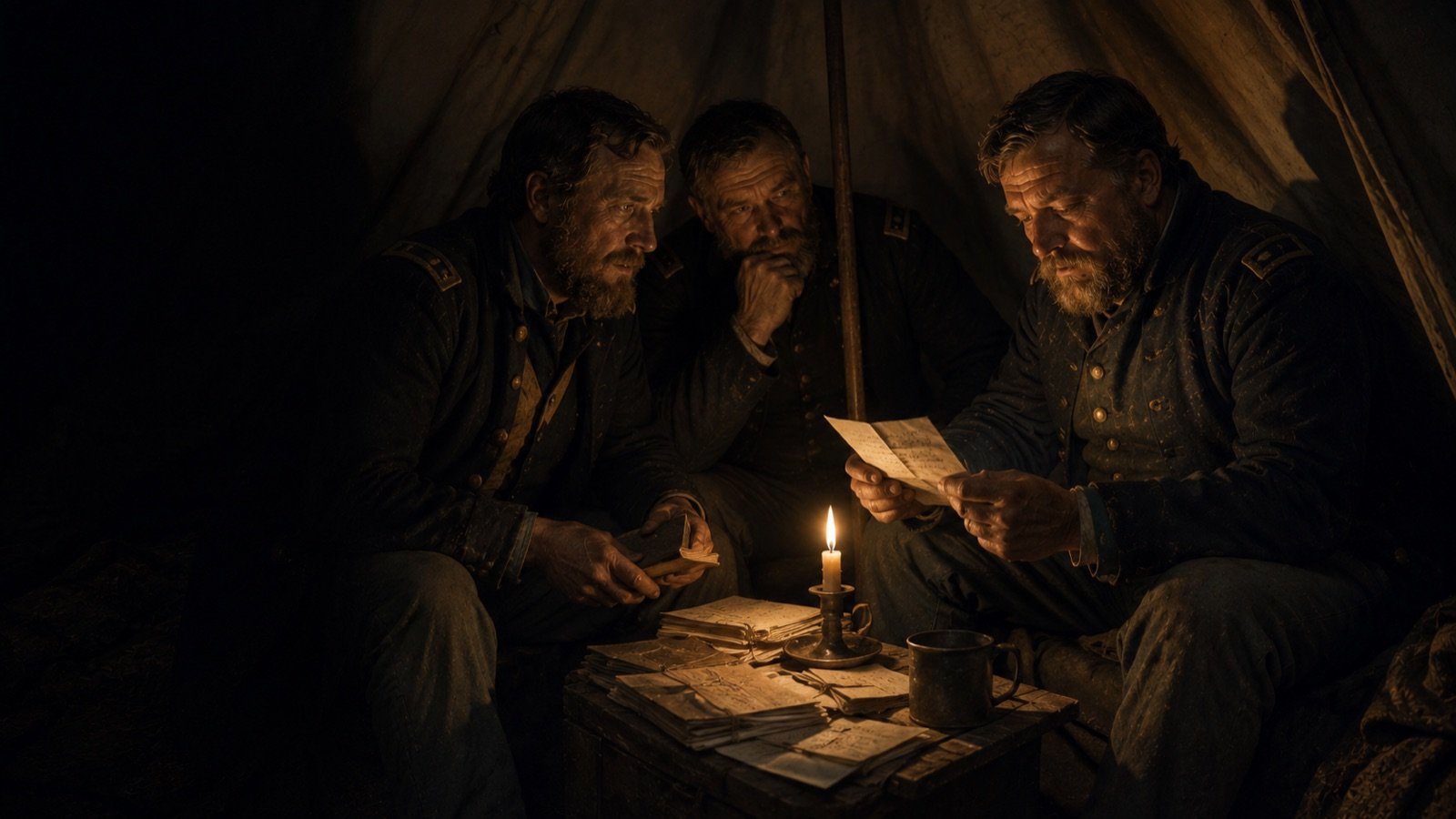
A great deal of a soldier's letter was a casualty report in reverse, a list of the neighbors he had seen alive. Benedict kept that list faithfully, and through it the regiment fills with faces.
His tent mates are the through-line. In the earliest letters he is glad of a change: he is now tenting with "Mr Ames of Angelica and Simeon Bennet of Short tract," and Ames "is a good Christian man," a Close Baptist preacher. He was glad to be rid of the previous man, John Watts of Angelica, whom the Abbey boys wanted gone too, "for he is lazy, and you now I always hated a lazy person." And yet John Watts earns the collection's finest small act of grace. Days after Benedict was glad to be shut of him, Watts walked over to his tent the morning Benedict was going out on picket and gave him a pocket Testament, because he had been given one and already had another. Benedict carried it out on the post, and it "helped pass away the time first rate." He says he is thankful twice in three lines. The lazy tent mate gave the devout old farmer his Bible.
Benjamin Ames the preacher is the constant. Through nine months and a whole campaign, from Suffolk to the winter quarters on the Rapidan, the two shared a tent, and when the regiment settled in for the winter of 1864 Benedict wrote that he tented with Mr Ames of Angelica yet, and probably would for the winter. Of all the men in these letters, Ames is the one who never leaves.
The others come and go through the roll. Sergeant Benjamin Shute of Amity, Benedict's own townsman, was sent down sick to Fortress Monroe in May and never came back to the regiment; Benedict passed on hopeful reports for two months, "he is agiting better I believe," until in August the company commander said flatly that Shute would never be able to rejoin. The roster confirms it: transferred to the Veteran Reserve Corps that November. Bowen's roster records the transfer. It does not record what Benedict's letter records, that Shute carried a wound. "They say he has been troubled with the liver Complaint besides his wound," Benedict wrote, and a comrade's letter home is the only surviving evidence that the man was ever hurt.
There is John J. Adams, the blacksmith of Company H, seen well in May, talked with at length in June about a furlough, left behind at White House Landing in July "poisned Some how, So his fase was Swelled up So he Could not Scarcely See out of his eyes," and turning up again in the autumn safe, at work shoeing the regiment's horses. There is Sergeant Alonzo Barrett of Belmont, and Benjamin Fairchild of Company C, and Corporal Vanderpool of Angelica, discharged for disability, and Edwin Loveland, whom Benedict watched dying of consumption at Warrenton, "he looks very bad indeed," and who did not die at all but mustered out with the company at the end of the war, having outlived the man who wrote his death sentence by two years.
And these letters did not stay private. This is the thing the roster can never show. Sergeant Barrett heard from home that one of his own daughters had read a letter Benedict wrote to Sarah. The letters were carried round the neighborhood, read aloud, passed between families as the only reliable news of what had become of the county's men. When a private near Benedict received a letter from a cousin who had been at Fredericksburg during Chancellorsville, the letter was read aloud in camp and Benedict copied its contents to Sarah the same day, and it was still being passed from hand to hand five days later, the only account of the battle the regiment trusted. When Jay Peckham of the 136th New York, camped a mile and a half off, could not get word to his own father, the word traveled instead in Benedict's letter to Sarah, to be carried down a road in Allegany County by hand. This was the news network of a county at war, and George Benedict's letters were one of its wires.
"We have no Chaplain," and the standing of the men who led them
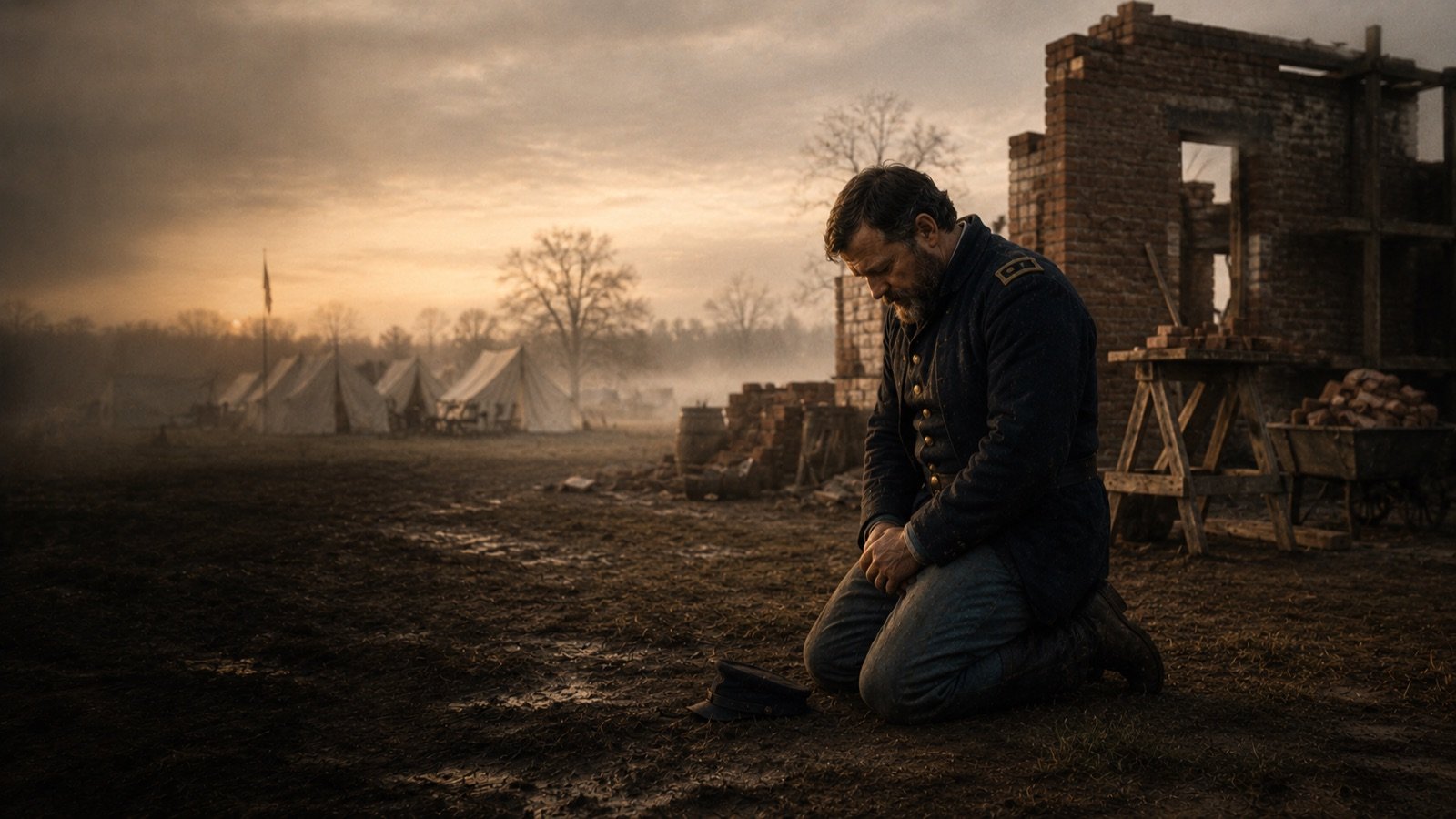
On the eighth of June 1863, laboring on a brick cook room and stealing a few lines whenever he got ahead of the masons, Benedict set down the one thing he had to regret. It is worth quoting entire, because it is the hinge of everything this collection can tell us about the relationship between the men and the officers who commanded them.
"Thare is one thing that I have to regret very much," he wrote, "and that is because we have no Chaplin and no prospect of having any. The leading officers are all apposed to it. They think that a Chaplin would draw the minds of the people from their Military duty. But thanks be to the good Lord we will try to live through it."
Read that slowly. The regiment had no chaplain, and no prospect of one, and the reason was not neglect or oversight. It was policy, set by the regiment's own senior officers, who held as a matter of principle that a chaplain would soften the men, would draw their minds off soldiering. This is a private soldier, a devout Methodist farmer who had written a fortnight earlier that he never hated sin worse in his life, reporting that the leadership of his regiment had decided the men's souls were a distraction from their duty. He does not rage. He records it, and lets it go with the quietest possible dignity: "we will try to live through it."
Hold that against what the letters say about the leading officers themselves. Seven months later, from the Rapidan, the same devout man wrote of Lieutenant Colonel Thorp and the officers around him: "we do not like him at all Because he drinks. The officers most all drink and Gamble, and dont Regard the Sabboth day at all. oh So much evil in the army, the Good Lord have mercy upon us all." That is not a soldier's grudge against one man. It is a religious objection to the manners of an entire officer class, from a man who tented for nine months with a preacher and asked his wife for prayers in nearly every letter. The officers who forbade the regiment a chaplain, in Benedict's telling, were themselves men who drank and gambled and did not keep the Sabbath. The men were to be denied the comfort of religion because it might weaken them, by leaders who denied themselves nothing.
And here is where the letters correct any easy conclusion, and where they become most valuable. Benedict was not a sour man inventing sins to justify a complaint. Look at what Company G did without a chaplain. In February 1864 he wrote, "we had a prayer meeting last knight in our Co and it was good, we Calculate to have them as often as we Can." The men held their own prayer meetings. Denied a chaplain from above, the devout among them simply became the regiment's spiritual life themselves. The faith the officers thought would distract from military duty went on anyway, in the tents, at the ranks, organized by privates and preachers like Ames rather than by any commissioned man.
There is one more turn, and it is the most human of all. On the fifth of July 1863, in a camp on the Virginia Peninsula, a chaplain belonging to some other regiment walked into their lines, handed out little books, sang a hymn, spoke a little, made a prayer, and left. It was the first service the regiment had had, it lasted perhaps half an hour, it was borrowed from another unit. And Benedict, listing the day's blessings, fresh bread and salt pork and fresh beef and sugar and coffee, wrote of the passing chaplain: "the best of all." A man who had been told his prayers were a hindrance to soldiering, given half an hour of a stranger's ministry, called it the best thing that happened to him that day, better than food after weeks of hard crackers and raw pork.
What does all of this say about Alfred Gibbs and the standing of the leadership with the men? It says something careful and true, and it needs the letters to say it, because Bowen's history, written by and for the survivors, would never record a grievance about the men who led them. The men noticed what their officers valued and what they did not. They noticed that their commanders would organize the regiment's mounting, its horses, its drill, its readiness for the field, the machinery of war, and would not organize the one thing the men most wanted for themselves. They noticed the drinking and the gambling at the top while they held prayer meetings at the bottom. And they judged. Benedict's letters are not an indictment of Gibbs, whom he otherwise credits and respects, as we shall see. They are something subtler and more valuable: the daily ledger a devout private kept of where his leaders stood in his esteem, entered as it happened, before anyone had smoothed it into the language of reunion and regimental pride. The men followed their officers into the Wilderness and to Todd's Tavern and to Trevilian Station. They did not, all of them, love them. The letters let us see the difference, which the history cannot.
The summer the whole war moved, and he missed it
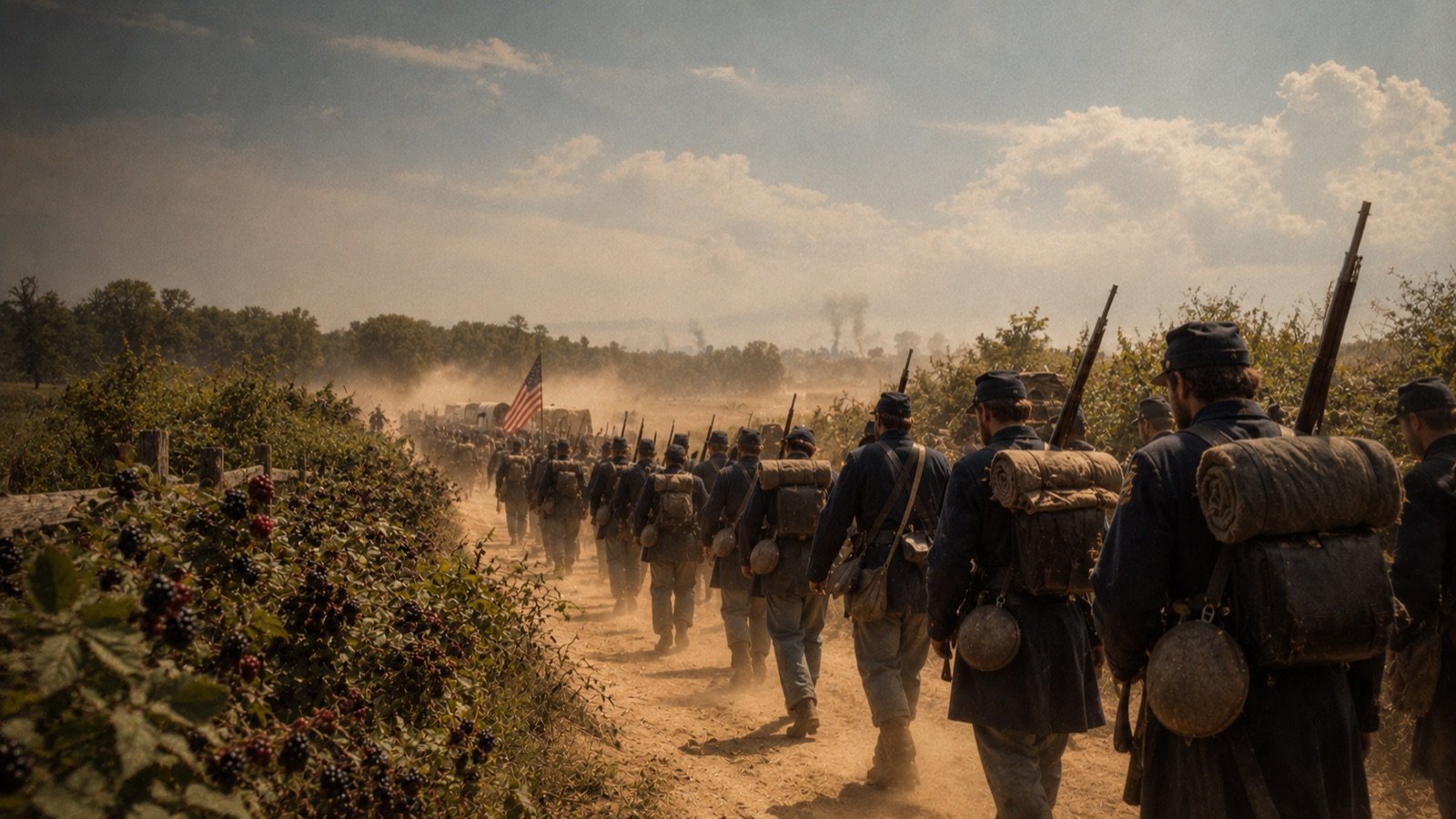
There is no better demonstration of what a soldier actually sees than the summer of 1863, when the war reached its hinge and George Benedict, a soldier in the middle of it, saw almost none of it.
While Lee marched north into Pennsylvania, the Union command pushed what troops it had up the Peninsula toward Richmond, a demonstration meant to hold Confederate strength in Virginia. Benedict's regiment was part of it, and the men who made that march named it themselves, from the ripe berries along every road: the Blackberry Raid. On the third of July 1863, the afternoon that twelve thousand Confederate infantry crossed the open ground at Gettysburg toward Cemetery Ridge, Benedict was two hundred miles to the south, marching fourteen miles from White House Landing, forming line of battle, watching his own artillery shell a Confederate position that did not shell back. The battle that would be remembered as the turning point of the war was fought that day, and the man writing home that evening had no idea it was happening. The next day, the fourth of July, Vicksburg surrendered a thousand miles to the west and Lee began his retreat, and Benedict, four miles from White House Landing, knew of neither, and opened his letter by saying he was thankful he could still take a pen in hand.
When the news did come, it came late and secondhand and mixed in with the day's rations, and, most tellingly, he could not believe it. Three separate times in six weeks he had been told Vicksburg had fallen, once with the added flourish that Grant had been killed. Each time it was false. He had written on the twenty-sixth of May that the men "did not believe the reports" because they had been "So bad disapointed" before. He had trained himself out of believing good news at the precise moment it became true. Only on the fifteenth of July, from Frederick City, did he finally write it as fact without a hedge: "Vicksburg is ours." It is the end of a small, honest arc that runs through five letters, three false reports, a refusal to believe the true one, and at last acceptance.
He gave his wife the finest warning ever written about how to read a soldier's letters. "You take the paper," he told her, "you get war news perhaps more Correct than we do, for we are marching and do not get the news every day." A man at the front telling his wife at home that she was better informed about the war than he was. It is the interpretive key to the whole collection. When Benedict reports that Lee's army is "all Cut to peices," he is repeating camp rumor and stale newspapers, and he is often wrong. When he reports what he saw with his own eyes, he is exact. He even reasoned correctly, from a picket post, about grand strategy: that his own march up the Peninsula "was to draw the Rebs atension so they would not reinfource Lee," which is precisely what it was. And he recorded the news of the New York City draft riots the way it actually reached a soldier in Maryland, two days in, as a rumor of catastrophe: "half of New york City was burnt by the Coper heads in Concequence of drafting." Half the city was not burned. But for a man who had spent a year being shot at while others rioted rather than be drafted, the blame was not neutral.
And in the same summer, without emphasis, he recorded the way most soldiers actually died. The last hard march to the Blackwater, he wrote, was "So very hot dry and dusty" that "thare were 3 or 4 men Sun Struck and died by the road side on the way back." They appear in no battle return. A man of Company D, at Warrenton, gave out on the march, was loaded into a baggage wagon, and the jolting of the wagon over Virginia roads killed him. Benedict did not give his name. Bowen's roster does: Alonzo Hodge of Company D, the only man in the regiment to die at Warrenton, and it disposes of him in two words, "of disease." Benedict tells you what disease means when a private writes it home. It means a man too worn to walk, jolted to death in a wagon, and it means, as Benedict adds and no official record anywhere preserves, that the man "left a Dear wife and one Child."
"It is Colonel Gibbses doings"
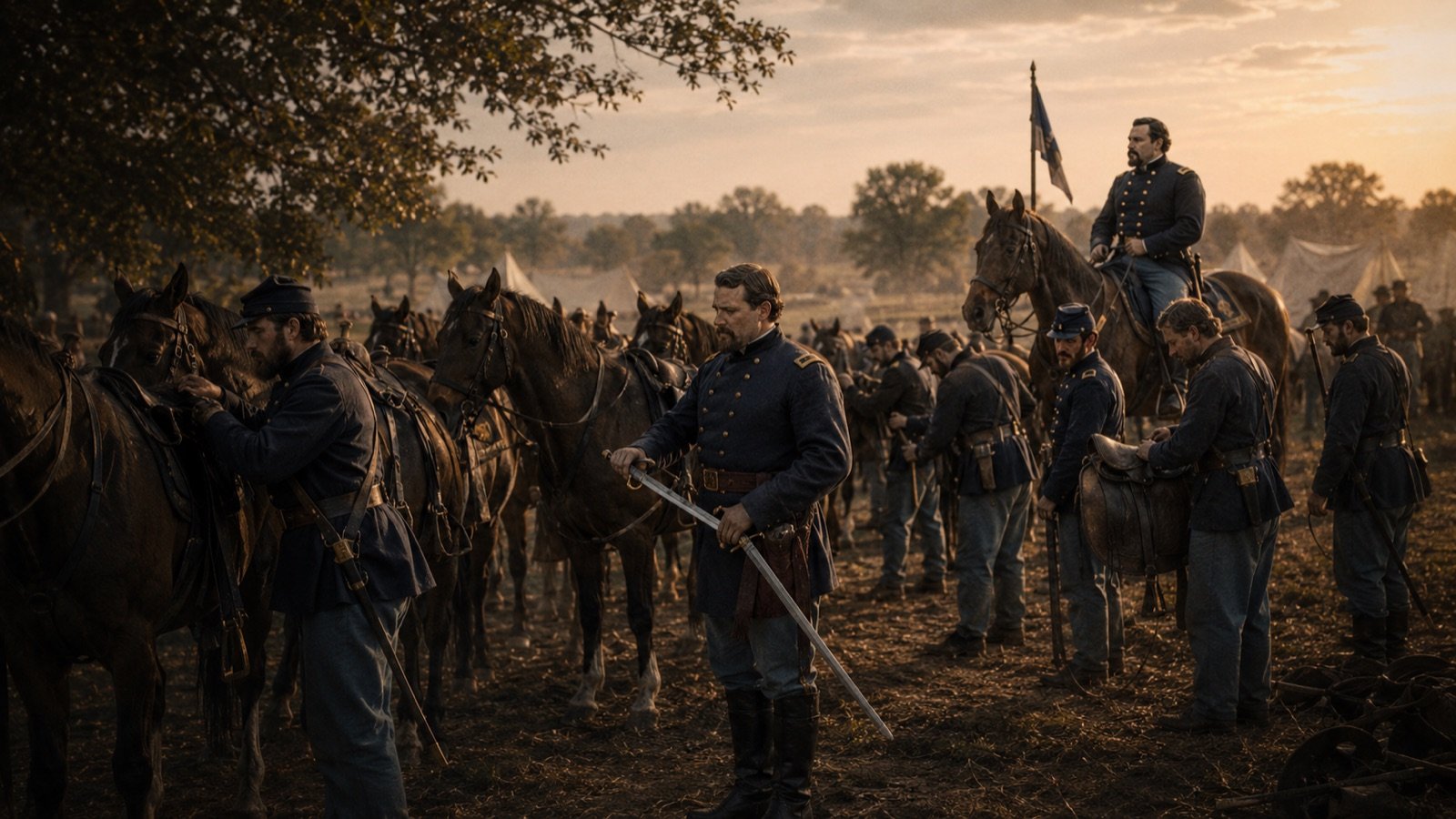
For all his complaint about the officers' manners, Benedict is the reason we can say, from inside the ranks, that the men knew whose achievement the regiment's transformation was.
Through the early summer of 1863 the coming change was only "a Camp Story," that the 130th New York, foot soldiers for a year, were to be given horses. Benedict passed the rumor along in June with a farmer's skepticism. Then, on the thirty-first of July 1863, from Warrenton, he wrote it as settled fact and named the man responsible in six words that no regimental history would ever print: the regiment was going into the cavalry, and "it is Colonel Gibbses doings."
This is corroboration from the ranks for what the War Department paperwork shows on paper, the story this site tells in full under the title of how the 130th New York became the First Dragoons, at Alfred Gibbs's own repeated solicitation. Gibbs wanted his infantry regiment converted to cavalry, applied for it, pressed for it, and got it. What Benedict adds, and what only a private's letter home could add, is that the men themselves knew whose doing it was, weeks before the order was issued, and said so to their wives. They gave the credit where it belonged.
And here is the machinery of it, dated and named. On the eighth of August, camped on the old Bull Run battlefield and formally released from all army duty, Benedict wrote that Lieutenant Colonel Thomas J. Thorp had gone home to New York State with nine men to buy the regiment's horses, to be delivered and paid for at Portage Station. That is a specific, dated, eyewitness account of how the First New York Dragoons got mounted, from a man who watched it happen. Portage Station is the same corner of the Genesee that had sent the regiment its men and its officers. These soldiers were recruited, officered, and remounted out of the same few miles of country.
The last word on the conversion belongs to Benedict, and it is a verdict in Gibbs's favor. In April 1864, after eight months in the saddle, on the eve of the campaign that would kill him, he weighed the change and approved it: "I like Cavelry much beter than Infentry in Some respects. We do not have to go afoot and Carry Such heavy loads. The men are generaly healthier than in Infentry." The man who lived through the transformation Gibbs had fought for thought his colonel had chosen right. That is the balance the letters strike, and it is a fair one. Gibbs's men could dislike the officer class for its drink and its Sabbath-breaking and its ban on chaplains, and in the same breath give the colonel his due for the thing he had built. Both are on the record now, because Benedict put both in the same bundle of letters.
What the book does not hold
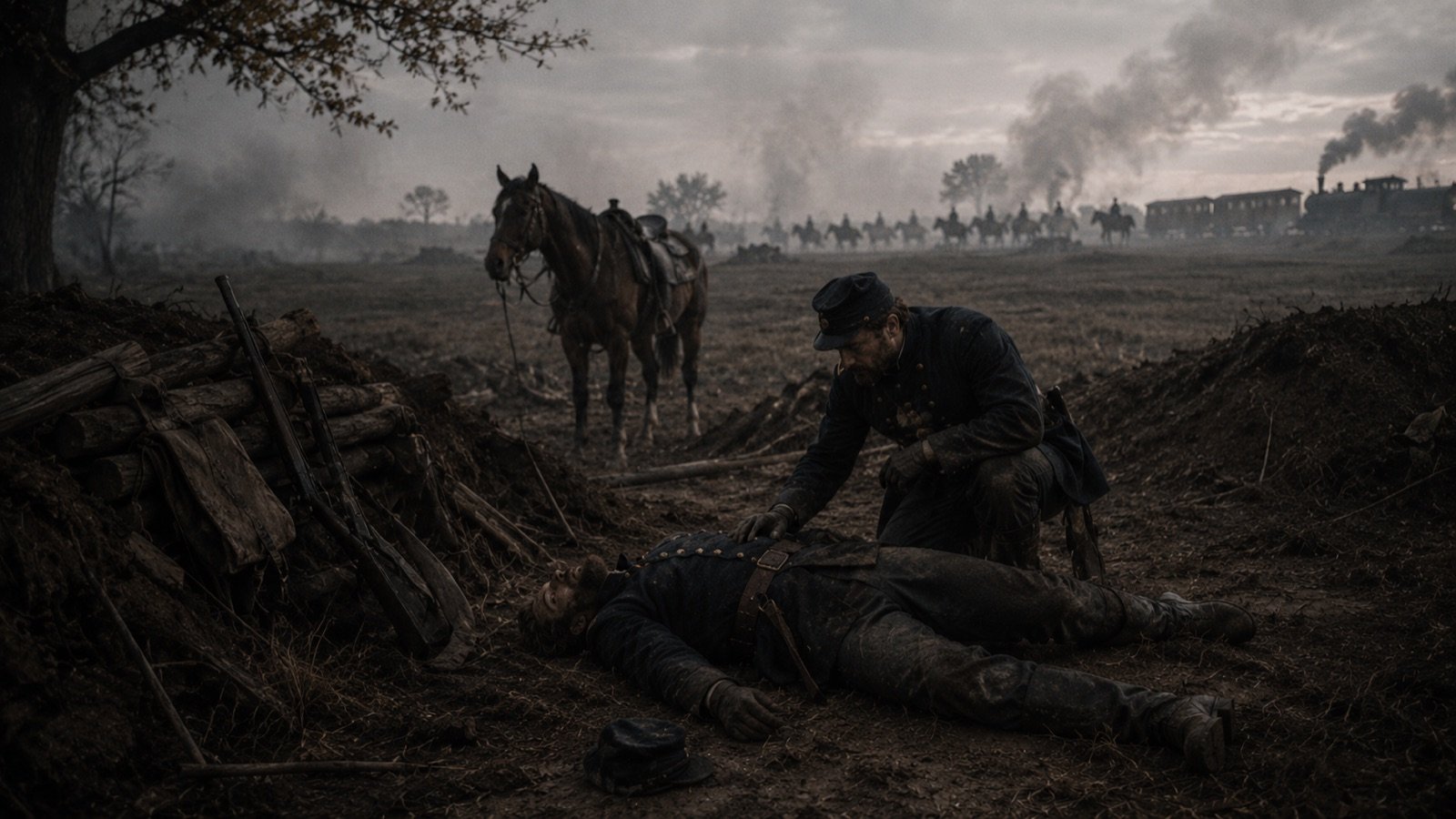
The most important thing these letters do, the thing that justifies reading them beside Bowen at all, is that they hold what the book left out.
Consider the first fighting the regiment ever did as cavalry. In the middle of October 1863, newly mounted, the Reserve Cavalry Brigade under Colonel Gibbs, with his own regiment in the advance, crossed Bull Run in the night, met the enemy on the Plains of Manassas behind old earthworks, charged them, drove them to Bristoe Station, and saved four miles of the Orange and Alexandria Railroad from destruction. That is the printed account, and it is glorious. Benedict, writing on the twenty-third of October in great haste, expecting to move within the hour, gives what it cost: "3 men killed from our Regiment and Some wounded." He could not stop for the particulars. A month later, unhurried, in winter camp, he set the figure down a second time: "3 men killed and Sevral wounded out of our Regiment." Two independent statements, a month apart, from a man who lived among the men who made the charge.
Now open Bowen. His roster, printed in 1900, records no death, no wound, no casualty of any kind anywhere in the regiment dated October 1863. Not one entry among more than fifteen hundred mentions that month. Three men of the First New York Dragoons were killed in the regiment's first action as cavalry, and their names are not in the book that is supposed to hold them. We do not yet know who they were. Until they can be found in other records they are named here only as Benedict named them, three men, killed, in the charge that saved the railroad. If a descendant or a researcher can supply a name, they will each be given a page. That is the whole purpose of a site like this, and it is Benedict's letters, not the regimental history, that told us there was a debt to pay.
Update, 2 November 2026: the three men are named. This essay first said we did not yet know who Benedict’s three dead were, and that paragraph is kept above as it was published. We do now. They are Private Edwin Wight of Company F, eighteen at enlistment, from Centreville, N.Y.; Corporal Thomas Pendergast of Company F, from Hume; and Private Charles Wolf of Company C, from Java. Their entries were in Bowen’s roster all along, each with the full date: “killed, Oct. 17, 1863, at Manassas Junction, Va.” (Wight, p. 455; Pendergast, p. 417) and “killed in action, Oct. 17, 1863, at Manassas Junction, Va.” (Wolf, p. 458). [Correction, 20 November 2026: this note first said that Bowen’s printed lines leave off the year, so that a search for October 1863 could not find them. They do not leave it off; the scans of pp. 417, 455 and 458 print 1863. The yearless wording came from this site’s Killed in Action list, which drops the year from every date.] The New York Adjutant General’s register, reproduced on this site’s full roster, gives each of them the year 1863. The army’s own count agrees: General Wesley Merritt’s list of casualties in the Reserve Brigade “during the engagement at Bull Run, October 17, 1863” shows the First New York Dragoons with three enlisted men killed, one officer and two men wounded, and one missing (Official Records, Ser. I, Vol. 29, Pt. 1, p. 354). Pendergast’s father later swore that his son “was killed at the battle of Manassas Junction the 17th day of October 1863.” The debt Benedict’s letters pointed to has been paid: each of the three has a page.
This is not an isolated case. It is the pattern. Alonzo Hodge is "of disease" in the book and a man jolted to death in a baggage wagon, leaving a wife and child, in the letters. Ben Shute is "transferred to the Veteran Reserve Corps" in the book and a man carrying an unrecorded wound in the letters. The men who died sunstruck by the roadside are in no return at all. This is why the letter written at the moment is a different kind of evidence from the history written in comfort. Bowen tells the truth as the survivors remembered and arranged it, thirty-five years on. Benedict tells the truth as it happened to him, before it could be arranged, and where the two differ it is almost always because Benedict saw a man die whom the paperwork rounded off into a category. The book is the regiment's memory. The letters are its conscience.
The winter, the household, and the girl he governed by pencil
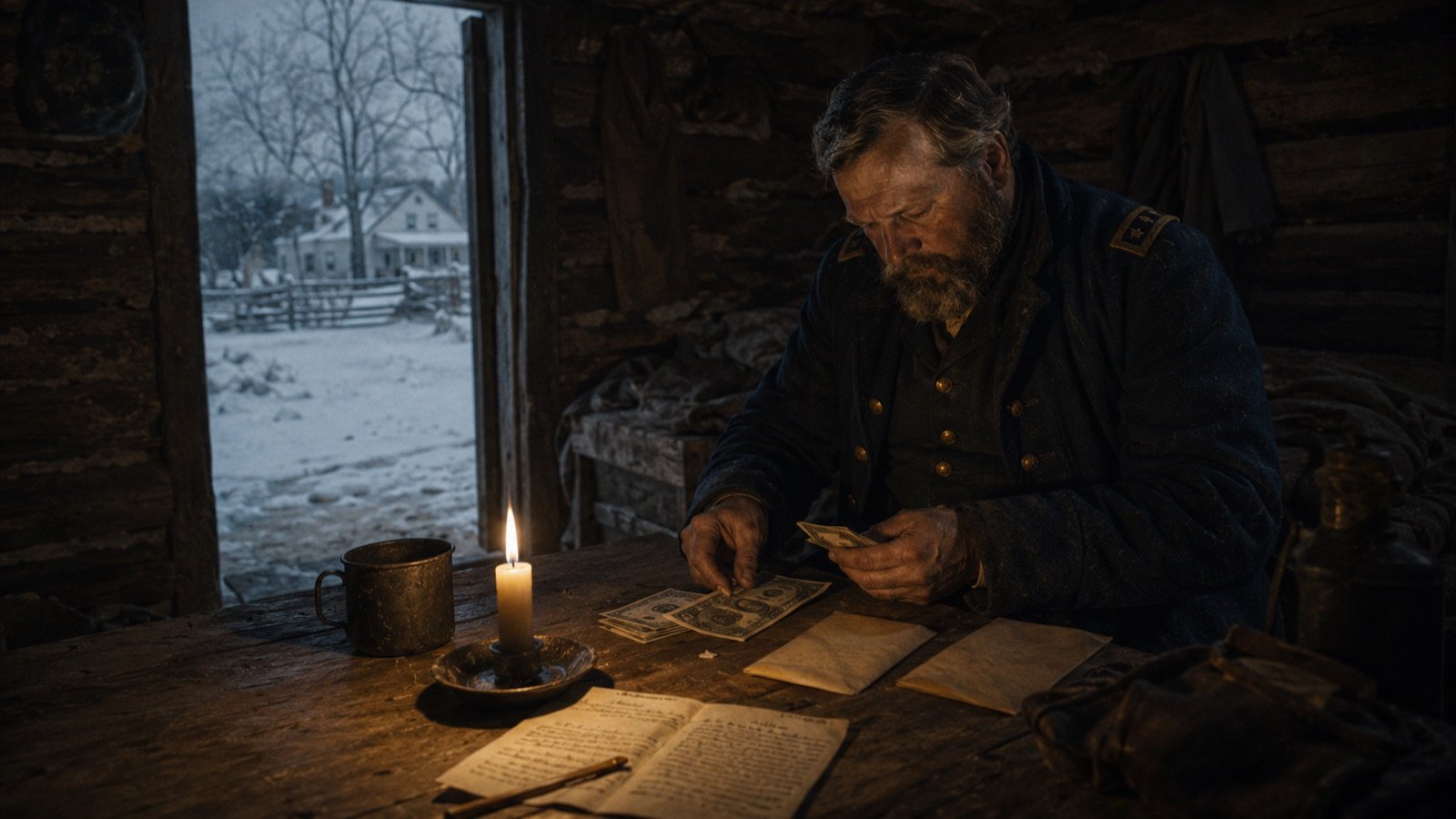
The regiment went into winter quarters on the Rapidan, and the letters turn domestic, and it is in the domestic letters that the man is most fully alive.
He ran his household from three hundred miles away, and the letters are full of the small, exact management of a farm and a family kept together in his absence. He sent his pay home almost entire. A private earned thirteen dollars a month; when Benedict drew twenty-six he would settle two dollars with the sutler and send twenty of the remaining twenty-four to Sarah, keeping four. And he did not trust the mail with it. He split the cash across two envelopes, ten dollars in each, because a man on a private's wage did not gamble a fortnight's pay on the post. He kept the accounts to the cent, and reported them to the wife who would spend them, and worried, always, that she would economize herself into hunger. "Sarah do not go hungry nor bare foot nor destitute of Clothing as long as you have got money." He knew exactly how his wife would behave with twenty dollars, and he wrote to stop her.
He wanted a box from home going into winter, and the request is a portrait: black thread, his razor and shaving brush, "you need not Send the lather box," his vest, a good pair of overall suspenders, and the boots, size eleven, broad toes, because the boots the government issued "are worthless, they rip all to peices" and had left him off duty ten days in January for want of footwear that would keep his feet. And then, having asked, he half took it back, because he could not bear to put her out: "Sarah I do not want you to go to to much trouble." When the box came and the boots fit, a farmer's wife in Allegany County had solved what the United States Army could not. He insisted she pay the carriage at her end and send him the amount so he could send it back. He would not have her out of pocket for his razor.
And he tried to father his daughter by post, in the eleven months he had left. It is rare in soldiers' letters for a man to write directly to a child; most write about their children. Benedict wrote to Arvillia by name, again and again. When she went visiting without telling her mother, he answered it, gently, telling her she was wrong and why, that her mother carried "a greatdeal of Care on her mind now, both in the House and out dores," and that she should get up early, wash, and take hold. When word came that she was keeping late hours and bad company, "old T[a]ylors boys and some others of no beter Caracter," he wrote the sternest thing in the collection, threatening to break up the household, to send his own mother down to Virginia to live with him in camp and leave Arvillia, he said, "to what your own destruction." It is the threat of a man with almost no power, reaching for the one lever he has. And every single time he scolded that girl, he closed by praising her handwriting. "Arvillia, the last letter you rote me you done first rate." Every time.
But the sentence that stays with you, the one that gives this whole collection its weight, he wrote to his daughter on the eighteenth of February 1864. He was not arguing discipline any longer. He wrote one line, the most direct thing he ever set down, and it was not about right and wrong at all: "Arvillia this never will answer. I have to pass through cold and heat, wet and dry, and my life is at Stake every day, and I want you Should remember me." He was not asking her to be good because it was good. He was asking her to be someone who would remember him, because he might not come back. He was killed eleven weeks later.
The picket line that winter had a strange, quiet intimacy that runs all through the last letters. The two armies watched each other across three quarters of a mile of the Rapidan, close enough to see plainly. In April, out on the old line, Benedict watched the enemy across the river with the spring thaw and wrote one of the stillest images in the whole bundle: "the Rebs have just thawed out, thare plenty of them to be seen on the oposite side of the River, now they are fishing all along the bank of the River, and their Pickets are within 30 rods of my post." The men he would be sent to kill in a week's time were close enough to see, and they were fishing. He looked at them and saw not an army but poor men: "they have all sorts of Clothing, I Should think very home Spun by the looks of them." The Confederacy could no longer clothe its soldiers, and a New York private noticed it from a hundred and sixty-five yards.
And in that last spring the brothers found each other. In January he had written that he had "not heard any thing from Brother at Washington yet," and this site could only record the question. In April came the answer, and it is a good one: "who do you suppose Came thare to see me, Brother Samuel." And a few days later, the reunion made whole: "Benjamine, Samuel and myself have all got into the Army of the Potomack, and I hope we Shall See one another often." Three brothers from Belvidere under one army in the spring of 1864, with the peach trees, he noted, in full bloom.
Todd's Tavern
He saw it coming. He had been saying so since February, when he wrote that "the papers and other things indicate a early moove with the army, and I believe thare will be Something done." The something was Grant's Overland Campaign. His last full letter is dated the twenty-seventh of April 1864. In it he described the roadside cost that the cavalry paid and the infantry did not, the horses worked to death, "dead Horses in all directions," and then he wrote the sentence that hangs over everything after it: "the Rebels are a fortifying all the time and a preparing for a great Battle I Suppose." He was right. He signed it, as he had signed so many, "your Husband, Geo. D. Benedict," and told Sarah to direct her next letter as usual. There would be little time for another.
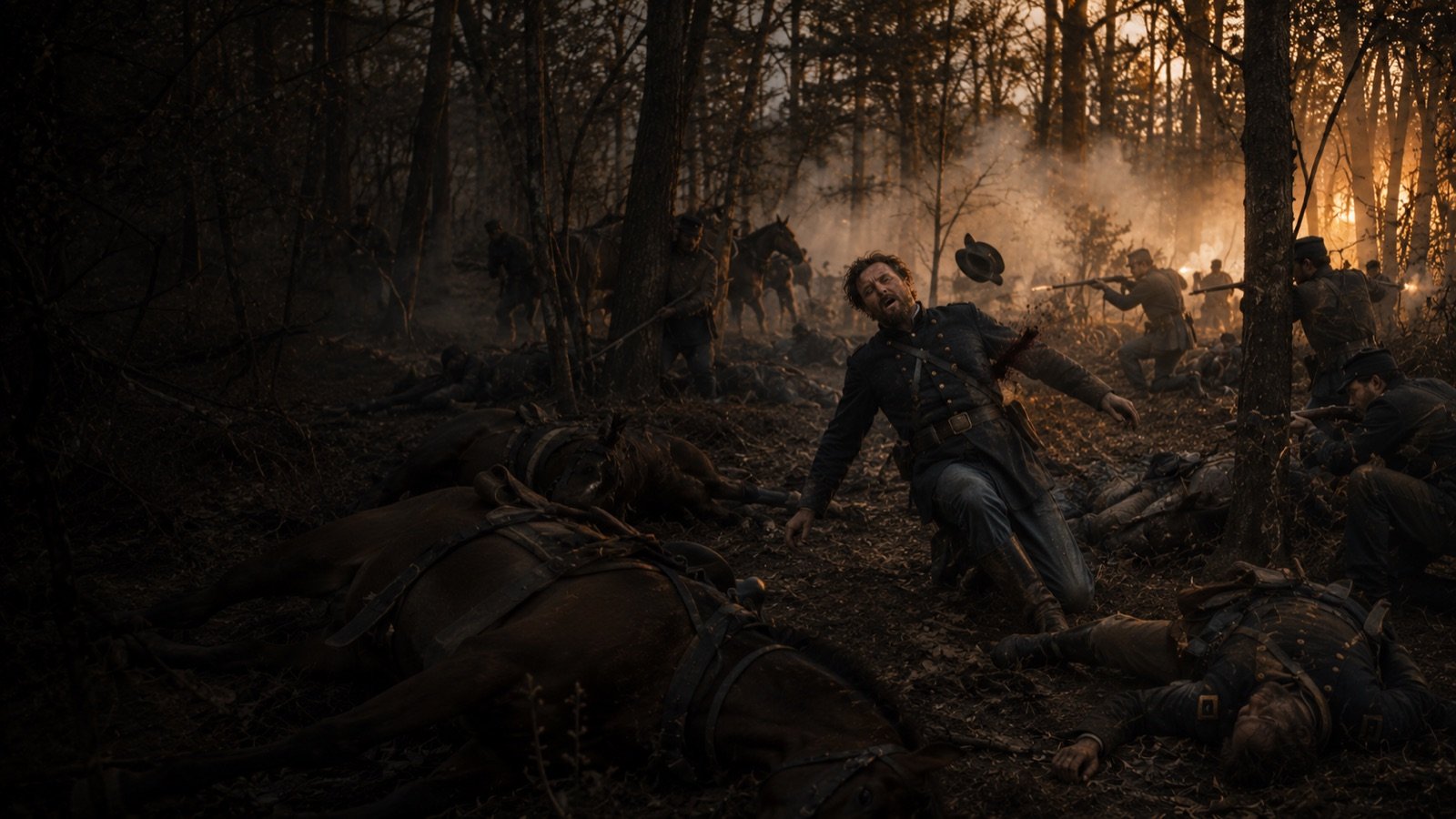
Grant crossed the Rapidan on the fourth of May. The Wilderness opened on the fifth. On the seventh of May 1864, in the cavalry fighting that screened the army's move toward Spotsylvania, at a crossroads called Todd's Tavern, George Benedict was shot. He was carried back to Fredericksburg, which the army had turned into one vast hospital, and laid in a house that had once, tradition said, been occupied by Mary Washington, the mother of George Washington. It stands still. There an Episcopal clergyman from Philadelphia, the Reverend James Hall, a delegate of the United States Christian Commission, the wartime volunteer body that ministered to the sick and wounded, visited him twice.
Remember the chaplain. Benedict's regiment had none, because its officers had forbidden it. And so, at the end, the man who prayed in nearly every letter, who called half an hour of a borrowed chaplain "the best of all," who held prayer meetings in his company because the leadership would not provide the means, was ministered to at his death not by any officer of the First New York Dragoons but by a stranger from a volunteer commission, a clergyman who happened to be passing through the wards. The absence Benedict had noticed and mourned two years earlier closed over him at the last. The Reverend Hall wrote to Sarah on the eighteenth of May, in a hand steadier than her husband's, and told her that her good husband loved Christ, that he had held a service in his ward, that he was comfortable, and that he was severely wounded in the shoulder and back. "Your letters at present cannot reach him," he wrote. It was the plain truth, and it meant more than he knew. George Benedict died of his wound on the twenty-fifth of May 1864, one week after the letter was written, and never came home to the wife and daughter whose letters could not reach him. Bowen's roster, printed thirty-five years later, disposes of him in the language of the book: mustered in as private, Company G, August 1862, wounded May 7, 1864, at Todd's Tavern, died of such wounds, May 25, 1864. Two lines. The letters are the rest of him.
What Sarah kept
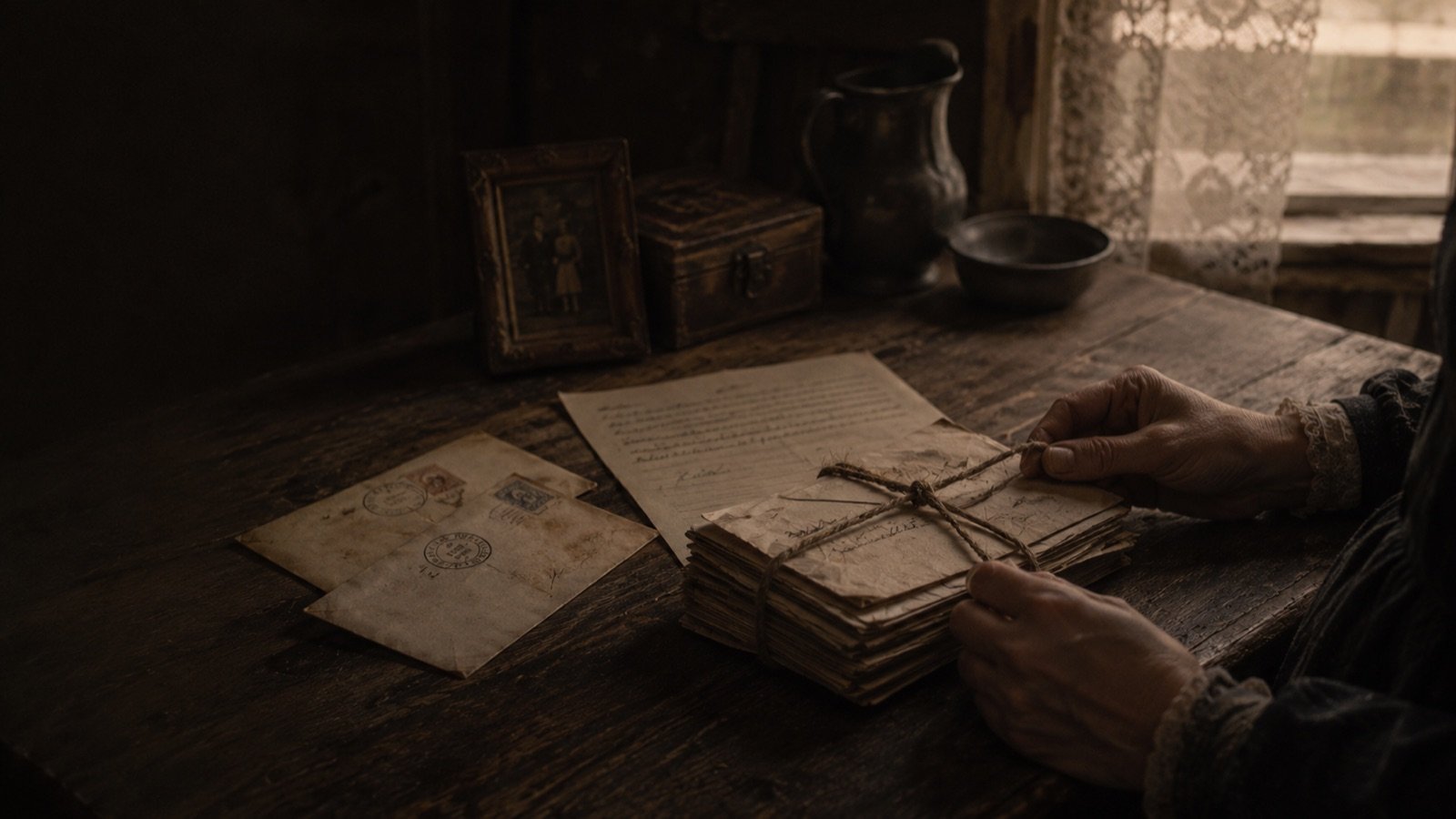
The comfort in the Reverend Hall's letter, that the dying man sent his love, that he loved Christ, that he told the minister Sarah was a blessed good woman, was the last word she would have of her husband alive. And the collection preserves, in another hand entirely, on the flap of a companion cover, the trace of the family that dreaded and waited for the news. It also preserves the docket that opened this story, four words in a later, steadier hand at the foot of one of his letters: George D. Benedicts letter. Someone sorted these papers after he died and marked whose they were. Almost certainly it was Sarah. She kept them. She kept the envelopes he had addressed a hundred times, the one postmarked at Norfolk and the one at Alexandria, the three-cent Washington stamp, the town on the Genesee they had traveled to. She kept the sheet with her own name on it, Sarah A. Benedict, in her careful, even hand. She kept the letters to Arvillia, the scoldings that ended in praise. She kept the one where he weighed himself and marveled. She kept, for the rest of her life, a hundred and more pages of a plain man's plain love, written on his knee, by pencil for want of ink, and apologized for in advance.
This is what the roster cannot hold, and what these letters give back. Bowen's history will tell you that the First New York Dragoons fought at Todd's Tavern in May 1864 and that Private George D. Benedict of Company G died of a wound there. It is true, and it is nothing. It is a line in a ledger. The letters are a forty-two-year-old farmer telling his daughter to be someone who would remember him, and being right to fear he would need her to. They are a devout man mourning that his officers had denied him a chaplain, and holding prayer meetings anyway. They are a soldier who missed Gettysburg by two hundred miles and told his wife she knew more about the war than he did. They are a husband splitting ten dollars across two envelopes so the mail could not lose it all, and a son whose own mother kept his household running, and a brother who found his brothers in the vast machine of an army the spring before he died. They are, in his own words, the record of a man who hoped that "we few that are Spared may be permitted to return to their near and Dear families." He was not spared. But Sarah kept the letters, and the letters kept him, and now, a hundred and sixty years on, they can do for him the one thing the roster never could. They can open the curtain, and let you meet the man.
Read what you can, he told his wife, and guess at the rest. There is very little here to guess at. It is nearly all in his own hand, and it is nearly all true, and it belonged, every word of it, to a decent man from Belvidere who deserved to come home and did not.
Sources

Benedict, G. D. (1863-1864). George D. Benedict Papers (Collection No. 4943-z). Southern Historical Collection, Louis Round Wilson Special Collections Library, University of North Carolina at Chapel Hill. Transcribed in full at https://alfredgibbs.com/private-george-d-benedict/ ; spelling and punctuation are the writer's own.
Bowen, J. R. (1900). Regimental History of the First New York Dragoons (originally the 130th New York Volunteer Infantry). Published by the author.
Hall, J. (1864, May 18). Letter to Mrs. Sarah Benedict, Fredericksburg, Virginia [Manuscript]. In the George D. Benedict Papers, as above.
New York (State) Adjutant-General's Office. (1896). Annual report of the Adjutant-General of the State of New York for the year 1895: Registers of the First Dragoons… in the War of the Rebellion. Wynkoop Hallenbeck Crawford Co.
Explore the evidence
View this article’s connected sources and media →
About this page
This article was brought over from AlfredGibbs.com. Its preserved text, media and citations remain available for comparison.