
History of the 130th Volunteers, or First New York Dragoons
From History of Wyoming County, N.Y. (F. W. Beers & Co., 1880). Reproduced here in full, page by page, from the original.
Page 93
CHAPTER XXIII. HISTORY OF THE 130TH VOLUNTEERS, OR IST NEW YORK DRAGOONS. N the month of July, 1862, the disastrous campaign of General McClellan on the Peninsula culminated at Harrison’s Landing. A gigantic effort had been put forth, and a signal failure was the result. A call was made for men to recruit the depleted ranks of the regiments in the field, and to constitute along with these regiments an army that would be able to check the progress of the Rebellion, retrieve the national prestige, and demonstrate to the world the cohesive force of republican institutions.
The need of a stronger force was recognized, and in response to this call regiments sprang into existence as if by magic. The 130th N. Y. volunteers was organized at this time. It included in its ranks many ofthe best citizens of Wyoming, Allegany and Livingston counties. The governor of New York, at the suggestion of General McClellan, appointed Alfred Gibbs colonel of this regiment. Colonel Gibbs was a classmate with General McClellan at West Point,and he had had the benefit of twenty years ‘ experience in the regular army.
Thomas J. Thorpe and Rufus Scott, who were appointed respectively lieutenant-colonel and major, had fought side by side in the Peninsular campaign, and both had received wounds. Companies A, C and D were from Wyoming county. In point of character and patriotism the men of this regiment were not second to any in the service. Their record of
Page 94
94 C brilliant achievements, untarnished by a single disaster, tells its own story. September 6th, 1862, the regiment left its rendezvous at Portage for the seat of war, followed by the adieus, the cheers, and the ” God speeds ” of a throng of friends who had gathered from all parts of the senatorial district to witness its departure. Its route was over the Northern Central railroad through Pennsylvania. It halted a single night at Washington, and was then pushed at once to the front south of the James river, at Suffolk, Va., where it arrived September 13th.
From this time till January 29th, 1863, the men were occupied with the usual duties of the soldier in an advanced garrisoned position-picket duty, throwing up entrenchments, building corduroy roads, burying the victims of swamp malaria, turning out at midnight for long roll alarm, usually without cause, and occasionally, to relieve the monotony, going on a reconnoisance to the Blackwater, with no other results than blistered feet and swollen limbs. On the night of January 29th, 1863, this monotony was relieved by a genuine sensation; and the regiment received its ” baptism of fire. ” At midnight a large force was turned out for an expedition. It consisted of 3,500 infantry; made up of Corcoran’s brigade, the 130th, and two other regiments, 12 pieces of artillery and Spears’s cavalry in advance.
About 4 o’clock on the morning of the 30th, at Deserted Farm, midway between Suffolk and the Blackwater, this force encountered a rebel advance on Suffolk, under General Roger A. Pryor. His force consisted of about 2,500 infantry, 14 pieces of artillery, and the proper ratio of cavalry. Without halting the column, the Union cavalry by a single dash drove the enemy’s pickets back upon the main body, which was stationed on the far side of an open field one-quarter to one-half a mile in width.
Into this open field on the near side the Union artillery at once debouched and opened fire, with the 130th and the other two regiments of infantry supporting and immediately behind it-Corcoran’s brigade being still further in the rear. For two hours, with the forces thus disposed, the action was made an artillery duel. The cannonade was incessant and terrific. Shot and shell went plowing through the ranks of the infantry in rear of the artillery, with terrible effect.
Colonel Gibbs, a veteran of the Mexican war, ventured to expostulate with Corcoran at the outset against this disposition, and to suggest that the infantry should be posted on the flanks of the artillery, where they would escape the raking fire, and where they could repel an assault upon it, if made. For his temerity in so doing he was put under arrest by Corcoran and his sword taken from him. But the wisdom of his suggestion was soon demonstrated. Corcoran’s own brigade, unused to fire, broke in confusion and disorder, and began a precipitate retreat. He was himself obliged to leave the field and join in the effort to rally them. In this he only partially succeeded.
Meanwhile the fight in front went on without orders or direction. The day was just breaking. Everybody looked the puzzled astonishment that they felt. Were there orders to retreat ? No one knew of any orders of any kind-and yet the last of the artillery was filing by. ” This is a shame! ” began some one. ” This is a shame ! ” echoed all. ” Let’s go on without orders ! let’s charge them! ” The key note had been struck. ” Let’s charge them! let’s charge them! ” went up as from one throat along the whole line. NG COUNTY, NEW YORK.
Everybody knew now just what to do. Quicker than it can be told here, three regiments in line of battle moved out from the edge of the wood and charged across the open field. Who that was there can ever forget it? Who that witnessed it will not always remember the thrilling picture of brave Colonel Gibbs, under arrest as he was, swordless and horseless, seizing the colors and bearing them, like the hero that he was, in front of the regiment throughout the whole of that charge? From that hour his kingdom in the regiment was established.
There had been doubts, almost murmurings, but now and henceforth every man in the regiment was willing to die for him. The enemy broke and ran in confusion, leaving many of theirdead on the field. The 130th was at once deployed as skirmishers, and pushed into the woods beyond, where they soon developed two pieces of artillery and a force of the enemy covering the retreat. They were forcing them steadily back amidst a shower of grape and canister, and were shooting the gunners at their guns, when General Corcoran arrived on the field and recalled them.
After two hours’ delay, in which were gathered up the remaining fragments of Corcoran’s brigade, the pursuit was resumed, but without success, only a small rear guard being overtaken. This engagement established on a firm footing that mutual confidence between officers and men so essential to success. Thereafter each felt that they could depend in any emergency upon the other. In this engagement the regiment lost Captain Taylor, Company C, killed, and about 30 men killed and wounded; among the latter E. M. Jennings, who lost an arm.
Once afterward during the winter the regiment made a reconnoisance to the Blackwater, and engaged in a brisk skirmish across the river, in which it lost two men killed and several wounded. April 3d, 1863, Longstreet in force invested the place. The 130th was stationed on the South Quay road, upon which he approached and upon which his main force operated. April 17th a sortie was made by the 130th and two other regiments, for the purpose of developing the enemy’s strength.
The affair was brilliant and successful beyond expectation. The enemy were driven from their rifle pits and first line of earthworks and compelled to disclose the main body of their forces. The greatest difficulty was experienced by the officers in getting the men to retreat. They were bound to have ” another shot, ” and officers were actually compelled to draw their pistols to force some of them to retreat to save them froin capture. In this sortie Major Scott was struck in his sword arm by a ball which sent his sabre flying some feet distant.
Picking it up with his other hand he went on as though nothing had happened. The loss was only 8 or to killed and wounded. May Ist the siege was abandoned and the 130th regiment joined in the pursuit. June 19th it embarked for the peninsula, and by way of Norfolk reached Yorktown, and at once joined Keyes’s command in the second peninsula advance upon Richmond. The regiment sustained its part in all the minor and insignificant engagements, and on being ordered to join the Army of the Potomac returned to Yorktown July 7th, and proceeded thence by transport to Washington, and thence by rail to Frederick City, Md., which it reached July 13th.
July 19th, by a forced night march, the Army of the Potomac was reached at Berlin, and the Pleasant valley trav
Page 95
THE 120TH AS CAVALRY-ITS RECORD IN THE M At this point the regiment was in changed to cavalry, given the title of Ist N.Y. Dragoons, and ordered into drilling camp at Manassas, Va. Drill was prosecuted incessantly until late in September,when the regiment oc ersed to Warrenton, Va. was mounted, and after a few days’ mounted drill resumed re tw tu active duty. br This was at the time when Meade was falling back from the Rapidan, hotly pursued by Lee.
The first duty of the regiment was a reconnoisance by three companies through Thoroughfare Gap into Pleasant valley, October 12th, to ascertain the truth of the report that a large force of the enemy was advancing through it to repeat the tactics of falling on the Union rear. The reconnoisance pushed through as far as Salem, demonstrating the fact that no force was there. At that point it was recalled and ordered to join the main army near Catlett’s Station, the officer in command to report to General Meade. He was found leaning against a stump near Catlett’s Station, weary, worn and haggard.
When told by the officer, in answer to his inquiries, where he had been and that he found no enemy there, he heaved a sigh of relief, and said: ” You don’t know how much I am obliged to you; it’s a great relief to me. ” During the remainder of the retreat to Centreville the regiment was guarding the approaches on the left flank of the army, and between it and the enemy. After reaching Centreville it recrossed Bull Run, on the evening of October 16th, and engaged in a skirmish on its recent camp ground. On the evening of the 17th of October it again crossed, and on the plains of Manassas, single-handed, charged a rebel brigade of cavalry and drove them near to Bristoe Station, with considerable loss in killed and wounded. It was near sunset when the charge began, and night only put a stop to the pursuit.
The following day the pursuit was resumed, when the destruction of the Orange and Alexandria railroad was discovered, up to the point to which the enemy had been driven the night before. The pursuit continued without further engagement to the Rappahannock. After picketing the line for some time, stationed at Morrisville and Bealton, the regiment, November 8th, moved with the cavalry column rapidly to White Sulphur Springs, crossed the Rappahannock, and pushing rapidly forward attacked the enemy in flank as they were of El Gr af ru fa wa Tw re pu Sp de bi th wi li 10 su fo 9t ve se mo ma re tw pu be th ho se ch ed retreating through Culpepper on the 9th. In this engagement the regiment suffered no loss, though inflicting severe punishment upon the enemy.
The following day Culpepper en was occupied, some captures made and the enemy followed across the Rapidan. Captain Knapp, of Company D, was tu ma in command of the squadron in this raid. Shortly afterward the regiment went into camp beyond and near Culpepper, from which point it made several important reconnoisances, engaging the enemy, in one of which it captured a signal station on the top of Slaughter Mountain, and in another of which it pushed up to within sixty rods of the rebel works at Rapidan Station, and engaged the forces in them, developing their full strength.
November 23d this regiment, with others, moved rapidly down the river, crossed at Ely’sford, occupied the heights beyond and raided the country to and beyond Chancellorsville, covering the operations of Meade at Mine Run. This op position was held until after the withdrawal of Meade. Returning to Culpepper the regiment soon afterward went into winter quarters near Mitchell’s Station, and the followin af ne ju co di su ti th Th an la Ge op THE MINE RUN AND WILDERNESS BATTLES. 95 ing winter was occupied in picketing the Rapidan, with occasional raids. In one of these, with 140 men of the regiment, to Sperryville, on the night of January 10th, 1864, two officers and six men of a Virginia regiment were captured, and a barbarous practice of shooting pickets was broken up.
May 4th, 1864, the regiment started out on the campaign of the war. Pursuing its route of the previous autumn by Ely’sford to Chancellorsville, it passed thence to the left of Grant’s army, engaged in the Wilderness fight, and on the afternoon of May 7th attacked the enemy’s line on a small run beyond Todd’s Tavern, maintaining the contest until far into the night against greatly superior numbers. Twice was the line broken by the desperate efforts of the enemy.
Twice was the front changed and the enemy compelled to relinquish their temporary advantage. Night found them pushed, with great loss, far back into the woods towards Spottsylvania. All night long was spent in burying the dead. In the morning, while yet the fire from belching carbines lit up the darkness, the contest was resumed. Steadily the enemy were forced back until the breastworks, lined with their infantry, were reached.
Here the 5th corps relieved the cavalry, which at once prepared for new work; 104 empty saddles was the result of this engagement. After remaining one day at Aldrich’s Tavern to replenish supplies the Ist Dragoons, with Sheridan’s cavalry, pushed for Lee’s line of communications. On the evening of May 9th, which had been a sultry, dusty day, they were at Beaver Dam Station, where they burned Lee’s supplies, captured several trains of cars, sent cannon balls through the locomotives and destroyed the track.
The next day the column marched towards Richmond. The 1st Dragoons had the rear. General Stuart, with his rebel cavalry, was hovering on the left flank and rear, and twice during the day he charged on the rear, but was repulsed with loss each time. The column encamped at night beyond Squirrel Bridge. At early dawn the next morning an attack was made at the point where the 1st Dragoons was encamped. Leaving horses to be saddled by every fourth man the balance seized their arms and charged the assailants.
Although the charge was irresistible, the enemy were stubborn and yielded ground slowly. Major Scott was wounded in the thigh in this charge. After the enemy had been driven far enough to give the necessary time the regiment hastily returned to its horses, mounted and filed out after the main column just as the enemy again got in range, and opened on them without effect. The casualties in these affairs were always slight. In the afternoon Stuart’s cavalry had reached a point so nearly in advance of the column that they commanded the junction of the old Brock road with that over which the column advanced, near Hungary, or Yellow Tavern. Το dislodge them, the line was formed with the 1st Dragoons supported on either side by regular regiments.
The artillery of the enemy had taken a commanding position, and the plan was formed to swing to the left and envelope it. The 1st Dragoons made an impetuous charge on the enemy, and but for the want of support by the too cautious regulars, would have captured them. In this charge the rebel General Stuart was killed. The result of the fight was the opening of the road to Richmond; but twenty men of the
Page 96
96 C Ist Dragoons did not take it. They had taken the one to eternity. It was near night when the action ended, yet the troops moved on toward Richmond, crossed the Chickahominy by Russel’s bridge, and the command was inside of the first line The command turned to of the defenses of Richmond. the left and moved down the river between the lines. As the day dawned torpedoes began to explode under the tread of the troops, and the advance was soon engaged with the second line of defenses. An effort to recross the river at Meadow Bridge disclosed Stuart’s cavalry on the opposite side, disputing the passage.
With the enemy in large force in front, and the enemy and the river in the rear, the situation was critical. While the attack in front was kept up, a division was massed to force the passage at Meadow Bridge. A hot, dismounted fight for the control of the bridge ended with Sheridan’s troops in possession and occupying the opposite bank. The bridge was repaired, and the 1st Dragoons crossed in advance of the mounted troops, and charged the enemy, who fled in every direction.
The road was thus opened to Mechanicsville, and the 1st Dragoons led in the march thither. At noon pickets were thrown out in all directions during the bivouac for dinner, after which the march in the direction of Cold Harbor was resumed, the brigade to which the 1st was attached taking the lead. The regiment itself was delayed in drawing in its pickets, but it pushed rapidly by the moving column to overtake the advance.
The rattle of musketry was heard in front, and an orderly came in haste with orders for the 1st Dragoons to hurry up, which they did at a gallop. As they came abreast of the battery, which stood in column, they met the balance of the brigade retreating in wild confusion, closely pursued by the exultant foe. The bullets were flying thickly, and the battery seemed to be doomed. As the head of the 1st Dragoons came abreast of the battery, Colonel Thorpe, who was in command, shouted the order, ” Forward into line ! Prepare to fight on foot ! ” They galloped forward into line, and each man numbered for fighting on foot leaped from his saddle as he reached the line, and ran forward, firing as he went. In ten minutes the enemy were in full flight, and fifty prisoners were taken -nearly all of them found behind entrenchments which were thrown up by the enemy during the Peninsula campaign of 1862.
Not a man was lost. After various movements with Sheridan’s command, the Ist Dragoons joined the Army of the Potomac, on its race with Lee to reach Richmond. The regiment wheeled about and took the advance again, and at daylight on the morning of the 26th dashed across the Pamunkey at Hanover Town, and during that and the next day drove the enemy some distance beyond Hawes’s Shop. On the 28th a large rebel force attempted to dislodge this advance by such an impetuous attack that the fight really opened from General Gregg’s headquarters.
Then ensued, during several hours, p m one of the most hotly contested fights of the war. Flanking forces were sent to the right, in the advance of which marched the 1st Dragoons. a They were met with a shower of grape and canister from a battery across a deep and t seemingly impassable gulf. They at once turned it to their advantage by dismounting, sending their horses to the rear, and plunging into it out of harm’s way. It was better than a breastwork, for the guns of the enemy could not be dea t U ING COUNTY, NEW YORK. pressed to reach them, and when they charged up the opposite bank, under Captain Knapp, the rebels quickly took to flight.
They then turned to the left and attacked the remaining force, which fled precipitately, leaving theirdead on the field. On the 30th, at Old Church, a charge by Custer’s brigade and the 1st Dragoons drove the enemy back, with considerable loss, on Cold Harbor, before which the Union forces encamped for the night. The next day the contest was resumed for the possession of that point. During the night the enemy threw up formidable lines of earthworks, and behind them awaited the at tack. In the afternoon the assault was made directly in front, openly, boldly, and with full notice.
The route of the Ist Dragoons was over an open field, billowed with swells and troughs. From cover to cover of these troughs they charged through showers of bullets, halting in each for a fresh start. In that way they reached the last trough, within five rods of the works. There they paused and made extra preparations for the final assault. Every carbine was charged, every muscle was ready for the word. With a shout they ran to the crest and rushed for the works. ‘The contest was terrible.
They pressed to within twenty feet of the rebel line, with ranks constantly becoming thinner. Soon one-third of the line officers had been wounded. It was more than poor human nature could bear. It became evident that the rebel line could never be taken with that force, and doggedly the men fell back to their cover and opened a straggling fire. The general saw the need of the hour. At once was heard on the left the eternal bugle advance ot Custer.
His line swept up with that of the Ist Dragoons; they rose the crest again together and charged. Another fierce but short conflict ensued. Custer had struck the weak point in the rebel line, and doubling it back, he sent a shower of bullets raking down the line in front of the 1st. The fire in front slackened, and the men leaped upon the works as the enemy ran in confusion from them, and the day was won. They had driven Hoke’s division of infantry from their breastworks, and they found that among their prisoners were 300 of the men who captured the 85th N. Y. at Plymouth; 60 of their brave comrades had fallen, but they had gained a victory.
During the next forenoon the 1st Dragoons held the ground against repeated and desperate assaults without the surrender of a foot. At about noon they were relieved by the 6th corps, and moved to near Bottom’s Bridge, where they remained two days. They next went to Old Church, and then to Trevillian Station, where, on the 11th and 12th of June, they were again hotly engaged, and where, in the thick of the fight, Colonel Thorpe was wounded and taken prisoner. Returning, they recrossed the James with the main army, and had some rest until July 26th. On the afternoon of that day, with other cavalry, the regiment crossed the Appomattox at Point of Rocks, marched all night and crossed the James early in the morning at Jones’s Neck, passed around to the right of the infantry on the afternoon of the 27th, and charged a force of the enemy at Darbytown, obtaining possession of the Newmarket road and driving the enemy back for miles.
The following day the rebel division of Wilcox attempted to dislodge the Union force and recover the position. Hawes’s shop was repeated. The enemy gained a temporary advantage, only
Page 97
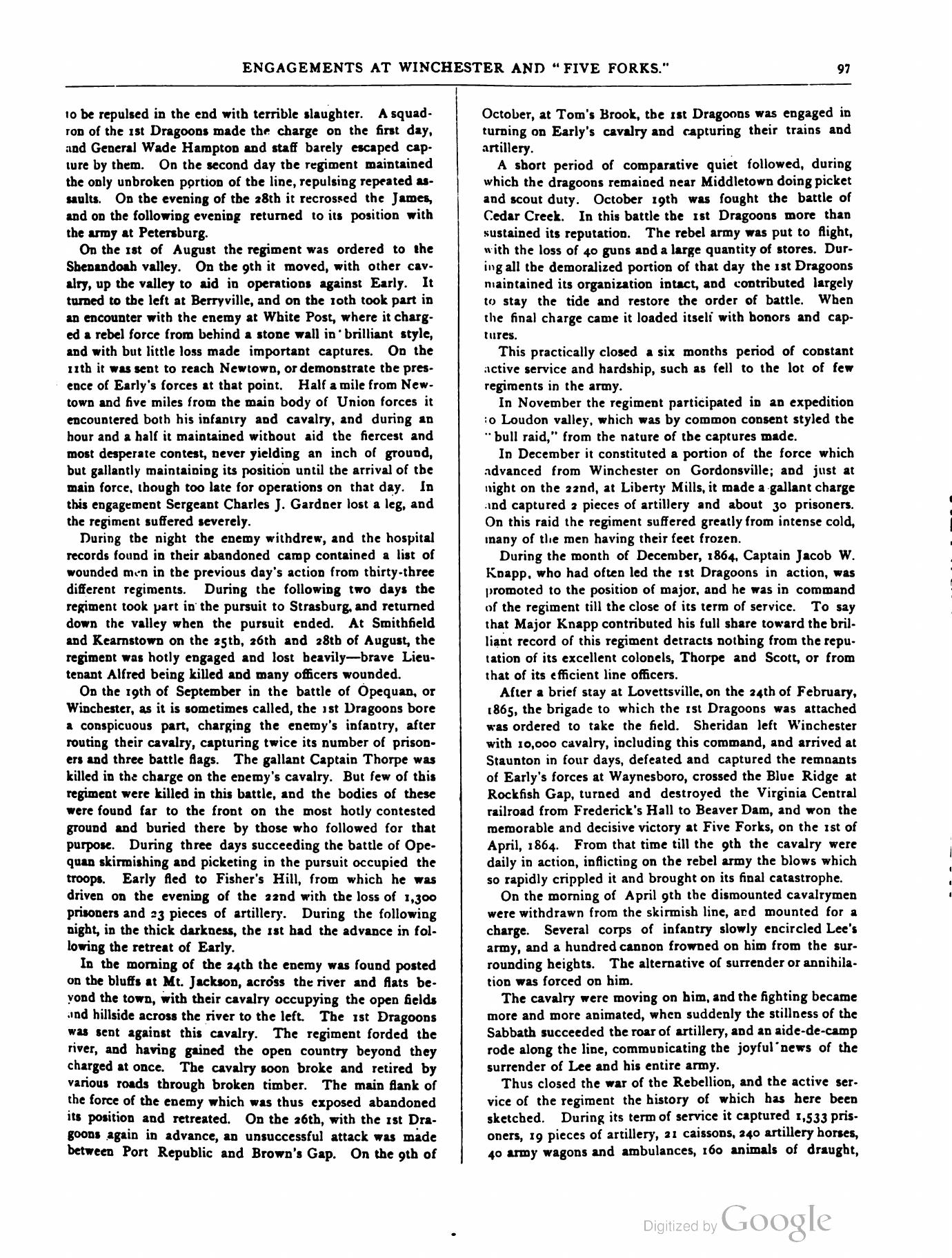
ENGAGEMENTS AT WINCHESTE ron of the 1st Dragoons made the charge on the first day, Oc tu and General Wade Hampton and staff barely escaped capar to be repulsed in the end with terrible slaughter. A squadture by them. On the second day the regiment maintained the only unbroken portion of the line, repulsing repeated assaults. On the evening of the 28th it recrossed the James, and on the following evening returned to its position with the army at Petersburg. On the 1st of August the regiment was ordered to the Shenandoah valley. On the 9th it moved, with other cavalry, up the valley to aid in operations against Early. It w a turned to the left at Berryville, and on the 10th took part in t an encounter with the enemy at White Post, where it chargt ed a rebel force from behind a stone wall in brilliant style, t and with but little loss made important captures. On the Ith it was sent to reach Newtown, or demonstrate the presence of Early’s forces at that point.
Half a mile from Newtown and five miles from the main body of Union forces it encountered both his infantry and cavalry, and during an a hour and a half it maintained without aid the fiercest and ” r most desperate contest, never yielding an inch of ground, but gallantly maintaining its position until the arrival of the main force, though too late for operations on that day. In this engagement Sergeant Charles J. Gardner lost a leg, and the regiment suffered severely.
During the night the enemy withdrew, and the hospital a n a O i records found in their abandoned camp contained a list of wounded men in the previous day’s action from thirty-three different regiments. During the following two days the regiment took part in the pursuit to Strasburg, and returned down the valley when the pursuit ended. At Smithfield and Kearnstown on the 25th, 26th and 28th of August, the l regiment was hotly engaged and lost heavily-brave Lieut tenant Alfred being killed and many officers wounded. t On the 19th of September in the battle of Opequan, or Winchester, as it is sometimes called, the 1st Dragoons bore a conspicuous part, charging the enemy’s infantry, after routing their cavalry, capturing twice its number of prisoners and three battle flags.
The gallant Captain Thorpe was killed in the charge on the enemy’s cavalry. But few of this regiment were killed in this battle, and the bodies of these were found far to the front on the most hotly contested ground and buried there by those who followed for that purpose. During three days succeeding the battle of Opequan skirmishing and picketing in the pursuit occupied the troops. Early fled to Fisher’s Hill, from which he was driven on the evening of the 22nd with the loss of 1,300 prisoners and 23 pieces of artillery.
During the following night, in the thick darkness, the 1st had the advance in following the retreat of Early. In the morning of the 24th the enemy was found posted on the bluffs at Mt. Jackson, across the river and flats beyond the town, with their cavalry occupying the open fields and hillside across the river to the left. The 1st Dragoons was sent against this cavalry. The regiment forded the A a river, and having gained the open country beyond they r charged at once.
The cavalry soon broke and retired by s various roads through broken timber. The main flank of the force of the enemy which was thus exposed abandoned its position and retreated. On the 26th, with the 1st Dragoons again in advance, an unsuccessful attack was made between Port Republic and Brown’s Gap. On the 9th of 4 97 HESTER AND ” FIVE FORKS. ” October, at Tom’s Brook, the 1st Dragoons was engaged in turning on Early’s cavalry and capturing their trains and artillery. A short period of comparative quiet followed, during which the dragoons remained near Middletown doing picket and scout duty.
October 19th was fought the battle of Cedar Creek. In this battle the 1st Dragoons more than sustained its reputation. The rebel army was put to flight, with the loss of 40 guns and a large quantity of stores. Duringall the demoralized portion of that day the 1st Dragoons maintained its organization intact, and contributed largely to stay the tide and restore the order of battle. When the final charge came it loaded itself with honors and captures.
This practically closed a six months period of constant active service and hardship, such as fell to the lot of few regiments in the army. In November the regiment participated in an expedition o Loudon valley, which was by common consent styled the ” bull raid,” from the nature of the captures made. In December it constituted a portion of the force which advanced from Winchester on Gordonsville; and just at night on the 22nd, at Liberty Mills, it made a gallant charge and captured 2 pieces of artillery and about 30 prisoners. On this raid the regiment suffered greatly from intense cold, inany of the men having their feet frozen.
During the month of December, 1864, Captain Jacob W. Knapp, who had often led the 1st Dragoons in action, was promoted to the position of major, and he was in command of the regiment till the close of its term of service. To say that Major Knapp contributed his full share toward the brilliant record of this regiment detracts nothing from the reputation of its excellent colonels, Thorpe and Scott, or from that of its efficient line officers.
After a brief stay at Lovettsville, on the 24th of February, 1865, the brigade to which the 1st Dragoons was attached was ordered to take the field. Sheridan left Winchester with 10,000 cavalry, including this command, and arrived at Staunton in four days, defeated and captured the remnants of Early’s forces at Waynesboro, crossed the Blue Ridge at Rockfish Gap, turned and destroyed the Virginia Central railroad from Frederick’s Hall to Beaver Dam, and won the memorable and decisive victory at Five Forks, on the 1st of April, 1864.
From that time till the 9th the cavalry were daily in action, inflicting on the rebel army the blows which so rapidly crippled it and brought on its final catastrophe. On the morning of April 9th the dismounted cavalrymen were withdrawn from the skirmish line, and mounted for a charge. Several corps of infantry slowly encircled Lee’s army, and a hundred cannon frowned on him from the surrounding heights. The alternative of surrender or annihilation was forced on him.
The cavalry were moving on him, and the fighting became more and more animated, when suddenly the stillness of the Sabbath succeeded the roar of artillery, and an aide-de-camp rode along the line, communicating the joyful news of the surrender of Lee and his entire army. Thus closed the war of the Rebellion, and the active service of the regiment the history of which has here been sketched. During its term of service it captured 1,533 prisoners, 19 pieces of artillery, 21 caissons, 240 artillery horses, 40 army wagons and ambulances, 160 animals of draught,
Page 98
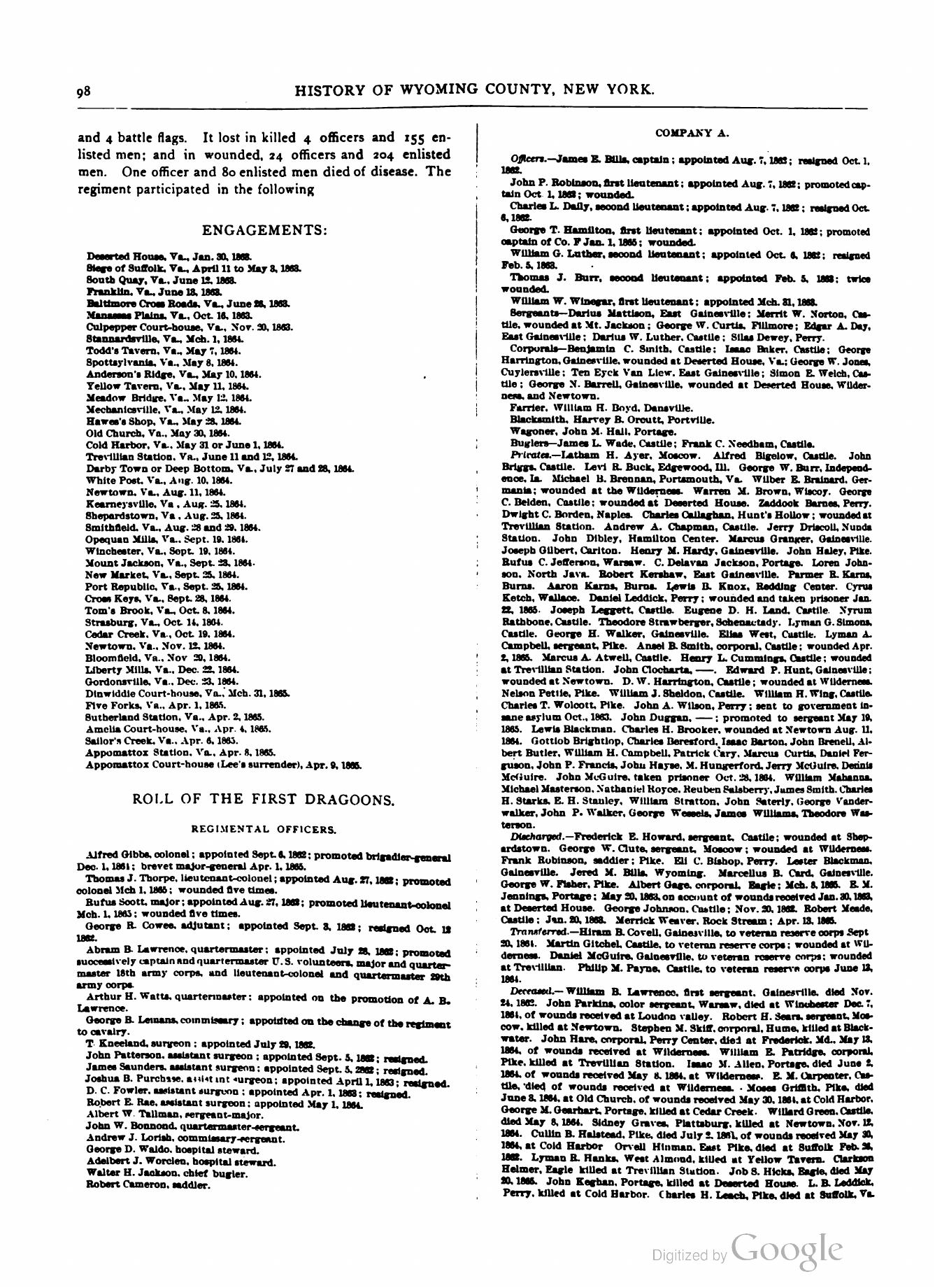
C 98 and 4 battle flags. It lost in killed 4 officers and 155 enlisted men; and in wounded, 24 officers and 204 enlisted men. One officer and 80 enlisted men died of disease. The regiment participated in the following ENGAGEMENTS: Deserted House, Va., Jan. 30, 1863. Siege of Suffolk, Va., April 11 to May 3, 1863. South Quay, Va., June 12, 1863. Franklin. Va., June 13, 1863. Baltimore Cross Roads, Va., June 26, 1863. Manassas Plains, Va., Oct. 16, 1863.
Culpepper Court-house, Va., Nov. 20, 1863. Stannardsville, Va., Mch. 1, 1864. Todd’s Tavern, Va., May 7, 1864. Spottsylvania, Va., May 8, 1864. Anderson’s Ridge, Va., May 10, 1864. Yellow Tavern, Va., May 11, 1864. Meadow Bridge, Va.. May 12, 1864. Mechanicsville, Va., May 12, 1864. Hawes’s Shop, Va., May 28, 1864. Old Church, Va., May 30, 1864. Cold Harbor, Va., May 31 or June1, 1864. Trevillian Station, Va., June 11 and 12, 1864.
Darby Town or Deep Bottom, Va., July 27 and 28, 1884. White Post, Va., Ang. 10, 1884. Newtown, Va., Aug. 11, 1864. Kearneysville, Va, Aug. 25. 1864. Shepardstown, Va. Aug. 25, 1864. Smithfield. Va., Aug. 28 and 29, 1864. Opequan Mills, Va.. Sept. 19. 1864. Winchester, Va., Sept. 19, 1864. Mount Jackson, Va., Sept. 23, 1864. New Market, Va., Sept. 25, 1864. Port Republic, Va., Sept. 25, 1864. Cross Keys, Va., Sept. 28, 1864. Tom’s Brook, Va., Oct. 8. 1884. Strasburg, Va., Oct. 14, 1864.
Cedar Creek, Va., Oct. 19, 1864. Newtown. Va.. Nov. 12. 1864. Bloomfield, Va., Nov 20, 1864. Liberty Mills, Va., Dec. 22, 1864. Gordonsville, Va., Dec. 23. 1864. Dinwiddie Court-house, Va., Mch. 31, 1865. Five Forks, Va., Apr. 1, 1865. Sutherland Station, Va., Apr. 2, 1865. Amelia Court-house, Va., Apr. 4, 1865. Sailor’s Creek, Va.. Apr. 6, 1865. Appomattox Station, Va., Apr. 8, 1865. Appomattox Court-house ( Lee’s surrender), Apr. 9, 1865. ROLL OF THE FIRST DRAGOONS. REGIMENTAL OFFICERS. AlfredGibbs, colonel; appointed Sept. 6, 1862; promoted brigadier-general Dec. 1, 1861; brevet major-general Apr. 1, 1885.
Thomas J. Thorpe, lieutenant-colonel; appointed Aug. 27, 1862; promoted colonel Mch 1, 1865; wounded five times. Rufus Scott, major; appointedAug. 27, 1862; promoted lieutenant-colonel Mch. 1, 1865; wounded five times. George R. Cowee, adjutant; appointed Sept. 3, 1862; resigned Oct. 12 1862. Abram B. Lawrence, quartermaster; appointed July 28, 1862; promoted successively captainand quartermaster U. S. volunteers, major and quartermaster 18th army corps, and lieutenant-colonel and quartermaster 29th army corps.
Arthur H. Watts, quarterinaster; appointed on the promotion of A. B. Lawrence. George B. Leinans, coinmissary; appointed on the change of the regiment to cavalry. T. Kneeland, surgeon; appointed July 29, 1862. John Patterson, assistant surgeon; appointed Sept. 5, 1882; resigned. James Saunders, assistant surgeon; appointed Sept. 5, 2862; resigned. JoshuaB. Purchase, assistant surgeon; appointed April 1, 1883; resigned. D. C. Fowler, assistant surgeon; appointed Apr. 1, 1883; resigned.
Robert E. Rae, assistant surgeon; appointed May 1, 1864. Albert W. Tallman, sergeant-major. John W. Bonnond, quartermaster-sergeant. Andrew J. Lorish, commissary-sergeant. George D. Waldo. hospital steward. Adelbert J. Worclen, hospital steward. Walter H. Jackson, chief bugler. Robert Cameron, saddler.: NG COUNTY, NEW YORK. COMPANY A. Oficers.-James E. Bills, captain; appointedAug. 7, 1862; resigned Oct. 1, 1862. John P. Robinson, first lieutenant; appointed Aug. 7, 1862; promotedcaptain Oct.1, 1882; wounded.
Charles L. Daily, second lieutenant; appointed Aug. 7, 1862; resigned Oct. 6,1862. George T. Hamilton, first lieutenant; appointed Oct. 1, 1862; promoted captain of Co. F Jan. 1, 1865; wounded. William G. Luther, second lieutenant; appointed Oct. 6. 1862; resigned Feb. 5, 1863. Thomas J. Burr, second lieutenant; appointed Feb. 5, 1863; twice wounded. William W. Winegar, first lieutenant; appointed Mch. 31, 1883. Sergeants-Darius Mattison, East Gainesville: Merrit W. Norton, Castile, wounded at Mt. Jackson; George W. Curtis, Fillmore; Edgar A. Day, East Gainesville; Darius W. Luther, Castile; Silas Dewey, Perry. Corporals-Benjamin C. Sinith, Castile: Isaac Baker, Castile; George Harrington, Gainesviile, wounded at Deserted House, Va.; George W. Jones, Cuylersville: Ten Eyck Van Liew.
East Gainesville; Simon E. Welch, Castile: George N. Barrell, Gainesville, wounded at Deserted House, Wilderness, and Newtown. Farrier, William H. Boyd, Dansville. Blacksmith, Harvey B. Orcutt, Portville. Wagoner, John M. Hall, Portage. Buglers-James L. Wade, Castile; Frank C. Needham, Castile. Prirates.- Latham H. Ayer, Moscow. Alfred Bigelow, Castile. John Briggs. Castile. Levi R. Buck, Edgewood, Ill. George W. Burr, Independence, Ia.
Michael B. Brennan, Portsmouth, Va. Wilber E. Brainard, Germania; wounded at the Wilderness. Warren M. Brown, Wiscoy. George C. Belden, Castile; wounded at Deserted House. Zaddock Barnes, Perry. Dwight C. Borden, Naples. Charles Callaghan, Hunt’s Hollow; wounded at Trevillian Station. Andrew A. Chapman, Castile. Jerry Driscoll, Nunda Station. John Dibley, Hamilton Center. Marcus Granger, Gainesville. Joseph Gilbert, Cariton.
Henry M. Hardy, Gainesville. John Haley, Pike. Rufus C. Jefferson, Warsaw. C. Delavan Jackson, Portage. Loren Johnson. North Java. Robert Kershaw, East Gainesville. Parmer R. Karns, Burns. Aaron Karns, Burns. Lewis B. Knox, Redding Center. Cyrus Ketch, Wallace. Daniel Leddick, Perry; wounded and taken prisoner Jan. 22, 1865. Joseph Leggett, Castile. Eugene D. H. Land, Castile. Nyrum Rathbone, Castile. Theodore Strawberger, Schenactady.
Lyman G. Simons, Castile. George H. Walker, Gainesville. Elias West, Custile. Lyman A. Campbell, sergeant, Pike. Ansel B. Smith, corporal, Castile; woundedApr. 2, 1865. Marcus A. Atwell, Castile. Henry L. Cummings, Castile; wounded at Trevillian Station. John Clocharta,. Edward P. Hunt, Gainesville; wounded at Newtown. D. W. Harrington, Castile; wounded at Wilderness. Nelson Pettie, Pike. William J. Sheldon, Castile. William H. Wing, Castile.
Charles T. Wolcott, Pike. John A. Wilson, Perry; sent to government insane asylum Oct., 1863. John Duggan, -; promoted to sergeant May 19, 1865. Lewis Blackman. Charles H. Brooker, wounded at Newtown Aug. 11, 1884. Gottlob Brightlop, Charles Beresford, Isaac Barton, John Brenell, Albert Butler, William H. Campbell, Patrick Cary, Marcus Curtis, Daniel Ferguson, John P. Francis, John Hayse, M. Hungerford, Jerry McGuire.
Derinis McGuire. John McGuire, taken prisoner Oct. 28, 1804. William Mahanna, Michael Masterson, Nathaniel Royce, Reuben Salsberry, James Smith. Charles H. Starks, E. H. Stanley, William Stratton, John Saterly, George Vanderwalker, John P. Walker, George Wessels, James Williams, Theodore Wasterson. Discharged.- Frederick E. Howard, sergeant, Castile; wounded at Shepardstown. George W. Clute, sergeant, Moscow; wounded at Wilderness.
Frank Robinson, saddler: Pike. Eli C. Bishop, Perry. Lester Blackman, Gainesville. Jered M. Bills. Wyoming. Marcellus B. Card, Gainesville. George W. Fisher, Pike. Albert Gage, corporal, Eagle; Mch. Jennings, Portage; May 20, 1863, on account of wounds received Jan. 30, 1863, atDeserted House. George Johnson, Castile; Nov. 20, 1862. Robert Meade, Castile: Jan. 20, 1863. Merrick Weaver, Rock Stream; Apr. 13. 1865. Transferred.-Hiram B. Covell, Gainesville, to veteran reserve corps Sept 20, 1861.
Martin Gitchel, Castile, to veteran reserve corps; wounded at Wilderness. Daniel McGuire, Gainesville, to veteran reserve corps; wounded at Trevillian. Philip M. Payne, Castile, to veteran reserve corps June 13, 1864. Deceased.-William B. Lawrence, first sergeant. Gainesville, died Nov. 24, 1862. John Parkins, color sergeant, Warsaw, died at Winchester Dec. 7,: 1864, of wounds received at Loudon valley. Robert H. Sears, sergeant,Moscow, killed at Newtown.
Stephen M. Skiff, corporal, Hume, killed at Blackwater. John Hare, corporal, Perry Center, died at Frederick. Md., May 13, 1864, of wounds received at Wilderness. William E. Patridge, corporal, Pike, killed at Trevillian Station. Isaac M. Allen, Portage, died June 2. 1864, of wounds received May 8, 1864. at Wilderness. E. M. Carpenter, Castile, ‘died of wounds received at Wilderness. Moses Griffith, Pike, died June 3, 1864, at Old Church, of wounds received May 30, 1864, at Cold Harbor, GeorgeM.Gearhart, Portage, killed at Cedar Creek.
Willard Green. Castile. diedMay 8, 1864. Sidney Graves, Plattsburg, killed at Newtown. Nov. 12. 1864. Cullin B. Halstead, Pike, died July 2, 1861, of wounds received May 30, 1864, at Cold Harbor Orvell Hinman. East Pike, died at Suffolk Feb. 28, 1862. Lyman R. Hanks, West Almond, killed at Yellow Tavern. Clarkson Helmer, Eagle killed at Trevillian Station. Job S. Hicks, Eagle, died May 20, 1865. John Keghan, Portage, killed at Deserted House. L. B. Leddick,. Perry, killed at Cold Harbor.
Charles H. Leach, Pike, died at Suffolk, Va
Page 99
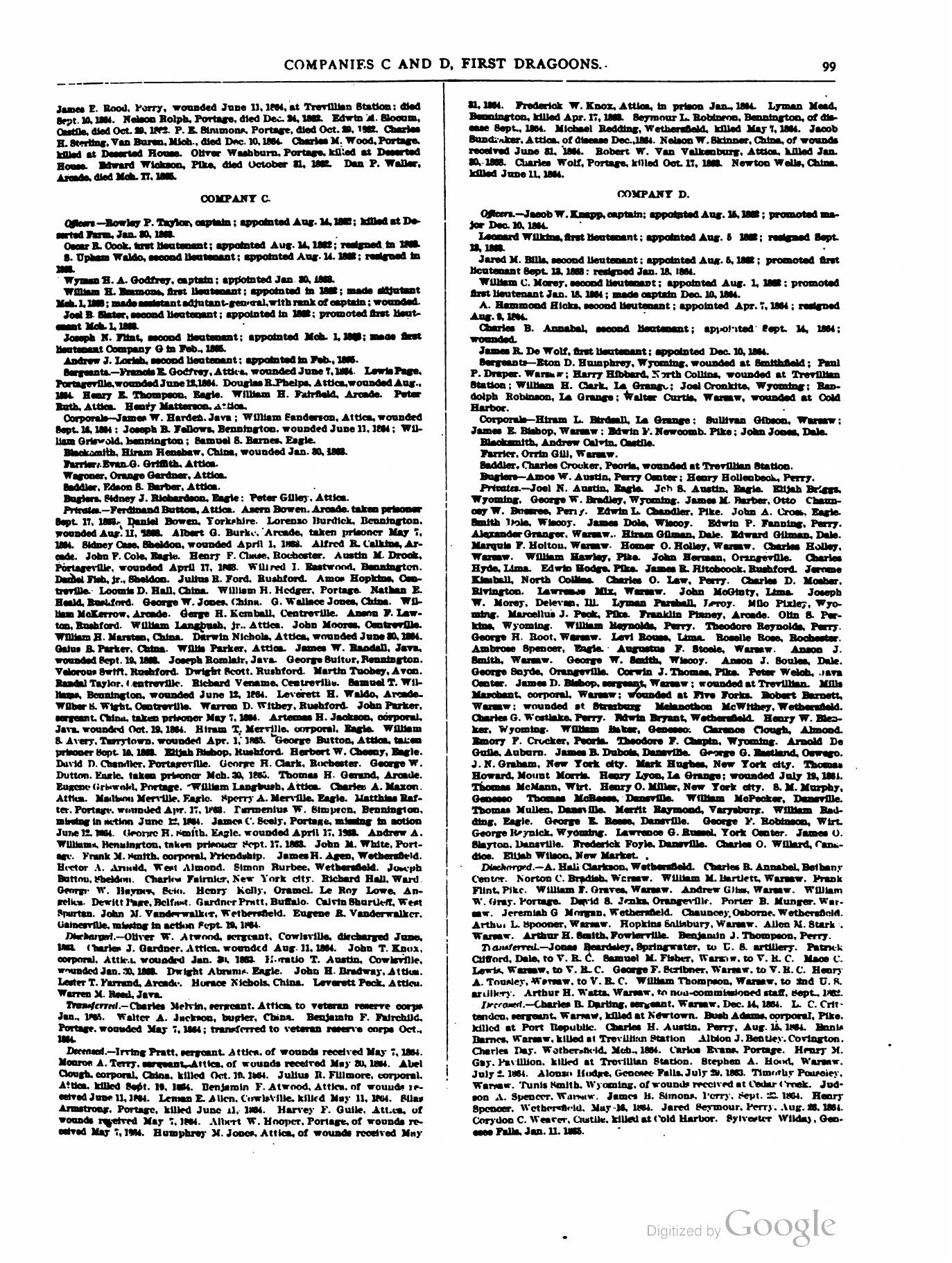
COMPANIES C AND D, FIRS James E. Rood, Perry, wounded June 11, 1864, at Trevillian Station; died 81, 186 Sept. 10, 1864. Nelson Rolph, Portage, died Dec. 24, 1862. Edwin M. Slocum, Benni Castile, died Oct. Simmons, Portage, died Oct. 20, 1962. Charles H. Sterling. Van Buren, Mich., died Dec. 10, 1864. Charles M. Wood, Portage, killed at Deserted House. Oliver Washburn, Portage, killed at Deserted House. Edward Wickson, Pike, died October 31, 1862.
Dan P. Waller, ease Arcade, died Mch. 17. 1865. Sund recei 30, 18 kille COMPANY C. Off Oficers-Rowley P. Taylor, captain; appointedAug. 14, 1842; killedatDe sertedFarm, Jan. 30, 1863. jor D Leo OscarR. Cook, first lieutenant; appointed Aug. 14, 1862; resigned in 1863. 8. Upham Waldo, second lieutenant; appointedAug. 14. 1862; resigned in 1863. Wyman H. A. Godfrey, captain; appointed Jan 30, 1863. William H. Emmons, first lieutenant; appointed in 1863; made adjutant Mch. 1,1863; madeassistant adjutant-general,withrank ofcaptain; wounded.
Joel B. Slater, second lieutenant; appointed in 1863; promoted first lieutenant Mch. 1,1863. 13,18 Jar licut Wil first A. Aug. Cha Joseph N. Flint, second lieutenant; appointed Mch. 1, 1863; made first lieutenant Company G in Feb., 1865. Andrew J. Lorish, second lieutenant; appointed in Feb.,1865. Sergeants.-Francis E. Godfrey, Attica, wounded June 7, 1864. LewisPage, Portageville, woundedJune 12,1864. Douglas R.Phelps, Attica,woundedAug., 1884.
Henry E. Thompson, Eagle. William H. Fairfield, Arcade. Peter woun Ruth, Attica. Henry Matterson, tica. Harb Corporals-James W. Hardeń. Java; William Sanderson, Attica, wounded Sept. 16, 1864: Joseph B. Fellows, Bennington, wounded June 11, 1864; William Griswold, hennington; Samuel S. Barnes, Eagle. Cor Jame Blacksmith, Hiram Henshaw, China, wounded Jan. 30, 1863. Farrier:EvanG. Griffith. Attica. Wagoner, Orange Gardner, Attica. Saddler, Edson S. Barber, Attica.
Jam Ser P. Dr Stati dolp Bla Far Sad Buglers, Sidney J. Richardson, Eagle: Peter Gilley, Attica. Bug Pri Wyo Privates.-Ferdinand Button, Attica. Azern Bowen. Arcade, taken prisoner ceyW Sept. 17, 1863. Daniel Bowen, Yorkshire. Lorenzo Burdick, Bennington, woundedAug. 11, 1863. Albert G. Burke, Arcade, taken prisoner May, 1864. Sidney Case, Sheldon, wounded April 1, 1863. Alfred R. Calkins,Arcade. John F. Cole, Eagle. Henry F. Chase, Rochester.
Austin M. Drock, Portageville, wounded April 17, 1863. Wilfred I. Eastwood, Bennington. Daniel Fish, jr., Sheldon. Julius R. Ford, Rushford. Amos Hopkins, Centreville. Loomis D. Hall, China. William H. Hedger, Portage. Nathan E. Heald, Rushford. George W. Jones, China. G. Wallace Jones, China. William McKerrow, Arcade. Gerge H. Kemball, Centreville. Anson F. Lawton, Rushford. William Langbush, jr.. Attica. John Moores. Centreville.
William H. Marsten, China. Darwin Nichols, Attica, woundedJune30,1864. Gaius B. Parker, China. Willis Parker, Attica. James W. Randall, Java, wounded Sept. 10, 1863. Joseph Romlair, Java. George Suitor, Rennington. Velorous Swift. Rushford. Dwight Scott. Rushford. Martin Tuobey, Avon. Randal Taylor. Centreville. Richard Vename, Centrevilie. Samuel T. Williams, Bennington, wounded June 12, 1864. Leverett H. Waldo, Arcade.
Wilber S. Wight, Centreville. Warren D. Withey, Rushford. John Parker, sergeant, China, taken prisoner May 7, 1864. Artemas H. Jackson, corporal, Java, wounded Oct. 19, 1864. Hiram T. Merville, corporal, Eagle. William 8. Avery, Turrytown, wounded Apr. 1, 1885. George Button, Attica, taizen prisoner Sept. 10, 1963. Elijah Bishop, Kushford. Herbert W. Cheeny, Eagle. David D. Chandler, Portageville. George H. Clark, Rochester. GeorgeW. Dutton. Engle, taken prisoner Mch. 30, 1865.
Thomas H. Gerand, Arcade. Eugene Griswold, Portage. William Langbush,Attica. Charles A. Maxon. Attica. Madison Merville, Fagle. Sperry A. Merville. Eagle. Liatthias Rafter. Portage, wounded Apr.17, 1863. Turmenius W. Simpson, Bennington, Smit Alex Marq Wars Hyd Kimb Rivi W. ming kins Geor Ambr Smit Geor Cent Marc Wars Char ker, Emo Guil J. N. Howa Thom Gene missing in action June 2, 1864. James C. Scely, Portage, missing in action June 12. 1864.
George H. smith, Eagle, wounded April 17, 1963. Andrew A. Williams, Henuington, taken prisoner Sept. 17. 1863. John M. White, PortThom ding Geor age. Frank M. Sinith, corporal, Friendship. James H. Agen, Wethersfield. Hector A. Arnold, West Almond. Simon Burbee, Wetbersfield. Joseph Button, Sheldon. Charles Fairnier, New York city. Richard Hall, Ward. George W. Haynes, Scio. Henry Kelly, Oramel. Le Roy Lowe, Anrelicu.
Dewitt lage, Belfast. Gardner Pratt, Buffalo. Calvin Shurtleft, West Spartan. John M. Vanderwalker, Wethersfield. Eugene R. Vanderwalker. Gainesville, missing in action Sept. 10, 1864. Dischargel.-Oliver W. Atwood, sergeant, Cowlsville, discharged June, 1863. (harles J. Gardner. Attica, wounded Aug. 11, 1864. John T. Knox, corporal, Attica, wounded Jan. 31, 1853. Horatio T. Austin, Cowlsville, wounded Jan. 20, 1863. Dwight Abrams. Eagle.
John H. Bradway, Atticu. Lester T. Farrand, Arcade. Horace Nichols, China. Leverett Peck, Attica. Warren M. Reed, Java. Transferred. -Charles Melvin, sergeant. Attica, to veteran reserve corps Jan., 1965. Walter A. Jackson, bugler, China. Benjanin F. Fairchild. Portage, wounded May 7, 1864; transferred to veteran reserve corps Oct., 1864. Deceaserl. -Irving Pratt, sergeant. Attica, of wounds received May 7, 1864. Monroe A. Terry. sergeant,Attica, of wounds received May 30, 1864.
Abel Clough, corporal, China, killed Oct. 19. 1864. Julius R. Fillmore, corporal. Attica, killed Sept. 19, 1864. Benjamin F. Atwood, Attica, of wounds received June 11, 1804. Leman E. Allen, Cowlsville, killed May 11, 1864. Silas Armstrong, Portage, killed June 11, 1864. Harvey F. Guile. Att.ca, of wounds received May 7, 1864. Albert W. Hooper, Portage, of wounds received May 7, 1964. Humphrey M. Jones, Attica, of wounds received May Slay Dis dice. C’ent Flin W. G saw.
Arth Wars Tra Cliff Lew A. T artil Dre tend kille Barn Char Gay July Wars son Spen Cory esee FIRST DRAGOONS.. Frederick W. Knox, Attica, in prison Jan., 1864. Lyman Mead, Bennington, killed Apr. 17, 1863. Seymour L. Robinson, Bennington, ofdisease Sept., 1884. Michael Redding, Wethersfield, killed May 7, 1864. Jacob Sundinker, Attica, ofdisease Dec.,1884. Nelson W. Skinner, China, of wounds received June 31, 1864. Robert W.
Van Valkenburg, Attick, killed Jan. 30, 1863. Charles Wolf, Portage, killed Oct. 17, 1863. Newton Wells, China, killed June 11, 1864. COMPANY D. Officers.-Jacob W. Knapp, captain; appointedAug. 15, 1862; promoted major Dec. 10, 1864. Leonard Wilkins, first lieutenant; appointed Aug. 5 1862; resigned Sept. 13,1863. Jared M. Bills, second lieutenant; appointed Aug. 5, 1862; promoted first licutenant Sept. 13, 1863: resigned Jan. 18, 1864.
William C. Morey, second lieutenant; appointed Aug. 1, 1863: promoted first lieutenant Jan. 18. 1864; made captain Dec. 10, 1864. A. Hammond Hicks, second lieutenant; appointed Apr. 7, 1864; resigned Aug.9, 1864. Charles B. Annabal, second lieutenant; appointed fept. 14, 1864; wounded. James R. De Wolf, first lieutenant; appointed Dec. 10, 1864. Sergeants-Eton D. Humphrey, Wyoming, wounded at Smithfield; Paul P. Draper. Warsaw; Harry Hibbard, North Collins, wounded at Trevillian Station; William H. Clark, La Grange; Joel Cronkite, Wyoming; Randolph Robinson, La Grange; Walter Curtis, Warsaw, wounded at Cold Harbor. Corporals-Hiram L. Birdsall, La Grange: Sullivan Gibson, Warsaw: James E. Bishop, Warsaw: Edwin F ‘. Newcomb. Pike; John Jones, Dale. Blacksmith, Andrew Calvin, Castile. Farrier, Orrin Gill, Warsaw. Saddler, Charles Crocker, Peoria, wounded at Trevillian Station. Buglere-Amos W. Austin, Perry Center; Henry Hollenbeck, Perry. Privates.-Joel N. Austin, Eagle.
Jch S. Austin, Eagle. Elijah Briggs, Wyoming, George W. Bradley, Wyoming. James M. Barber, Otto ChaunceyW. Bussree, Periy. Smith Dole, Wiscoy. Edwin L. Chandler, Pike. John A. Cross, Eagle. James Dole, Wiscoy. Edwin P. Fanning, Perry. AlexanderGranger, Warsaw.. Hiram Gilman, Dale. Edward Gilman, Dale. Marquis F. Holton, Warsaw. Homer 0. Holley, Warsaw. Charles Kolley, Warsaw. William Hawley, Pike. John Herman, Orangeville.
Charles Hyde, Lima. Edwin Hodge. Pike. James R. Hitchcock. Rushford. Jerome Kimball, North Collins. Charles O. Law, Perry. Charles D. Mosher, Rivington. Lawrence Mix, Warsaw. John McGinty, Lima. Joseph W. Morey, Delevan. Ill. Lyman Parshall, Leroy. Milo Pixley, Wyoming. Marcellus J. Peck, Pike. Franklin Pinney, Arcade. Olin S. Perkins, Wyoming. William Reynolds, Perry. Theodore Reynolds, Perry. George H. Root, Warsaw.
Levi Rouse, Lima. Rozelle Rose, Rochester. Ambrose Spencer, Eagle. Augustus F. Stoele, Warsaw. Anson J. Smith, Warsaw. George W. Smith, Wiscoy. Anson J. Soules, Dale. George Snyde, Orangeville. Corwin J. Thomas, Pike. Peter Welch, Java Center. James D. Bishop, sergeant, Warsaw; wounded at Trevillian. Mills Marchant, corporal, Warsaw; wounded at Five Forks. Robert Barnett, Warsaw; wounded at Strasburg Melancthon McWithey, Wethersneld. CharlesG. Westlake. Perry.
Fdwin Bryant, Wethersfield. Henry W. Bleker, Wyoming. William Baker, Geneseo: Clarence Clough, Almond. Emory F. Crocker, Peoria. Theodore F. Chapin, Wyoming. Arnold De Guile, Auburn. James B. Dubois, Dansville. George G. Eastland, Oswego. J. N. Graham, New York city. Mark Hughes, New York city. Thomas Howard, Mount Morris. Henry Lyon,La Grange; wounded July 19, 1861. Thomas McMann, Wirt. Henry O. Miller, New York city. 8. M. Murphy, Geneseo Thomas McReese, Dansville.
William McPecker, Dansville. Thomas Mullen, Dansville. Merrit Raymond, Varysburg. William Radding, Eagle. George E. Reese, Dansville. George F. Robinson, Wirt. George Reynick, Wyoming. Lawrence G. Russel, York Center. James 0. Slayton, Dansville. Frederick Foyle, Dansville. Charles O. Willard, CanaDischarged. Hali Clarkson, Wethersfield. Charles B. Annabel, Bethany dice. Elijah -A. Wilson, New Market. C’enter. Norton C. Bradish, Warsaw.
William M. Bartlett, Warsaw. Frank Flint, Pike. William F. Graves, Warsaw. Andrew Gliss, Warsaw. William W. Gray, Portage. David S. Jenks, Orangeville. Porter B. Munger. Warsaw. Jeremiah G Morgan, Wethersfield. Chauncey,Osborne, Wethersfield. Arthus L. Spooner, Warsaw. Hopkins Salisbury, Warsaw. Allen M. Stark, Warsaw. Arthur H. Smith, Fowlerville. Benjamin J. Thompson, Perry. Transferred.-Jonas Beardsley, Springwater, to U. S. artillery.
Patrick Clifford, Dale, to Samuel M. Fisher, Warsaw, to Mace C. Lewis, Warsaw, to V. R.C. George F. Scribner, Warsaw, to Henry A. Tousley, Warsaw, to William Thompson, Warsaw, to 2nd U.S. artillery. Arthur H. Watts, Warsaw, to non-commissioned staff, sept., 1962. Dreraxerd.C -harles B. Darling, sergeant, Warsaw, Dec. Crittenden, sergeant, Warsaw, killed at Newtown. Bush Adams, corporal, Pike. killed at Port Republic. Charles H. Austin, Perry, Aug. 15, 1864.
Ennis Barnes, Warsaw, killed at Trevillian Station Albion J. Bentley. Covington. Charles Day, Wethersfield, Mch., 1864. Carlos Evans, Portage. Henry M. Gay. Pavillion, killed at Trevillian Station. Stephen A. Hood, Warsaw. July 2. 1864. Alonzo Hodge, Genesee Falls, July 29, 1863. Timothy Poweiey, Warsaw. Tunis Smith, Wyoming, ofwounds received at Cedar Creek. Judson A. Spencer, Warsaw. James B. Simons, l’erry, Sept. 22. 1864.
Henry Spencer, Wethersfield, May -16, 1864. Jared Seymour, Perry, Aug. 26, 1861. Corydon C. Weaver, Castile, killed at Cold Harbor. Sylvester Wilday, Genesee Falls, Jan. 11. 1865.
Source
F. W. Beers & Co. (1880). History of Wyoming County, N.Y. (pp. 93–99). New York, NY: F. W. Beers & Co.. Public domain. Digitised copy held in the archive of this site.
Views: 18
Explore the evidence
View this article’s connected sources and media →
About this page
This article was brought over from AlfredGibbs.com. Its preserved text, media and citations remain available for comparison.