
Charles L. Brundage of Portage, New York, was commissioned an officer of Company G of the regiment that became the First New York Dragoons, originally the 130th New York Volunteer Infantry, in August 1862, at the age of N/S. He was discharged for disability before the war’s end.
The Service Record
Enlisted: August 1862, at Portage, N.Y.; age N/S.
Company: Company G, 130th New York Volunteers → First New York Dragoons.
Rank: Captain.
Fate: Discharged for disability, Aug. 11, 1863.
Post-war home: Muskegon, Mich.
Source: New York Adjutant-General’s register of the First New York Dragoons; Bowen, J. R. (1900). Regimental History of the First New York Dragoons.
From the Regimental Register
“Charles L. Brundage. Mustered in as First Lieutenant, Co. G, Sept. 3, to serve three years. Mustered in as Captain, Oct. 8, 1862; discharged for disability, Aug. 11, 1863;commissioned First Lieutenant, Nov. 1, with rank from Aug. 30, original; Captain, Nov. 24, with rank from Oct. 9, vice Cornell, resigned. —Muskegon, Mich.”
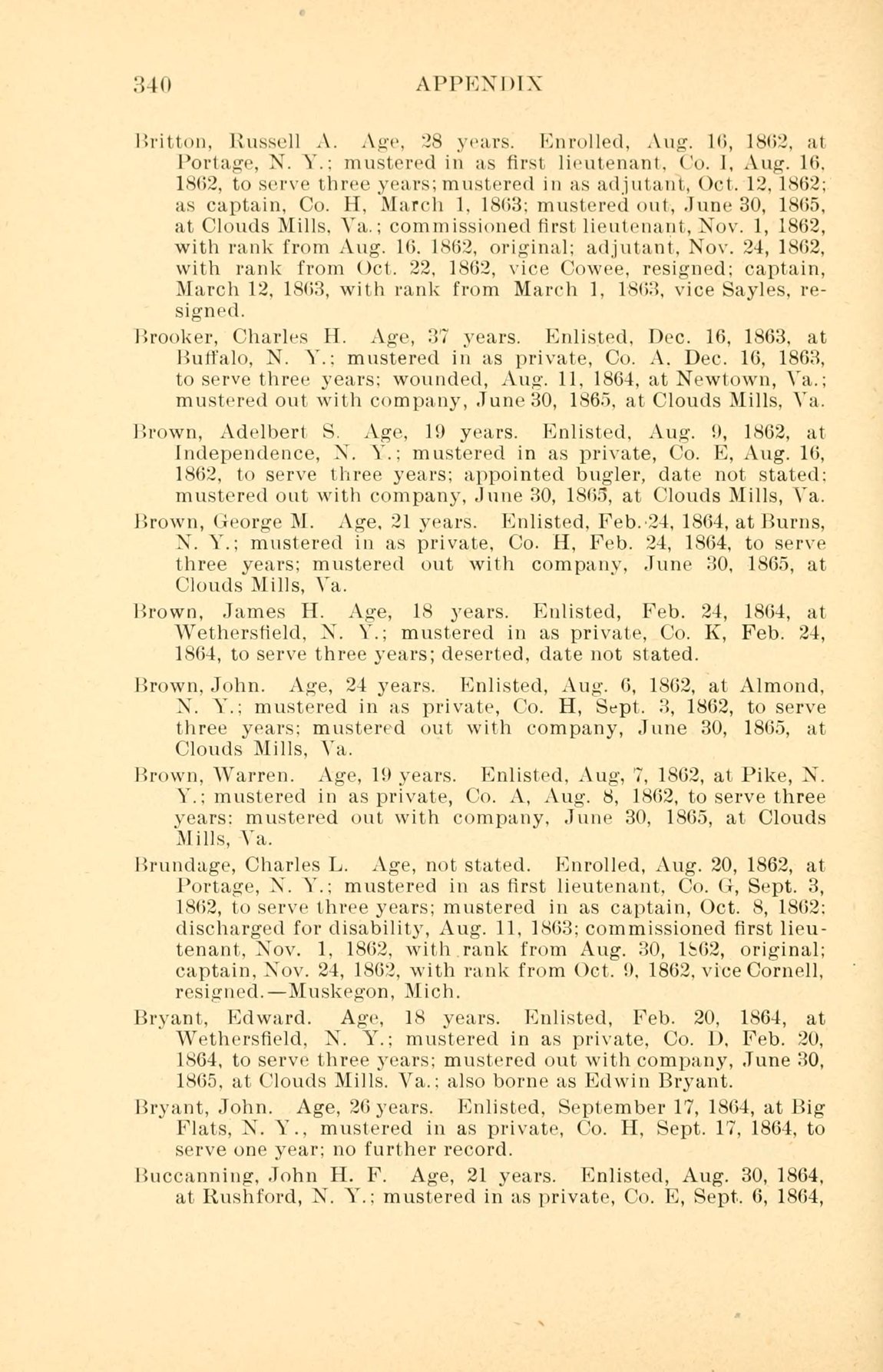
Verbatim from the roster of the First New York Dragoons in the New York Adjutant-General’s report. The page reproduced above is from Bowen, J. R. (1900). Regimental History of the First New York Dragoons (originally the 130th N.Y. Vol. Infantry) (p. 340). Internet Archive. archive.org/details/regimentalhistor00bowe
Compiled Military Service Record
The index to the compiled service records confirms Charles L Brundage in the 19th Cavalry (the regiment’s Fold3 designation; it is the First New York Dragoons), Company G, entering service as 1 Lieut and leaving it as Captain.
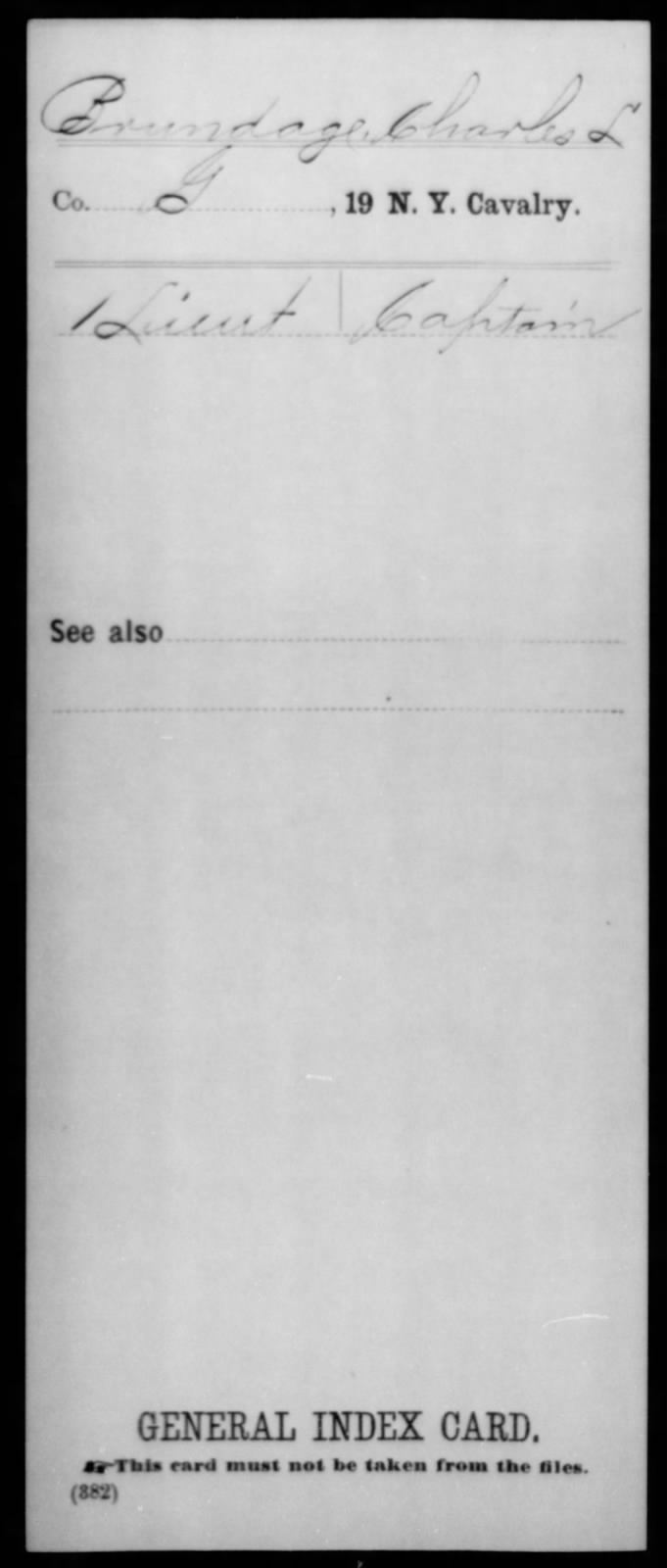
| Military unit | 19th Cavalry |
|---|---|
| Company | G |
| Enlistment rank | 1 Lieut |
| Discharge rank | Captain |
Brundage, Charles L.
Co. G, 19 N. Y. Cavalry.
1 Lieut -        Captain -
See also [blank]
[printed footer] General Index Card. This card must not be taken from the files. (382)
Source. Compiled Military Service Record, Brundage, Charles L, Co. G, 19th Cavalry. Indexes to the Carded Records of Soldiers Who Served in Volunteer Organizations During the Civil War (NARA microfilm publication M551), Record Group 94. Digital image, Fold3 (https://www.fold3.com/image/288510530), accessed 16 September 2026. Transcribed from the original by sight.
Terms on this page, from brevet and mustered out to the classes of the Roll of Honor, are defined in the site Glossary.
Named in a Comrade’s Letter
Private George D. Benedict of Company G wrote home to his wife Sarah at Belvidere. His letters survive, and they name this man.
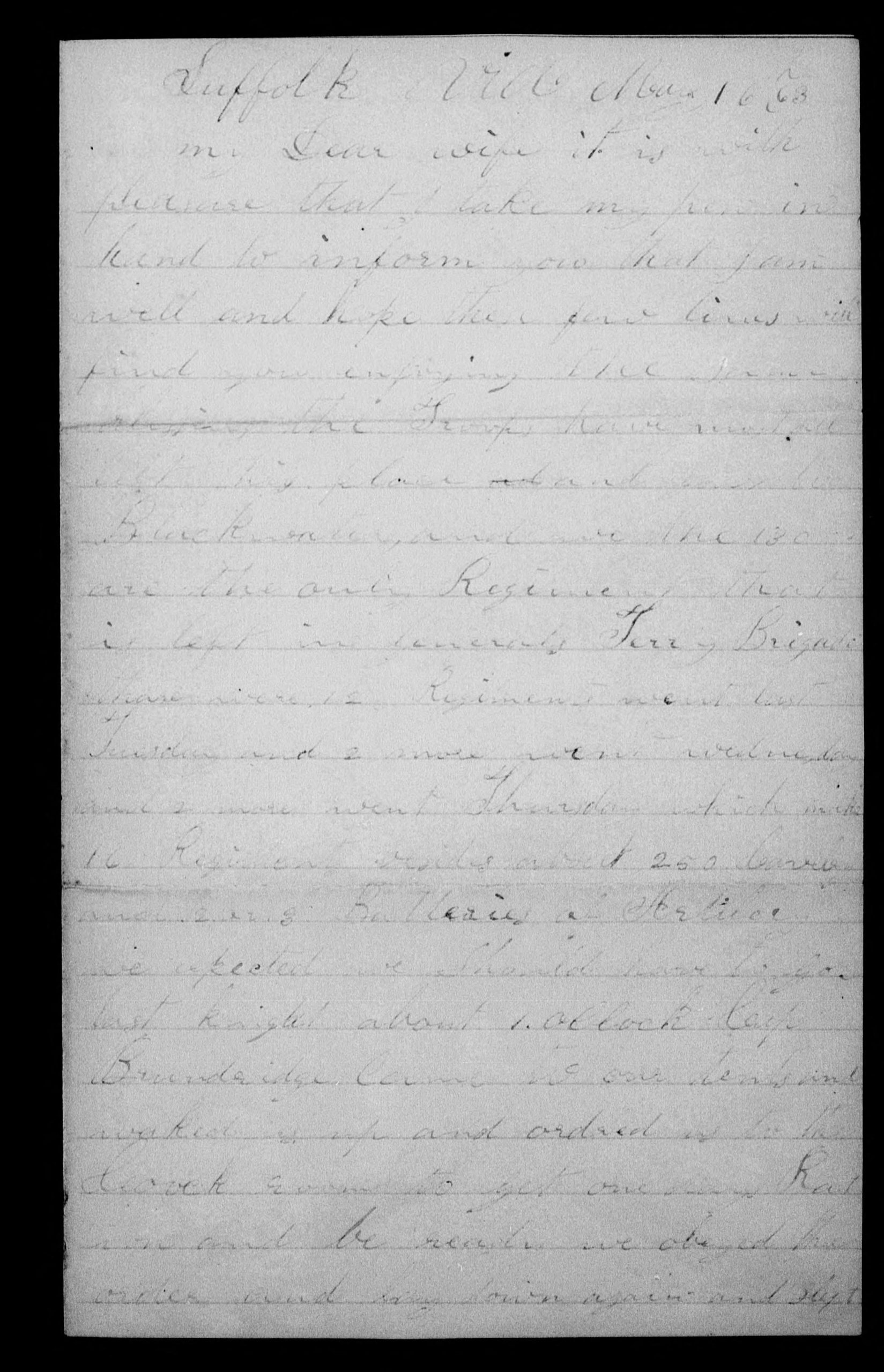
The manuscript. Click to enlarge.
Southern Historical Collection, UNC Chapel Hill, #4943-z.
The passage that names him
“we expected we Should have to go last knight. about 1 oClock Capt Brundidge Came to our tent and waked us up and ordered us to be ready to get our Rations and be ready. we obeyed the order and lay down again and slept.”
— George D. Benedict, 16 May 1863
Brundage commanded Benedict’s Company G from October 1862 until he was discharged for disability in August 1863. This is him at one in the morning, going tent to tent.
The whole page, transcribed
Suffolk Vill May 16 63
my Dear wife it is with pleasure that I take my pen in hand to inform you that I am well and hope thee few lines will find you enjoying the Same blessing the Troops have marched off this place about and to Blackwater and we the 130 are the only Regiment that is left in Generals Terry Brigade thare were 12 Regiments went last Tuesday and 2 more went wedensday and 2 more went Thursday which makes 16 Regiments beside about 250 Cavelry and 3 Batteries of Artilery we expected we Should have to go last knight about 1 oClock Capt Brundidge Came to our tent and waked us up and ordered us to be ready to get our Rations and be ready we obeyed the order and lay down again and slept
Transcribed from the manuscript, in Benedict’s own spelling and punctuation.
Men he served beside
Named alongside him in the same letters, or standing on the same post:
The letters themselves, transcribed page by page, are on the page of Private George D. Benedict, Company G, who wrote them.
Source. Benedict, G. D. (1863–1864). George D. Benedict Papers (Collection #4943-z). Southern Historical Collection, Louis Round Wilson Special Collections Library, University of North Carolina at Chapel Hill.
What His Own Men Said — Three Letters, July and August 1863
Private George D. Benedict of Company G — Brundage’s own company — wrote home to his wife Sarah through 1863 and 1864. He wrote about his captain three times in a fortnight, and he did not write the same thing twice.
29 July 1863 — “I hope he will not return”
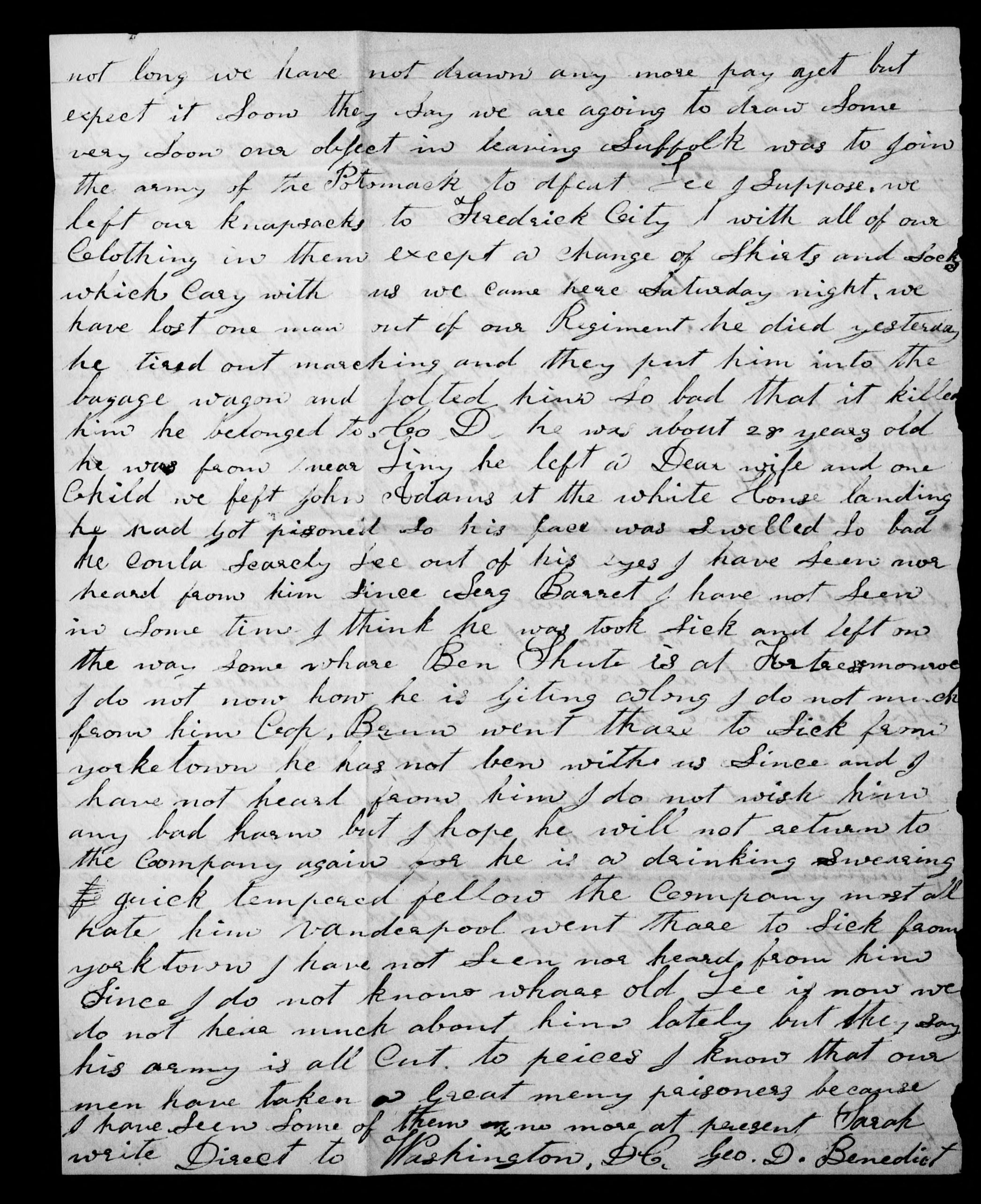
“Ceap. Brun went thare to Sick from yorketown he has not ben with us Since and I have not heard from him I do not wish him any bad harm but I hope he will not return to the Company again for he is a drinking Swearing quick tempered fellow the Company most all hate him”
— George D. Benedict, Warrenton, Virginia, 29 July 1863
The whole page, transcribed
not long we have not drawn any more pay yet but expect it Soon they Say we are agoing to draw Some very Soon our object in leaving Suffolk was to join the army of the Potomack to defeat Lee I Suppose,
we left our knapsacks to Fredrick City with all of our Clothing in them except a change of Shirts and Socks which Cary with us we came here Saturday night,
we have lost one man out of our Regiment he died yesterday he tired out marching and they put him into the bagage wagon and jolted him So bad that it killed him he belonged to Co D he was about 28 years old he was from near Liny he left a Dear wife and one Child
we left John Adams at the white house landing he had got pisoned So his face was Swelled So bad he could Scarcly See out of his eyes I have Seen nor heard from him Since
Serg Barret I have not Seen in Some time I think he was took Sick and left on the way Some whare
Ben Shute is at Fortress monroe I do not now how he is giting along I do not much from him
Corp. Benn went thare to Sick from yorketown he has not ben with us Since and I have not heard from him I do not wish him any bad harm but I hope he will not return to the Company again for he is a drinking Swearing quick tempered fellow the Company most all hate him
Vanderpool went thare to Sick from yorktown I have not Seen nor heard from him Since
I do not know whare old Lee is now we do not hear much about him lately but they Say his army is all Cut to peices I know that our men have taken a Great meny prisoners because I have Seen Some of them
no more at present Sarah write Direct to Washington, D C
Geo. D. Benedict
August 1863 — “he will do all he Can for me”
“I have aplied for one [a furlough] and Sergt Barret has to Ceap. Brun Says he will do all he Can for me to get one”
— George D. Benedict, Manassas Junction, August 1863
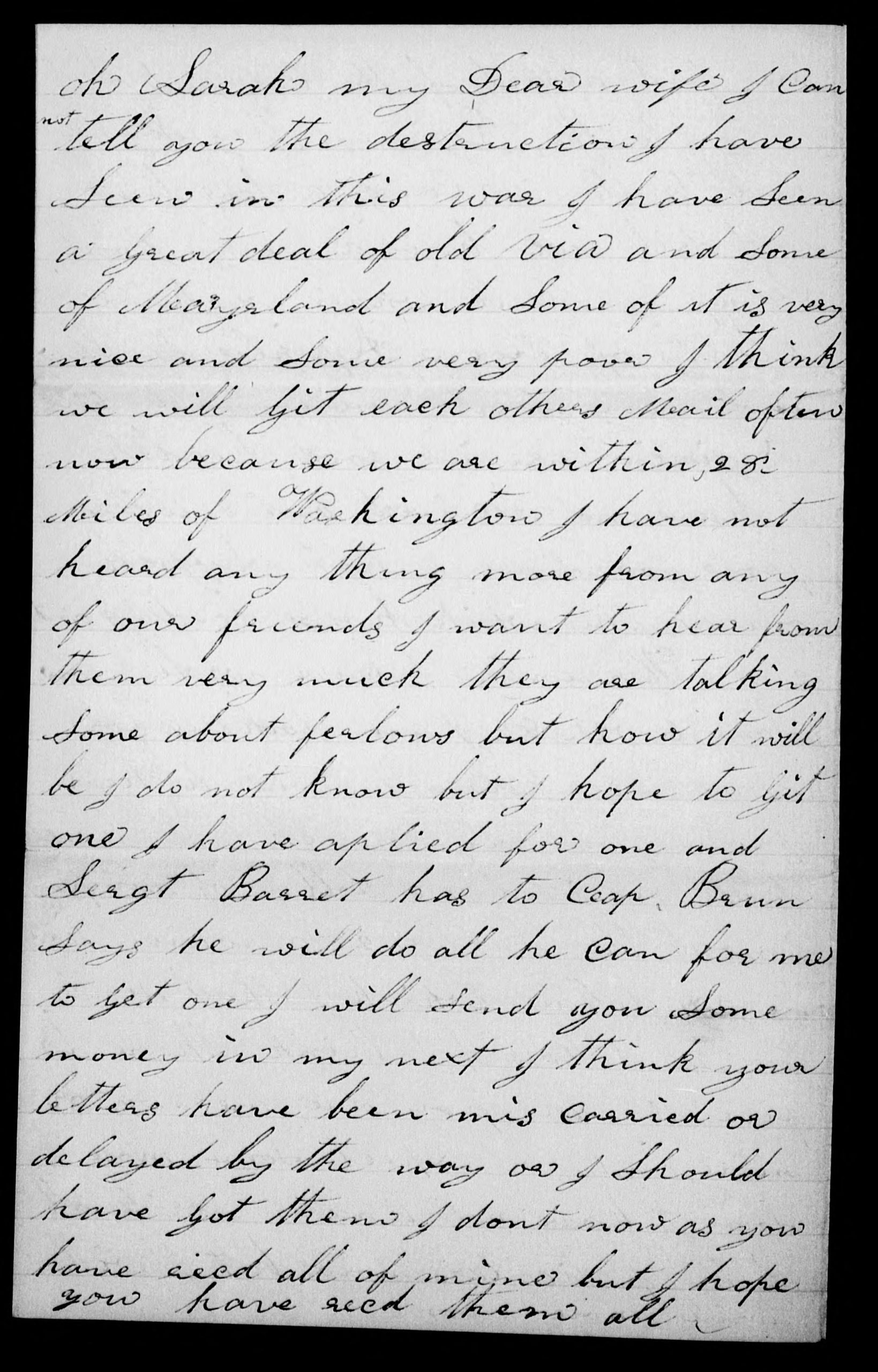
The whole page, transcribed
oh Sarah my Dear wife I Cannot tell you the destruction I have Seen in this war I have Seen a great deal of old Virginia and Some of Maryland and Some of it is very nice and Some very poor
I think we will git each others Mail often now because we are within 28 Miles of Washington I have not heard any thing more from any of our friends I want to hear from them very much
they are talking Some about ferlows but how it will be I do not know but I hope to git one I have aplied for one and Sergt Barret has to Ceap. Brun Says he will do all he Can for me to get one
I will Send you Some money in my next
I think your letters have been mis Carried or delayed by the way or I Should have got them I dont now as you have recd all of mine but I hope you have recd them all
9 August 1863 — “he thinks he will go home and Stay”
“Ceap. Brun is with us now he has been to the hospital Sick he is unwell now and thinks he will go home and Stay”
— George D. Benedict, Manassas Junction, 9 August 1863
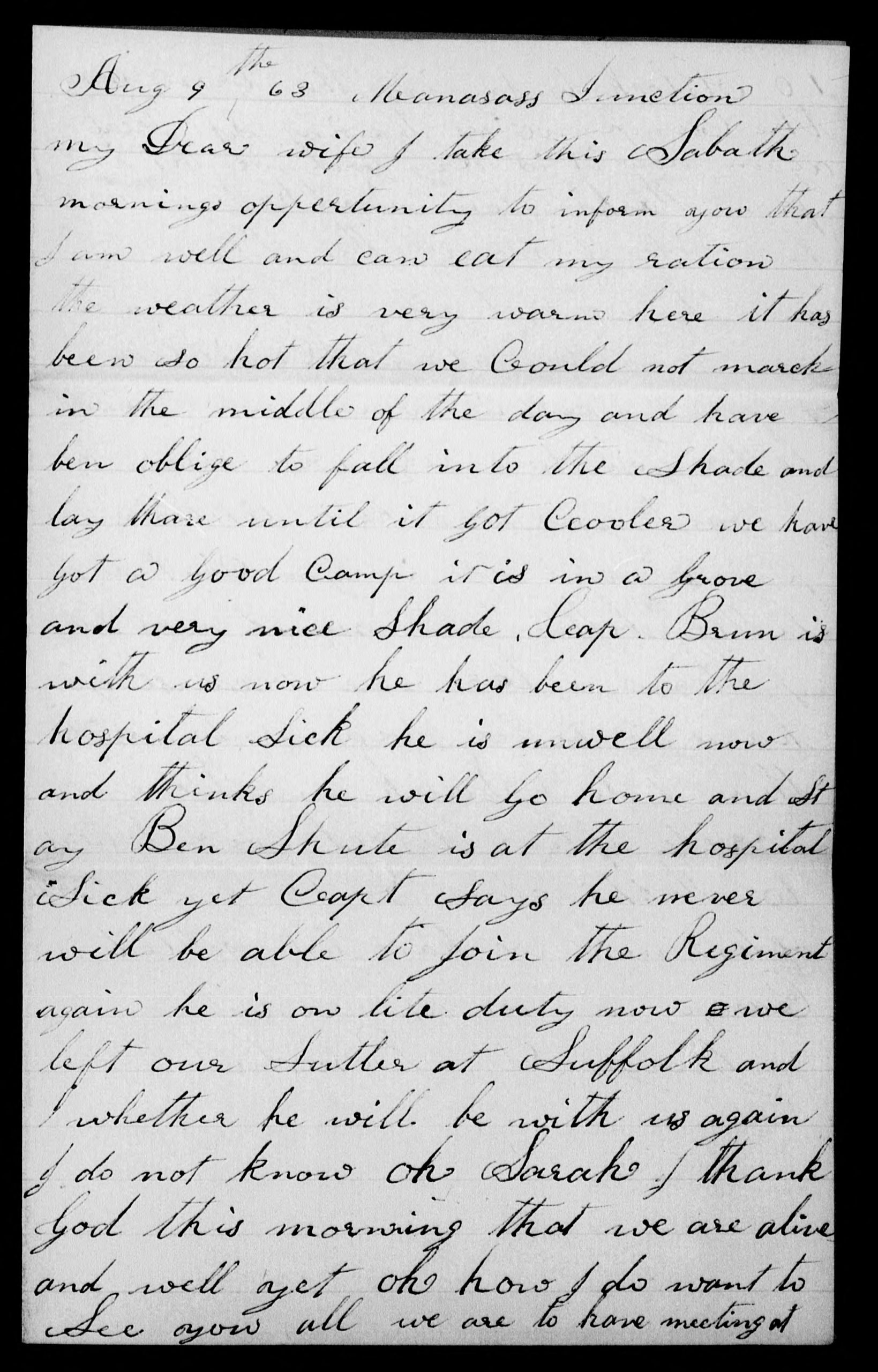
The whole page, transcribed
Aug 9th 63 Manasass Junction
my Dear wife I take this Sabath mornings oppertunity to inform you that I am well and can eat my ration
the weather is very warm here it has been So hot that we Could not march in the middle of the day and have ben oblige to fall into the Shade and lay thare until it got Cooler we have got a good Camp it is in a grove and very nice Shade,
Ceap. Brun is with us now he has been to the hospital Sick he is unwell now and thinks he will go home and Stay
Ben Shute is at the hospital Sick yet Ceapt Says he never will be able to join the Regiment again he is on lite duty now
we left our Sutler at Suffolk and whether he will be with us again I do not know
oh Sarah I thank God this morning that we are alive and well yet oh how I do want to See you all we are to have meeting at
Both accounts stand because both are in the record. On 29 July, with his captain absent sick since Yorktown, Benedict hoped he would never come back and set down why: a drinking, swearing, quick-tempered man his company mostly hated. That is as harsh a thing as anyone says about anyone in these letters.
Ten days later Brundage was back, and Benedict was applying to him for a furlough. The captain said he would do all he could. There is no sign Benedict thought this worth remarking on, and no sign he had changed his mind. Both things were true at once, which is how most men are actually remembered by the people who serve under them.
Brundage was right about himself. Still unwell on 9 August and thinking he would go home and stay, he was discharged for disability that same month, after commanding Company G since October 1862.
A note on the reading. The 29 July passage was first published on this site as “Corp. Benn” and left unattributed, because no corporal of that name could be found. The letters of 8 and 9 August use the identical abbreviation where the context names the man beyond doubt. Set side by side the two words are the same hand, same form, same comma: Ceap. Brun. The full run of Benedict’s letters is on his own page.
Source. Benedict, G. D. (1863–1864). George D. Benedict letters, 1863–1864 (Collection #4943-z). Southern Historical Collection, Louis Round Wilson Special Collections Library, University of North Carolina at Chapel Hill.
Views: 5
Explore the evidence
View this article’s connected sources and media →
About this page
This article was brought over from AlfredGibbs.com. Its preserved text, media and citations remain available for comparison.