
General Alfred Gibbs · A Document Reconsidered
The Cost of Caution
A reading of the 1864 pamphlet that was written to destroy General McClellan, and the documented truth about the one officer this site follows, Alfred Gibbs, the West Point classmate whose colonelcy McClellan himself recommended.
In the autumn of 1864, with a presidential election weeks away, a thirty-two page pamphlet went out from Washington under the imprint of the Union Congressional Committee. Its title was blunt: McClellan’s Military Career Reviewed and Exposed. Its purpose was equally blunt. George B. McClellan, the general who had built and twice commanded the Army of the Potomac, was now the Democratic candidate for President against Abraham Lincoln, and this pamphlet was written to destroy his reputation as a soldier before the country voted. It is not a neutral history. It is a campaign document, and it should be read as one. But it is also a close, document-based indictment of a style of command, and that is why it is worth reading here.
The author, though the cover does not say so, was William Swinton, the war correspondent of the New York Times. The pamphlet is a condensation of twelve articles he had published in the Times in February, March, and April of 1864, reviewing McClellan’s own official report of his campaigns. Swinton claimed to build his case on the record, acknowledging in his prefatory note the use of “a large mass of unpublished official documents.” This page examines what that pamphlet actually charges, corrects a few things that earlier drafts of this essay got wrong, and then sets beside it the documented record of one Union officer whose name is bound to McClellan’s in a way the pamphlet never mentions: General Alfred Gibbs.
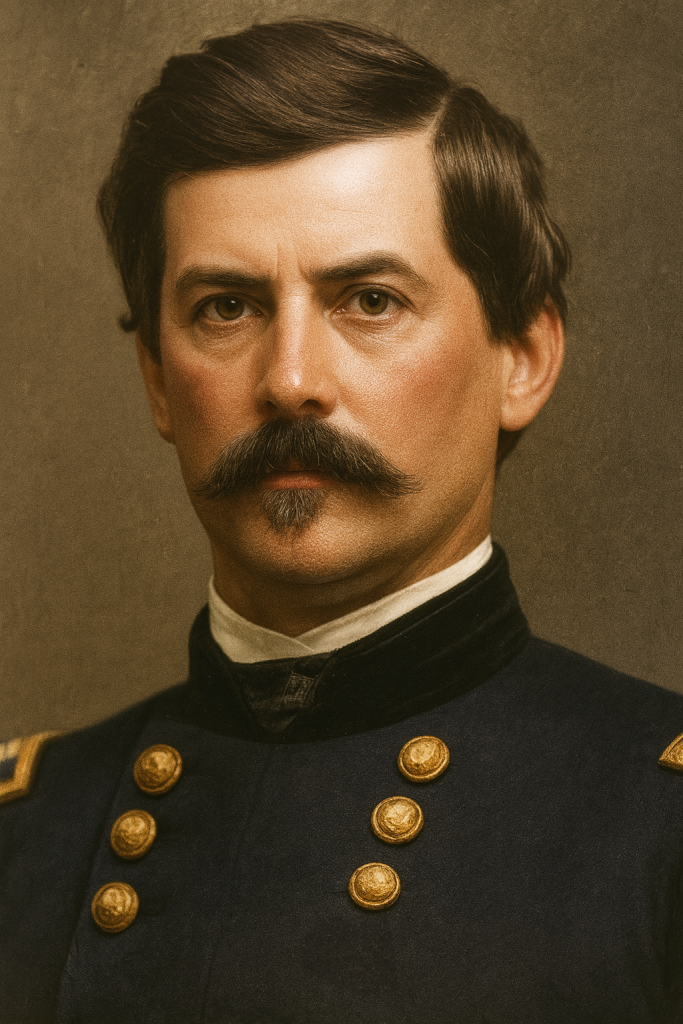
Download the full 1864 pamphlet (PDF)
What the pamphlet charges
Swinton opens not with strategy but with politics. His first chapter is titled “McClellan as a Political Strategist,” and its argument is that McClellan had built a candidacy on his own defeats:
It is savage, and it is partisan. A few lines later Swinton turns the Peninsula Campaign’s sickness into an epigram: “While his soldiers were being struck down by thousands with the fevers of the Chickahominy, the fever of the White House struck him” (Swinton, 1864, p. 3). No reader should mistake this for disinterested analysis. But underneath the invective Swinton states a method, and it is a serious one:
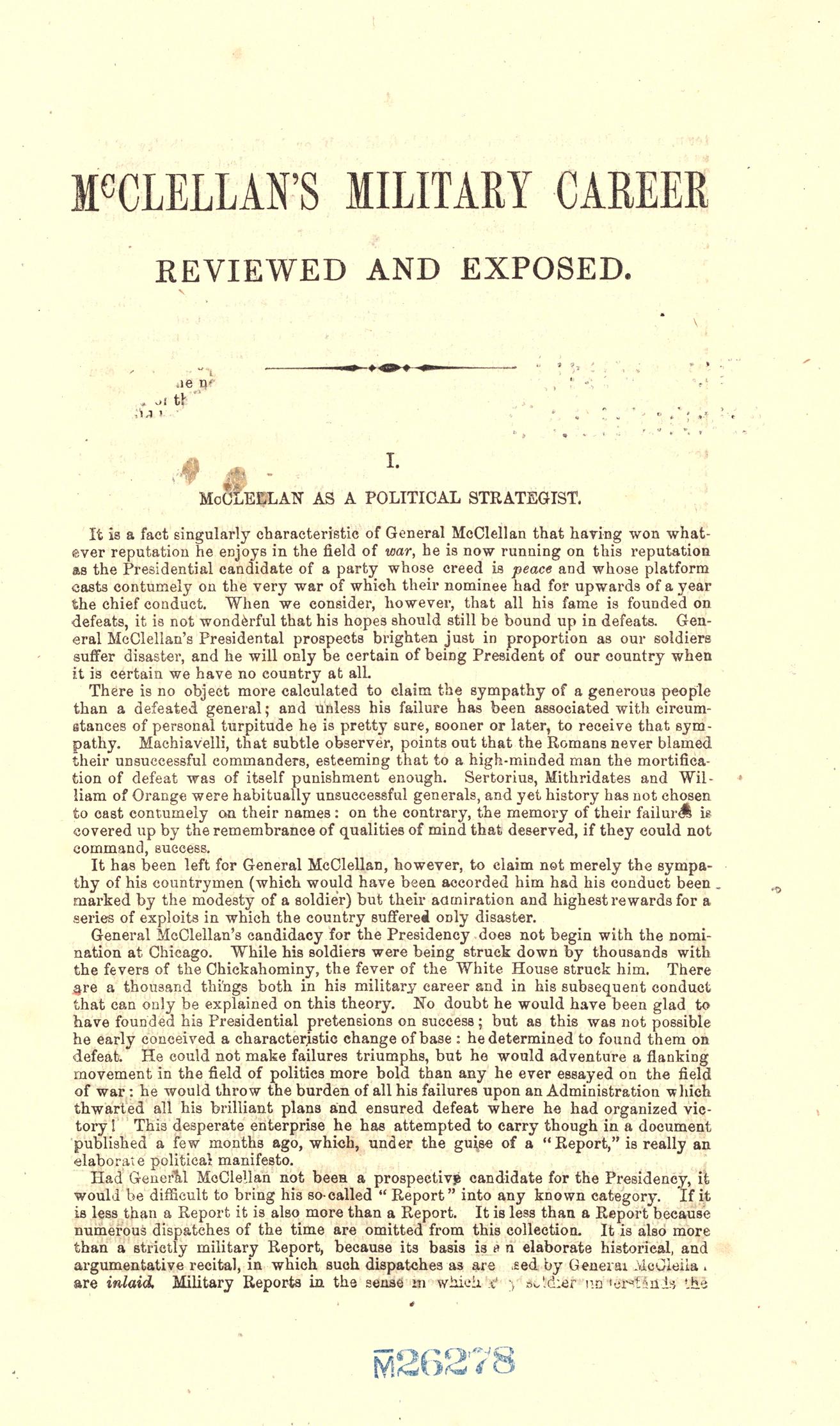
Three concrete charges carry the pamphlet, and each can be read on the pages themselves.
One. He overestimated the enemy
Swinton’s third chapter, headed “A Hundred and Fifty Thousand Men in Buckram,” fixes on McClellan’s habit of magnifying the force in front of him. He quotes McClellan’s own October 1861 estimate that a fighting column of 150,000 men, and a total establishment near 240,000, was required before he could take the offensive, and his claim that the enemy on the Potomac was “not less than 150,000 strong, well drilled and equipped, ably commanded, and strongly entrenched.” Against this Swinton sets Napoleon:
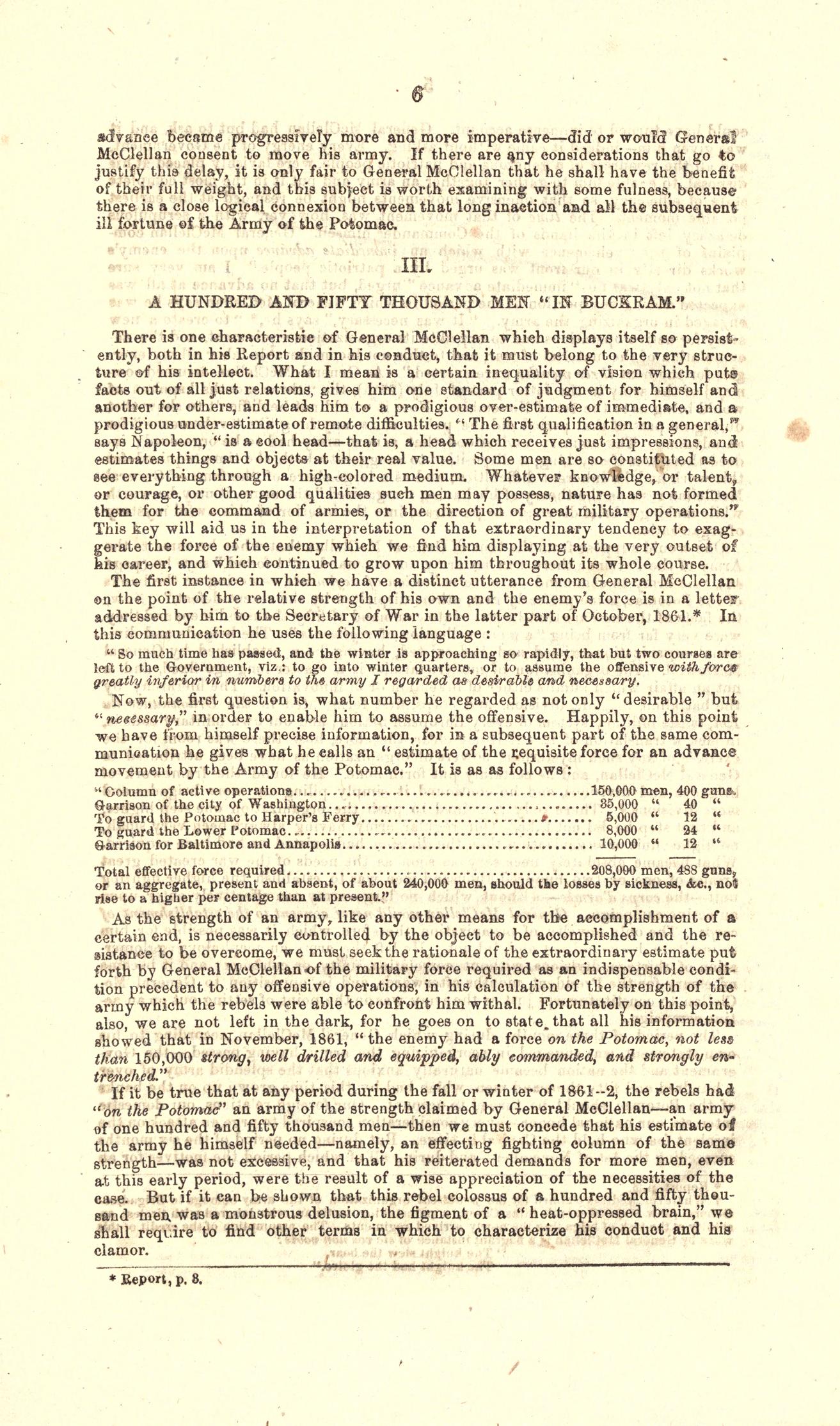
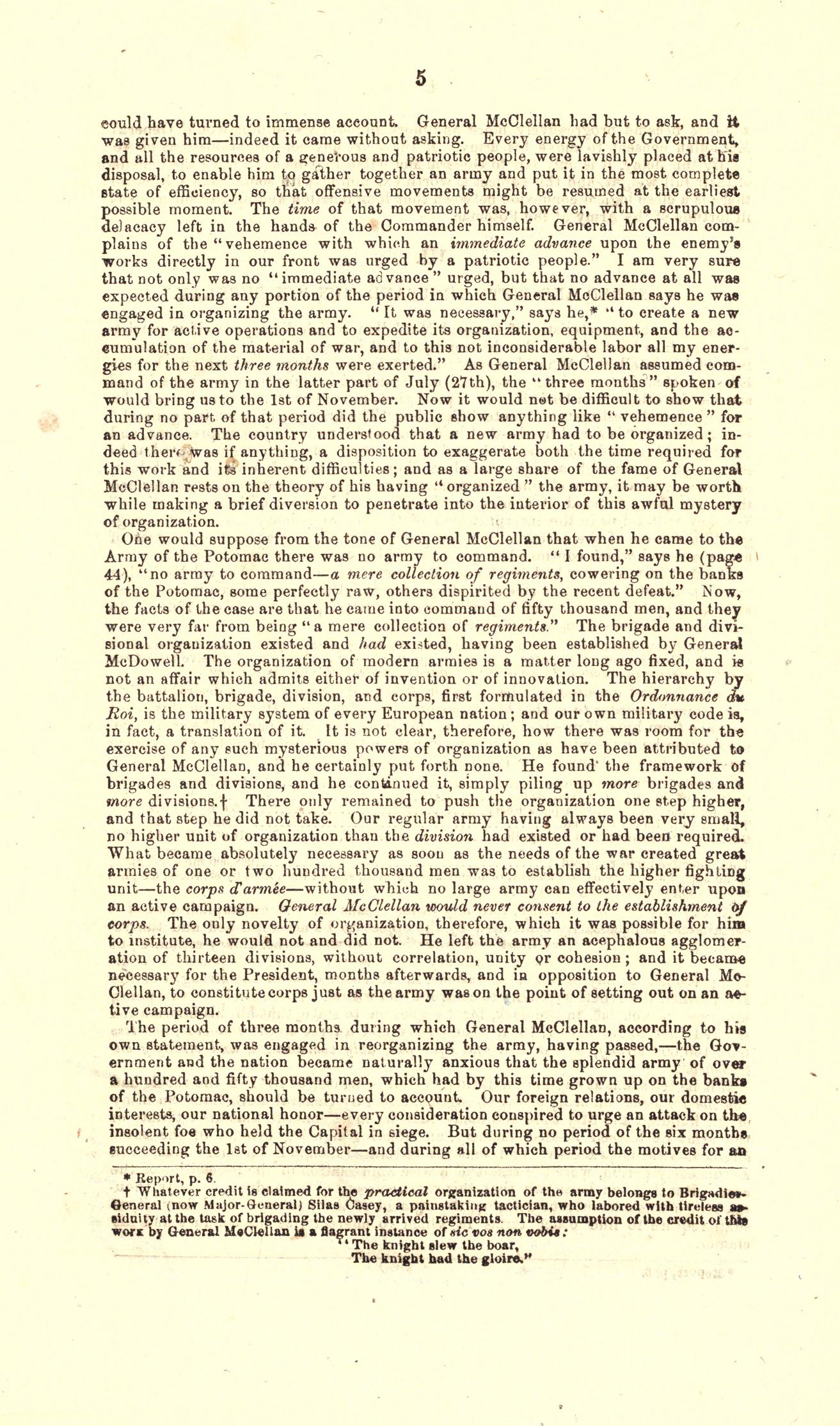
Two. He resisted organizing the army into corps
The pamphlet argues that McClellan left the Army of the Potomac without its highest command structure until civilian authority forced the change on him. Swinton’s words are exact:
Three. He would not press an advantage
Swinton’s recurring complaint is inaction: the long delay before Manassas, which he derides after the Prince de Joinville as the “most senseless and aimless ‘promenade’ ever conceived by a general” (Swinton, 1864, p. 11); the failure to pursue; the disregard of his own corps commanders’ unanimous warnings about the Merrimac before the Peninsula (Swinton, 1864, p. 15). Whatever one makes of the politics, the charge is coherent: an army given every resource, held back by the caution of the man who led it.
Where Alfred Gibbs actually stood
An earlier version of this essay presented McClellan’s failures “through the eyes of General Alfred Gibbs,” imagining how Gibbs, serving beneath him, would have felt the weight of that caution. The documents do not support that framing, and the truth is more interesting than the invention.
Gibbs never served under McClellan. He could not have. During the whole of McClellan’s field command, from the summer of 1861 through his removal on November 7, 1862, Gibbs was first a prisoner of war and then a colonel in a different theater. We do not have to guess at this. Gibbs wrote out his own record of service in his own hand in 1866, and it survives in his personnel file at the National Archives:
Read the dates against each other. Gibbs was captured at San Augustine Springs in July 1861, held as a prisoner and then on parole commanding a prison post in Michigan, and not exchanged until September 6, 1862. He became colonel of the 130th New York that same day and took his regiment to Suffolk, Virginia, in the command of General John Peck, not the Army of the Potomac. He did not join the Army of the Potomac until July 25, 1863, eight months after McClellan was gone from it. The full document, scan and complete transcription, is on this site: Gibbs’s statement of military services.
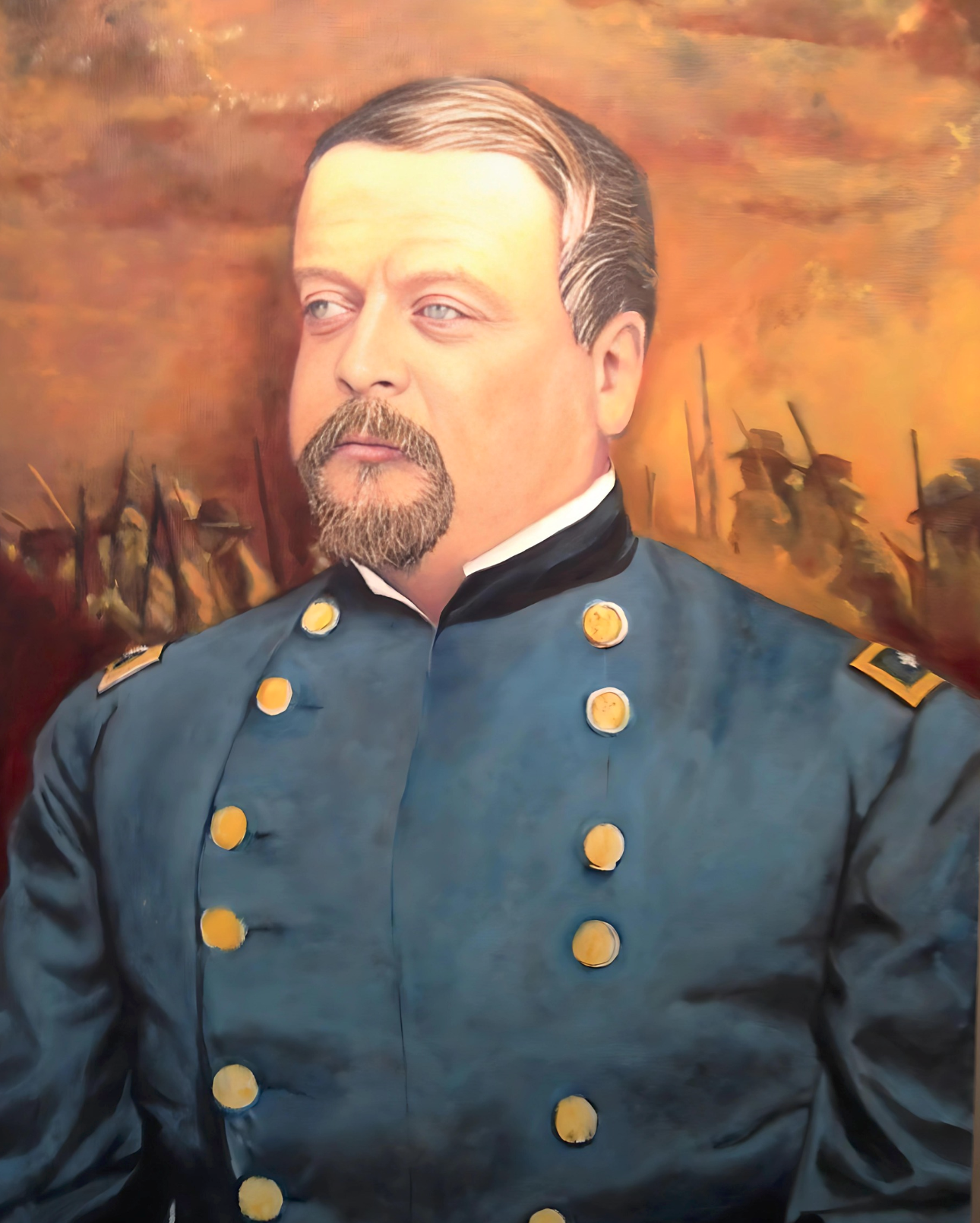
So what is the real tie between the two men? It is older and closer than the pamphlet, and it runs the other way. McClellan and Gibbs were classmates at West Point, the Class of 1846 (Cullum, 1891, No. 1313). And when the exchanged prisoner needed a command in the autumn of 1862, it was McClellan who opened the door. The regimental historian of the First New York Dragoons, the regiment the 130th New York would become, states it plainly:
Gibbs owed his return to command, in part, to the very general the 1864 pamphlet was written to bury. That is the fact the original essay missed, and it changes the whole shape of the story. This was not a subordinate’s grievance against a failed chief. It was a professional debt between two men of the same class, formed long before either name meant anything to the country.
The contrast the record makes on its own
There is still a contrast worth drawing, but the documents draw it without any help from imagined feelings. The pamphlet’s charge against McClellan is caution: an unwillingness to move, to close, to spend the advantage he held. Gibbs, the officer McClellan helped to promote, became one of the most forward cavalry commanders in the Union army. His own statement of services and his official reports, all reproduced on this site, record him leading the Reserve Brigade through Sheridan’s Overland raids and the Shenandoah Valley: Todd’s Tavern, where his old 19th New York took the heaviest single-engagement loss of any Union mounted regiment; Yellow Tavern; Trevilian Station; the Opequon; Cedar Creek; Five Forks; Appomattox. Whatever else is said of him, no one accused Alfred Gibbs of holding back.
The reader can weigh that for what it is worth. Two West Point classmates, one remembered for the battle he would not fight, the other for the ones he would not leave. This site makes no claim about what Gibbs thought of his classmate’s generalship, because no document tells us. What the documents tell us is where each man stood, and that is enough.
Researcher’s note
This page began as a shorter essay built around Swinton’s pamphlet. In revising it I checked the pamphlet quotation by quotation against the digitized original at the Library of Congress and the Internet Archive, and I checked the account of Gibbs against his own service record at the National Archives and against the regimental history. Three things had to be fixed. The pamphlet’s author is William Swinton, not the Union Congressional Committee, which was its publisher. Two quotations that did not appear in the pamphlet were removed. And the framing that placed Gibbs under McClellan’s command was corrected, because the record shows Gibbs was a prisoner of war during the Peninsula Campaign and joined the Army of the Potomac only in July 1863, and because McClellan was in fact the classmate who recommended his colonelcy. The pamphlet remains what it always was, a partisan document that is also a real historical source. It is worth reading with both of those facts in mind.
References
Bowen, J. R. (1900). Regimental history of the First New York Dragoons. Published by the author. (Full text reproduced on this site.)
Cullum, G. W. (1891). Biographical register of the officers and graduates of the U.S. Military Academy (3rd ed.), No. 1313, Alfred Gibbs. Houghton, Mifflin.
Gibbs, A. (1866). Statement of military services [autograph manuscript, April 11, 1866]. Case of Alfred Gibbs, G92 CB 1869, Commission Branch (M1064), Records of the Adjutant General’s Office, RG 94, National Archives (naId 70516353). Scan and transcription on this site: Gibbs’s statement of military services.
Swinton, W. (1864). McClellan’s military career reviewed and exposed: The military policy of the administration set forth and vindicated. Union Congressional Committee; printed by Lemuel Towers. (Condensed from twelve articles in the New York Times, February to April 1864.) Digitized: Library of Congress, loc.gov/item/03018731; Internet Archive, mcclellansmilitary00swinrich.
Pamphlet page images reproduced above are from the public-domain 1864 edition. Quotations verified against that edition, July 2026; page numbers as printed.
Views: 52
Explore the evidence
View this article’s connected sources and media →
About this page
This article was brought over from AlfredGibbs.com. Its preserved text, media and citations remain available for comparison.