
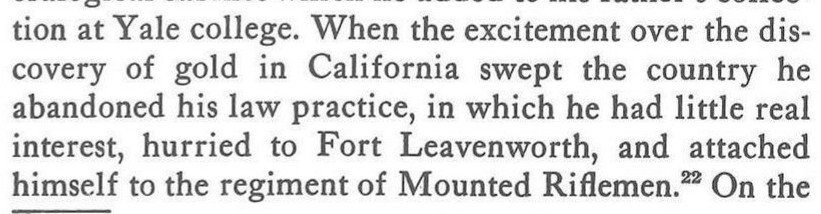
In the spring of 1849 George Gibbs was thirty three years old and, by every outward measure, settled. Harvard law, an office in New York under Prescott Hall, two published books, a name that carried a signer of the Declaration and two governors of Connecticut in it. Then the gold excitement broke over the country, and the settled man put his affairs in order, went up the Missouri, and on May 8, 1849 rode into the camp of the Regiment of Mounted Riflemen five miles out of Fort Leavenworth. The memoranda he wrote that spring, arranging his accounts before the march, survive among the family papers on this site’s own shelves. Settle, the march’s historian, put the decision in one sentence:
The regiment he attached himself to was not a stranger’s. The Mounted Riflemen were his brother’s outfit. Alfred Gibbs had gone into the regiment straight from West Point in 1846, ridden with it through the Mexican War, and won his brevets at Cerro Gordo and the Belén Gate. By 1849 Alfred was on the Pacific coast as aide to Gen. Persifor Smith, the Riflemen’s first colonel, while the regiment itself was ordered overland to garrison the Oregon road. So when George fell in with the column at Camp Sumner, he was riding west among his younger brother’s comrades of Contreras and Chapultepec, toward the coast where his brother already stood. Two Gibbs brothers converged on the Pacific that year by opposite routes, one around Panama, one across the whole width of the continent.
A general camp nuisance
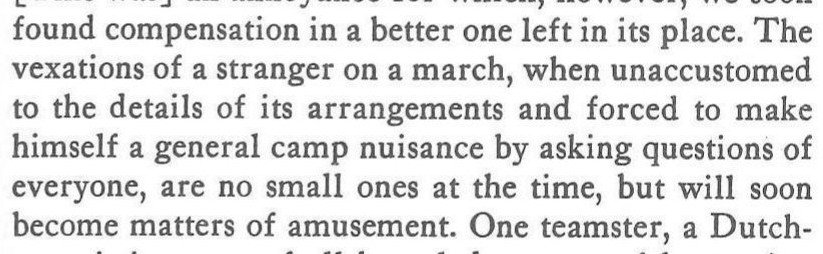
Gibbs joined the march as a civilian with his own wagon and mules, one of four such hangers-on the regiment’s rolls admit to, alongside the Boston artist William Henry Tappan. He kept a journal from the first day, and its opening pages are the confession of a New York gentleman learning, in public, how a cavalry column works:
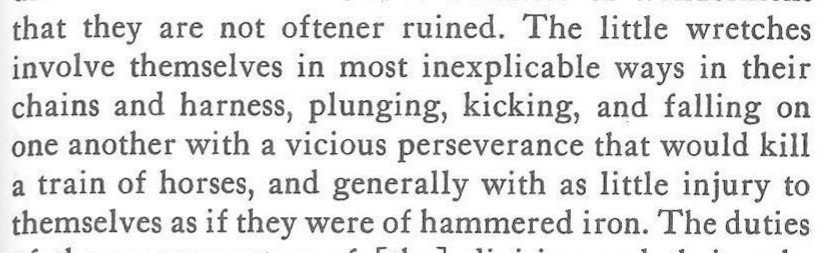
He learned fast, because he watched everything. Within three days the lawyer is writing field notes on mule teams at a bad crossing that read like a man discovering his own eye:
The road of the Forty-Niners
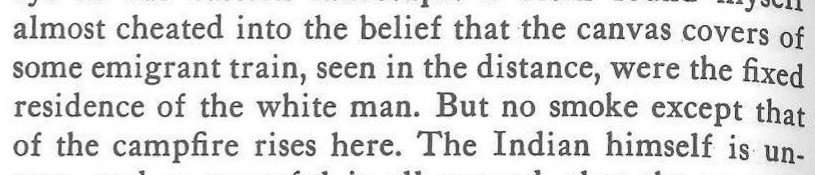
The Riflemen were the first military unit ever to ride the Oregon Trail end to end, but in 1849 they did not have the road to themselves. They shared it with the largest overland migration the continent had yet seen, and Gibbs’s diary is one of the great eyewitness records of that flood. The white wagon covers deceived him into seeing farmhouses on the empty prairie:
At Fort Kearny he sat down and did the arithmetic of the rush: nearly four thousand wagons past the post by the end of May, sixteen thousand people already gone by and half as many more behind them, not counting the Mormon road on the far bank (Gibbs, in Settle, 1940/1989, p. 301). And he saw at once what the arithmetic meant. Of the emigrants he wrote, the day he first walked among their trains: “Bitter disappointment is perhaps in store for all; distress and death for many most certainly” (p. 285).
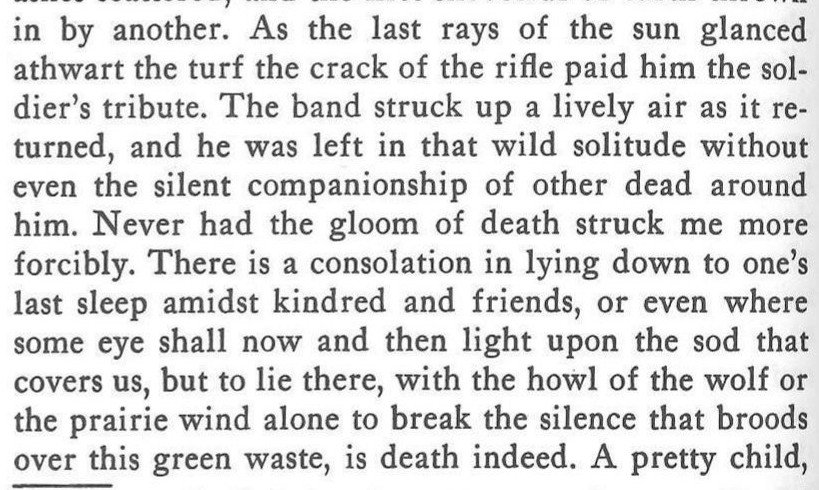
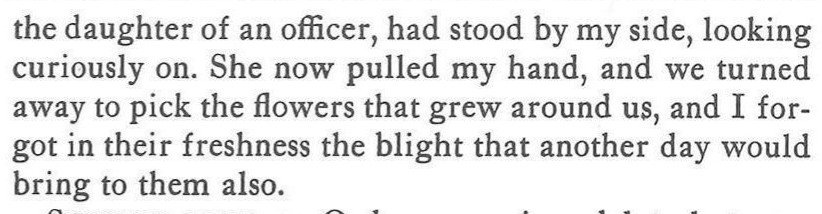
Death did not wait for California. Cholera rode the road west with the wagons, and on May 26 it took Patrick Caldwell, a farrier of company F, the column’s second man lost. What George Gibbs wrote that evening is the finest passage in his diary, and one of the finest written on the trail in that terrible season:
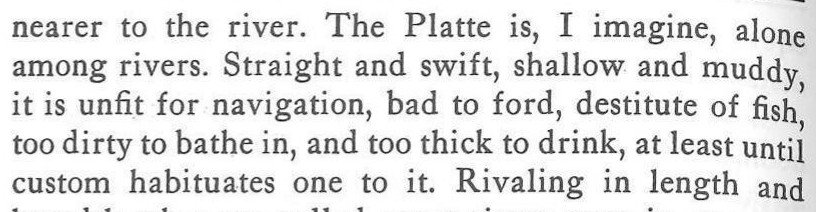
He could also be very funny. No one has written a better character assassination of a river than his verdict on the Platte:
A night in Bull Tail’s lodge
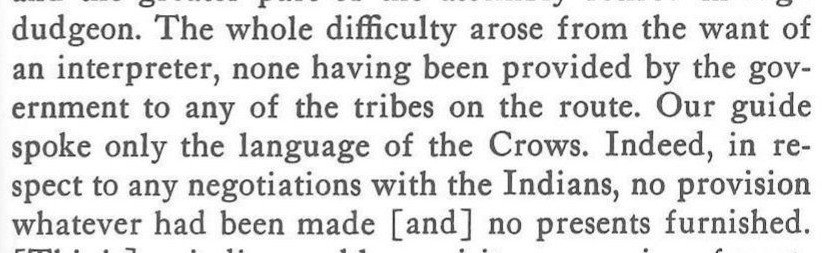
On June 11, on the South Platte, the column met a delegation of Brulé Sioux under the old chief Bull Tail, and a dispute over a horse nearly ended the meeting before it began. What Gibbs noticed was not the dispute. It was the reason for it, and his complaint reads today like the mission statement of the rest of his life:
When Colonel Loring sent the guide to the Sioux village to return the disputed horse, Gibbs went along, gladly, and spent the night. He dined in the chief’s own lodge, watched the meal served with what he recognized as ceremony, and recorded it with the mixture of warmth and exactness that would one day fill his Smithsonian ethnographies:
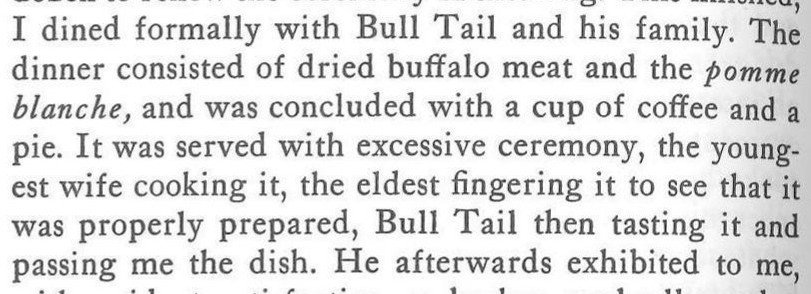
This was the future author of the Chinook jargon dictionary, the Clallam and Lummi vocabularies, and the great 1856 report on the tribes of Washington Territory, sitting down to his first recorded meal in a Native lodge, twelve years before any of those works were written. The man who would spend two decades insisting that the government learn the languages of the people it treated with met that need on his twenty-ninth day on the trail, and never let go of it. The diary’s period language, here and elsewhere, is left exactly as he wrote it in the page images; the observation underneath it is what lasted.
An ex-lawyer from New York
A week later, riding away from Courthouse Rock with Tappan after a day of sketching and climbing, Gibbs wrote the sentence that gives this essay its title, and that catches the whole strangeness of 1849 in a single scene:
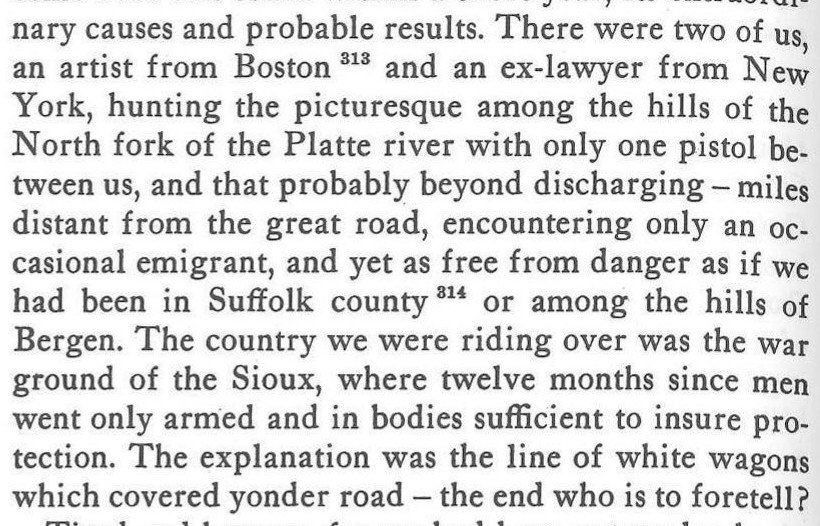
“An ex-lawyer.” He had been on the trail five weeks and the old life was already past tense. Note too what he is doing in the scene: hunting the picturesque. All along the road he and Tappan dropped behind the column to sketch, at Courthouse Rock, at Chimney Rock, at Scott’s Bluffs. The engraved plates in the printed edition of the march trace back to the drawings of the expedition’s two civilian artists, and a portfolio of the original sketches survives at the State Historical Society of Wisconsin, the same institution that preserves the Gibbs family papers this site draws on.
The diary that burned
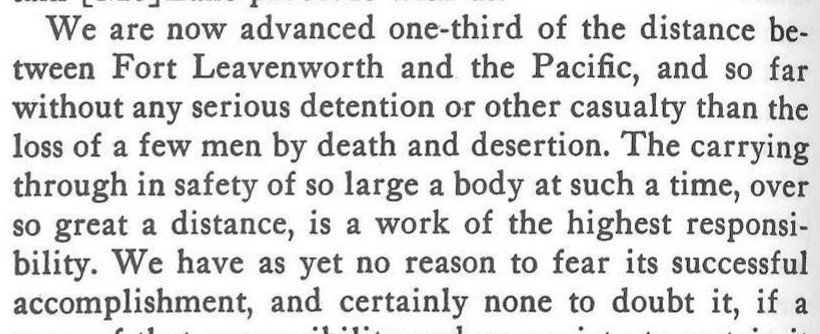
Gibbs mailed his journal east in installments, as letters to the New York Journal of Commerce. The first went back from Fort Kearny, the second from Fort Laramie, and the second nearly did not survive: it was pulled from the wreck of the steamer Algoma, burned at the St. Louis wharf in July 1849, and forwarded by the St. Louis postmaster with a note of explanation that the newspaper printed above the text (Settle, 1940/1989, p. 305). No later installment ever appeared. The diary as we have it therefore ends at Fort Laramie on June 25, 1849, one third of the way to Oregon, with George in high spirits:
Beyond Laramie: the falls that got his name on the map
For the rest of the road we see George only through other men’s eyes, chiefly those of Major Osborne Cross, the expedition’s quartermaster, whose official journal runs the whole two thousand miles. Cross mentions the civilian only once in his narrative, but the once is worth the wait. On the Snake River in mid August 1849, an Indian showed the guide a cataract ten miles off the trail, and the guide took Gibbs and Lieutenant A. J. Lindsay to see it:
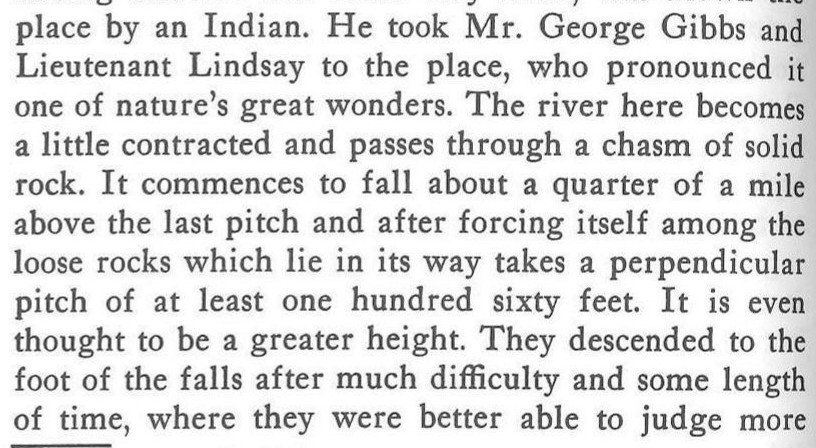
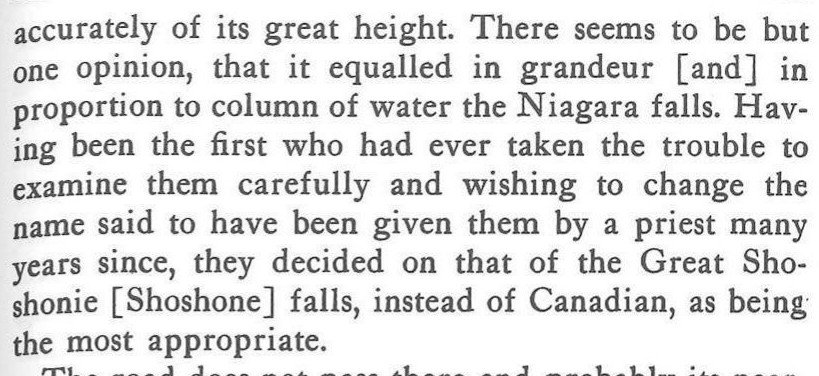
Shoshone Falls, the Niagara of the West, higher than the real Niagara, carries to this day the name George Gibbs and a lieutenant of the Riflemen chose for it, and Settle credits Gibbs with what was perhaps the first drawing of it ever made. The ex-lawyer had been on the trail three months and was already naming the landmarks of the country that would keep him.
The road that earned that keeping was brutal. Beyond Fort Hall lay seven hundred miles the quartermaster described as nearly grassless desert; the column marched through dust half a leg deep, was buried alive in drifting sand by a night wind on the Snake, and lined the road with its dead animals. Of some six hundred horses that left Fort Leavenworth, about one hundred skeletons reached Oregon City. Men were lost too, to cholera on the plains, to the Snake at a failed crossing, and six at once when a raft went over the falls of the Cascades in the dark, within days of the journey’s end. The regiment reached the Columbia in September, came down it by boat and portage, and marched into Oregon City on October 9, 1849, five months out of Fort Leavenworth (Cross and Loring, in Settle, 1940/1989).
The door the march opened
For the Mounted Riflemen, Oregon was a posting. For George Gibbs it was the rest of his life’s work, arrived at by wagon. He did not go home when the march ended. He took the deputy collectorship at Astoria in 1850; rode with the treaty commissions to the Willamette tribes in 1851 and to the Klamath country that winter, filling notebooks with vocabularies as he went; farmed at Steilacoom; and in 1853-54 joined Governor Stevens’s railroad survey, for which he wrote the geological report to Capt. George B. McClellan that this archive presents, in his own hand, page by page, in its own section. The 1856 ethnography of the Washington tribes, the boundary survey, the Smithsonian years, the dictionaries: all of it stands downstream of the day in 1849 when a bored New York lawyer heard about gold and chose, instead of the gold, the road itself.
Settle saw the difference between his two journalists plainly:

Thrilled is the right word, and it never wore off. The man who pulled a child away from a trailside grave to pick flowers, who catalogued the birds he could not waste shot on, who stayed the night in Bull Tail’s lodge because he wanted to see the village, spent the next quarter century doing exactly that, seeing, asking, and writing down, until the Smithsonian’s shelves and the maps of the Northwest carried the results. The march of the Mounted Riflemen took a regiment to Oregon. It took George Gibbs to himself.
Source and references
Cross, O. (1940). The journal of Major Osborne Cross. In R. W. Settle (Ed.), The march of the mounted riflemen: First United States military expedition to travel the full length of the Oregon Trail from Fort Leavenworth to Fort Vancouver, May to October, 1849 (pp. 31-272). The Arthur H. Clark Company. (Reprinted 1989, University of Nebraska Press, Bison Books; original journal 1849.)
Gibbs, G. (1940). The diary of George Gibbs. In R. W. Settle (Ed.), The march of the mounted riflemen (pp. 273-327). The Arthur H. Clark Company. (Reprinted 1989; original diary 1849, first published in part in the New York Journal of Commerce, July 25 and September 1, 1849.)
Loring, W. W. (1940). Official report of Colonel William Wing Loring, October 15, 1849. In R. W. Settle (Ed.), The march of the mounted riflemen (pp. 329-342). The Arthur H. Clark Company. (Reprinted 1989.)
Settle, R. W. (1940). Preface and introduction. In R. W. Settle (Ed.), The march of the mounted riflemen (pp. 11-30). The Arthur H. Clark Company. (Reprinted 1989.)
Beckham, S. D. (2020). The surprising adventures of George Gibbs on the Oregon frontier [Video presentation]. Oregon Historical Society with the Confederated Tribes of Grand Ronde.
Stevens, H. (1873). A memorial of George Gibbs. (Cited in Settle, 1940.)
Quotations are verbatim from the copy of the 1989 Bison Books printing in this project’s library, scanned June 17, 2026. Each displayed quotation is accompanied by an image of only the quoted lines as they stand in print, for verification; no complete pages of the edition are reproduced. George’s 1849 pre-departure memoranda are preserved in the Gibbs Family Papers, reel 2 (State Historical Society of Wisconsin microfilm), on this site’s Gibbs Papers hub.
See also the shorter companion essay on this site, George Gibbs and the 1849 March of the Mounted Riflemen, and the diary itself, published in full by the stages of the trail at George Gibbs’s Diary of the Mounted Riflemen, 1849.
Views: 25
Explore the evidence
View this article’s connected sources and media →
About this page
This article was brought over from AlfredGibbs.com. Its preserved text, media and citations remain available for comparison.