
Bound in at the end are George’s own corrections: errata to the geological report, Rainier’s height, the Nahchess basalt, the extinct crater, and two loose enclosures belonging to his Shoalwater Bay reconnaissance, including a memorandum on the mounds of the Skookum Chuck prairies rebutting Wilkes’s theory that they were artificial. The last frames carry the title page of the Shoalwater Bay and Puget Sound report itself, the next manuscript in the reel and a future section of this archive.
Complete transcription: scan 1577
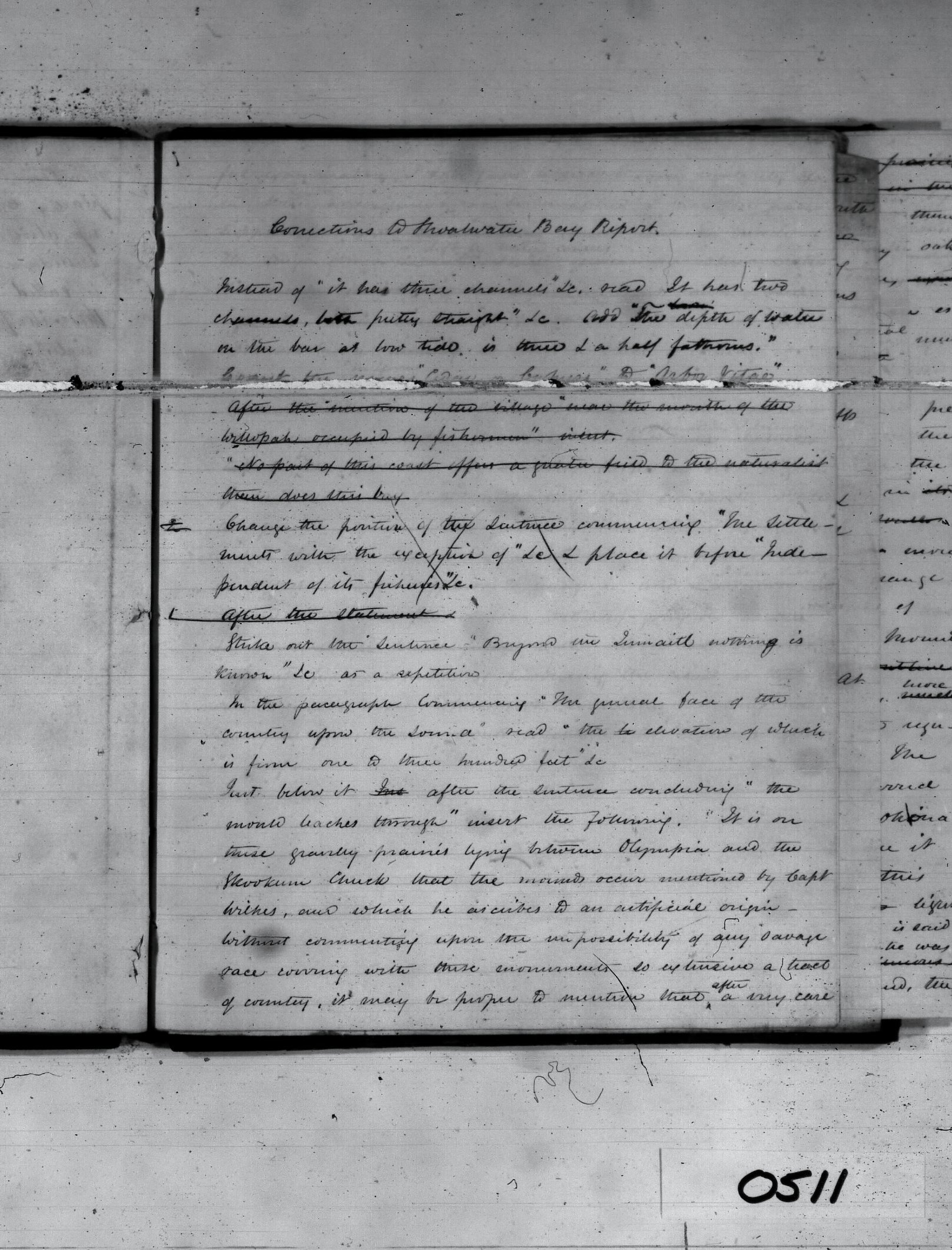
Corrections to Shoalwater Bay Report.
Instead of “it has three channels” &c. read It has two channels, both pretty straight” &c. Add “The two depth of water on the bar at low tide is three & a half fathoms.”
Correct the name[“Cedar or Cypress”?] to “Arbor Vitae” [line largely obscured by a damage band across the microfilm frame; only fragments and the closing “Arbor Vitae” are clearly legible]After the mention of the village” near the mouth of the Willopah occupied by fishermen” insert.“No part of this coast offers a greater field to the naturalist than does this bay
Change the position of the sentence commencing “The settlements with the exception of” &c & place it before “independent of its fisheries”&c. [this entry cancelled with a large X]After the statement
Strike out the sentence “Beyond the [Quinaitl?] nothing is known” &c as a repetition
In the paragraph commencing “The general face of the country upon the Sound” read “the to elevation of which is from one to three hundred feet”&c
Just below it In after the sentence concluding “the mould reaches through” insert the following. “It is on these gravelly prairies lying between Olympia and the Skookum Chuck that the mounds occur mentioned by Capt Wilkes, and which he ascribes to an artificial origin – Without commenting upon the impossibility of any savage race covering with these monuments so extensive a tract of country, it may be proper to mention that after a very care
Complete transcription: scan 1578
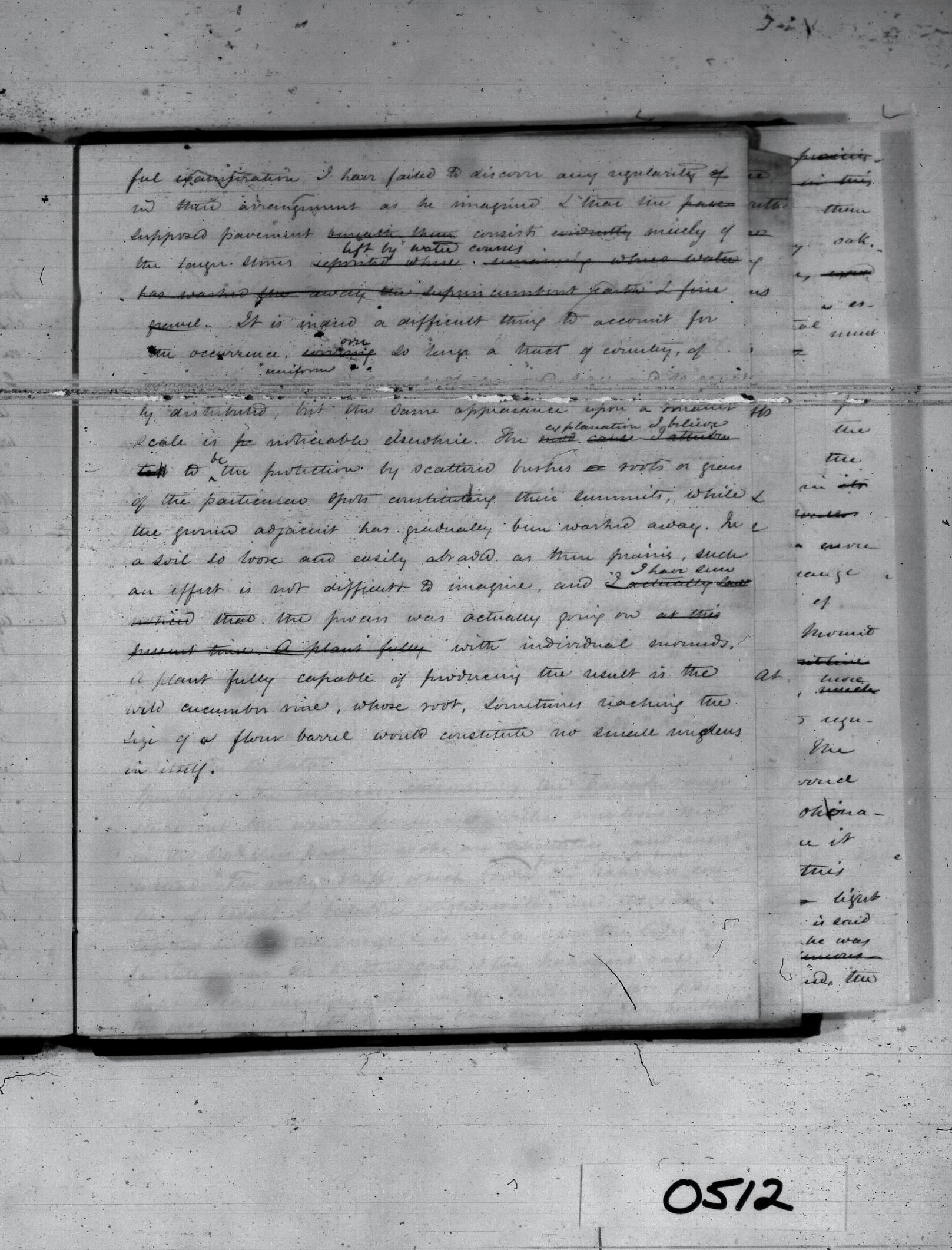
ful examination I have failed to discover any regularity of in their arrangement as he imagined & that the pave supposed pavement beneath them consists evidently merely of the larger stones separated where? left by water courses remaining where water has washed them away the superincumbent earth & fine gravel. It is indeed a difficult thing to account for the occurrence, [illegible] over so large a tract of country, of uniform [one line largely obscured by a damage band across the microfilm frame] ly distributed, but the same appearance upon a smaller scale is for noticeable elsewhere. The said cause I attributed explanation I believe to be the protection by scattered bushes or roots or grass of the particular spots constituting their summits, while the ground adjacent has gradually been washed away. In a soil so loose and easily abraded as these prairies, such an effect is not difficult to imagine, and I actually have noticed I have seen that the process was actually going on at this present time. A plant fully with individual mounds. A plant fully capable of producing the result is the wild cucumber vine, whose root, sometimes reaching the size of a flour barrel would constitute no small nucleus in itself.
Complete transcription: scan 1579
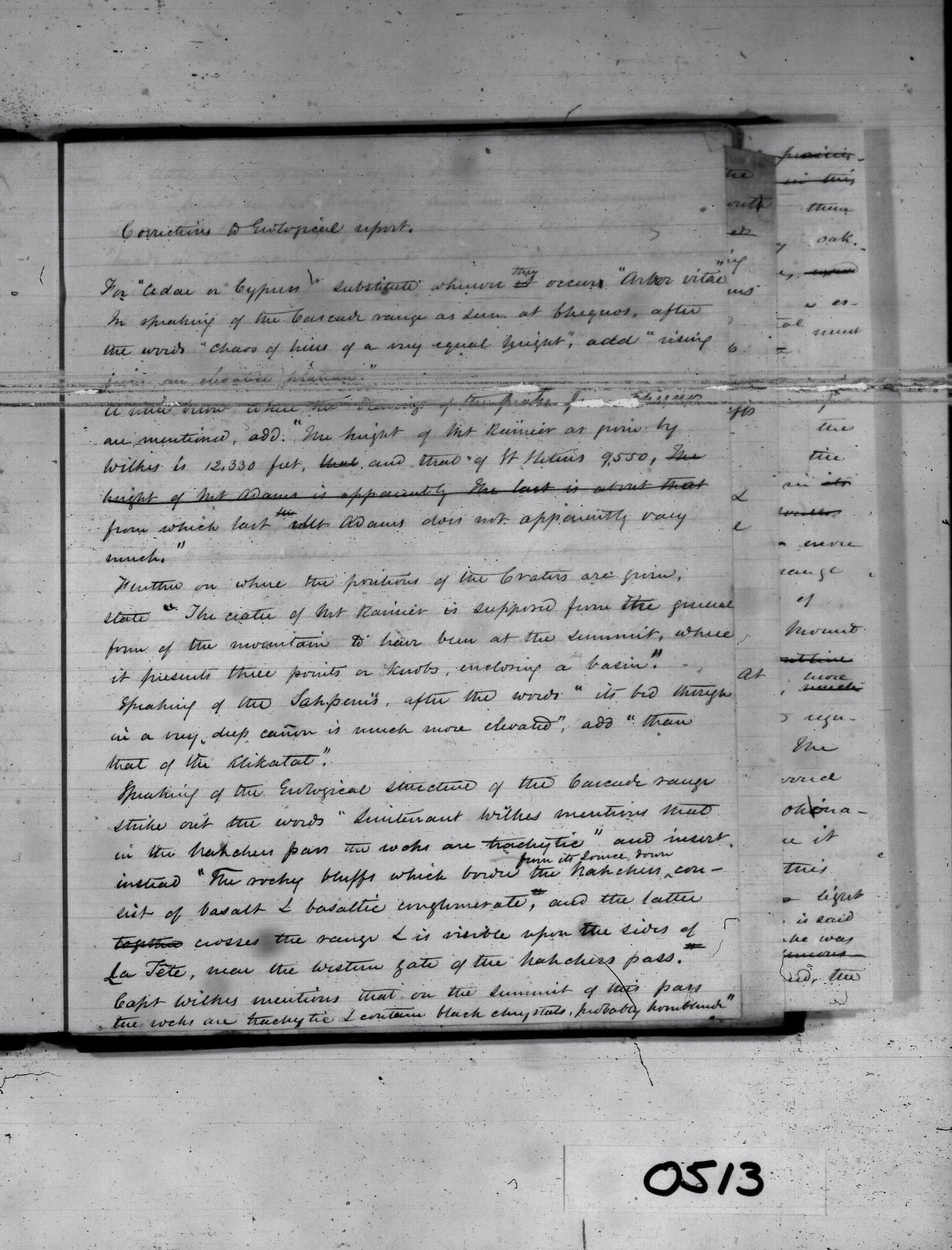
Corrections to Geological report.
For “Cedar or Cypress” substitute wherever this they occur “Arbor vitae”
In speaking of the Cascade range as seen at [Chequos?], after the words “chaos of hills of a very equal height”, add “rising from an elevated plateau.”
A little [below?] where the [naming?] of the peaks [three or four words illegible — damage band across the microfilm frame] are mentioned, add: “The height of Mt Rainier as given by Wilkes is 12,330 feet, that and that of St Helens 9,550, The height of Mt Adams is apparently The last is about that from which last the Mt Adams does not apparently vary much.”
Further on where the positions of the Craters are given, state “The crater of Mt Rainier is supposed from the general form of the mountain to have been at the summit, where it presents three points or knobs, enclosing a basin.”
Speaking of the [Sahpenis?], after the words “its bed through in a very deep cañon is much more elevated”, add “than that of the Klikatat”.
Speaking of the Geological structure of the Cascade range strike out the words “Lieutenant Wilkes mentions that in the Nahchess pass the rocks are trachytic” and insert instead “The rocky bluffs which border the Nahchess from its source down consist of basalt & basaltic conglomerate,” and the latter together crosses the range & is visible upon the sides of La Tête, near the western gate of the Nahchess pass.” Capt Wilkes mentions that on the summit of this pass the rocks are trachytic & contain black chrystals, probably hornblende”
Complete transcription: scan 1580
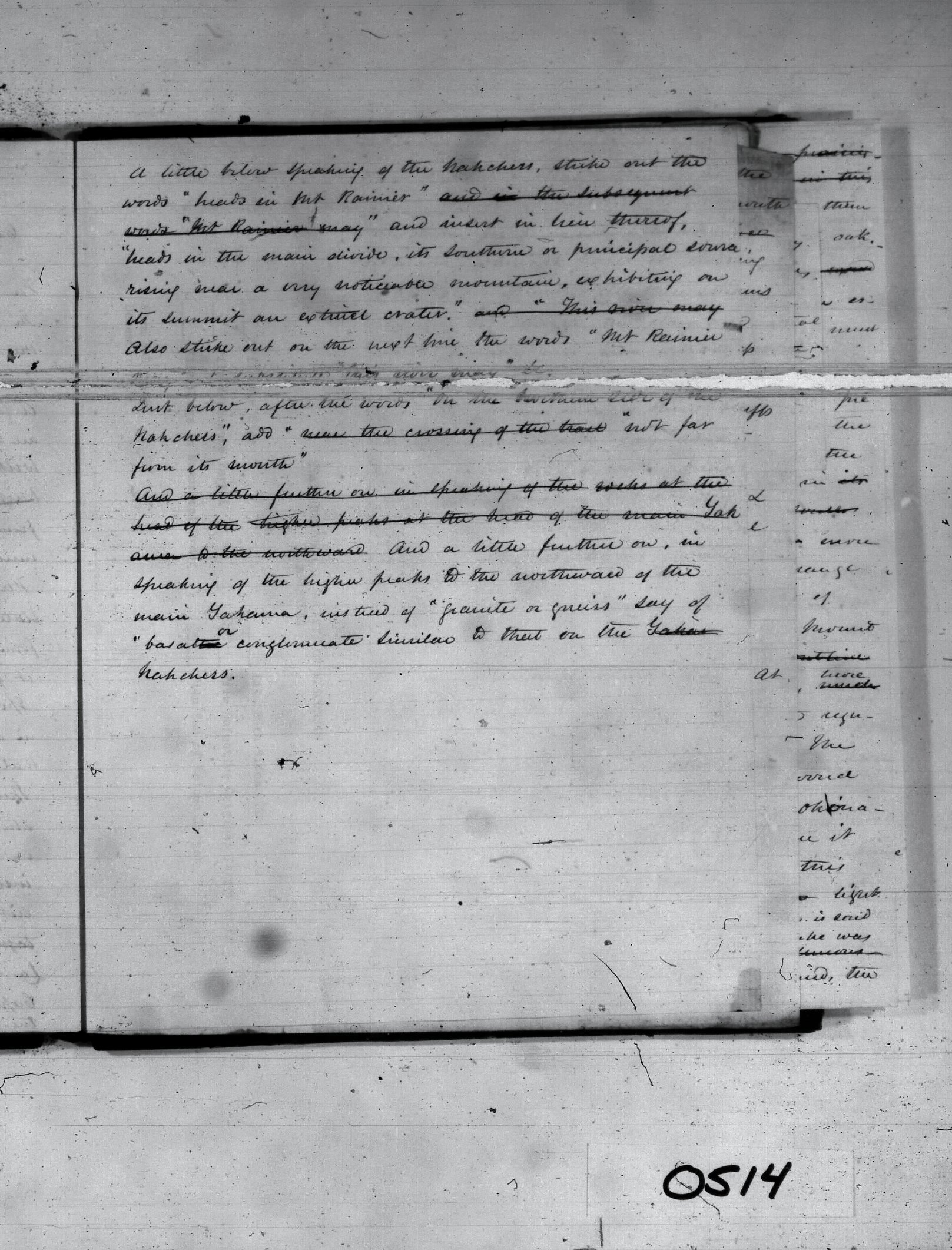
A little below speaking of the Nahchess, strike out the words “heads in Mt Rainier” and in the subsequent words “Mt Rainier may” and insert in lieu thereof, “heads in the main divide, its Southern or principal source rising near a very noticeable mountain, exhibiting on its summit an extinct crater.” and “This river may Also strike out on the next line the words “Mt Rainier [remainder of line obscured by a damage band across the microfilm frame; legible fragments: … “this river may” &c.]
Just below, after the words “on the [southern?] side of the Nahchess”, add “near the crossing of the trail “not far from its mouth”And a little further on in speaking of the rocks at the head of the higher peaks at the head of the main Yak ama to the northward And a little further on, in speaking of the higher peaks to the northward of the main Yakama, instead of “granite or gneiss” say of “basalt or conglomerate similar to that on the Yakim Nahchess.
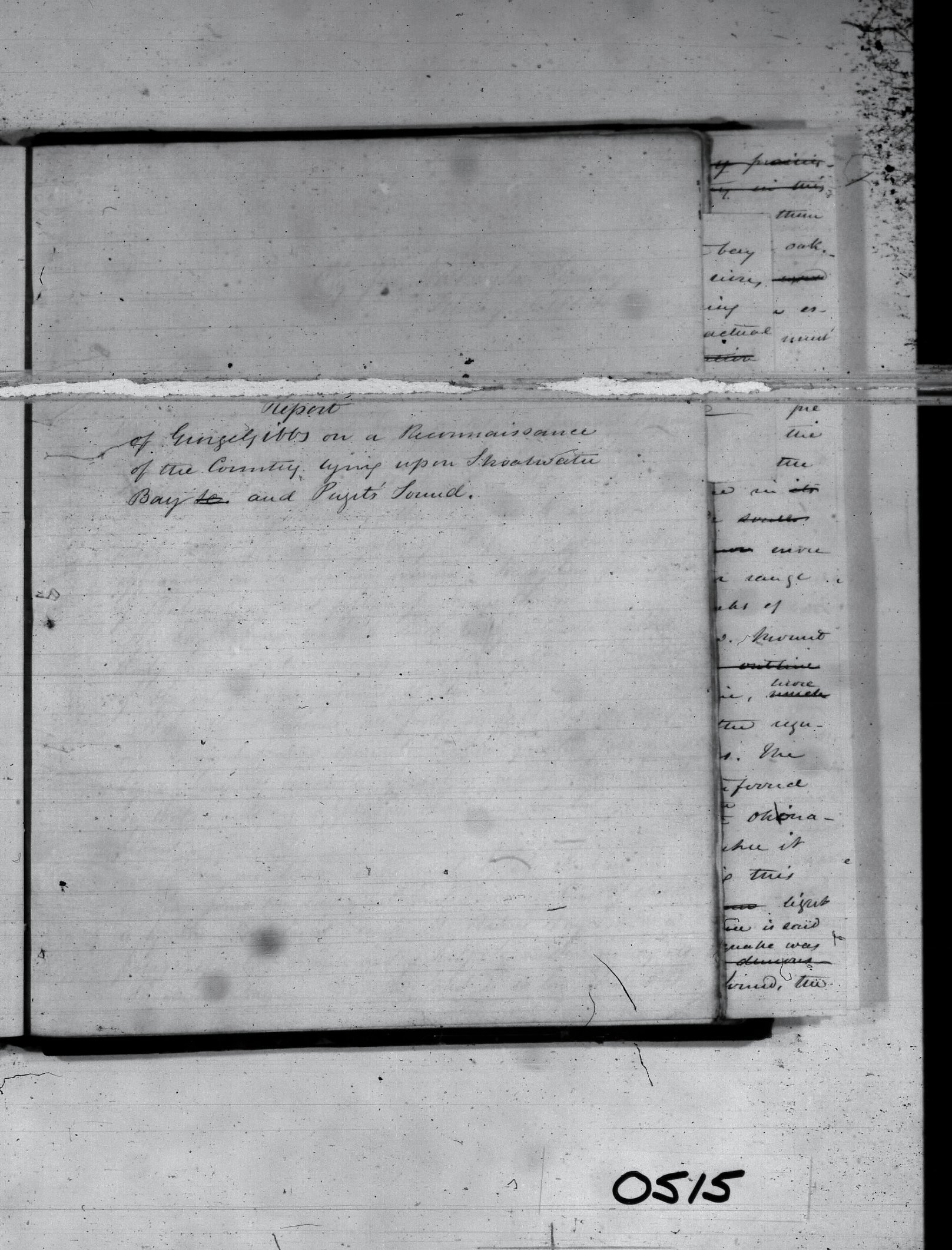
Complete transcription: scan 1581
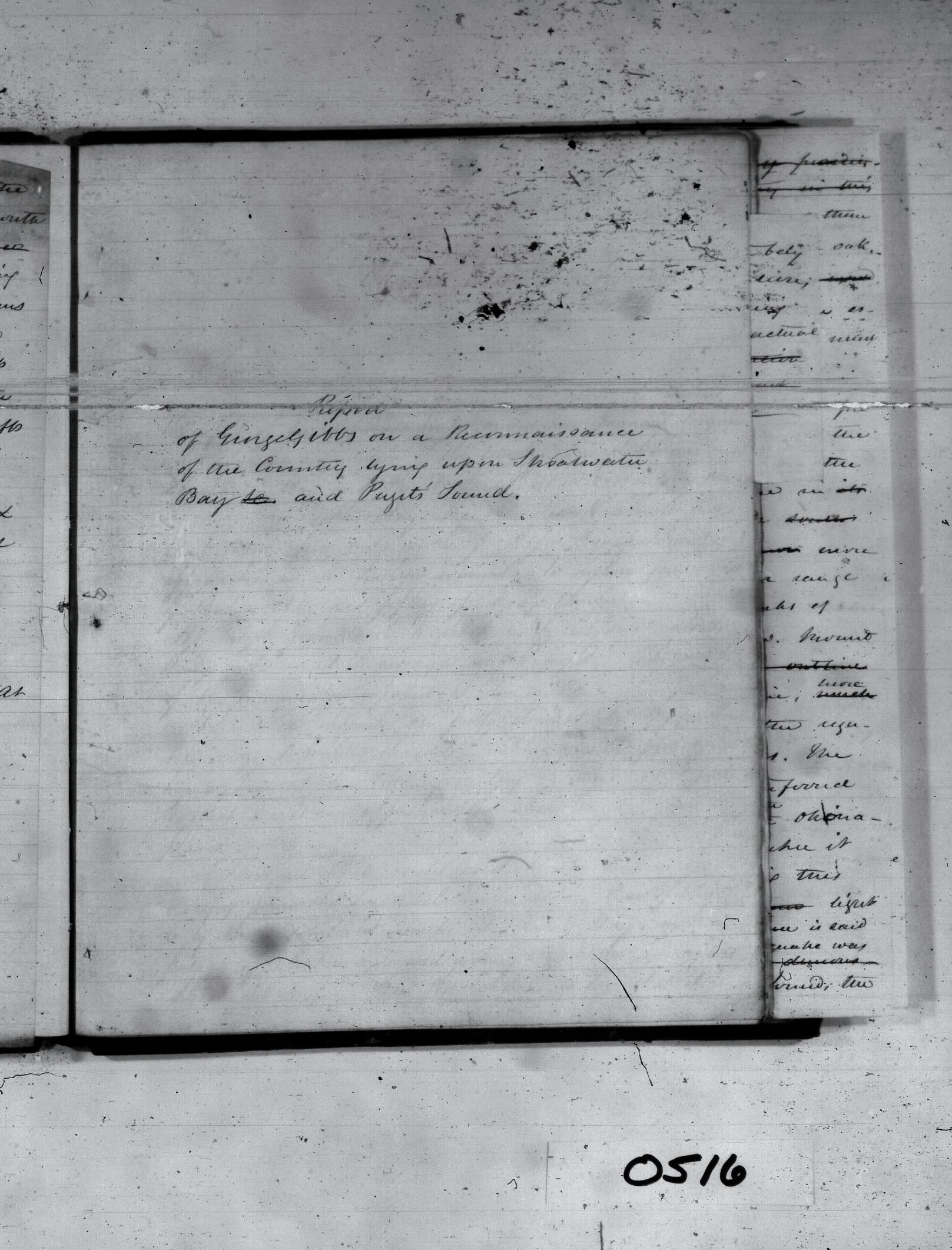
Report of George Gibbs on a Reconnaissance of the Country lying upon Shoalwater Bay &c and Puget’s Sound.
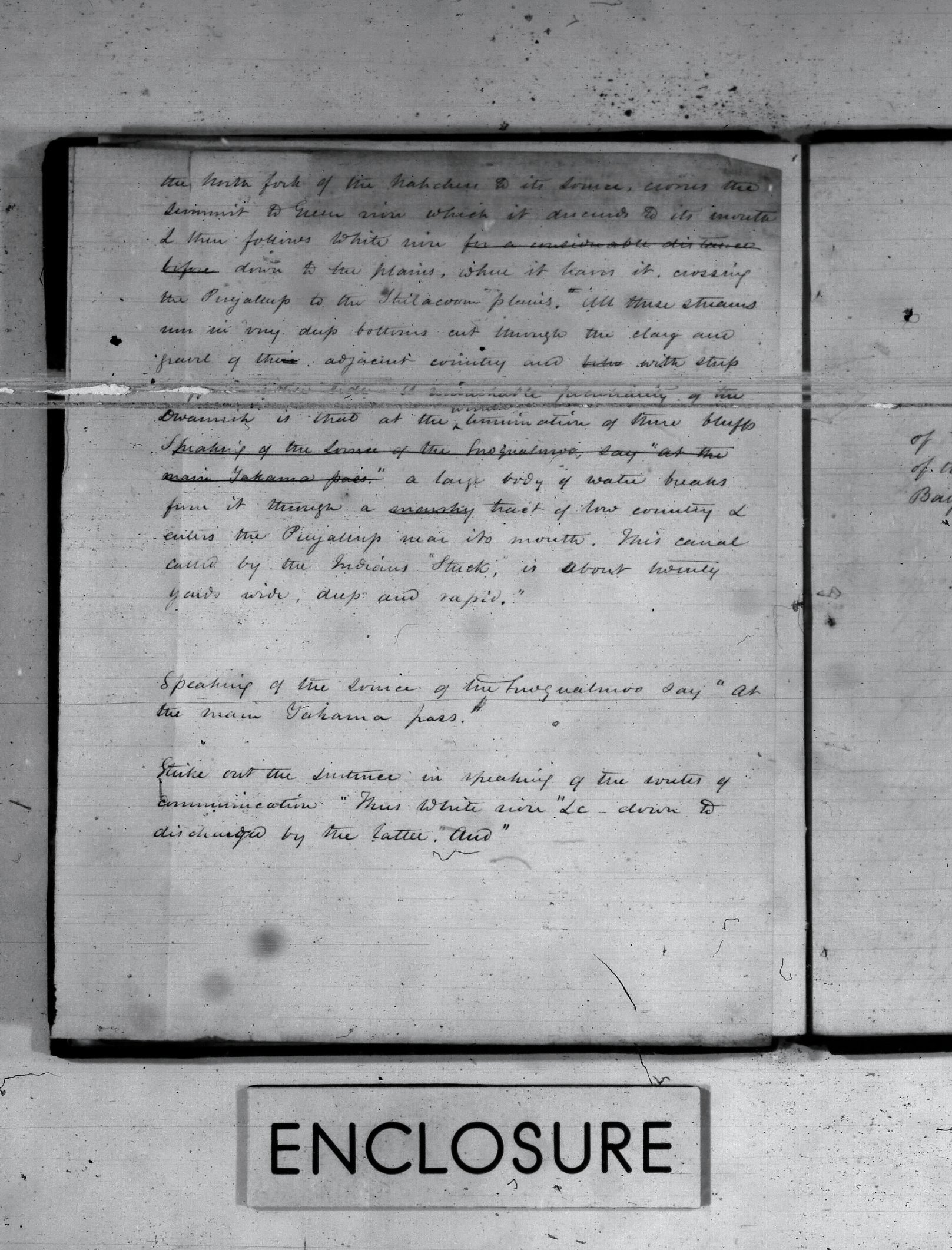
Complete transcription: scan 1582
the North fork of the Nahchess to its source, crosses the summit to Green river which it descends to its mouth & then follows White river for a considerable distance before down to the plains, where it leaves it, crossing the Puyallup to the Steilacoom plains.” All these streams run in very deep bottoms cut through the clay and gravel of the their adjacent country and below with steep [banks?] on either side. A remarkable peculiarity of the [line partly obscured by a damage band across the microfilm frame] Dwamish is that at the [western?] termination of these bluffs Speaking of the Source of the Snoqualmoo, say “at the main Yakama pass.” a large body of water breaks from it through a marshy tract of low country & enters the Puyallup near its mouth. This canal called by the Indians “Stuck,” is about twenty yards wide, deep and rapid.”
Speaking of the Source of the Snoqualmoo say “At the main Yakama pass.”
Strike out the sentence in speaking of the routes of communication “Thus White river”&c – down to discharged by the latter. And”
Views: 16
Explore the evidence
View this article’s connected sources and media →
About this page
This article was brought over from AlfredGibbs.com. Its preserved text, media and citations remain available for comparison.