
In the summer of 2026 a search of the Gilder Lehrman Institute’s catalogue turned up a small cluster of documents that reach into nearly every chapter of Alfred Gibbs’s story: his own hand in three letters, the general he served in Mexico, the orders of the army of occupation, the Confederate cavalryman who fought him for a year, the frontier he garrisoned, and his brother George at his librarian’s desk. Every one is shown below as a scan of the original, with its text transcribed beside it. The letters, written in the eighteen-forties through eighteen-sixties, are in the public domain; the transcriptions are ours, and are completed document by document.
❦In Alfred’s Own Hand
Three autograph letters signed by Gibbs himself — the soldier off duty, and the soldier seeking a command.
GLC02465.12 · 1 page
Alfred Gibbs to Adjutant-General Thomas Hillhouse
Fort Wayne, Michigan, August 27, 1862 — written the very day his exchange was declared, offering New York his sword for command of a regiment.
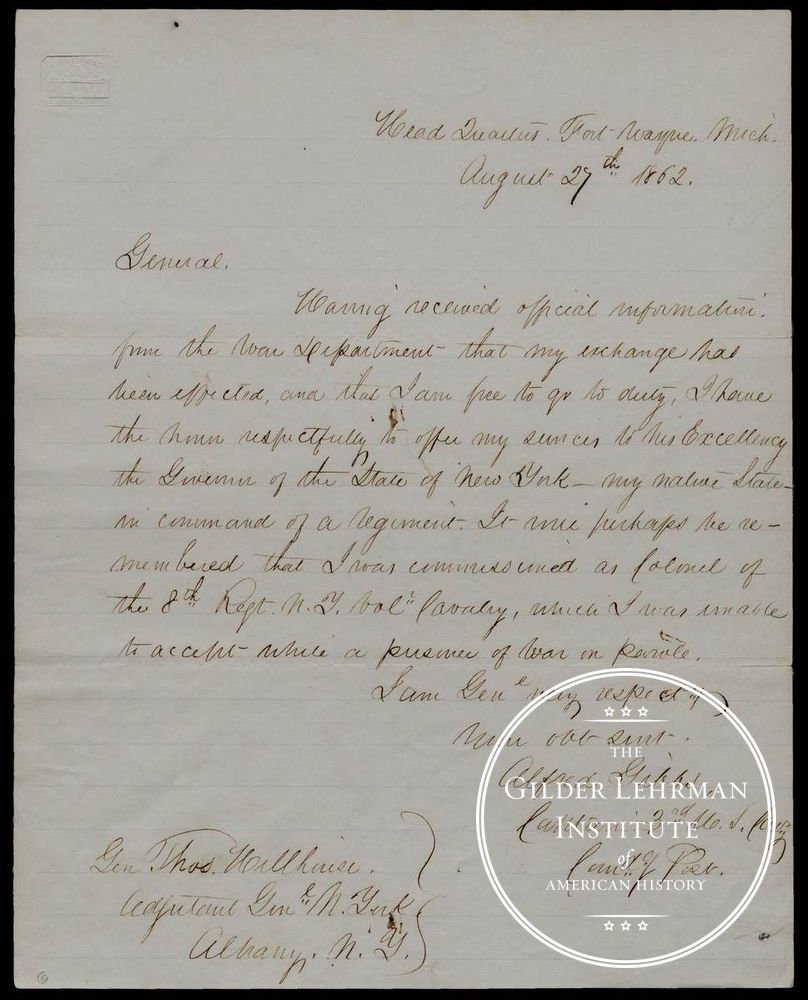
Head Quarters, Fort Wayne, Mich.
August 27th 1862.
General,
Having received official information from the War Department that my exchange has been effected, and that I am free to go to duty, I have the honor respectfully to offer my services to His Excellency the Governor of the State of New York - my native State - in command of a Regiment. It will perhaps be remembered that I was commissioned as Colonel of the 8th Regt. N. Y. Vol’r Cavalry, which I was unable to accept while a prisoner of war on parole.
I am, General, very respectfully, Your obt servt,
Alfred Gibbs,
Captain, Third U. S. Cavalry, Commanding Post.
[Addressed:] Gen. Thos. Hillhouse, Adjutant General N. York, Albany, N. Y.
Original in the Gilder Lehrman Collection, New-York Historical Society (GLC02465.12).
GLC05033 · 3 pages
Alfred Gibbs to Frederic S. Cozzens, March 1, 1864
From camp near Culpeper. Gibbs at his most playful, passing himself off to a Presbyterian parson on the Washington train as “a brevet Bishop in the Army of the Potomac.”
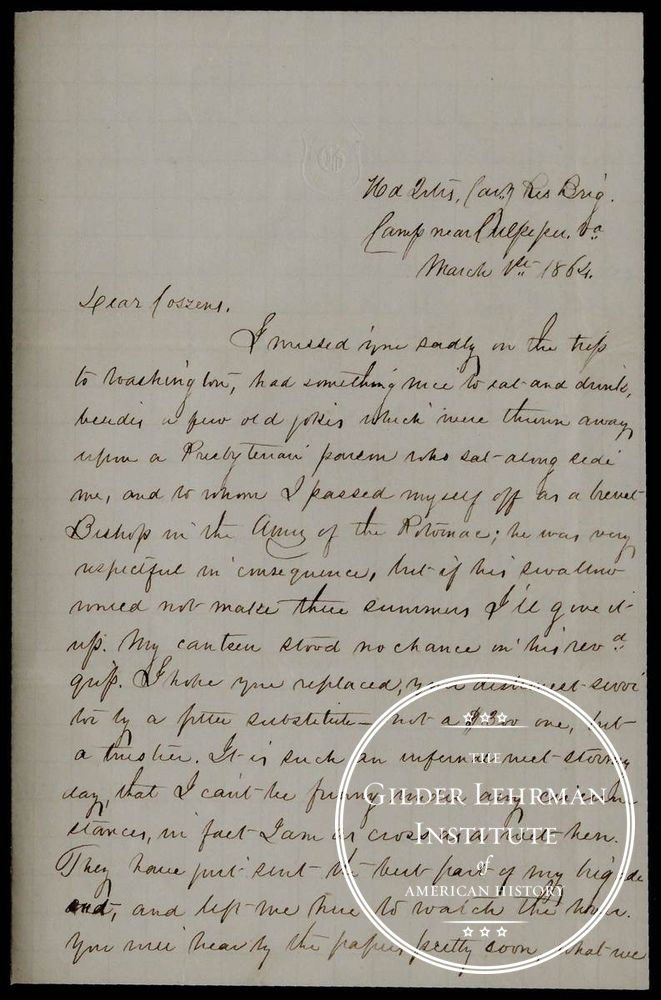
Head Quarters, Cavalry Reserve Brigade
Camp near Culpeper, Va.
March 1st 1864.
Dear Cozzens.
I missed you sadly on the trip to Washington, had something nice to eat and drink, besides a few old jokes which were thrown away upon a Presbyterian parson who sat alongside me, and to whom I passed myself off as a brevet Bishop in the Army of the Potomac; he was very respectful in consequence, but if his swallow would not match three sermons I’ll give it up. My canteen stood no chance in his reverend grip. I hope you replaced your disconnected [servitor?] by a fitter substitute - not a [gayer?] one, but a truer. It is such an infernal wet stormy day that I can’t be funny under the circumstances, in fact I am in cross humor then. They have just sent the best part of my brigade, and left me here to watch the [rest]. You will hear by the papers pretty soon what we are doing up here.
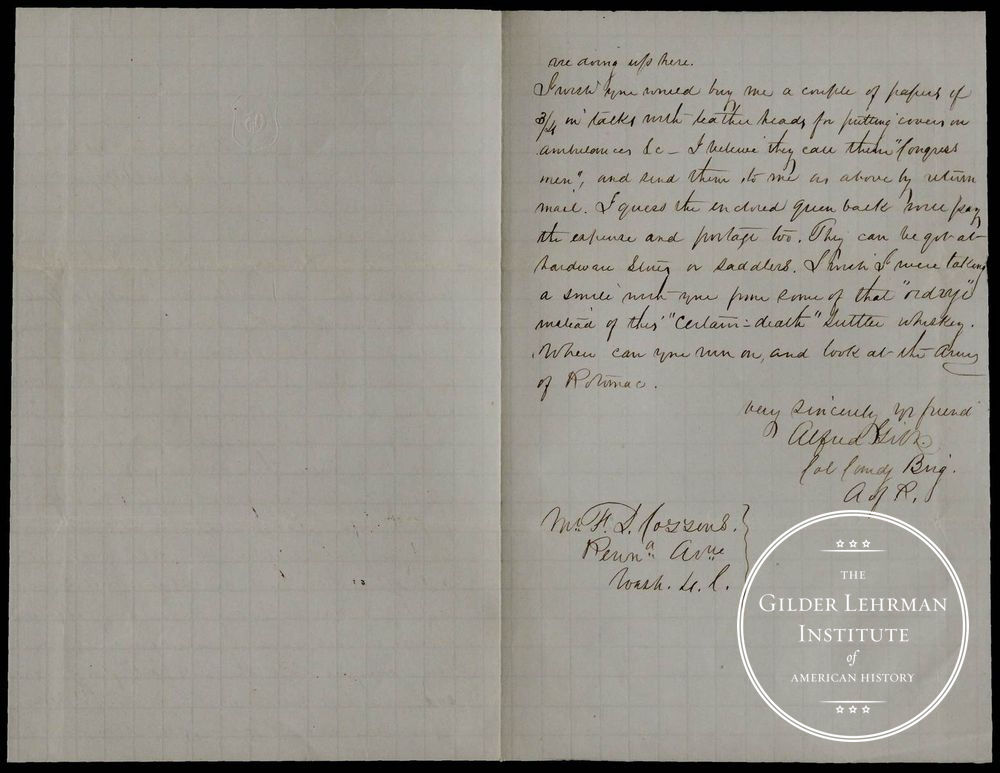
I wish you would buy me a couple of papers of 3/4 in’ tacks with leather heads for putting covers on ambulances &c - I believe they call them “Congressmen,” and send them to me as above by return mail. I guess the enclosed green back will pay the expense and postage too. They can be got at hardware, tin, or saddlers. I wish I were taking a smile with you from some of that “[ordraye?]” instead of this “certain-death” sutler whiskey. When can you run on, and look at the Army of Potomac.
Very sincerely yr friend, Alfred Gibbs, Col Comdg Brig., A. of P.
[Addressed:] Mr. F. S. Cozzens, Penna Ave, Wash. D. C.
Original in the Gilder Lehrman Collection, New-York Historical Society (GLC05033).
GLC02465.11 · 1 page
Alfred Gibbs to “Ancient Sparrowgrass,” April 6, 1864
A comic reply to his friend Cozzens (whose pen name was Sparrowgrass), inviting him to visit the army by rail to “Gibbs Station” beyond Culpeper.
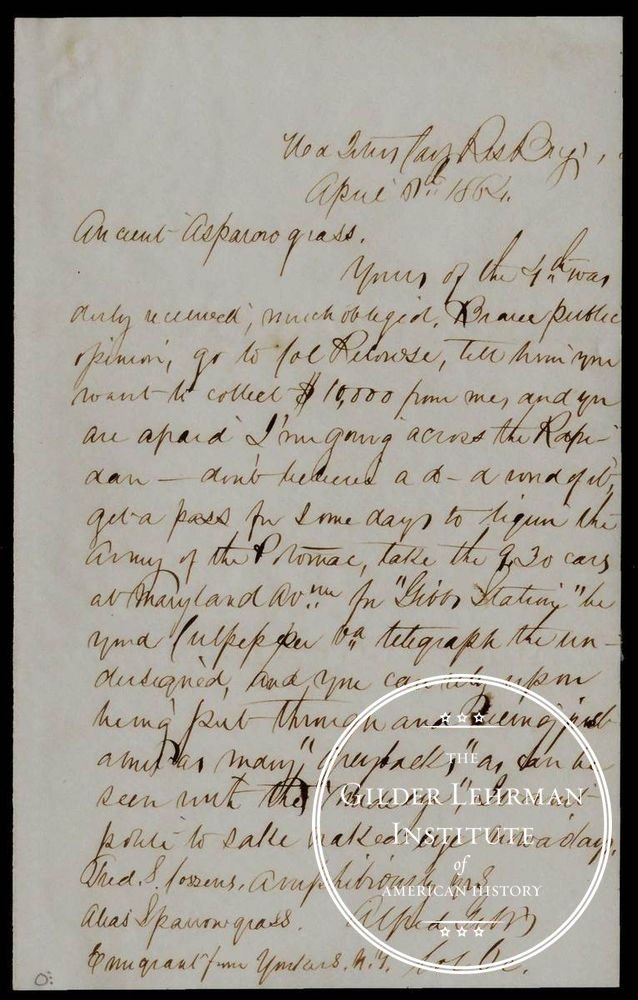
Head Quarters, Cavalry Reserve Brigade
April 6th 1864.
Ancient Asparowgrass.
Yours of the 4th was duly received; much obliged. Brave public opinion; go to Col [Rebowse?], tell him you want to collect $10,000 from me, and you are afraid I’m going across the Rapidan - don’t believe a d-a word of it, get a pass for some days to [join] the Army of the Potomac, take the 7.30 cars at Maryland Av’nue for “Gibbs Station” beyond Culpeper Va, telegraph the undersigned, and you can count upon being put through and being fed amid as many “greenback[s]” as can be seen with the [several words illegible] a day.
Fred. S. Cozzens, Amphibious [illegible]. Alias Sparrow grass. Emigrant from Yonkers, N. Y. — Alfred Gibbs, Col [Comdg].
[Docket:] Col Alfred Gibbs, Culpepper Va, April 6/64.
Original in the Gilder Lehrman Collection, New-York Historical Society (GLC02465.11).
The Occupation of Mexico City, 1847
The campaign that made him, seen through his commanding general’s pen and the orders of the army he served.
GLC05128 · 6 pages
Persifor F. Smith to R. Welman Nichols, October 26, 1847
The general under whom Gibbs served gives a firsthand account of the capture of Mexico City, the campaign in which Gibbs won two brevets.
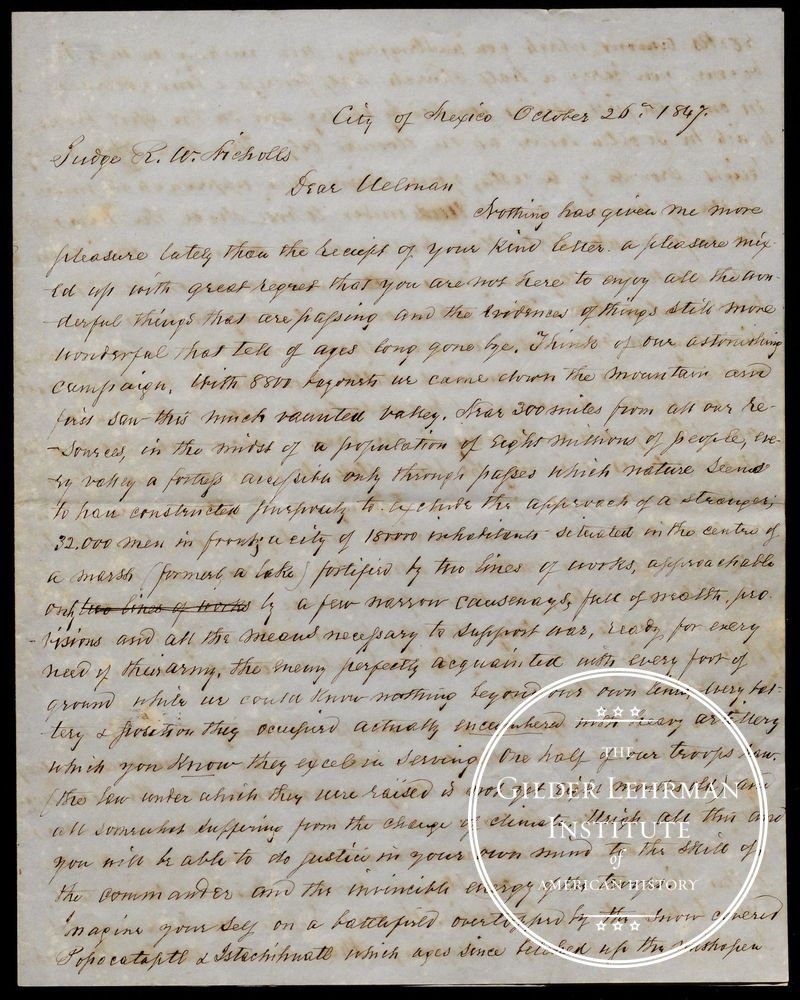
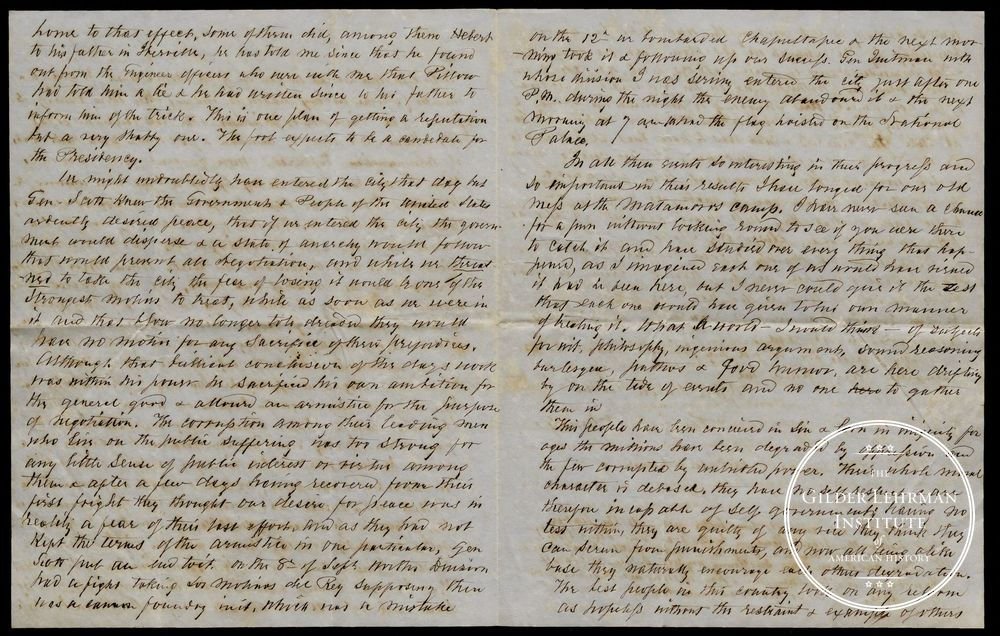
City of Mexico, October 26th 1847.
Judge R. W. Nicholls
Dear Welman,
Nothing has given me more pleasure lately than the receipt of your kind letter — a pleasure mixed up with great regret that you are not here to enjoy all the wonderful things that are passing, and the evidences of things still more wonderful that tell of ages long gone bye. Think of our astonishing campaign. With 8800 bayonets we came down the mountain and passed into this much vaunted valley, near 300 miles from all our resources, in the midst of a population of eight millions of people, [over so vast?] a fortress, accessible only through passes which nature seems to have constructed purposely to [resist] the approach of a stranger; 32,000 men in front of a city of 180,000 inhabitants, situated in the centre of a marsh (formerly a lake), fortified by two lines of works, approachable only by a few narrow causeways, full of wealth, provisions and all the means necessary to support war, ready for every need of their army; the enemy perfectly acquainted with every foot of ground while we could know nothing beyond our own lines. Every battery & position they occupied actually encumbered with heavy artillery, which you know they excel in serving. One half our troops raw … and all somewhat suffering from the change of climate. With all this, you will be able to do justice in your own mind to the skill of the commander and the invincible energy [of our men].
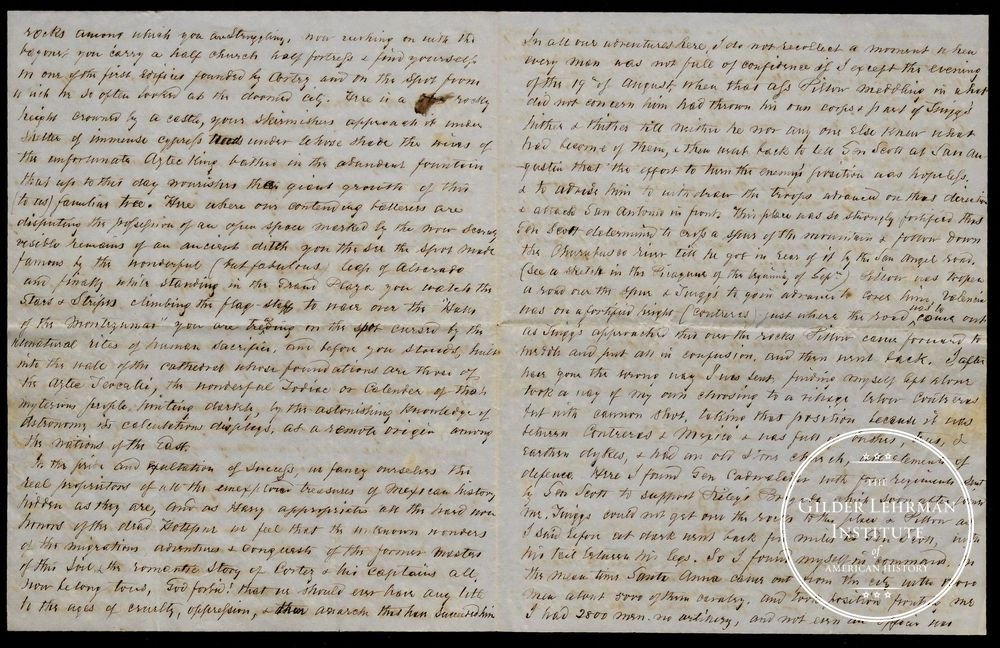
Imagine yourself on a battlefield overlooked by the snow-covered Popocatapetl & Iztaccihuatl, which ages since looked upon the like phenomenon, rocks among which you, astonishingly, now rushing on with the bayonet, now carry a half church, half fortress, and find yourself in one of the first edifices founded by Cortez, and on the spot from which he so often looked at the doomed city. There is a rocky height crowned by a castle; your skirmishers approach it under shelter of immense cypress trees, under whose shade the ruins of the unfortunate Aztec King bathe in the abundant fountain that, to this day, nourishes their giant growth. There, where our contending batteries are disputing the possession of an open space marked by the now scarcely visible remains of an ancient ditch, is the spot made famous by the wonderful (but fabulous) leap of Alvarado; and finally, while standing in the Grand Plaza, you watch the Stars & Stripes climbing the flag-staff to wave over the ‘Halls of the Montezumas.’ You are treading on the spot cursed by the [historical] rites of human sacrifice; and, before you [stand], hewn into the wall of the cathedral, whose foundations are those of the Aztec Teocallis, the wonderful Toltec or Calendar [stone] of that mysterious people, [uniting clearly], by the astonishing knowledge of Astronomy its calendars display, [at] a remote origin among the nations of the East.
[The following passage narrates the battle of Contreras (Padierna), August 19–20, 1847, which Smith illustrates with a sketch-map. His rapid hand makes several words uncertain; these are marked.]
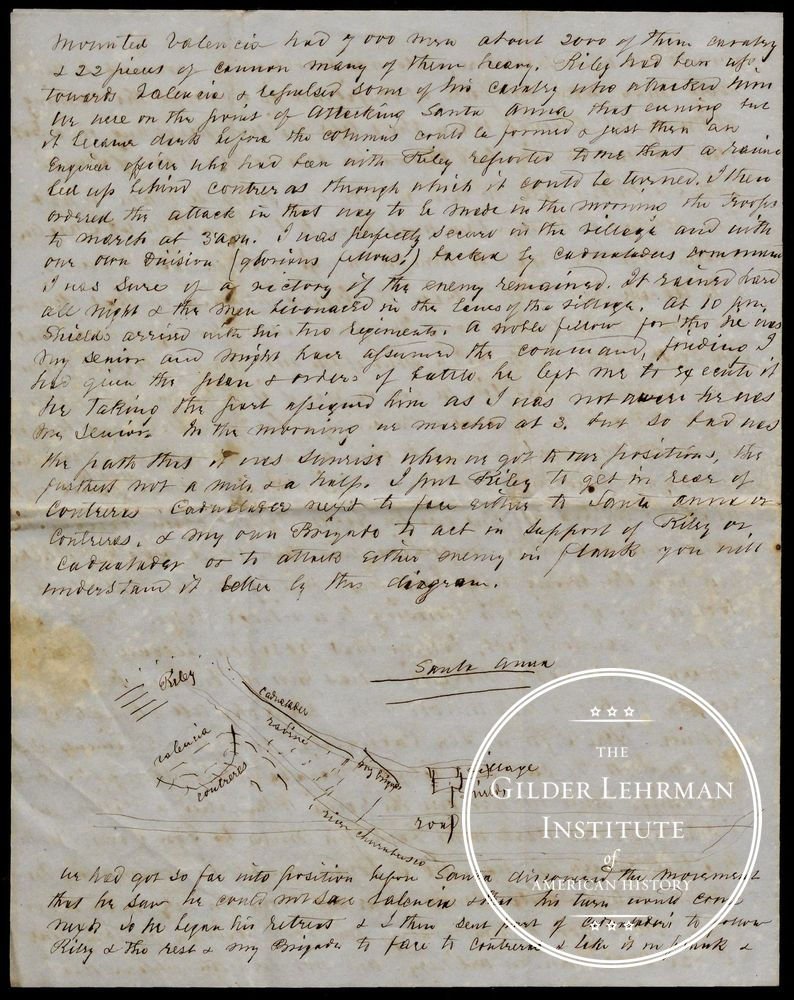
In all our adventures here, I do not recollect a moment when every man was not full of confidence, except the evening of the 19th of August, when that ass Pillow, [meddling] in what did not concern him, had thrown his own corps & part of Twiggs’ hither & thither till neither he nor any one else knew what had become of them; then [went] back to old Gen Scott at San Augustin [to say] that the effort to turn the enemy’s position was hopeless, & to advise him to withdraw the troops advanced in that direction & attack San Antonio in front. This place was so strongly fortified that Gen Scott determined to cross a spur of the mountain & follow down the [Churubusco] river till he got in rear of it by the San Angel road. Pillow was to open a road on the spur, & Twiggs to gain [ground] to cover him. Valencia was on a fortified height [of centuries], just where the road [came] out as Twiggs approached; but [as] our [troops came under fire] Pillow came forward to meddle and put all in confusion, and then went back. [Seeing] him gone the wrong way, I was sent; finding myself left alone, [I] took a way of my own choosing to a village whose cross-roads … [I held] that position because it was between Contreras & Mexico, & was full [of hedges], [lanes], & earthen dykes, & had an old Stone church, with elements of defence. There I found Gen Cadwalader with four regiments, sent by Gen Scott to support Riley’s Brigade … So I found myself in command. In the mean time Santa Anna comes out from the city with 3000 men, about 3000 of them cavalry … I had 2800 men, no artillery, and not even an appearance [of support]. Mounted Valencia had 7000 men, about 2000 of them cavalry & 22 pieces of cannon, many of them heavy. Riley had advanced towards Valencia & repulsed some of his cavalry who attacked him. We were on the point of attacking Santa Anna this evening, but it became dark before the columns could be formed; & just then an Engineer officer who had been with Riley reported to me that a ravine led up behind Contreras, through which it could be turned. I then ordered the attack in that way to be made in the morning, the troops to march at 3 a.m. I was perfectly secure in the village, and, with my own Division (Shields’ joining) backed by Cadwalader’s command, I was sure of a victory if the enemy remained. It rained hard all night, & the men bivouacked in the lanes of the village. At 10 p.m. Shields arrived with his two regiments — a noble fellow, for though he was my senior and might have assumed the command, finding I had given the plan & orders of battle, he left me to execute it, [taking] the part assigned him, as I was now never [aware] he was my senior. In the morning we marched at 3, but so bad was the path that it was Sunrise when we got to our positions, the furthest not a mile & a half. I put Riley to get in rear of Contreras; Cadwalader next to face either to Santa Anna or Contreras, & my own Brigade to act in support of Riley, or Cadwalader, or to attack either enemy in flank — you will understand it better by the diagram.
[Sketch-map: Riley, Cadwalader, and Smith’s brigade above Contreras and Valencia, with Santa Anna’s force, the village, and the Churubusco river.]
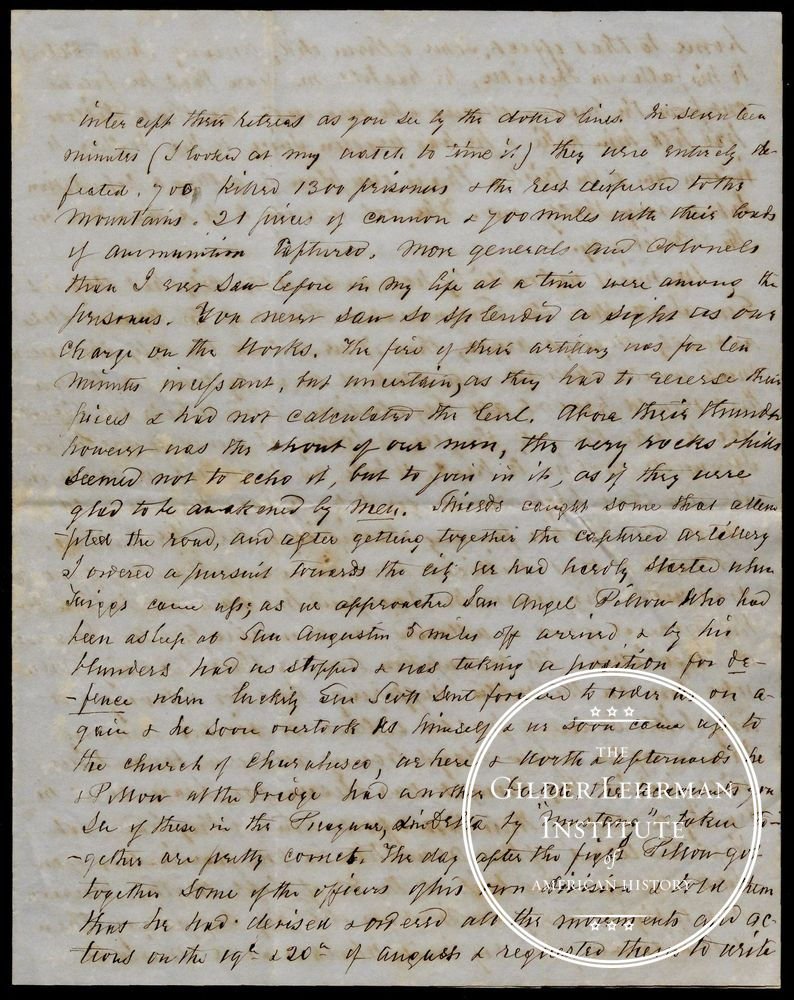
We had got so far into position before Santa Anna discovered the movement, that he saw he could not save Valencia unless his own [troops] came next, or he began his retreat; & I then sent part of Cadwalader’s to cover Riley, & the rest & my Brigade to face to Contreras & take it in flank & intercept their retreat, as you see by the dotted lines. In seventeen minutes (I looked at my watch to time it) they were entirely defeated. 700 killed, 1300 prisoners, & the rest dispersed to the mountains. 21 pieces of cannon & 700 mules with their loads of ammunition captured. More generals and colonels than I ever saw before in my life at a time were among the prisoners. You never saw so splendid a sight as our charge on the works. The fire of their artillery was for ten minutes incessant, but uncertain, as they had to reverse their pieces & had not calculated the level. Above their thunder, however, was the shout of our men; the very rocks, which seemed not to echo it, but to join in it, as if they were glad to be awakened by men. Shields caught some that attempted the road; and after getting together the captured artillery I ordered a pursuit towards the city. We had hardly started when Twiggs came up; as we approached San Angel, Pillow, who had been asleep at San Augustin 5 miles off, arrived, & by his blunders had us stopped & was taking a position for defence, when luckily Gen Scott sent forward to order us on again, & he soon overtook us himself, & we soon came up to the church of Churubusco; we here & North afterwards & Pillow at the bridge had another [fight]. [A sketch] of these in the Treasure, [divided] by ‘junctures,’ taken together, are pretty correct. The day after the fight Pillow got together some of the officers of his own [command & told] them how he had devised & ordered all the movements and actions on the 19th & 20th of August, & requested them to write home to that effect. Some of them did, among them [Hebert] to his father in [Sherrills]; he has told me since that he found out from the Engineer officers who were with me that Pillow had told him a lie, & he has written since to his father to inform him of the trick. This is one plan of getting a reputation, but a very shabby one. The fool aspires to be a candidate for the Presidency.
We might undoubtedly have entered the city that day but Gen Scott, when the Government & people of the united States ardently desired peace, thought, if we entered the city, the government would disperse & a state of anarchy would follow that would prevent all negotiation, & while we [strove] not to take the city, the fear of losing it would be one of the strongest motives to [treat]; while, as soon as we were in it, and they no longer felt threatened, they would have no motive for any sacrifice of their prejudices. Although that [brilliant] conclusion of the day’s work was within his power, he sacrificed his own ambition for the general good & allowed an armistice for the purpose of negotiation. The corruption among their leading men who live on the public suffering was too strong for any little sense of public interest or virtue among them, & after a few days having recovered from their first fright they thought our desire for peace was in reality a fear of their last effort. Now, as they have not kept the terms of the armistice in one particular, Gen Scott [put] an end to it. On the 8th of Sept. we attacked their [foundry] at Molino del Rey, supposing there was a cannon foundry in it, which was a mistake; on the 12th we bombarded Chapultepec, & the next morning took it; following up our success, Gen Quitman (with whose [division] I was serving) entered the city just after one P.M. During the night the enemy abandoned it, & the next morning, at 7 a.m., I saw the flag hoisted on the National Palace.
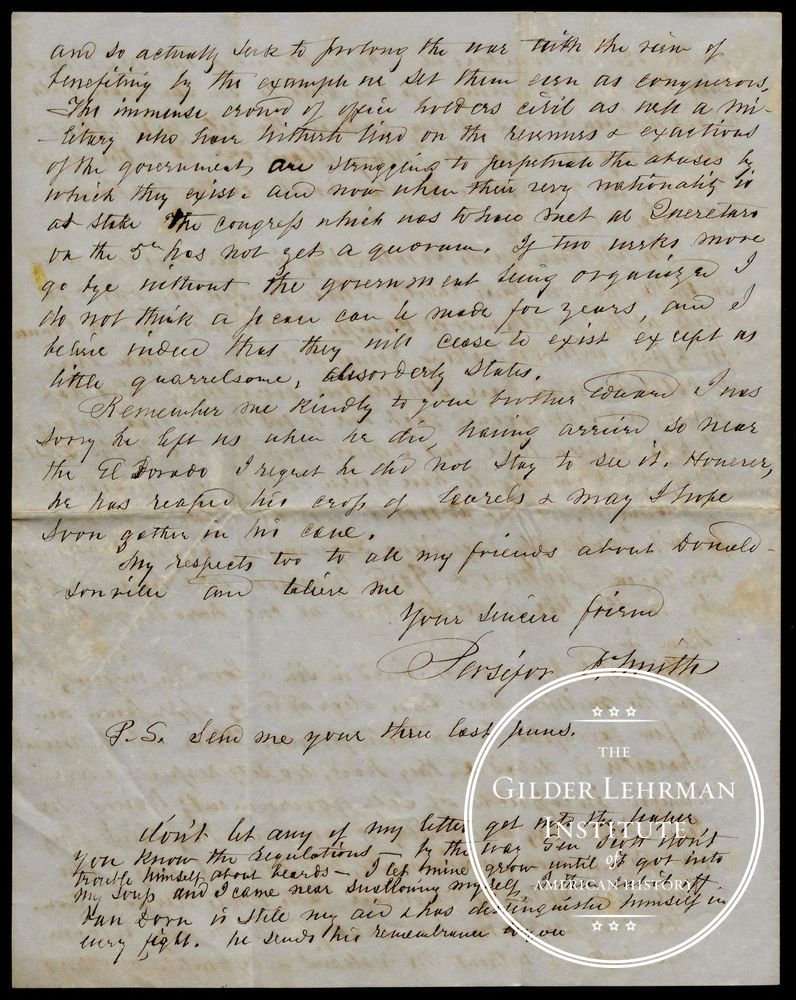
In all these events, so interesting in their progress and so important in their results, I have longed for our old mess at the Matamoros Camp. I never [saw] a [chance] for a firm [without] looking round to see if you were there to catch it, and have started over every thing that happened, as I imagined each one of us would have wished it had we been here; but I never could give it the [zest] that each one would have given to his own manner of telling it. What a world! I would [give] much for your wit, philosophy, ingenious arguments, sound reasoning, burlesque, pathos & good humor, are here drifting by on the tide of events, and no one here to gather them in.
This people have been conceived in Sin, [born] in iniquity; for ages the millions have been degraded by superstition and the few corrupted by unlimited power. Thus their whole [moral] character is debased; they have no just [sense] of religion; therefore, in no path of self-government having no test within, they are guilty of any vice they think they can screen from punishment; and now, all being alike base, they naturally encourage each other’s [dissimulation]. The best people in the country, [with] on any [reform] as hopeless without the restraint & example of others, and so actually seek to prolong the war, with the view of benefiting by the example we set them, seen as conquerors. This immense crowd of office holders, civil as well as military, who have hitherto lived on the revenues & exactions of the government, are struggling to perpetuate the abuses by which they exist; and now, when their very nationality is at stake, the congress which was to have met at Queretaro on the 5th has not got a quorum. If two weeks more go bye without the government being organized, I do not think a peace can be made for years; and I believe, indeed, that they will cease to exist except as little, quarrelsome, disorderly States.
Remember me kindly to your brother Edward. I was sorry he left us when he did, having arrived so near the El Dorado; I regret he did not stay to see it. However, he has reaped his crop of laurels, & may, I hope, soon gather in his cane. My respects, too, to all my friends about Donaldsonville; and believe me,
Your sincere friend, Persifor F. Smith.
P. S. Send me your three last puns. Don’t let any of my letters get into the [public] … you know the regulations by the war. Gen Scott won’t trouble himself about beards — I let mine grow until it got into my soup, and I came near swallowing myself. Van Dorn is still my aid & has distinguished himself in every fight; he sends his remembrance to you.
A few passages in Smith’s rapid hand are given in [brackets] as best readings; the sense is secure throughout. Names of Mexican volcanoes and places are regularized.
Original in the Gilder Lehrman Collection, New-York Historical Society (GLC05128).
GLC00911.27 · 2 pages
General Orders No. 325, October 26, 1847
Announces Brevet Brigadier General P. F. Smith as civil and military governor of Mexico City — the occupation government Gibbs served as a young officer.
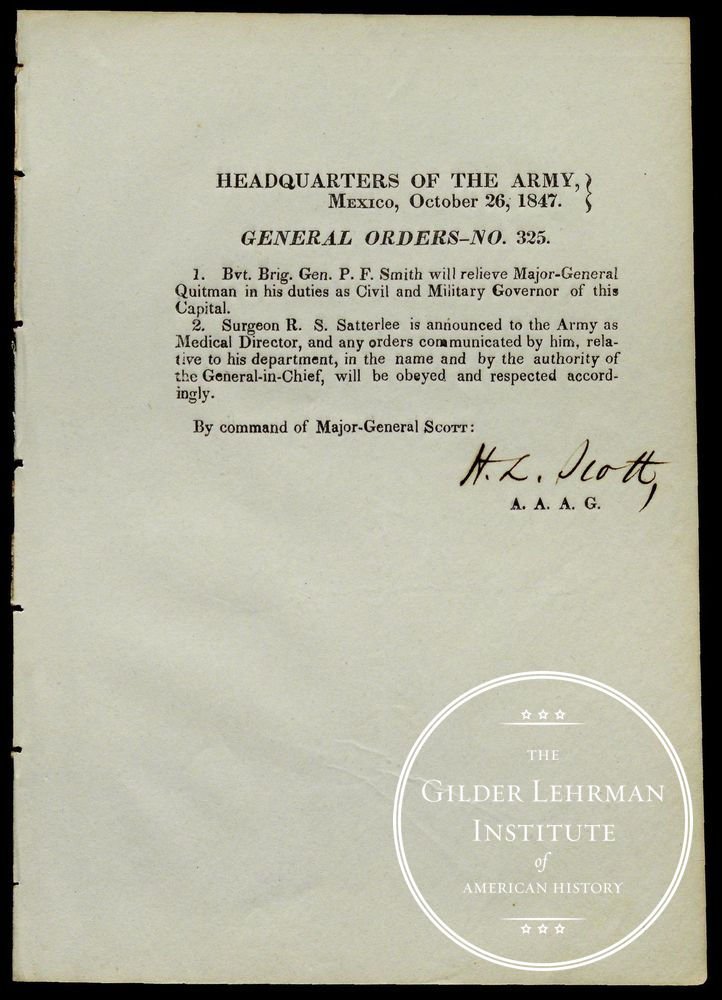
Headquarters of the Army,
Mexico, October 26, 1847.
General Orders — No. 325.
1. Bvt. Brig. Gen. P. F. Smith will relieve Major-General Quitman in his duties as Civil and Military Governor of this Capital.
2. Surgeon R. S. Satterlee is announced to the Army as Medical Director, and any orders communicated by him, relative to his department, in the name and by the authority of the General-in-Chief, will be obeyed and respected accordingly.
By command of Major-General Scott: H. L. Scott, A. A. A. G.
Original in the Gilder Lehrman Collection, New-York Historical Society (GLC00911.27).
GLC00911.28 · 3 pages
General Orders No. 327, October 28, 1847
The general court-martial of Major B. L. E. Bonneville — the famous Western explorer — on a charge of misbehavior before the enemy at Churubusco.
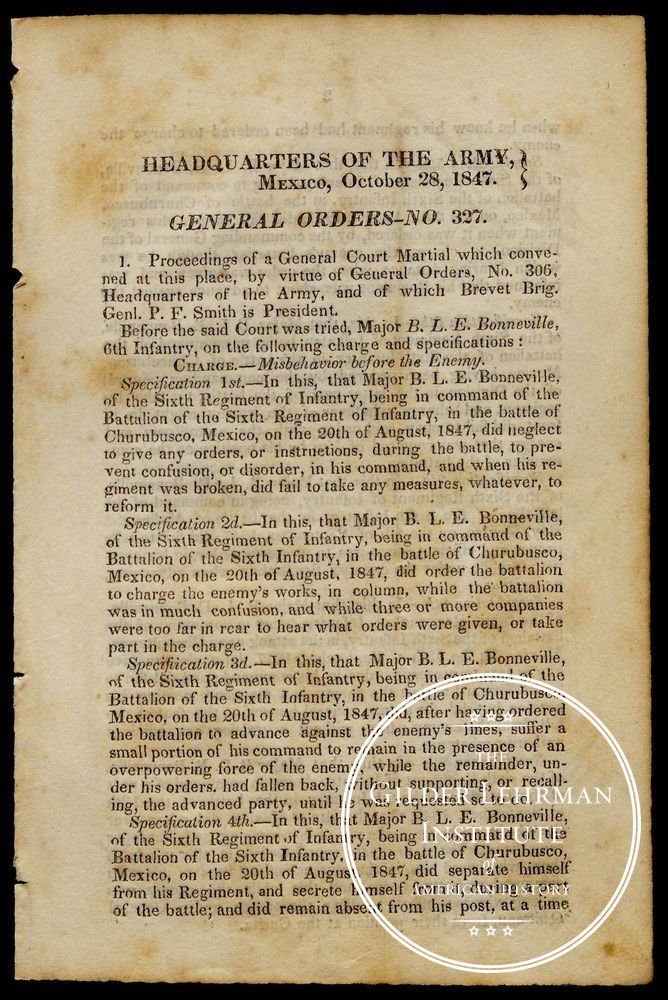
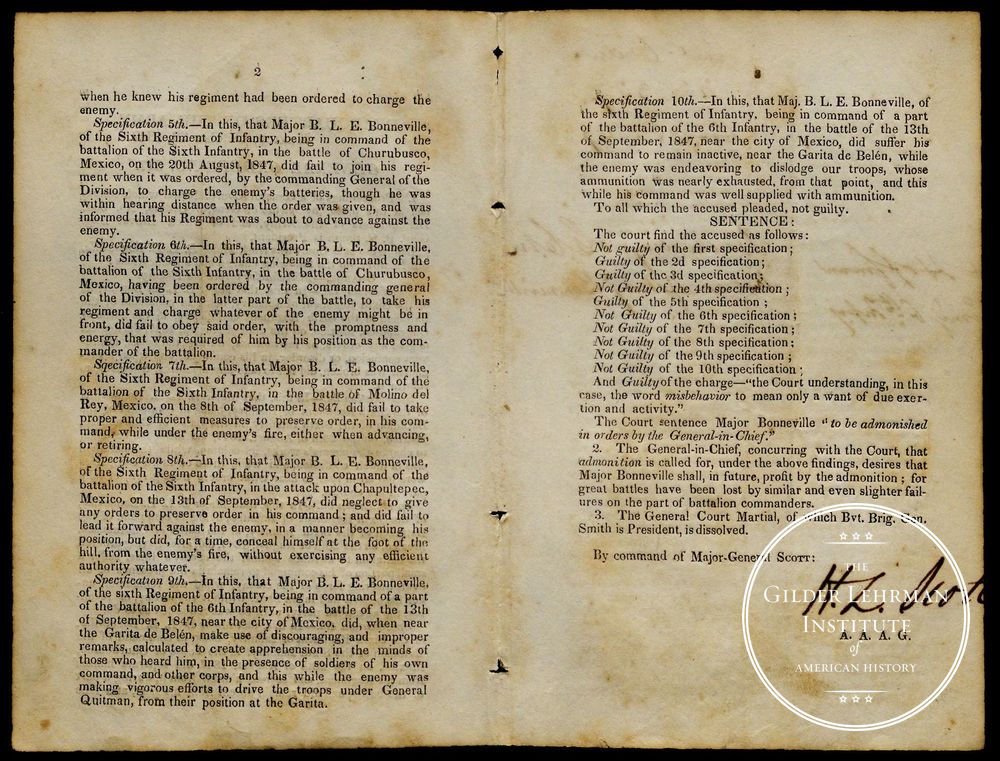
Headquarters of the Army,
Mexico, October 28, 1847.
General Orders — No. 327.
1. Proceedings of a General Court Martial which convened at this place, by virtue of General Orders, No. 306, Headquarters of the Army, and of which Brevet Brig. Genl. P. F. Smith is President.
Before the said Court was tried, Major B. L. E. Bonneville, 6th Infantry, on the following charge and specifications:
Charge. — Misbehavior before the Enemy.
Specification 1st. — In this, that Major B. L. E. Bonneville, of the Sixth Regiment of Infantry, being in command of the Battalion of the Sixth Regiment of Infantry, in the battle of Churubusco, Mexico, on the 20th of August, 1847, did neglect to give any orders, or instructions, during the battle, to prevent confusion, or disorder, in his command, and when his regiment was broken, did fail to take any measures, whatever, to reform it.
Specification 2d. — In this, that Major B. L. E. Bonneville, of the Sixth Regiment of Infantry, being in command of the Battalion of the Sixth Infantry, in the battle of Churubusco, Mexico, on the 20th of August, 1847, did order the battalion to charge the enemy’s works, in column, while the battalion was in much confusion, and while three or more companies were too far in rear to hear what orders were given, or take part in the charge.
Specification 3d. — In this, that Major B. L. E. Bonneville, of the Sixth Regiment of Infantry, being in command of the Battalion of the Sixth Infantry, in the battle of Churubusco, Mexico, on the 20th of August, 1847, after having ordered the battalion to advance against the enemy’s lines, suffer a small portion of his command to remain in the presence of an overpowering force of the enemy, while the remainder, under his orders, had fallen back, without supporting, or recalling, the advanced party, until he was requested so to do.
Specification 4th. — In this, that Major B. L. E. Bonneville, of the Sixth Regiment of Infantry, being in command of the Battalion of the Sixth Infantry, in the battle of Churubusco, Mexico, on the 20th of August, 1847, did separate himself from his Regiment, and secrete himself from it, during a part of the battle; and did remain absent from his post, at a time when he knew his regiment had been ordered to charge the enemy.
Specification 5th. — In this, that Major B. L. E. Bonneville … in the battle of Churubusco, Mexico, on the 20th August, 1847, did fail to join his regiment when it was ordered, by the commanding General of the Division, to charge the enemy’s batteries, though he was within hearing distance when the order was given, and was informed that his Regiment was about to advance against the enemy.
Specification 6th. — In this, that Major B. L. E. Bonneville … in the battle of Churubusco, Mexico, having been ordered by the commanding general of the Division, in the latter part of the battle, to take his regiment and charge whatever of the enemy might be in front, did fail to obey said order, with the promptness and energy, that was required for him by his position as the commander of the battalion.
Specification 7th. — In this, that Major B. L. E. Bonneville … in the battle of Molino del Rey, Mexico, on the 8th of September, 1847, did fail to take proper and efficient measures to preserve order, in his command, while under the enemy’s fire, either when advancing, or retiring.
Specification 8th. — In this, that Major B. L. E. Bonneville … in the battle of Chapultepec, Mexico, on the 13th of September, 1847, did neglect to give any orders to preserve order in his command; and did fail to lead it forward against the enemy, in a manner becoming his position, but did, for a time, conceal himself at the foot of the hill, from the enemy’s fire, without exercising any efficient authority whatever.
Specification 9th. — In this, that Major B. L. E. Bonneville, of the sixth Regiment of Infantry, being in command of a part of the battalion of the 6th Infantry, in the battle of the 13th of September, 1847, near the city of Mexico, did, when near the Garita de Belén, make use of discouraging and improper remarks, calculated to create apprehension in the minds of those who heard him, in the presence of soldiers of his own command, and other corps, and this while the enemy was making vigorous efforts to drive the troops under General Quitman, from their position at the Garita.
Specification 10th. — In this, that Maj. B. L. E. Bonneville, of the sixth Regiment of Infantry, being in command of a part of the battalion of the 6th Infantry, in the battle of the 13th of September, 1847, near the city of Mexico, did suffer his command to remain inactive, near the Garita de Belén, while the enemy was endeavoring to dislodge our troops, and this while his command was well supplied with ammunition.
To all which the accused pleaded, not guilty.
Sentence:
The court find the accused as follows: Not guilty of the first specification; Guilty of the 2d specification; Guilty of the 3d specification; Not Guilty of the 4th specification; Guilty of the 5th specification; Not Guilty of the 6th specification; Not Guilty of the 7th specification; Not Guilty of the 8th specification; Not Guilty of the 9th specification; Not Guilty of the 10th specification. And Guilty of the charge — “the Court understanding, in this case, the word misbehavior to mean only a want of due exertion and activity.”
The Court sentence Major Bonneville “to be admonished in orders by the General-in-Chief.”
2. The General-in-Chief, concurring with the Court, that admonition is called for, under the above findings, desires that Major Bonneville shall, in future, profit by the admonition; for great battles have been lost by similar and even slighter failures on the part of battalion commanders.
3. The General Court Martial, of which Bvt. Brig. Gen. Smith is President, is dissolved.
By command of Major-General Scott: H. L. Scott, A. A. A. G.
[Docket:] Gen’l Order, No. 327, Oct. 28, 47 · Proceedings of G. C. M. in case of Maj. Bonneville · Genl Hoffman, Comdg 6th Infy.
Original in the Gilder Lehrman Collection, New-York Historical Society (GLC00911.28).
GLC00911.31 · 5 pages
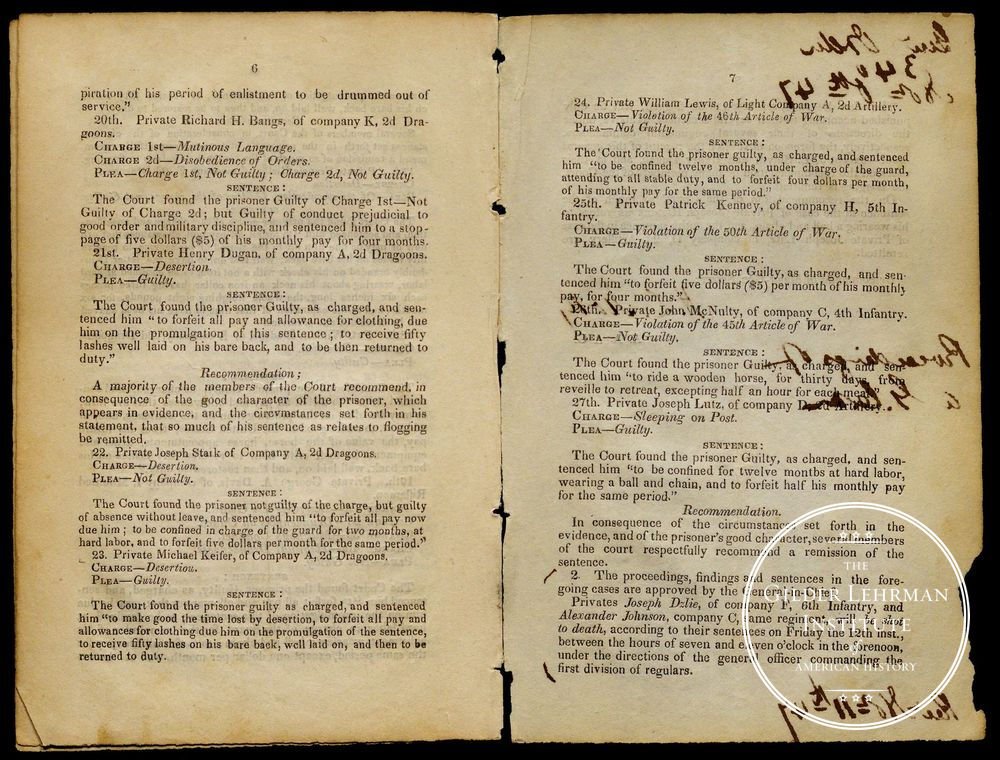
General Orders No. 340, November 6, 1847
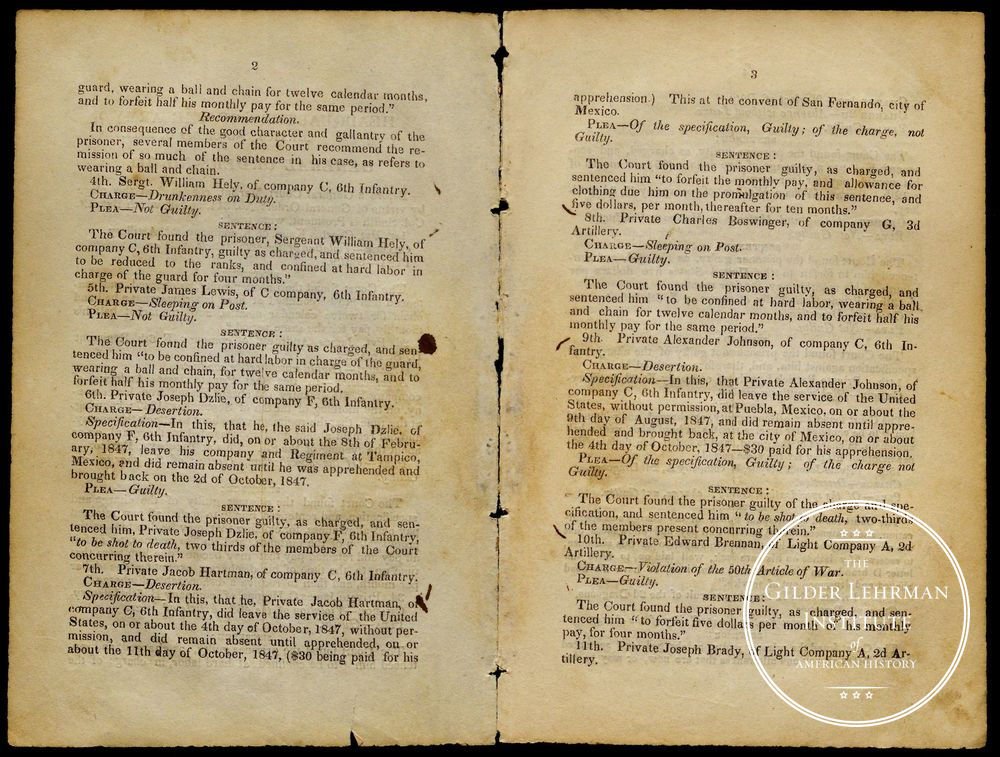
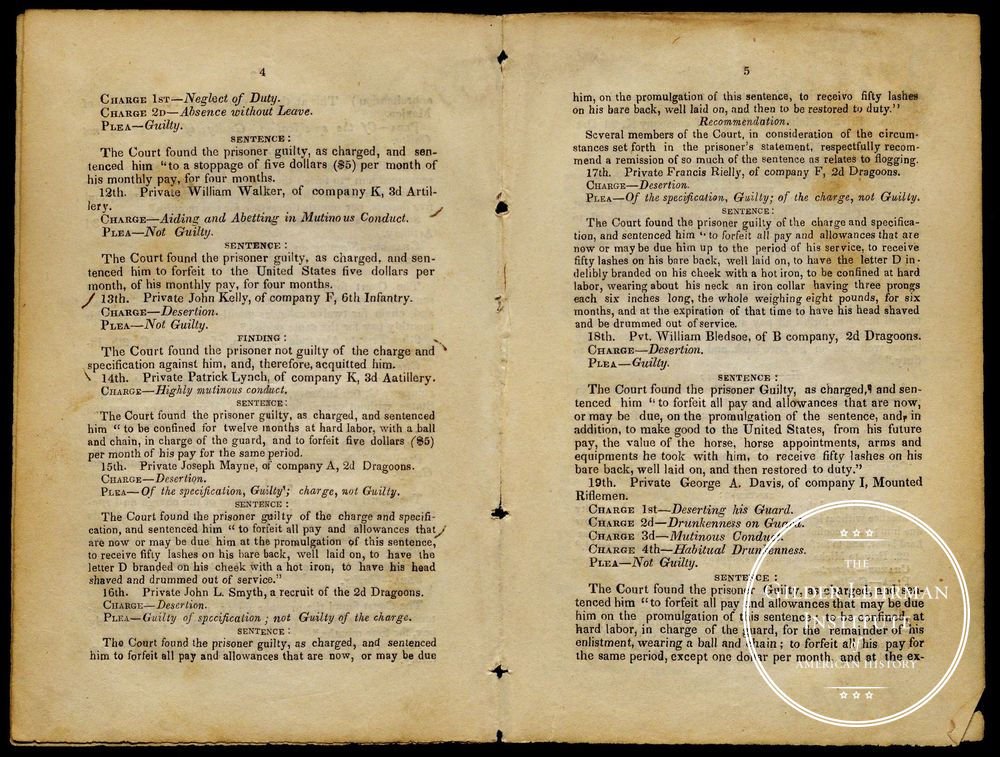
The occupation courts-martial of twenty-seven soldiers — desertion, sleeping on post, mutiny — two of them sentenced to be shot, and Scott’s order fixing the day.
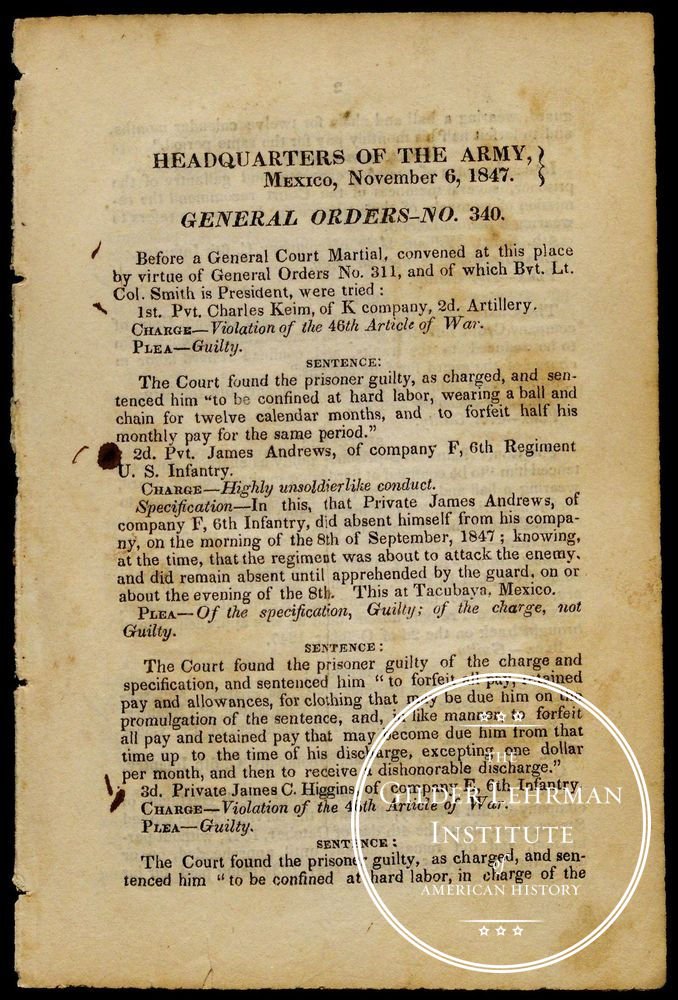
Headquarters of the Army,
Mexico, November 6, 1847.
General Orders — No. 340.
Before a General Court Martial, convened at this place by virtue of General Orders No. 311, and of which Bvt. Lt. Col. Smith is President, were tried:
1st. Pvt. Charles Keim, of K company, 2d Artillery. Charge — Violation of the 46th Article of War. Plea — Guilty. The Court sentenced him “to be confined at hard labor, wearing a ball and chain for twelve calendar months, and to forfeit half his monthly pay for the same period.”
2d. Pvt. James Andrews, of company F, 6th Regiment U. S. Infantry. Charge — Highly unsoldierlike conduct. Specification — that he did absent himself from his company, on the morning of the 8th of September, 1847, knowing, at the time, that the regiment was about to attack the enemy, and did remain absent until apprehended by the guard, on or about the evening of the 8th. This at Tacubaya, Mexico. Plea — Of the specification, Guilty; of the charge, not Guilty. Sentenced to forfeit all pay and allowances for clothing due him, and, in like manner, all pay and retained pay to the time of his discharge, excepting one dollar per month, “and then to receive a dishonorable discharge.”
3d. Private James C. Higgins, of company F, 6th Infantry. Charge — Violation of the 46th Article of War. Plea — Guilty. Sentenced “to be confined at hard labor, in charge of the guard, wearing a ball and chain for twelve calendar months, and to forfeit half his monthly pay for the same period.” Recommendation. In consequence of the good character and gallantry of the prisoner, several members of the Court recommend the remission of so much of the sentence as refers to wearing a ball and chain.
4th. Sergt. William Hely, of company C, 6th Infantry. Charge — Drunkenness on Duty. Plea — Not Guilty. The Court found him guilty as charged, and sentenced him to be reduced to the ranks, and confined at hard labor in charge of the guard for four months.
5th. Private James Lewis, of C company, 6th Infantry. Charge — Sleeping on Post. Plea — Not Guilty. The Court found him guilty and sentenced him “to be confined at hard labor in charge of the guard, wearing a ball and chain, for twelve calendar months, and to forfeit half his monthly pay for the same period.”
6th. Private Joseph Dzlie, of company F, 6th Infantry. Charge — Desertion. Specification — that he did, on or about the 8th of February, 1847, leave his company and Regiment at Tampico, Mexico, and did remain absent until apprehended and brought back on the 2d of October, 1847. Plea — Guilty. The Court sentenced him “to be shot to death, two thirds of the members of the Court concurring therein.”
7th. Private Jacob Hartman, of company C, 6th Infantry. Charge — Desertion. Specification — that he did leave the service of the United States, on or about the 4th day of October, 1847, without permission, and did remain absent until apprehended, on or about the 11th day of October, 1847 ($30 being paid for his apprehension). This at the convent of San Fernando, city of Mexico. Plea — Of the specification, Guilty; of the charge, not Guilty. Sentenced to forfeit the monthly pay and clothing allowance due, and five dollars per month thereafter for ten months.
8th. Private Charles Boswinger, of company G, 3d Artillery. Charge — Sleeping on Post. Plea — Guilty. Sentenced to be confined at hard labor, wearing a ball and chain for twelve calendar months, and to forfeit half his monthly pay for the same period.
9th. Private Alexander Johnson, of company C, 6th Infantry. Charge — Desertion. Specification — that he did leave the service without permission, at Puebla, Mexico, on or about the 9th day of August, 1847, and did remain absent until apprehended and brought back at the city of Mexico, on or about the 4th day of October, 1847 — $30 paid for his apprehension. Plea — Of the specification, Guilty; of the charge not Guilty. Sentenced “to be shot to death, two-thirds of the members present concurring therein.”
10th. Private Edward Brennan, of Light Company A, 2d Artillery. Charge — Violation of the 50th Article of War. Plea — Guilty. Sentenced to forfeit five dollars per month of his monthly pay, for four months.
11th. Private Joseph Brady, of Light Company A, 2d Artillery. Charge 1st — Neglect of Duty. Charge 2d — Absence without Leave. Plea — Guilty. Sentenced to a stoppage of five dollars ($5) per month of his monthly pay, for four months.
12th. Private William Walker, of company K, 3d Artillery. Charge — Aiding and Abetting in Mutinous Conduct. Plea — Not Guilty. The Court found him guilty, as charged, and sentenced him to forfeit to the United States five dollars per month, of his monthly pay, for four months.
13th. Private John Kelly, of company F, 6th Infantry. Charge — Desertion. Plea — Not Guilty. The Court found the prisoner not guilty of the charge and specification against him, and, therefore, acquitted him.
14th. Private Patrick Lynch, of company K, 3d Artillery. Charge — Highly mutinous conduct. Sentenced to be confined for twelve months at hard labor, with a ball and chain, in charge of the guard, and to forfeit five dollars ($5) per month of his pay for the same period.
15th. Private Joseph Mayne, of company A, 2d Dragoons. Charge — Desertion. Plea — Of the specification, Guilty; charge, not Guilty. Sentenced to forfeit all pay and allowances now or hereafter due, “to receive fifty lashes on his bare back, well laid on, to have the letter D branded on his cheek with a hot iron, to have his head shaved and drummed out of service.”
16th. Private John L. Smyth, a recruit of the 2d Dragoons. Charge — Desertion. Plea — Of specification, Guilty; not Guilty of the charge. Sentenced to forfeit all pay and allowances now or hereafter due, “to receive fifty lashes on his bare back, well laid on, and then to be restored to duty.” Recommendation. Several members of the Court, in consideration of the circumstances set forth in the prisoner’s statement, respectfully recommend a remission of so much of the sentence as relates to flogging.
17th. Private Francis Rielly, of company F, 2d Dragoons. Charge — Desertion. Plea — Of the specification, Guilty; of the charge, not Guilty. Sentenced to forfeit all pay and allowances due up to the period of his service, to receive fifty lashes on his bare back, well laid on, to have the letter D indelibly branded on his cheek with a hot iron, to be confined at hard labor, wearing about his neck an iron collar having three prongs each six inches long, the whole weighing eight pounds, for six months, and at the expiration of that time to have his head shaved and be drummed out of service.
18th. Pvt. William Bledsoe, of B company, 2d Dragoons. Charge — Desertion. Plea — Guilty. Sentenced to forfeit all pay and allowances now or hereafter due, and, in addition, to make good to the United States, from his future pay, the value of the horse, horse appointments, arms and equipments he took with him, to receive fifty lashes on his bare back, well laid on, and then restored to duty.
19th. Private George A. Davis, of company I, Mounted Riflemen. Charge 1st — Deserting his Guard. Charge 2d — Drunkenness on Guard. Charge 3d — Mutinous Conduct. Charge 4th — Habitual Drunkenness. Plea — Not Guilty. Sentenced to forfeit all pay and allowances due; to be confined, at hard labor, in charge of the guard, for the remainder of his enlistment, wearing a ball and chain; to forfeit all his pay for the same period, except one dollar per month, and at the expiration of his period of enlistment to be drummed out of service.
20th. Private Richard H. Bangs, of company K, 2d Dragoons. Charge 1st — Mutinous Language. Charge 2d — Disobedience of Orders. Plea — Charge 1st, not Guilty; Charge 2d, Not Guilty. The Court found him not Guilty of either charge, but Guilty of conduct prejudicial to good order and military discipline, and sentenced him to a stoppage of five dollars ($5) of his monthly pay for four months.
21st. Private Henry Dugan, of company A, 2d Dragoons. Charge — Desertion. Plea — Guilty. Sentenced to forfeit all pay and clothing allowance due, “to receive fifty lashes well laid on his bare back, and to be then returned to duty.” Recommendation. A majority of the Court recommend, in consequence of the good character of the prisoner and the circumstances in his statement, that so much of the sentence as relates to flogging be remitted.
22d. Private Joseph Stark, of Company A, 2d Dragoons. Charge — Desertion. Plea — Not Guilty. The Court found him not guilty of the charge, but guilty of absence without leave, and sentenced him to forfeit all pay now due; to be confined in charge of the guard for two months, at hard labor, and to forfeit five dollars per month for the same period.
23d. Private Michael Keifer, of Company A, 2d Dragoons. Charge — Desertion. Plea — Guilty. Sentenced to make good the time lost by desertion, to forfeit all pay and clothing allowance due, to receive fifty lashes on his bare back, well laid on, and then to be returned to duty.
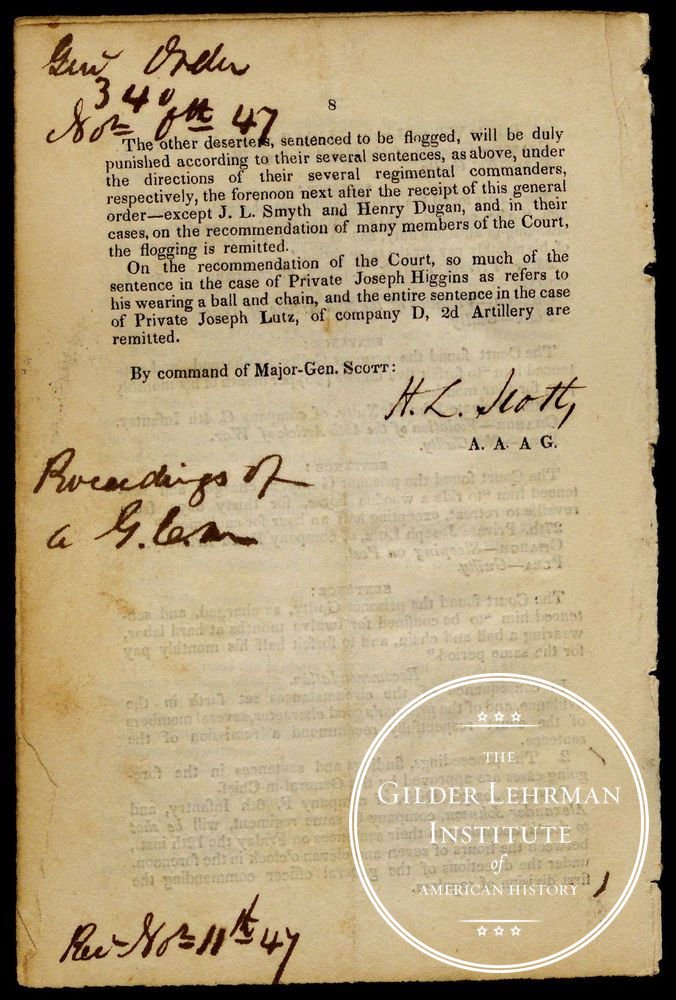
24. Private William Lewis, of Light Company A, 2d Artillery. Charge — Violation of the 46th Article of War. Plea — Not Guilty. The Court found him guilty, as charged, and sentenced him to be confined twelve months, under charge of the guard, attending to all stable duty, and to forfeit four dollars per month of his monthly pay for the same period.
25th. Private Patrick Kenney, of company H, 5th Infantry. Charge — Violation of the 50th Article of War. Plea — Guilty. Sentenced to forfeit five dollars ($5) per month of his monthly pay, for four months.
26th. Private John McNulty, of company C, 4th Infantry. Charge — Violation of the 45th Article of War. Plea — Not Guilty. The Court found him guilty, as charged, and sentenced him to ride a wooden horse, for thirty days, from reveille to retreat, excepting half an hour for each meal.
27th. Private Joseph Lutz, of company D, 2d Artillery. Charge — Sleeping on Post. Plea — Guilty. Sentenced to be confined for twelve months at hard labor, wearing a ball and chain, and to forfeit half his monthly pay for the same period. Recommendation. In consequence of the circumstances in evidence and the prisoner’s good character, several members of the court respectfully recommend a remission of the sentence.
2. The proceedings, findings and sentences in the foregoing cases are approved by the General-in-Chief. Privates Joseph Dzlie, of company F, 6th Infantry, and Alexander Johnson, of company C, same regiment, will be shot to death, according to their sentences, on Friday the 12th inst., between the hours of seven and eleven o’clock in the forenoon, under the directions of the general officer commanding the first division of regulars.
The other deserters, sentenced to be flogged, will be duly punished according to their several sentences, as above, under the directions of their several regimental commanders, respectively, the forenoon next after the receipt of this general order — except J. L. Smyth and Henry Dugan, and in their cases, on the recommendation of many members of the Court, the flogging is remitted.
On the recommendation of the Court, so much of the sentence in the case of Private Joseph Higgins as refers to his wearing a ball and chain, and the entire sentence in the case of Private Joseph Lutz, of company D, 2d Artillery, are remitted.
By command of Major-Gen. Scott: H. L. Scott, A. A. A. G.
[Docket:] Gen’l Order No. 340, Nov. 6, 47 · Proceedings of a G. C. M. · Rec. Nov. 11th 47.
Original in the Gilder Lehrman Collection, New-York Historical Society (GLC00911.31).
The Cavalry War, 1864–1865
The other side of the hill: the Confederate horseman who faced Gibbs’s brigade from the Wilderness to Appomattox.
GLC09392 · 27 pages
Fitzhugh Lee, Account of Confederate Cavalry Operations
A twenty-seven-page autograph narrative (signed December 20, 1866) of Army of Northern Virginia cavalry operations from the Wilderness to Appomattox — written by the man who fought opposite Gibbs across the whole of his brigade command.
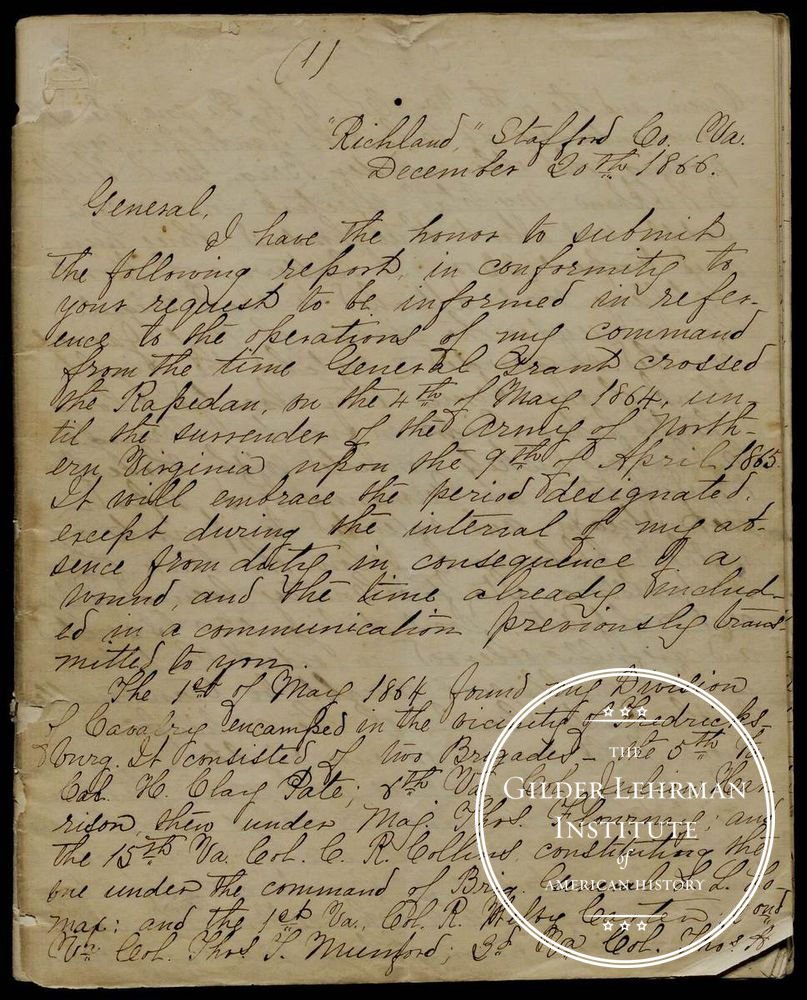
The complete verbatim transcription of this document is being prepared and will appear here beside the scan. The manuscript is shown in full above.
Original in the Gilder Lehrman Collection, New-York Historical Society (GLC09392).
Texas & the Frontier, 1853
The peacetime army of Gibbs’s Rio Grande years.
GLC02711.20 · 3 pages
John Porter Hatch to William E. Jones, April 22, 1853
Garrison life in the Regiment of Mounted Riflemen at Fort Merrill, Texas, during the years Gibbs served in the same country under Persifor Smith.
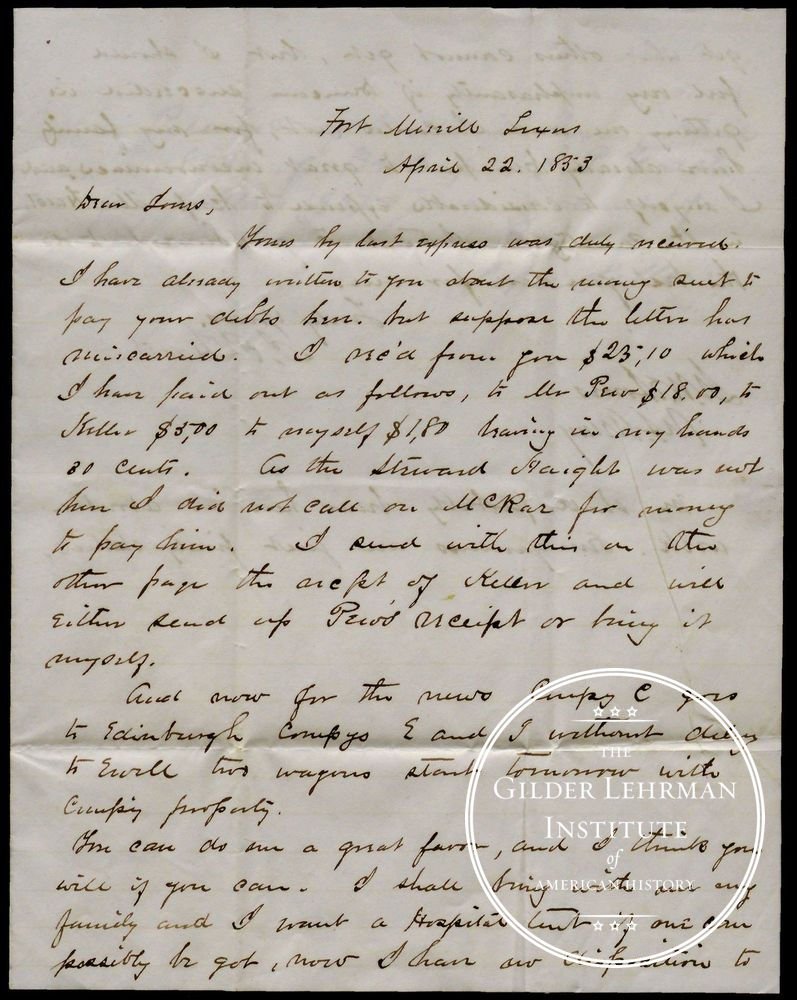
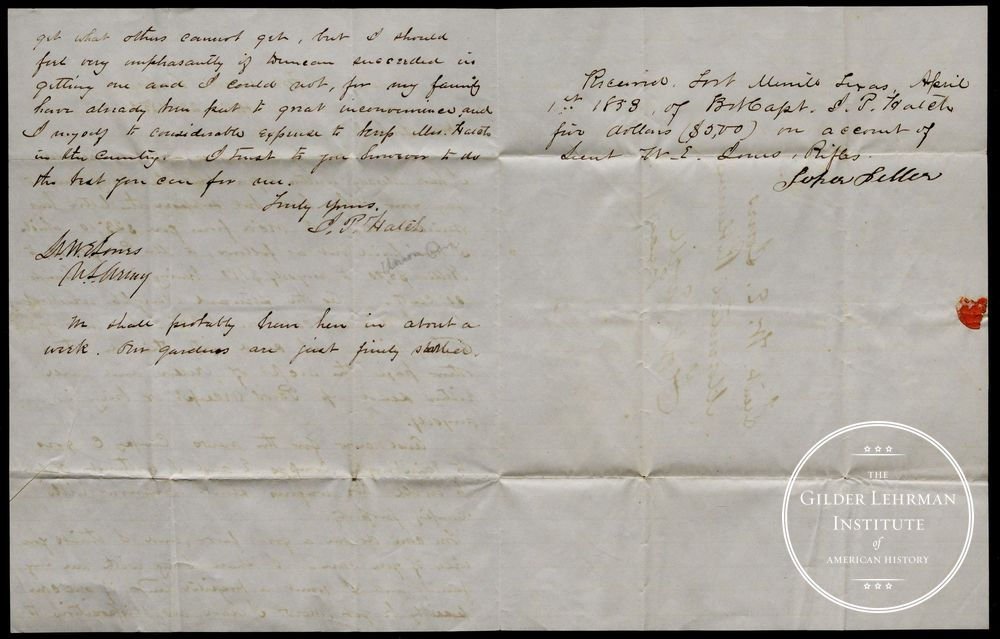
Fort Merrill, Texas.
April 22. 1853.
Dear Jones,
Yours by last express was duly received. I have already written to you about the money sent to pay your debts here, but suppose the letter has miscarried. I rec’d from you $23.10 which I have paid out as follows, to Mr [Pew?] $18.00, to Keller $5.00, to myself $1.80, leaving in my hands 30 cents. As the Steward [Faight?] was not here I did not call on McRae for money to pay him. I send with this on the other page the receipt of Keller and will either send up [Pew’s?] receipt or bring it myself.
And now for the news. Comp’y C goes to Edinburgh; Comp’ys E and I without delay to Ewell; two wagons start tomorrow with Comp’y property.
You can do me a great favor, and I think you will if you can. I shall bring my family and I want a Hospital tent if one can possibly be got. Now I have no disposition to get what others cannot get, but I should feel very unpleasantly if Duncan succeeded in getting one and I could not, for my family have already been put to great inconvenience, and I myself to considerable expense to keep Mrs Hatch in the country. I trust to your endeavor to do the best you can for me.
Truly Yours, J. P. Hatch.
[Postscript:] We shall probably leave here in about a week. Our gardens are just finely started.
[Enclosed receipt, in another hand:] Received, Fort Merrill, Texas, April 1st 1853, of Bvt. Capt. J. P. Hatch, five dollars ($5.00) on account of Lieut. W. E. Jones, Rifles. — [signed] Keller.
[Addressed:] Lieut. W. E. Jones, Mounted Riflemen, Fort Ewell, Texas.
Original in the Gilder Lehrman Collection, New-York Historical Society (GLC02711.20).
The Confederate Record
A Southern newspaper’s account of the 1861 fighting in New Mexico that followed the fall of Fort Fillmore.
GLC05959.29.04 · 3 pages
Salisbury Banner, September 3, 1861
A North Carolina newspaper reporting the “Battles of Oak Hill and Mesilla” — Confederate coverage of the New Mexico fighting that followed the fall of Fort Fillmore.
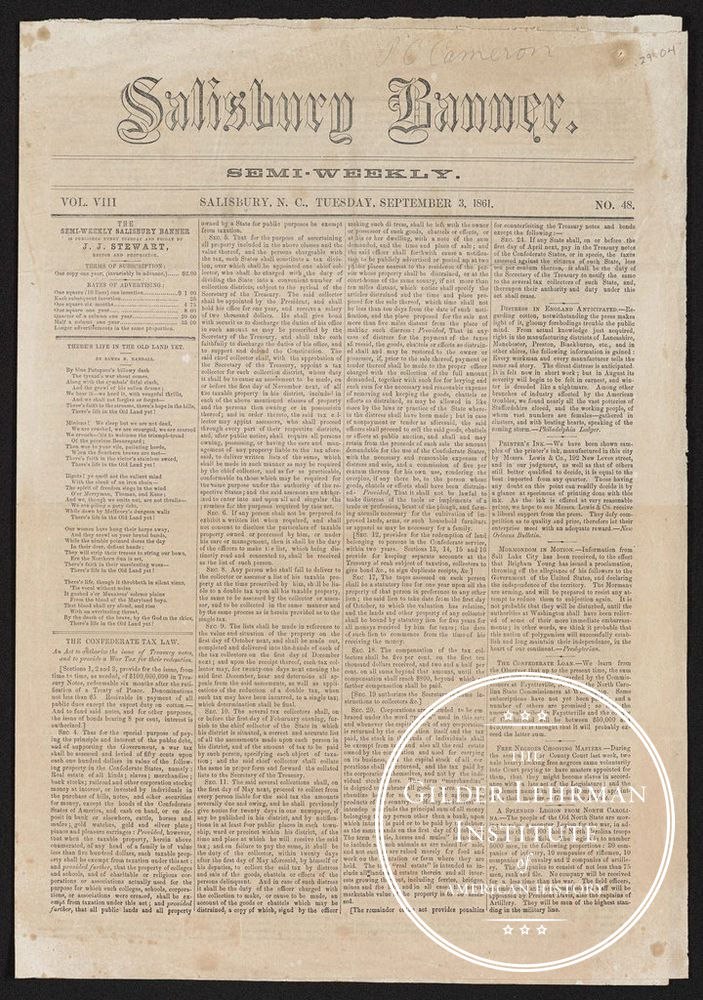
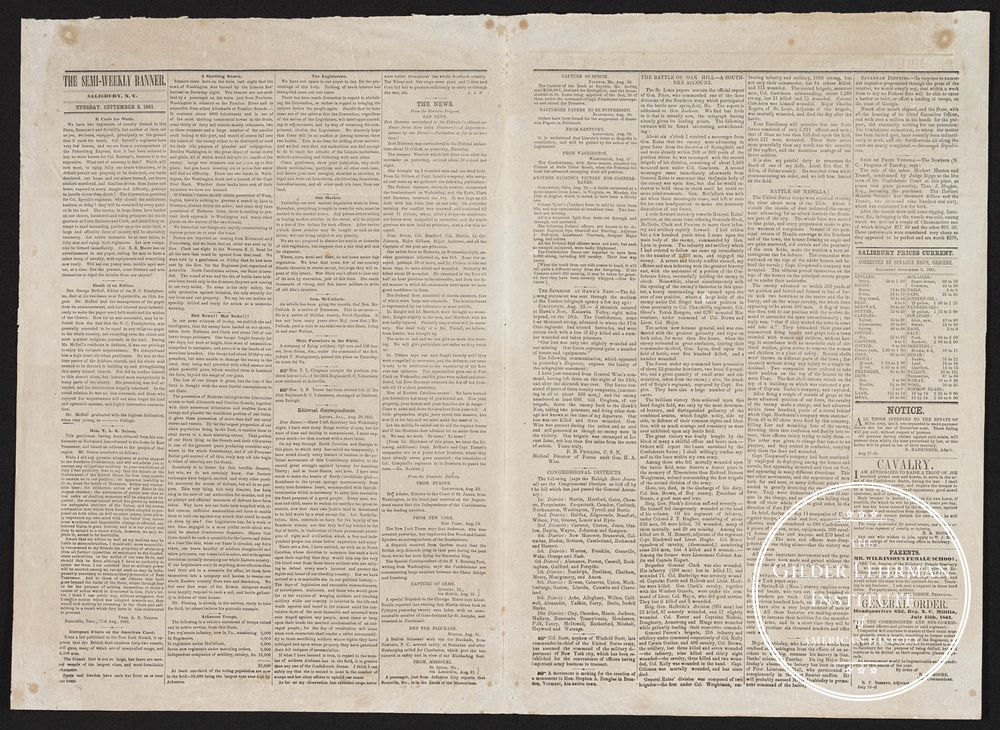
The complete verbatim transcription of this document is being prepared and will appear here beside the scan. The manuscript is shown in full above.
Original in the Gilder Lehrman Collection, New-York Historical Society (GLC05959.29.04).
The Gibbs Brothers as Custodians
Alfred’s brother George, keeper of documents, in his own official hand.
GLC02145.73 · 2 pages
George Gibbs, N-Y Historical Society Gift Acknowledgement, December 10, 1847
Signed by Alfred’s brother George as librarian of the New-York Historical Society, acknowledging a musket from the field of San Jacinto — George the antiquarian, in his own hand.
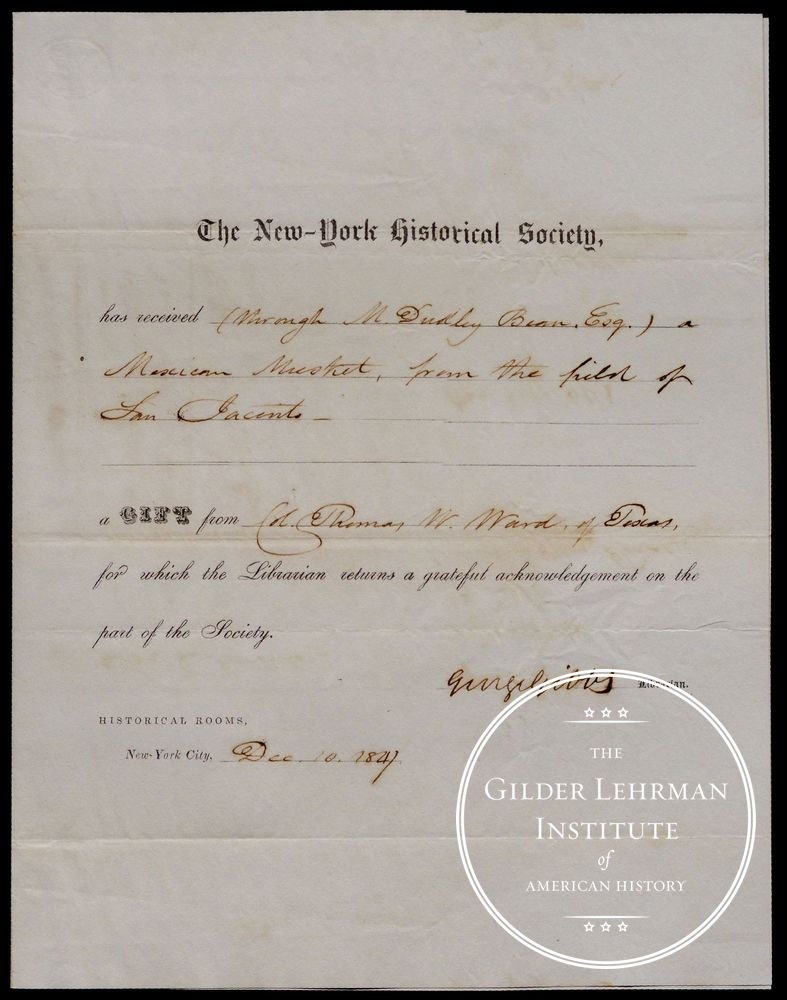
The New-York Historical Society, has received (through M. Dudley Bean, Esq.) a Mexican Musket, from the field of San Jacinto - a GIFT from Col. Thomas W. Ward, of Texas, for which the Librarian returns a grateful acknowledgement on the part of the Society.
George Gibbs, Librarian.
Historical Rooms, New-York City, Dec. 10, 1847.
Original in the Gilder Lehrman Collection, New-York Historical Society (GLC02145.73).
All items reproduced by courtesy of the Gilder Lehrman Institute of American History, New-York Historical Society, and cited to their collection numbers. Bracketed readings mark editorial insertions or uncertain words in the manuscripts.
Views: 15
Explore the evidence
View this article’s connected sources and media →
About this page
This article was brought over from AlfredGibbs.com. Its preserved text, media and citations remain available for comparison.