
No document in the family papers shows the division of labor among the Gibbs brothers better than this one. To George, the mineralogist-historian, Wolcott reports the imperial cabinet at Vienna – the suite of meteoric stones “the most complete in existence,” old director Schreibers in his dotage who “remembered father,” and Mrs. Lederer still bitter that her husband’s cabinet “had been sacrificed at such a price” to Yale (“I am glad that it is at Yale”). He begs American zircons and Chesterfield tourmalines for Rammelsberg’s Berlin laboratory: American minerals for European chemistry. Then he turns the sheet to “Dear Alf” and gives the cadet a full after-action report of the Vienna grand review and mock battle under Archduke Charles – Napoleon’s adversary at Aspern and Wagram – complete with an ink diagram of the field (“I got a good position on the top of a high ground in the middle of the battle”), a movement-by-movement narrative, a sketch and mechanical analysis of the Austrian percussion musket lock, and a connoisseur’s closing judgment on the Hungarian troops. The battlefield casualties, he reports, would have been strewn about “the dead – drunk.”
❦The Letter
Page 1 (scan 1159)
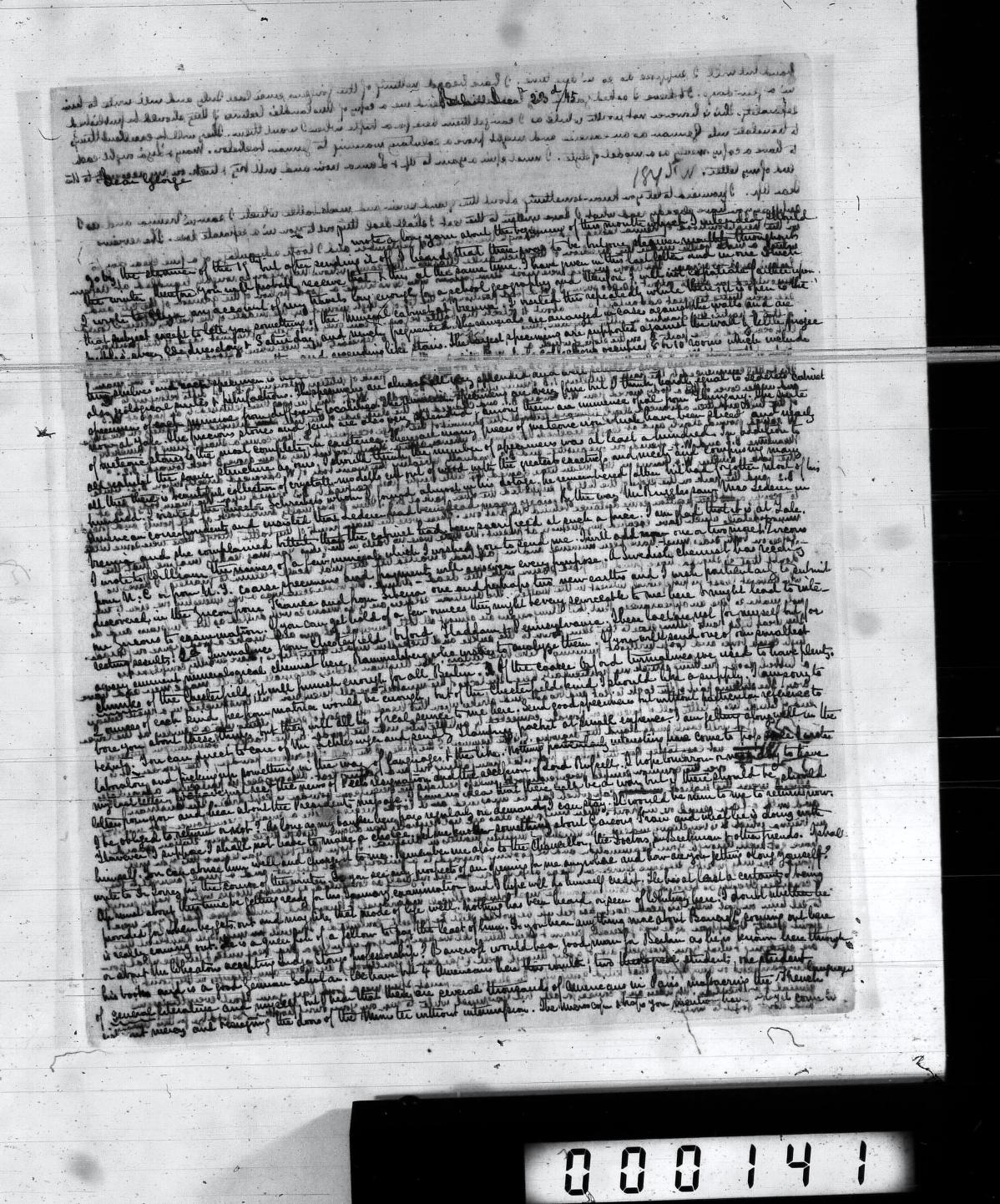
[The whole page carries a strong mirrored ink-offset of the facing page (scan 1160), so that nearly every other visible line is reversed text; the offset lines are transcribed under scan 1160. The dateline and salutation of this page read through the overlay:]
Berlin Dec’r 23d /45
Dear George
I wrote you a long [letter?] about the beginning of this month [which was?] [?] [?]
[to] go by the steamer of the 1st[?] but after sending it off I heard that there [was?] to be but one steamer [monthly?] during[?] the[?]
winter. therefore you will probably receive that & this at the same time. I have given in this last letter [several words illegible]
I undertook[?] to give an[?] account of my travels long enough for a school geography and [therefore?] I will not [expatiate?] [further?] upon
that subject except to tell you something of the Mineral Cabinet at Vienna. I visited this repeatedly while there. it is open to the
public always Wednesday & Saturday and [richly?] [furnished?]. The minerals are arranged in cases against the walls and are
[?] [shelves?] ascending like stairs. The largest specimens are supported against the wall & little [?]
[?] the [?] collection occupies 8 or 10 rooms which include [?]
[?] shelves and rock specimens [several words illegible] splendid agate[?] [several words illegible] hardly equal to [the?] students[‘] Cabinet
also geological suites & petrifactions. The specimens are almost all large[?] & splendid [several words illegible]
specimens of each mineral from different localities. The Hungarian[?] specimens are very fine [several words illegible] opal from Hungary. The suite
[?] at Yale. the precious stones and gems are also very splendid. among them are immense opal[s] [several words illegible] have been placed and nearly[?]
of meteoric stones is the most complete in existence. There are many pieces of meteoric iron which have been [?] [?] in addition to
all [exhibiting?] the same structure as our[s?] [several words illegible] I should think the number of specimens was at least a hundred [?] [?]
all this there is a beautiful collection of crystall models cut out of wood with the greatest exactness and neatly and comprising many
hundred[s]. I visited the director Schreibers whom I found almost in his dotage. he remembered [father?] [?] but had forgotten [most?] of his
[Americ?]an correspondent[s] and insisted that Lederer had been [dead?] [?] many years. By the way Mr Ruggles saw Mrs Lederer in
Vienna and she complained bitterly that the cabinet had been sacrificed at such a price. I am glad that it is at Yale.
I wrote to William the names of a few minerals which I wished you to send me. I will add now one or two much[?] [larger?] zircons
from N. C. or from N. Y. Coarse specimens and fragments will answer every purpose. A Swedish chemist has lately
discovered in the zircons from France[?] and from Siberia[?] one and perhaps two new earths and I wish particularly to submit
our zircons to examination. If you can get hold of a few ounces they might be very serviceable to me here & might lead to inte-
resting results. Get[?] tourmalines from Chesterfield, Oxford, Haddam & Pennsylvania. These I ask[?] not for myself but for
a very eminent mineralogical chemist here, Rammelsberg who wishes to analyse them. If you will send over one[?] smashed
chunks of the Chesterfield it will furnish enough for all Berlin. Of the coarse Oxford tourmalines we used to have plenty.
a few ounces of each kind, [with?] [some?] matrix would be enough, but of the Chesterfield kind I should like a supply. I am sorry to
bore you about these things, but they will all be of real service to me here. Send good specimens but without particular reference to
beauty. You can direct to care of Mr [?] and send by Hamburg packet at small expense. I am getting along well in the
laboratory and picking up something in the way of languages & the like. Nothing particularly interesting here [has?] come to pass [since?] [?]
my last letter. I am anxious [to] see[?] the news of Peel’s resignation and the accession of Lord Russell. I hope tomorrow or next day to have
letters from you and hear about the President’s message. I have no idea that there will be a war[?] but if there should be, should
I be obliged to return or not? As long as my banker here pays regularly on demand[,] I can stay. It would be ruin to me to return now.
However I suppose I shall not have to make a choice. [?] tell me[?] something about Carson’s [?] and what he is doing with
himself. You can abuse him well and charge it to me. Remember me also to the Chancellor, the Doctor, [Mr?] Beekman & other friends. What[?]
[I shall?] write to [Dr Torrey?] in the course of the winter. Do you see any prospects of an opening for me anywhere and how are you getting along yourself?
Alf must about this time be getting ready for his January examination and I hope will do himself credit. He has at last a certainty[?] [of?] being
provided for when he gets out and may like that mode of life well. Nothing has been heard, or seen of Whitney here. I doubt whether he
is really coming out. He is a queer sort of a fellow to say the least of him. Do you hear anything more about Bancroft’s coming out here
or about the Wheatons accepting Judge Story’s professorship? Bancroft would be a good man for Berlin as he is known here through
his books and is a good German Scholar. We have but 4 Americans here this winter, two theological students, one student
of general literature and myself but I hear that [there?] are several thousands [of] Americans in Paris massacring[?] the French [language?]
[with]out mercy and besieging the doors of the Ministers without intermission. The Microscope I hope you [two or three words illegible]
[Page ends; the sentence continues at the top of scan 1160.]
Page 2 (scan 1160)
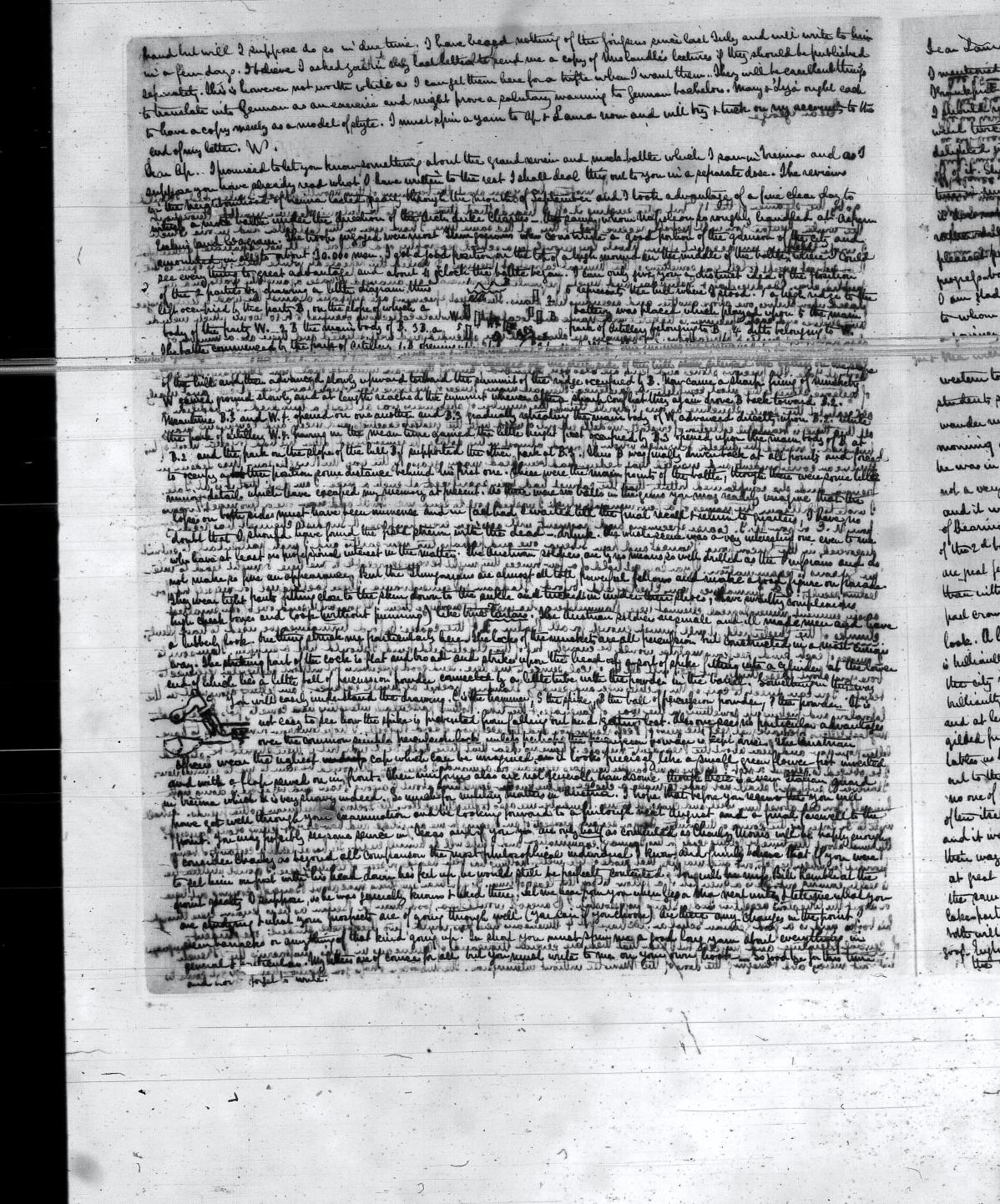
[Continues the George section from scan 1159:]
found but will I suppose do so in due time. I have heard nothing of the Jorissens since last July and will write to him
in a few days. I believe I asked you [1st?] in [my?] last letter[?] to send me a copy of Mrs Caudle’s lectures if they should be published
separately. This is however not worth while as I can get them here for a trifle when I want them. They will be excellent things
to translate into German as an exercise and might prove a salutary warning to German bachelors. Mary[?] & Liza[?] ought each
to have a copy merely as a model of style. I must spin a yarn to Alf & Laura now and will try & tuck one in my accounts[?] to the
end of my letter. W.
Dear Alf.. I promised to let you know something about the grand review and mock battle which I saw in Vienna and as I
suppose you have already read what I have written to the rest I shall deal this out to you in a separate dose. The review
of the [whole?] [garrison?] of Vienna lasted nearly through the month of September and I took advantage of a fine clear day to
witness a mock battle under the direction of the Arch duke Charles – the same whom Napoleon so roughly handled at Aspern[?]
Essling[?] and Wagram. The troops engaged were most[ly] Hungarians who constitute a good portion of the garrison of the city and
amounted in all to about 10,000 men. I got a good position on the top of a high ground in the middle of the battle where I could
see every thing to great advantage and about 4 o’clock the battle began. I can only give you a distinct idea of the position
of the 2 parties by drawing a little diagram, thus [ink diagram of the field] [?] represents the hill where I stood. 1 a high ridge to the
left occupied by the party B, on the slope of which a [?] battery was placed which played upon 5 the main
body of the party W. 2 B the main body of B. 3 B a [?] [diagram references, partly illegible] park of artillery belonging to B. 4 ditto belonging to W.
The battle commenced by the park of artillery 1. B opening upon [?]
[one or more lines lost in the heavy show-through at the fold]
of the hill and then advanced slowly upward toward the summit of the ridge occupied by B. Now came a sharp firing of musketry
W gained ground slowly and at length reached the summit whence after a sharp conflict they again drove B back toward 3.2[?].
Meantime B.3 and W.4 opened on one another and B.3 gradually retreating the main body of W advanced directly upon B.2 while
the park of artillery W.4 having in the mean time gained the little height first occupied by B.3 opened upon the main body of B at
B.2 and the park on the slope of the hill B.1 supported the other park at B.3. Thus B was finally driven back at all points and forced
to occupy another position some distance behind his first one. These were the main points of the battle, though there were some little
minor details which have escaped my memory at present. As there were no balls in the guns you may readily imagine that the
losses on both sides must have been immense and in fact had I waited till the final recall & return to quarters I have no
doubt that I should have found the field strewn with the dead – drunk. The whole scene was a very interesting one even to me[?]
who have at least no professional interest in the matter. The Austrian soldiers are by no means so well drilled as the Prussians and do
not make so fine an appearance. But the Hungarians are almost all tall, powerful fellows and make a good figure on parade
They wear tight pants fitting close to the skin down to the ankle and tucked in under their shoes[?], have swarthy complexions
high cheek bones and look without punning like true Turks[?]. The Austrian soldiers are small and ill made men and have
a lubberly look. One thing struck me particularly here. The locks of the muskets are all percussion but constructed in a most unique[?]
way. The striking part of the lock is flat and broad and strikes upon the head of a sort of spike fitting into a cylinder at the lower
end of which lies a little ball of percussion powder connected by a little tube with the powder in the barrel. [So that?] in this way
you will easily understand the drawing. C is the hammer, S the spike, B the ball of percussion powder, P the powder. It is
[ink sketch of the musket lock in the left margin] not easy to see how the spike is prevented from falling out [when?] [?] [?] getting lost. Also one sees no particular advantages
over the common double[?] percussion locks unless perhaps the percussion powder is kept dry[?]. The Austrian
officers wear the ugliest undress cap which can be imagined, as it looks precisely like a small green flower pot inverted
and with a flap sewed on in front. Their uniforms also are not generally handsome. though there is a very [dashing?] Italian guard
in Vienna which [is] very showy indeed. So much for military matters in Austria. I hope that before you receive this you will
have got well through your examination and be looking forward to a furlough next August and a final farewell to the
point. You may possibly see some service in Texas and if you are only half as contented as Charley Morris will be happy enough.
I consider Charley as beyond all comparison the most philosophical individual I know and firmly believe that if you were
to set him on end with his head down & his feet up, he would still be perfectly contented. You will [see?] [miss?] Bill Kemble at the
point shortly I suppose, as he was generally known & liked there. Let me hear from you when [you begin?] the next winter & tell me what you
are studying & what your prospects are of going through well (you can if you choose). Are there any changes in the point?
[new?] barracks or anything of that kind going up. In short you must spin me a good long yarn about everything in
general & particular. My letters are of course for all but you must write to me on your own hook – so good bye for this time
and don’t forget to write.
[Right edge of the frame shows a narrow strip of the NEXT page, which begins “Dear Laura” – the promised section to his sister; only word-beginnings are visible: “Dear Laura / I mentioned … Thankful[?] … I liked[?] … whil[e?] … delighted … of it. S[?] … [?] … rocks[?] … pleased[?] … purposes[?] … I am glad … to whom … ” and lower “western to[?] … students p[?] … wander[?] … morning … he was in … not a very … and it w[?] … of Bearing[?] … of the 2d b[?] … are real f[?] … then with[?] … past crown[?] … look. A l[?] … is brilliantl[y] … the city [?] … brilliantly … and at le[?] … gilded[?] … latter in[?] … out to the … no one of [?] … of ten[?] ite[?] … and it w[?] … there was … at great[?] … the same … take part … both will … prof. Ligh[?] …”. That page is not among these scans.]
1. The mineral cabinet described is the imperial cabinet at VIENNA, visited on Wolcott’s September 1845 journey – not the Berlin royal cabinet as the reel index caption implies; noted here as a correction.
2. For the Gibbs family, meteoric iron is an heirloom subject: their mother Laura gave the family’s meteoric iron to Yale in 1834 (the Silliman letters, Reel 1). Wolcott measuring Vienna’s meteorite suite against what he knew is the same family science, one generation on.
3. The page for Alfred – battle diagram, musket-lock sketch, troop assessments – is a working military document by a civilian scientist, written for a professional reader; it pairs with the Prussian-army letter of August. The manuscript’s ink diagrams are visible in the plates.
4. Scan 1159 carries a severe mirrored ink-offset from the facing page; conjectural readings are marked [?] rather than smoothed over.
Archival citation
Gibbs Family Papers, 1763-1918. U.S. Mss Y; Micro 1117; Photo Lots 3696-3697. Wisconsin Historical Society, Division of Library, Archives, and Museum Collections, Madison, Wis. Digitized research copy (Green collection), Reel 2. Scans 1159-1160; microfilm frames as sequenced in the reel index. Every page of the letter is shown above; duplicate microfilm exposures are noted in the reel index.
Suggested citation (Chicago): Oliver Wolcott Gibbs to George and Alfred Gibbs, December 23, 1845. Gibbs Family Papers, 1763-1918, U.S. Mss Y, Micro 1117, reel 2. Wisconsin Historical Society, Madison, WI. Accessed via AlfredGibbs.com.
Related in the Record
References
Gibbs, O. W.. (1845, December 23). [Letter to George and Alfred Gibbs]. Gibbs Family Papers, 1763-1918 (U.S. Mss Y, Micro 1117, reel 2) [Manuscript]. Wisconsin Historical Society, Madison, WI.
Gibbs family. (1763-1918). Gibbs Family Papers (U.S. Mss Y; Micro 1117; Photo Lots 3696-3697) [Manuscript collection]. Wisconsin Historical Society, Madison, WI.
Accuracy review: transcription checked against the full-resolution scans, July 11, 2026. Original spelling and punctuation are preserved; editorial matter appears in square brackets and uncertain readings are marked [?] rather than guessed. Corrections are made openly; this page will be updated, never silently, if better readings are established.
Views: 9
Explore the evidence
View this article’s connected sources and media →
About this page
This article was brought over from AlfredGibbs.com. Its preserved text, media and citations remain available for comparison.