
Two of George Gibbs’s handwritten manuscripts are presented here in full: the scanned pages are hosted on this site, and each is paired with an AI-assisted transcription for reading and full-text search. The transcriptions are a first pass and are under review.
The Gibbs–Torrey Correspondence (1854)
Two letters from George Gibbs to the botanist Dr. John Torrey — the first from Olympia (January 8, 1854) enclosing an odoriferous shrub, the second from Steilacoom (December 12, 1854) on his plant collecting and new farm near Fort Steilacoom. Page 2 is a blank verso.
Page 1
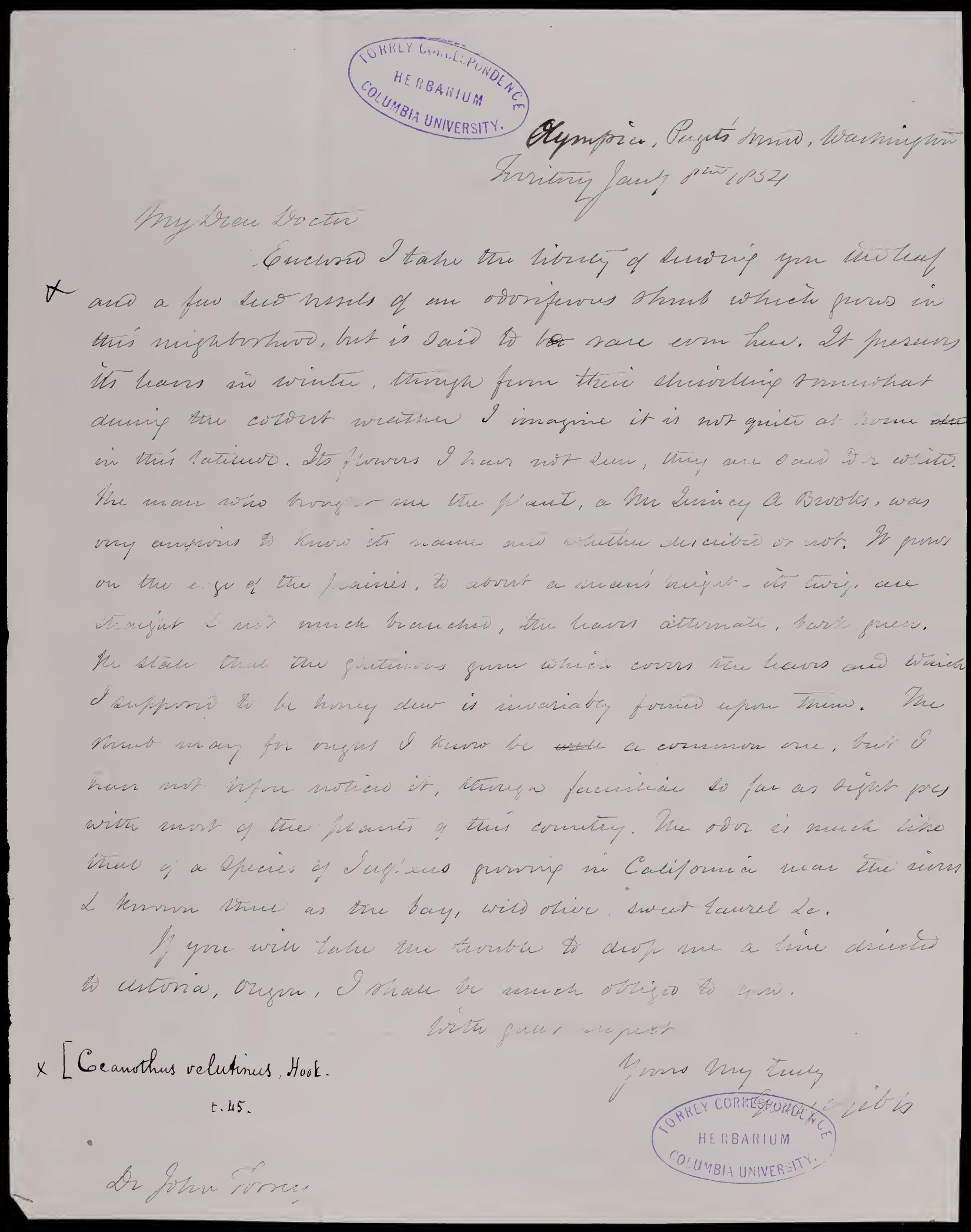
Olympia, Puget's Sound, Washington Territory Jany 8th 1854
My Dear Doctor
Enclosed I take the liberty of sending you the leaf and a few seed vessels of an odoriferous shrub which grows in this neighborhood, but is said to be rare even here. It preserves its leaves in winter, though from their shrivelling somewhat during the coldest weather I imagine it is not quite at home in this latitude. Its flowers I have not seen, they are said to be white. The man who brought me the plant, a Mr Quincy A Brooks, was very anxious to know its name and whether described or not. It grows on the edge of the prairies, to about a man's height — its twigs are straight & not much branched, the leaves alternate, bark green. He states that the glutinous gum which covers the leaves and which I suppose to be honey dew is invariably found upon them. The shrub may for aught I know be a common one, but I have not before noticed it, though familiar so far as sight goes with most of the plants of this country. The odor is much like that of a Species of Juglans growing in California near the rivers & known there as the bay, wild olive, sweet laurel &c.
If you will take the trouble to drop me a line directed to Astoria, Oregon, I shall be much obliged to you.
With great respect
Yours very truly
George Gibbs
[margin annotation, in another hand:] x [ Ceanothus velutinus, Hook. t. 45.
[lower left:] Dr John Torrey
Page 2

[This page is blank — the verso of the first leaf. No text; a faint centerfold and a small pencil "9" in the lower right corner.]
Page 3
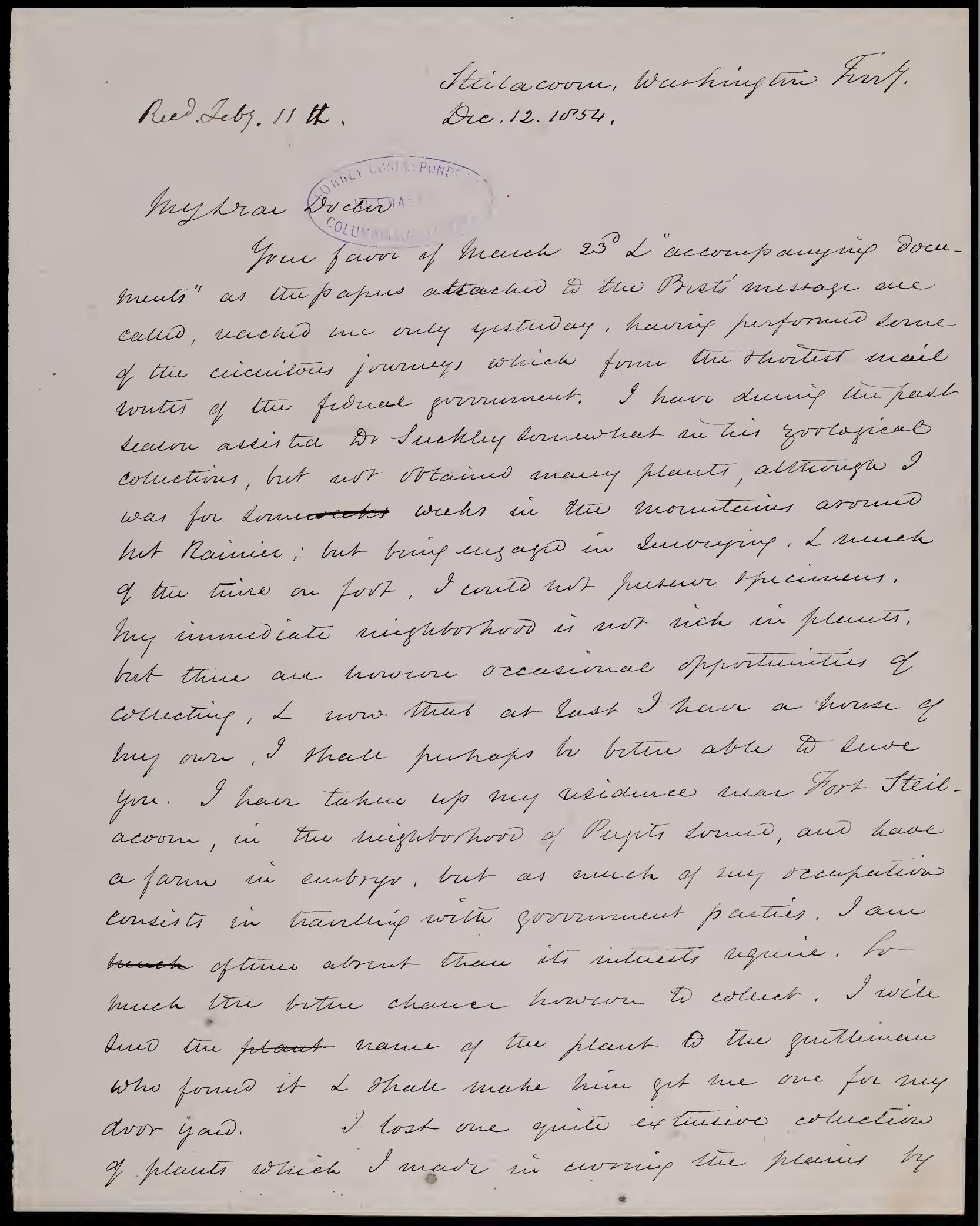
[upper left:] Rec'd Feby 11th.
[upper right:] Steilacoom, Washington Terr'y. Dec. 12. 1854.
My Dear Doctor
Your favor of March 23d & "accompanying documents" as the papers attached to the Prest's message are called, reached me only yesterday, having performed some of the circuitous journeys which form the shortest mail routes of the federal government. I have during the past season assisted Dr Suckley somewhat in his zoological collections, but not obtained many plants, although I was for some [several — struck through] weeks in the mountains around Mt Rainier; but being engaged in Surveying, & much of the time on foot, I could not preserve specimens. My immediate neighborhood is not rich in plants, but there are however occasional opportunities of collecting, & now that at last I have a house of my own, I shall perhaps be better able to serve you. I have taken up my residence near Fort Steilacoom, in the neighborhood of Puget's Sound, and have a farm in embryo, but as much of my occupation consists in travelling with government parties, I am [much — struck through] oftener about than its interests require. So much the better chance however to collect. I will send the [plant — struck through] name of the plant to the gentleman who found it & shall make him get me one for my door yard. I lost one quite extensive collection of plants which I made in crossing the plains by
Page 4
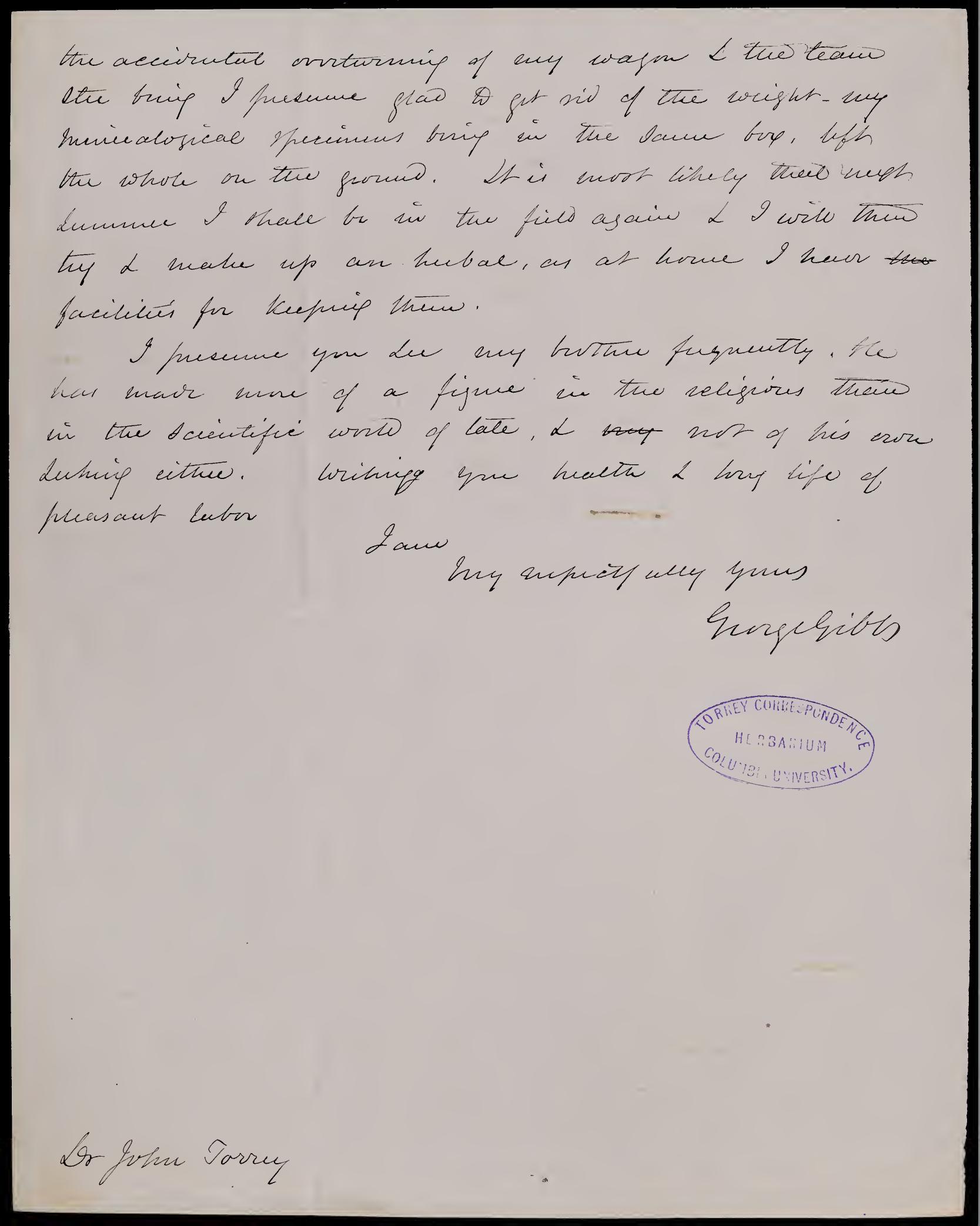
the accidental overturning of my wagon & the teamster being I presume glad to get rid of the weight — my mineralogical specimens being in the same box, left the whole on the ground. It is most likely that next summer I shall be in the field again & I will then try & make up an herbal, as at home I have [no — struck through] facilities for keeping them.
I presume you see my brother frequently. He has made more of a figure in the religious than in the scientific world of late, & [say — struck through] not of his own seeking either. Wishing you health & long life of pleasant labor
I am
Very respectfully yours
George Gibbs
[lower left:] Dr John Torrey
Gibbs, G. (1854). Letters to John Torrey [Manuscript letters]. Torrey Correspondence, Herbarium, Columbia University, New York, NY.
Digitized from Garland H. Green Jr.’s research copy; transcription AI-assisted, under review.
Notes on Forest Growth in Washington Territory (c.1860)
Gibbs’s prose field notes on the trees and shrubs of Washington Territory — the Similkameen and Columbia valleys, Fort Colville, and the Kootenay/Flathead country — annotated throughout with Latin binomials and his own corrections. Pages 5, 8, and 11 are largely blank in the original.
Page 1
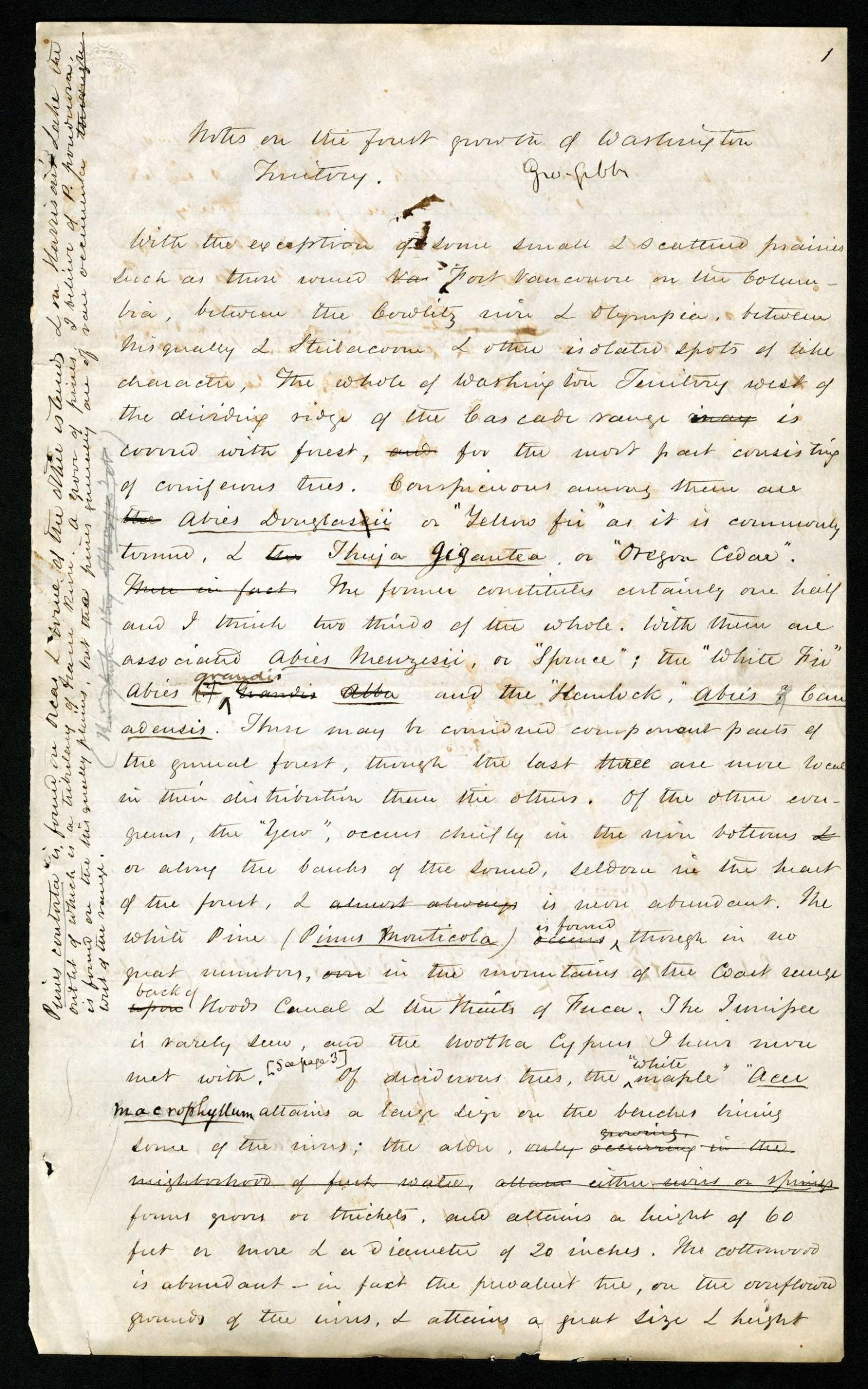
Notes on the forest growth of Washington
Territory. Geo. Gibbs
With the exception of some small & scattered prairies such as those round [about?] Fort Vancouver on the Columbia, between the Cowlitz river & Olympia, between Nisqually & Steilacoom & other isolated spots of like character, the whole of Washington Territory west of the dividing ridge of the Cascade range is covered with forest, for the most part consisting of coniferous trees. Conspicuous among them are the Abies Douglasii or "Yellow fir" as it is commonly termed, & Thuja Gigantea, or "Oregon Cedar". The former constitutes certainly one half and I think two thirds of the whole. With them are associated Abies Menziesii, or "Spruce"; the "White Fir" Abies grandis [Abies Alba crossed out] and the "Hemlock," Abies Canadensis. These may be considered component parts of the general forest, though the last three are more local in their distribution than the others. Of the other evergreens, the "Yew", occurs chiefly in the river bottoms & or along the banks of the Sound, seldom in the heart of the forest, & is never abundant. The white Pine (Pinus Monticola) is found, though in no great numbers, in the mountains of the Coast range back of Hoods Canal & the Straits of Fuca. The Juniper is rarely seen, and the Nootka Cypress I have never met with. [See page 3] Of deciduous trees, the "white maple" "Acer macrophyllum attains a large size on the benches lining some of the rivers; the alder, only growing in the neighborhood of fresh water, [illegible] forms groves or thickets, and attains a height of 60 feet or more & a diameter of 20 inches. The cottonwood is abundant – in fact the prevalent tree, on the overflowed grounds of the rivers, & attains a great size & height
[left margin, vertical:] Pinus contorta is found on New I. shore of the Sd. & tends this outlet of which is a territory of P. horridin [?], I believe of P. horridin, I found on the sandy plains near [illegible] Nisqually & Steilacoom, & a grove of pines, [illegible] one of some occurring [illegible]
Page 2
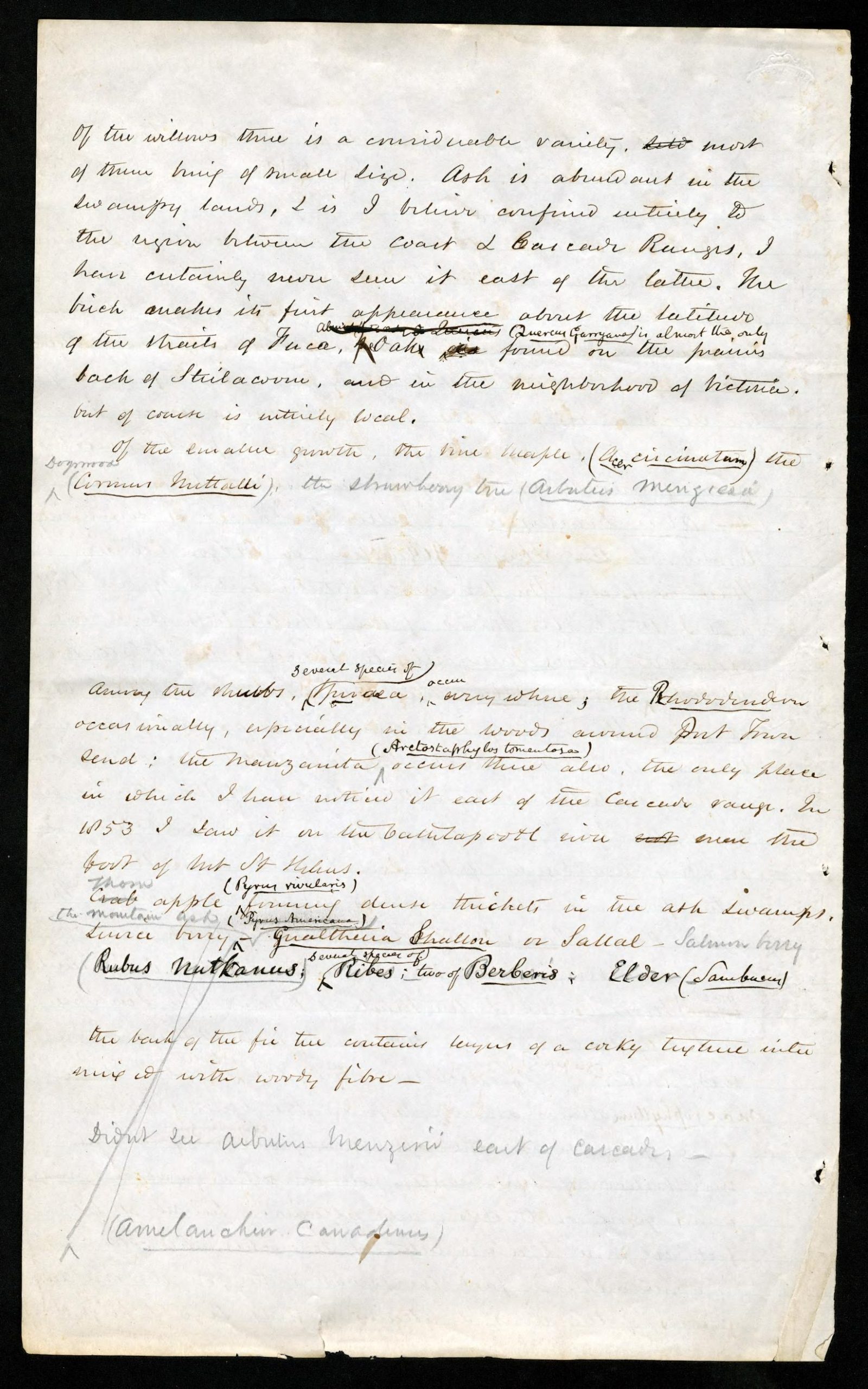
Of the willows there is a considerable variety, most of them being of small size. Ash is abundant in the swampy lands, & is I believe confined entirely to the region between the Coast & Cascade Ranges, I have certainly never seen it east of the latter. The birch makes its first appearance about the latitude of the straits of Fuca. Oak [Quercus Garryana is almost the only] found on the prairies back of Steilacoom, and in the neighborhood of Victoria. but of course is entirely local.
Of the smaller growth, the vine Maple (Acer circinatum) the dogwood (Cornus Nuttalli), the strawberry tree (Arbutus Menziesii)
Among the shrubs, [several species of] Thuiaca[?] occur everywhere; the Rhododendron occasionally, especially in the woods around Port Townsend; the Manzanita (Arctostaphylos tomentosa) occurs there also, the only place in which I have noticed it east of the Cascade range. In 1853 I saw it on the Cathlapootl river near the foot of Mt St Helens. Thorn — Crab apple (Pyrus rivularis) forming dense thickets in the ash swamps. the mountain ash Serviceberry (Pyrus Americana) — Gualtheria Shallon or Sallal — Salmon berry (Rubus Nutkanus; [several species of] Ribes; two of Berberis; Elder (Sambucus)
the bark of the fir tree contains layers of a corky texture intermixed with woody fibre —
Didn't see Arbutus Menziesii east of Cascades —
(Amelanchier Canadensis)
Page 3
[page numbered "2" at top right]
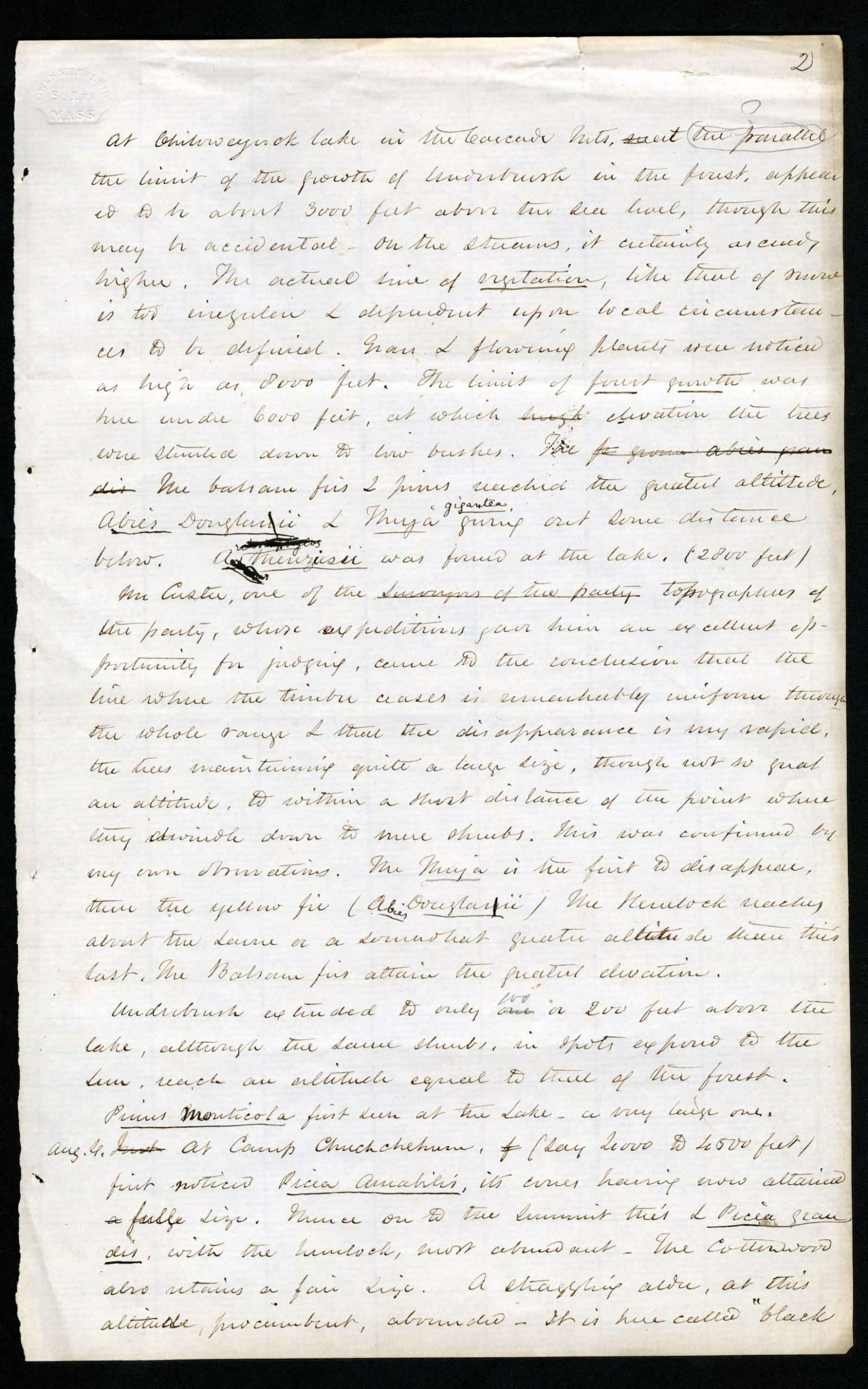
At Chilowaynok[?] lake in the Cascade Mts, near the parallel the limit of the growth of underbrush in the forest, appeared to be about 3000 feet above the sea level, though this may be accidental — On the streams, it certainly ascends higher. The actual line of vegetation, like that of snow is too irregular & dependent upon local circumstances to be defined. Grass & flowering plants were noticed as high as 5000 feet. The limit of forest growth was here under 6000 feet, at which elevation the trees were stunted down to low bushes. The balsam firs & pines reached the greatest altitude, Abies Douglasii & Thuja gigantea giving out some distance below. A. Menziesii was found at the lake. (2800 feet)
Mr Custer, one of the topographers of the party, whose expeditions gave him an excellent opportunity for judging, came to the conclusion that the line where the timber ceases is remarkably uniform through the whole range & that the disappearance is very rapid, the trees maintaining quite a large size, though not so great an altitude, to within a short distance of the point where they dwindle down to mere shrubs. This was confirmed by my own observations. The Thuja is the first to disappear, then the yellow fir (Abies Douglasii) The Hemlock reaches about the same or a somewhat greater altitude than this last. The Balsam firs attain the greatest elevation.
Underbrush extended to only 100 or 200 feet above the lake, although the same shrubs, in spots exposed to the sun, reach an altitude equal to that of the forest.
Pinus Monticola first seen at the Lake — a very large one. Aug. 4. At Camp Chuckchehum, (say 2000 to 4500 feet) first noticed Picea Amabilis, its cones having now attained a feeble size. Thence on to the summit this & Picea grandis, with the hemlock, most abundant — The Cottonwood also retains a fair size. A straggling alder, at this altitude, procumbent, abounded — It is here called "black
Page 4
[page numbered "3" at top right]
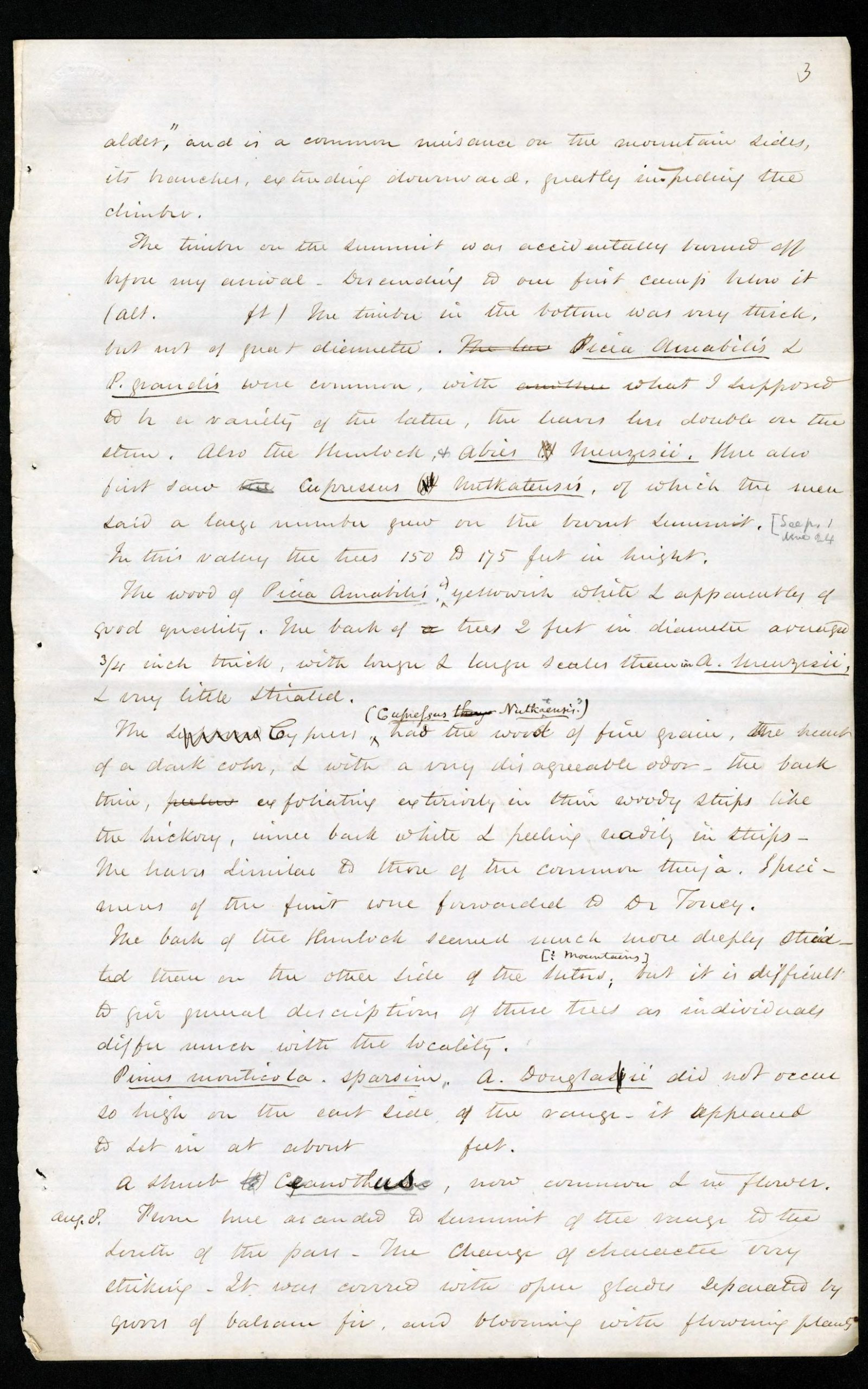
alder," and is a common nuisance on the mountain sides, its branches, extending downward, greatly impeding the climber.
The timber on the summit was accidentally burned off before my arrival — Descending to our first camp below it (alt. ft) The timber in the bottom was very thick, but not of great diameter. Picea Amabilis & P. grandis were common, with what I supposed to be a variety of the latter, the leaves less double on the stem. Also the Hemlock, & Abies Menziesii. Here also first saw Cupressus Nutkatensis, of which the men said a large number grew on the burnt summit. [See p. 1
line 24] In this valley the trees 150 to 175 feet in height.
The wood of Picea Amabilis[?] yellowish white & apparently of good quality. The bark of trees 2 feet in diameter averages 3/4 inch thick, with longer & larger scales than in A. Menziesii, & very little striated.
The Cypress (Cupressus Nutkaensis) had the wood of fine grain, the heart of a dark color, & with a very disagreeable odor — the bark thin, exfoliating exteriorly in thin woody strips like the hickory, inner bark white & peeling readily in strips — The leaves similar to those of the common thuja. Specimens of the fruit were forwarded to Dr Torrey.
The bark of the Hemlock seemed much more deeply striated than on the other side of the Mtns [? Mountains]; but it is difficult to give general descriptions of these trees as individuals differ much with the locality.
Pinus Monticola. sparsim. A. Douglasii did not occur so high on the east side of the range — it appeared to set in at about feet.
A shrub Ceanothus, now common & in flower. Aug. 5. Thence here ascended to summit of the range to the south of the pass. The change of character very striking — It was covered with open glades separated by groves of balsam fir, and blooming with flowering plants
Page 5
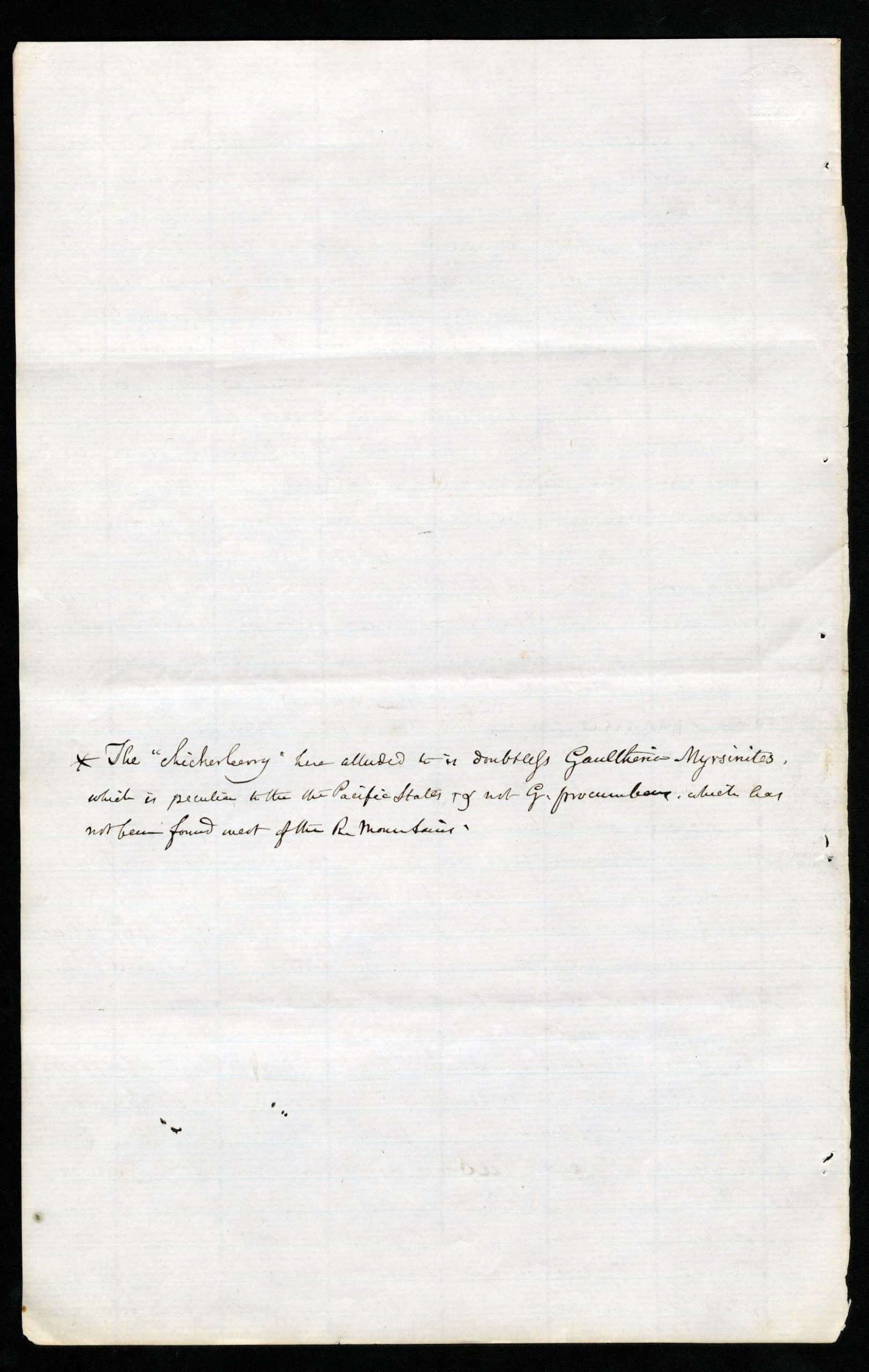
[Mostly blank page; a single footnote in the middle, marked with an asterisk/cross]
* The "chickerberry" here alluded to is doubtless Gaultheria Myrsinites, which is peculiar to the the Pacific States & is not G. procumbens, which has not been found west of the R. Mountains.
Page 6
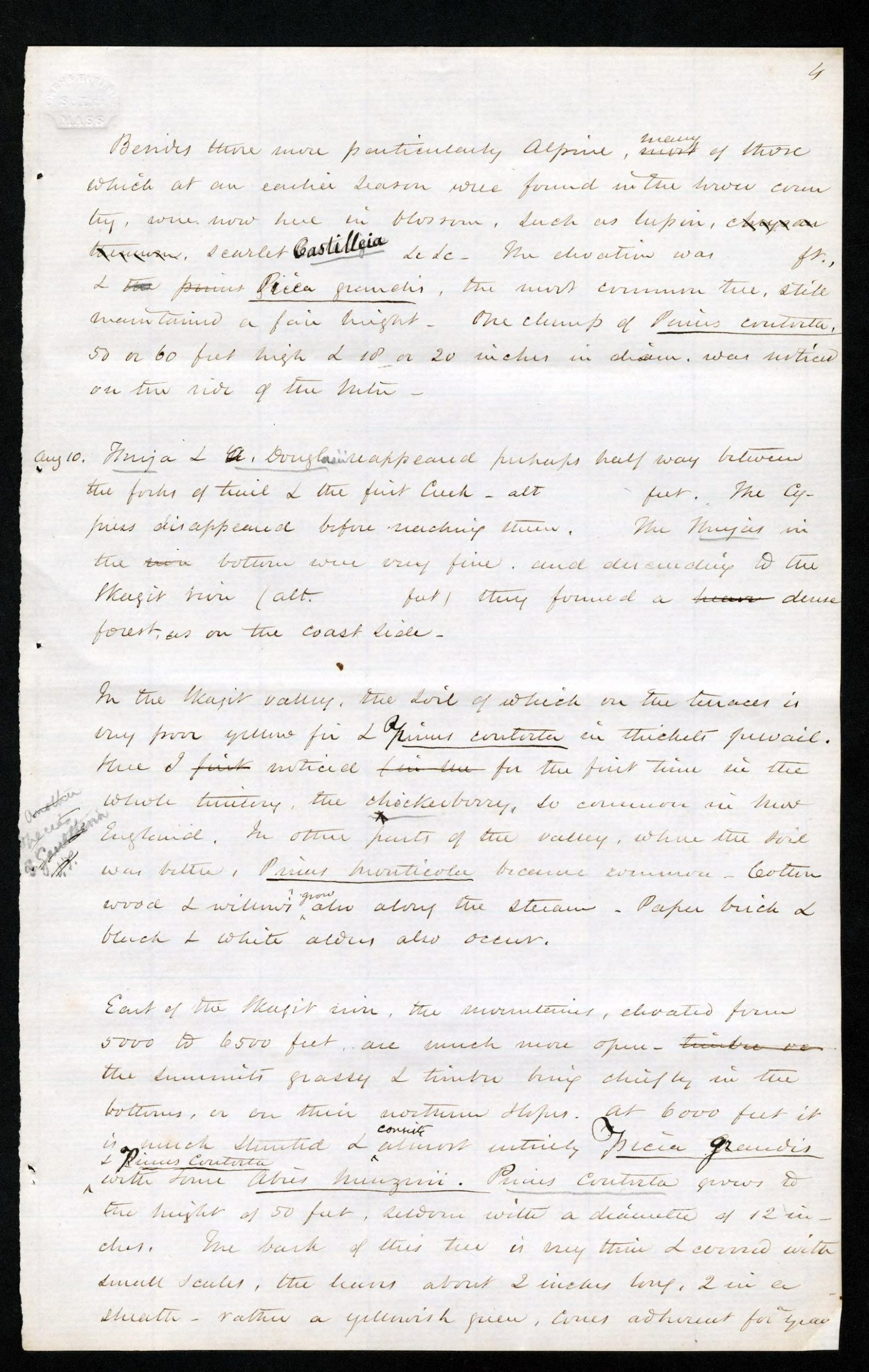
[page numbered "4" at top right]
Besides these more particularly Alpine, many of those which at an earlier season were found in the lower country, were now here in blossom, such as lupin, [illegible] [illegible], scarlet Castilleia &c &c — The elevation was ft., & the Picea grandis, the most common tree, still maintained a fair height — One clump of Pinus contorta, 50 or 60 feet high & 18 or 20 inches in diam. was noticed on the side of the Mtn —
Aug 10. Thuja & A. Douglasii appeared perhaps half way between the forks of trail & the first Creek — alt feet. The Cypress disappeared before reaching them. The Thujas in the bottom were very fine. and descending to the Skagit river (alt feet) they formed a dense forest, as on the coast side —
In the Skagit valley, the soil of which on the terraces is very poor, yellow fir & Pinus contorta in thickets prevail. Here I noticed for the first time in the whole territory, the chickerberry, so common in New England. In other parts of the valley, where the soil was better, Pinus Monticola became common — Cottonwood & willows grow also along the stream — Paper birch & black & white alders also occur.
East of the Skagit river, the mountains, elevated from 5000 to 6500 feet, are much more open — timber on the summits grassy & timber being chiefly in the bottoms, or on their northern slopes. At 6000 feet it is much stunted & almost entirely Picea grandis conitis[?] & Pinus contorta with some Abies Menziesii. Pinus contorta grows to the height of 50 feet, seldom with a diameter of 12 inches. The bark of this tree is very thin & covered with small scales, the leaves about 2 inches long, 2 in a sheath — rather a yellowish green, cones adherent for years
Page 7
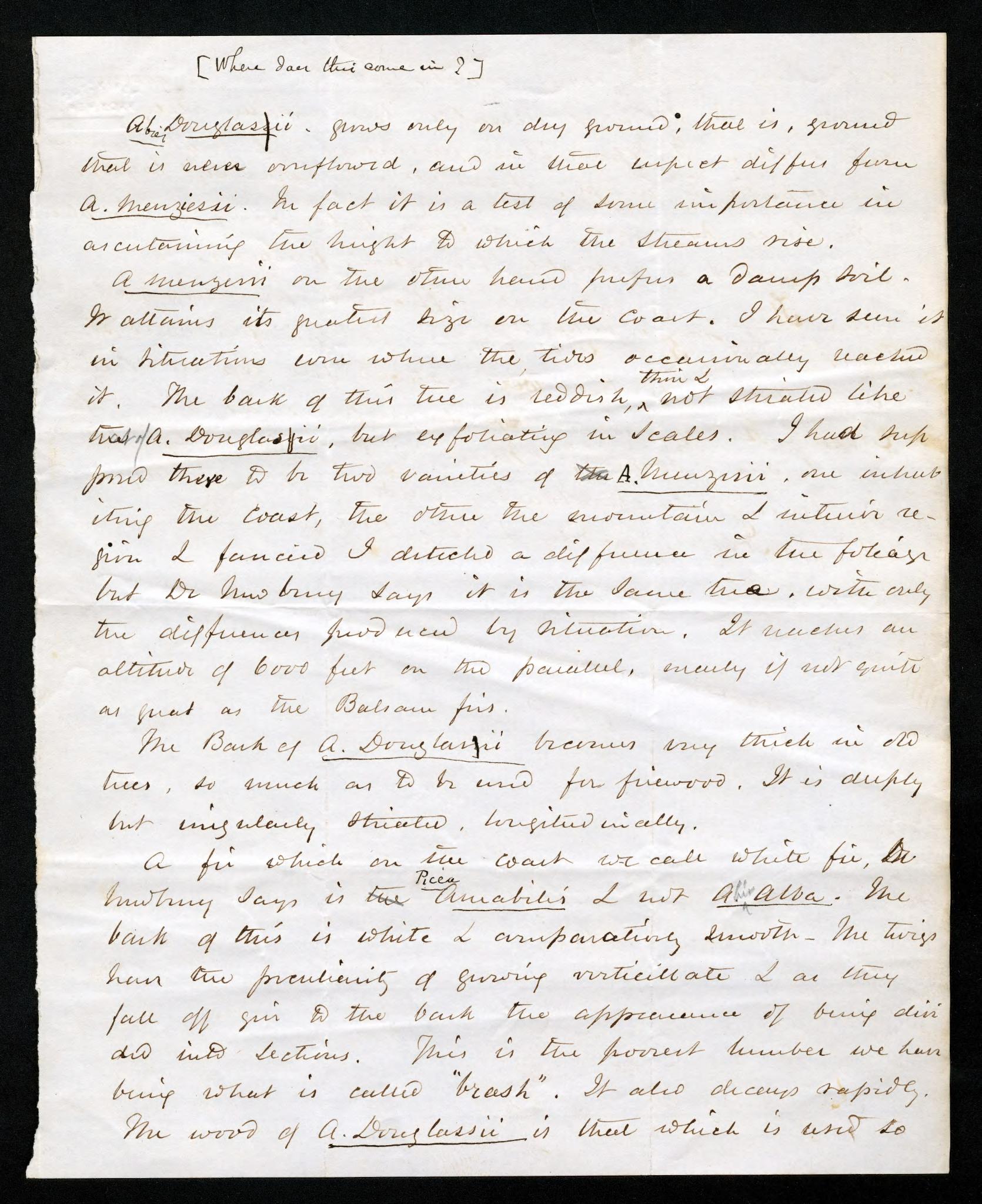
[Where does this come in?]
Abies Douglasii. grows only on dry ground; that is, ground that is never overflowed, and in that respect differs from A. Menziesii. In fact it is a test of some importance in ascertaining the height to which the streams rise.
A. Menziesii on the other hand prefers a damp soil. It attains its greatest size on the coast. I have seen it in situations even where the tides occasionally reached it. The bark of this tree is reddish, thin & not striated like that of A. Douglasii, but exfoliating in scales. I had supposed there to be two varieties of the A. Menziesii, one inhabiting the coast, the other the mountain & interior region & fancied I detected a difference in the foliage but Dr Newberry says it is the same tree, with only the differences produced by situation. It reaches an altitude of 6000 feet on the parallel, nearly if not quite as great as the Balsam firs.
The Bark of A. Douglasii becomes very thick in old trees, so much as to be used for firewood. It is deeply but irregularly striated, longitudinally.
A fir which on the coast we call white fir, Dr Newberry says is the Picea Amabilis & not Ab. Alba. The bark of this is white & comparatively smooth — The twigs have the peculiarity of growing verticillate & as they fall off give to the bark the appearance of being divided into sections. This is the poorest lumber we have being what is called "brash". It also decays rapidly.
The wood of A. Douglasii is that which is used so
Page 8
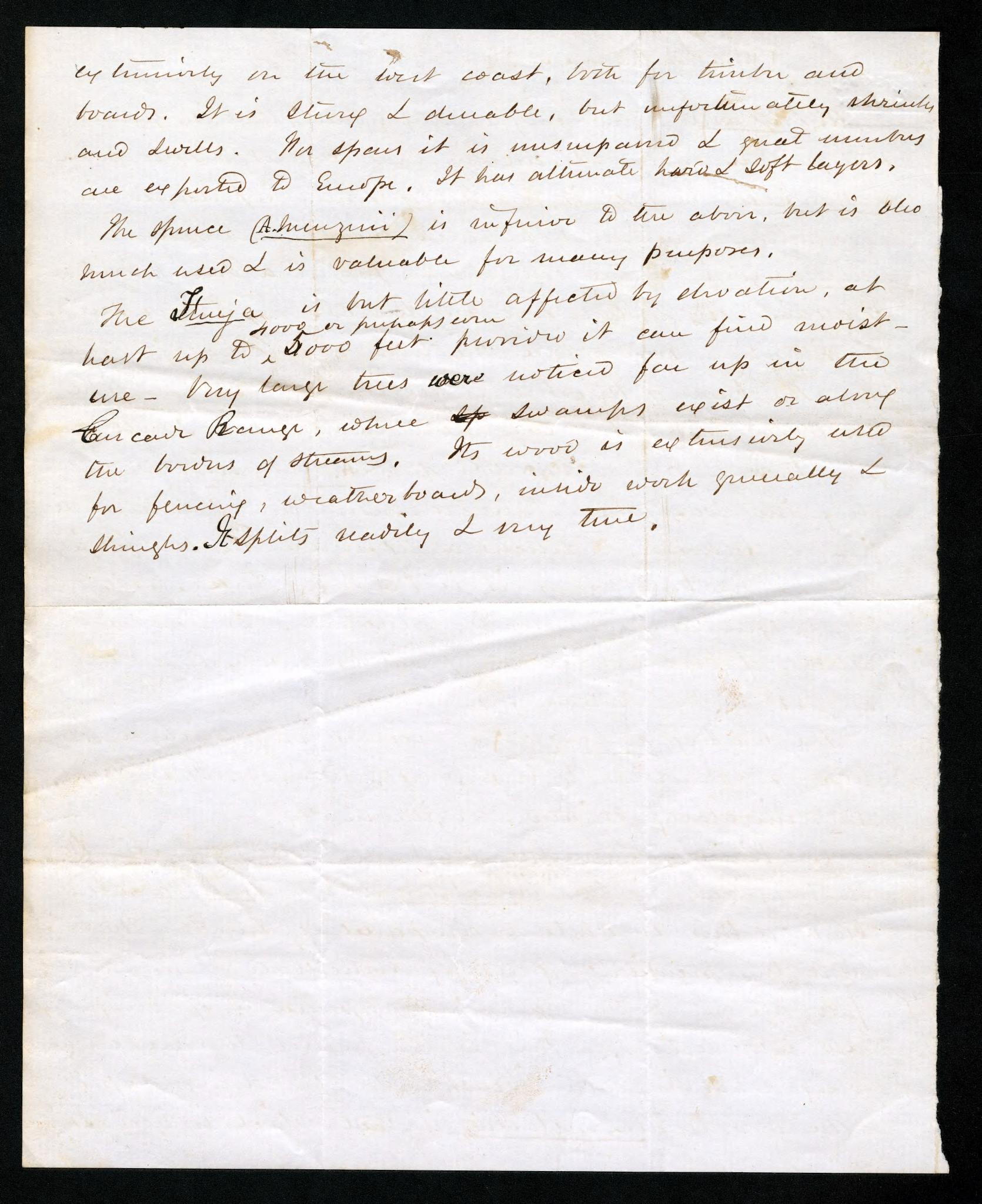
extensively on the west coast, both for timber and boards. It is strong & durable, but unfortunately shrinks and swells. For spars it is unsurpassed & great numbers are exported to Europe. It has alternate hard & soft layers.
The Spruce (A. Menziesii) is inferior to the above, but is also much used & is valuable for many purposes.
The Thuja is but little affected by elevation, at least up to 5000 feet [interlined: 4000 or perhaps even] provided it can find moisture — Very large trees were noticed far up in the Cascade Range, where swamps exist or along the borders of streams. Its wood is extensively used for fencing, weatherboards, inside work generally & shingles. It splits readily & very true.
[remainder of page blank]
Page 9
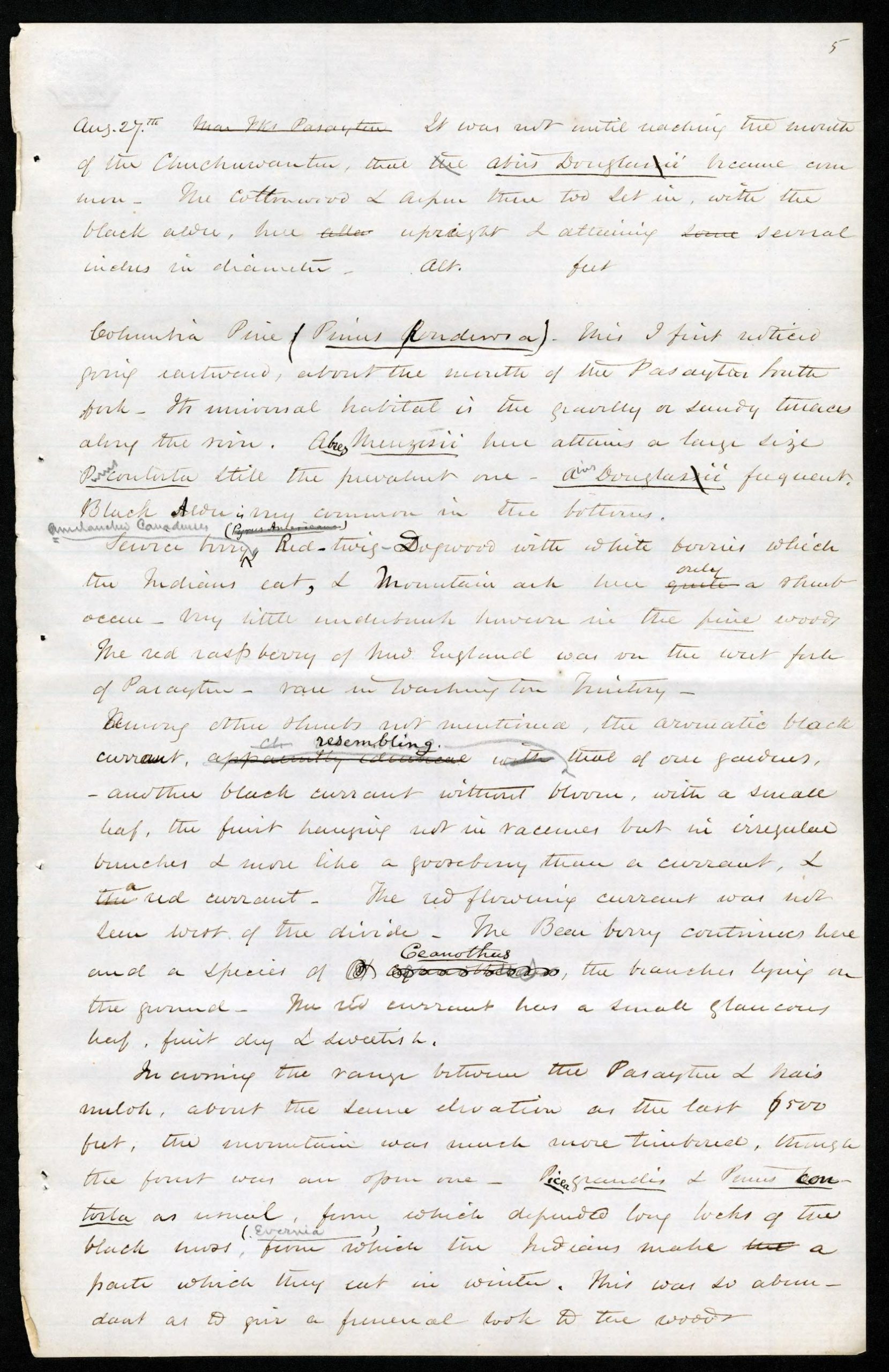
[page numbered "5" at top right]
Aug. 27th near the Pasayten[?] It was not until reaching the mouth of the Chuchuwanton[?], that the Abies Douglasii became common — The Cottonwood & Aspen there too set in, with the black alder, here upright & attaining several inches in diameter — Alt feet
Columbia Pine (Pinus Ponderosa). This I first noticed going eastward, about the mouth of the Pasayten, south fork — Its universal habitat is the gravelly or sandy terraces along the river. Abies Menziesii here attains a large size P. contorta still the prevalent one — A. Douglasii frequent. Black Alder is very common in the bottoms. Service berry (Pyrus Americana) [Amelanchier Canadensis] Red-twig Dogwood with white berries which the Indians eat, & Mountain ash here only a shrub occur — very little underbrush however in the pine woods The red raspberry of New England was on the west fork of Pasayten — rare in Washington Territory —
Among other shrubs not mentioned, the aromatic black currant, resembling that of our gardens, — another black currant without bloom, with a small leaf, the fruit hanging not in racemes but in irregular bunches & more like a gooseberry than a currant, & the red currant — The red flowering currant was not seen west of the divide — The Bear berry continues here and a species of Ceanothus, the branches lying on the ground — The red currant has a small glaucous leaf, fruit dry & sweetish.
In crossing the range between the Pasayten & Naismloh[?], about the same elevation as the last 6500 feet, the mountain was much more timbered, though the forest was an open one — Picea grandis & Pinus contorta as usual, from which depended long locks of the black moss (Evernia) from which the Indians make a paste which they eat in winter. This was so abundant as to give a funereal look to the woods
Page 10
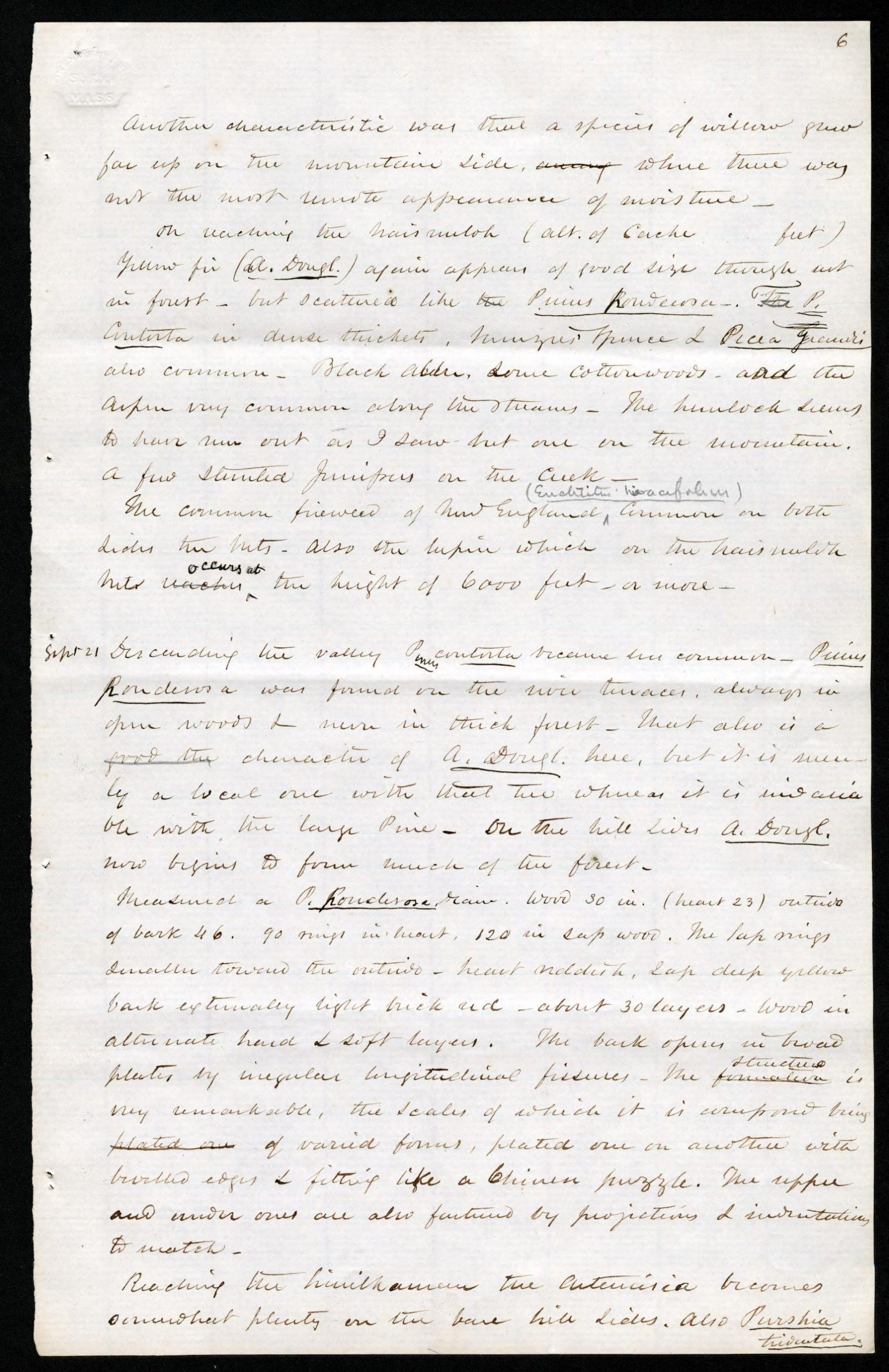
[page numbered "6" at top right]
Another characteristic was that a species of willow grew far up on the mountain side, where there was not the most remote appearance of moisture —
On reaching the Naismloh[?] (alt. of Cache feet) Yellow fir (A. Dougl.) again appears of good size though not in forest — but scattered like the Pinus Ponderosa — The P. contorta in dense thickets, Menzies Spruce & Picea Grandis also common — Black Alder, some cottonwoods — and the Aspen very common along the streams — The hemlock seems to have run out as I saw but one on the mountain. A few stunted Junipers on the Creek —
The common fireweed of New England (Epilobium spicatum[?]) common on both sides the Mts — Also the lupin which on the Naismloh Mts occurs at [reaches struck] the height of 6000 feet — or more —
Sept 21 Descending the valley P. contorta became less common — Pinus Ponderosa was found on the river terraces, always in open woods & never in thick forest — That also is a the character of A. Dougl. here, but it is merely a local one with that tree whereas it is invariable with the large Pine — On the hill sides A. Dougl. now begins to form much of the forest —
Measured a P. Ponderosa. Diam. wood 30 in. (heart 23) outside of bark 46. 90 rings in heart, 120 in sap wood. The sap rings smaller toward the outside — heart reddish, sap deep yellow bark externally light brick red — about 30 layers — wood in alternate hard & soft layers. The bark opens in broad plates by irregular longitudinal fissures — The structure is very remarkable, the scales of which it is composed being of varied forms, plated one on another with bevelled edges & fitting like a Chinese puzzle. The upper and under ones are also fastened by projections & indentations to match —
Reaching the Similkameen the Artemisia becomes somewhat plenty on the bare hill sides. Also Purshia tridentata.
Page 11
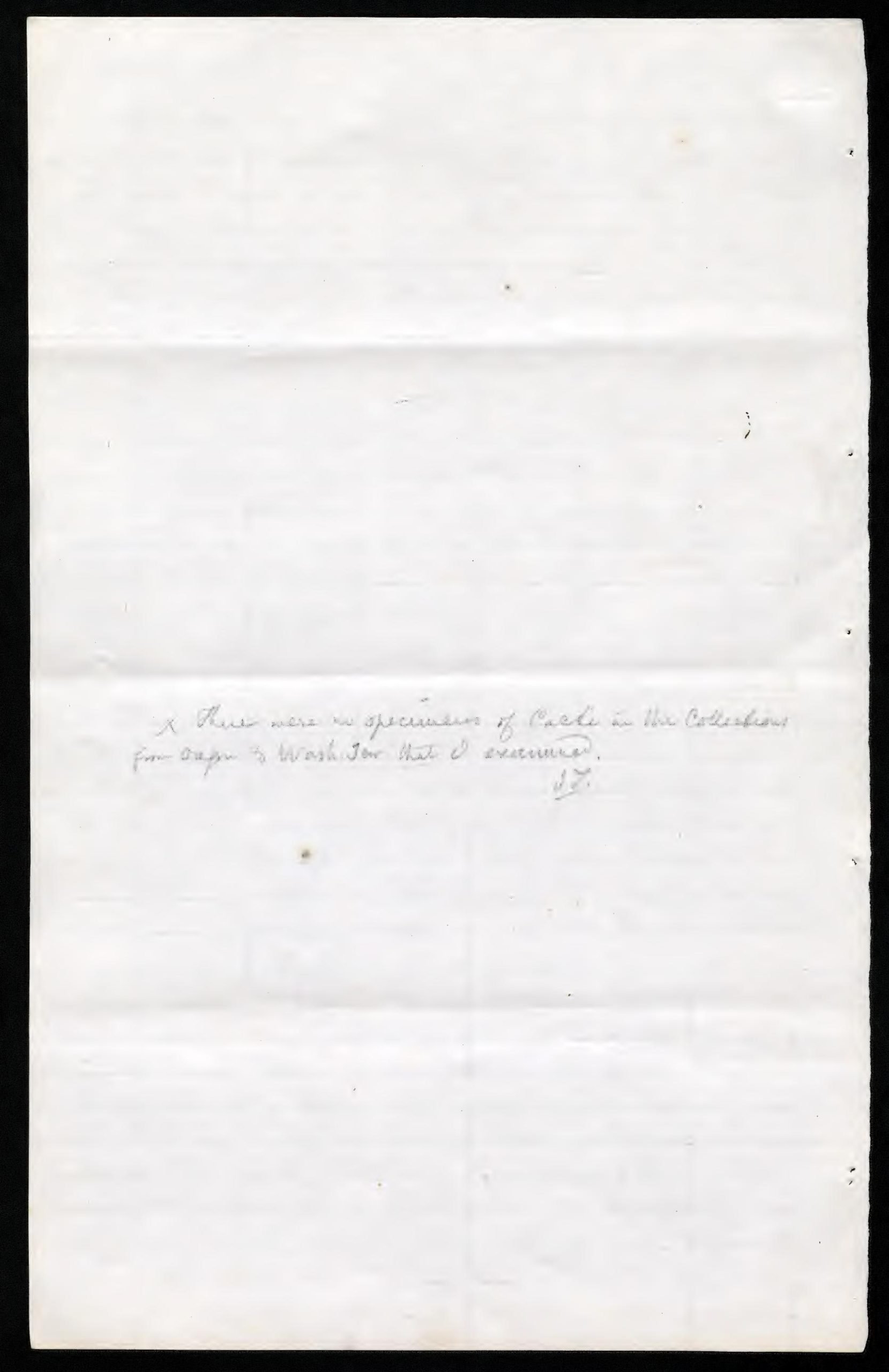
[Page mostly blank; single footnote in pencil near center]
x There were no specimens of Cacli [Cacti] in the Collections from Oregon & Wash Ter that I examined. J.T.
Page 12
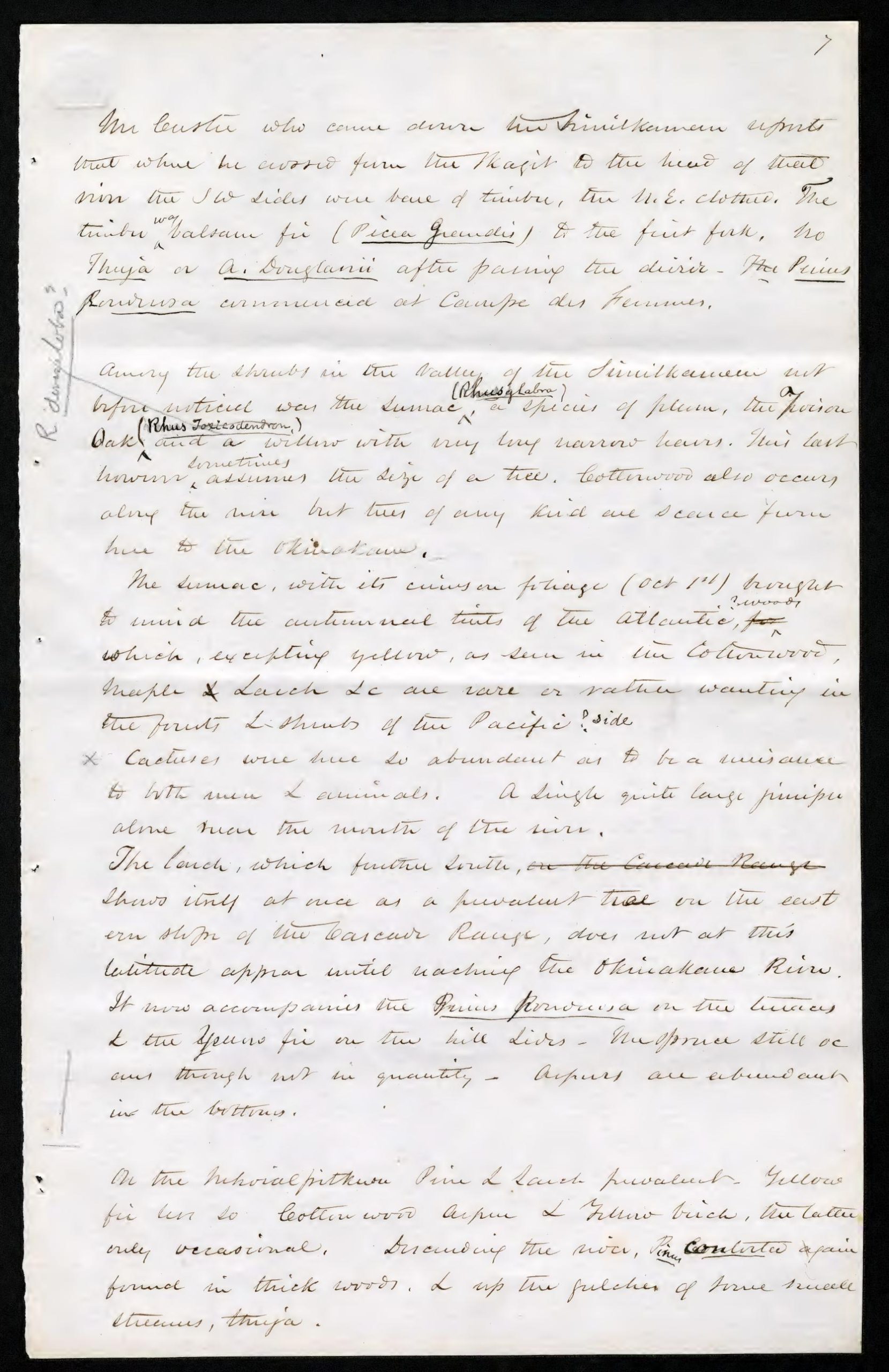
[Page number "7" upper right]
Mr Custer[?] who came down the Similkameen reports that where he crossed from the Skagit to the head of that river the S.W. sides were bare of timber, the N.E. clothed. The timber w[i]th balsam fir (Picea Grandis) to the first fork, no Thuja or A. Douglasii after passing the divide – The Pinus Ponderosa commenced at Campe des Femmes.
[margin left: R. douglasii?]
Among the shrubs in the Valley of the Similkameen not before noticed was the Sumac (Rhus glabra), a species of plum, the poison Oak (Rhus Toxicodendron) and a willow with very long narrow leaves. This last [interlined: sometimes] however, assumes the size of a tree. Cottonwood also occurs along the river but trees of any kind are scarce from here to the Okinakane.
The Sumac, with its crimson foliage (Oct 1st) brought to mind the autumnal tints of the Atlantic, [interlined: woods] for which, excepting yellow, as seen in the Cottonwood, Maple & Larch &c are rare or rather wanting in the forests & shrubs of the Pacific [?] side x Cactuses were here so abundant as to be a nuisance to both men & animals. A single quite large juniper alone near the mouth of the river. The Larch, which further South, on the Cascade Range shows itself at once as a prevalent tree on the east ern slope of the Cascade Range, does not at this latitude appear until reaching the Okinakane River. It now accompanies the Pinus Ponderosa on the terraces & the Young fir on the hill sides – The spruce still oc curs though not in quantity – Aspens are abundant in the bottoms.
On the Nehoialpitkwu Pine & Larch prevalent – Yellow fir less so Cottonwood Aspen & Yellow birch, the latter only occasional. Descending the river, Pinus Contorta again found in thick woods. & up the gulches of some small streams, thuja.
Page 13
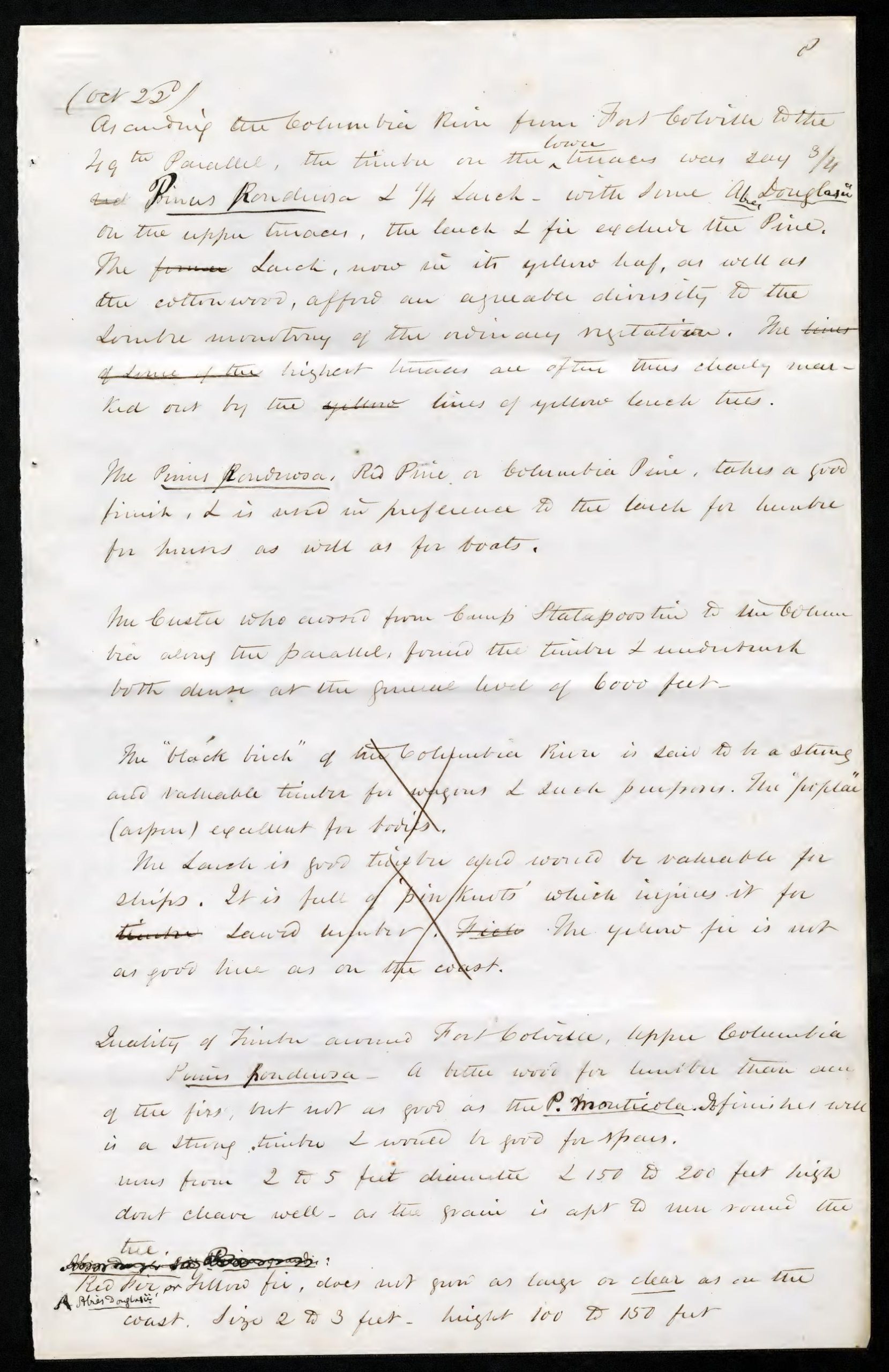
[Page number "8" upper right]
(Oct 22d) Ascending the Columbia River from Fort Colville to the 49th Parallel, the timber on the [interlined: lower] terraces was say 3/4 [struck: red] Pinus Ponderosa & 1/4 Larch – with some Ab[ies] Douglasii on the upper terraces, the larch & fir exclude the Pine. The [struck: former] Larch, now in its yellow leaf, as well as the cottonwood, afford an agreeable diversity to the sombre monotony of the ordinary vegetation. The [struck: lines] [struck: of some] of the highest terraces are often thus clearly marked out by the [struck: yellow] lines of yellow larch trees.
The Pinus Ponderosa. Red Pine or Columbia Pine, takes a good finish, & is used in preference to the larch for lumber for houses as well as for boats.
Mr Custer who crossed from Camp Statapoostin to the Colum bia along the parallel, found the timber & underbrush both dense at the general level of 6000 feet –
The "black birch" of the Columbia River is said to be a strong and valuable timber for wagons & such purposes. The "poplar" (aspen) excellent for bodies.
The Larch is good timber and would be valuable for ships. It is full of "pin knots" which injures it for [struck: timber] Sawed lumber. [struck: field] The yellow fir is not as good here as on the coast.
Quality of Timber around Fort Colville, Upper Columbia
Pinus ponderosa – A better wood for lumber than any of the firs, but not as good as the P. monticola. It finishes well is a strong timber & would be good for spars.
runs from 2 to 5 feet diameter & 150 to 200 feet high dont cleave well – as the grain is apt to run round the tree. [struck: Abies Douglasii?]
[margin left: A. Abies Douglasii]
Red fir or Yellow fir, does not grow as large or clear as on the coast. Size 2 to 3 feet – height 100 to 150 feet
Page 14
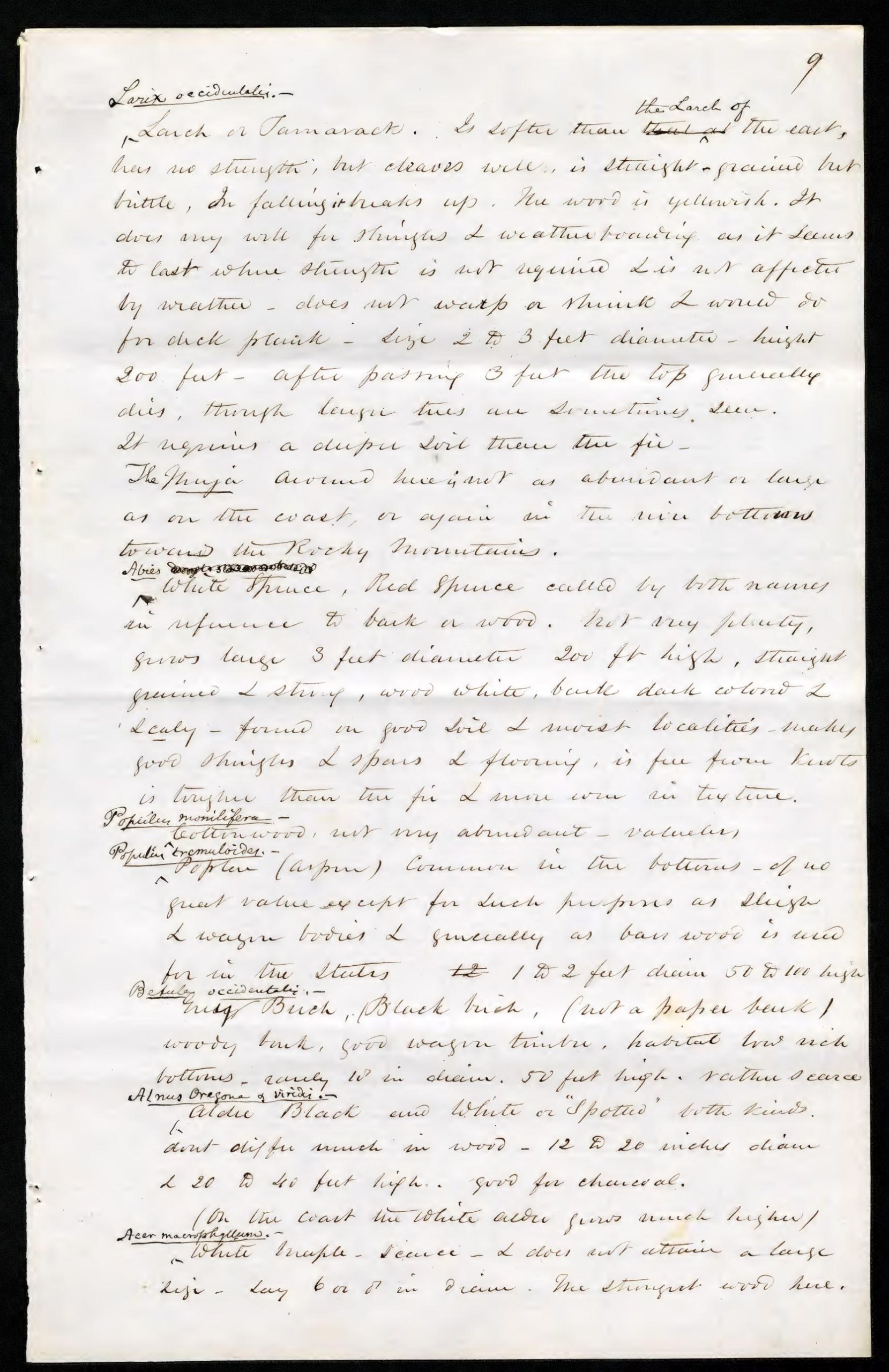
[Page number "9" upper right]
[margin left: Larix occidentalis. -]
Larch or Tamarack. Is softer than [struck: that of] [interlined: the Larch of] the east, has no strength, but cleaves well, is straight – grained but brittle, In falling it breaks up. The wood is yellowish. It does very well for shingles & weatherboarding as it seems to last where strength is not required & is not affected by weather – does not warp or shrink & would do for deck plank – Size 2 to 3 feet diameter – height 200 feet – after passing 3 feet the top generally dies, though larger trees are sometimes seen. It requires a deeper soil than the fir – The Thuja around here is not as abundant or large as on the coast, or again in the river bottoms toward the Rocky Mountains.
[margin left: Abies (struck) ]
White Spruce, Red Spruce called by both names in reference to bark or wood. Not very plenty, grows large 3 feet diameter 200 ft high, straight grained & strong, wood white, bark dark colored & scaly – found on good soil & moist localities – makes good shingles & spars & flooring, is free from knots is tougher than the fir & more even in texture.
[margin left: Populus monilifera -]
Cottonwood, not very abundant – valueless
[margin left: Populus tremuloides. -]
Poplar (aspen) Common in the bottoms – of no great value except for such purposes as sleigh & wagon bodies & generally as bass wood is used for in the States 1 to 2 feet diam 50 to 100 high
[margin left: Betula occidentalis. -]
neg[?] Birch, Black birch, (not a paper bark) woody bark, good wagon timber, habitat low rich bottoms – rarely 1 foot in diam. 50 feet high. rather scarce
[margin left: Alnus Oregona & viridis. -]
Alder Black and White or "Spotted" both kinds. dont differ much in wood – 12 to 20 inches diam & 20 to 40 feet high. good for charcoal. (On the coast the White alder grows much higher)
[margin left: Acer macrophyllum. -]
White Maple – Scarce – & does not attain a large size – say 6 or 8 in diam. The strongest wood here.
Page 15
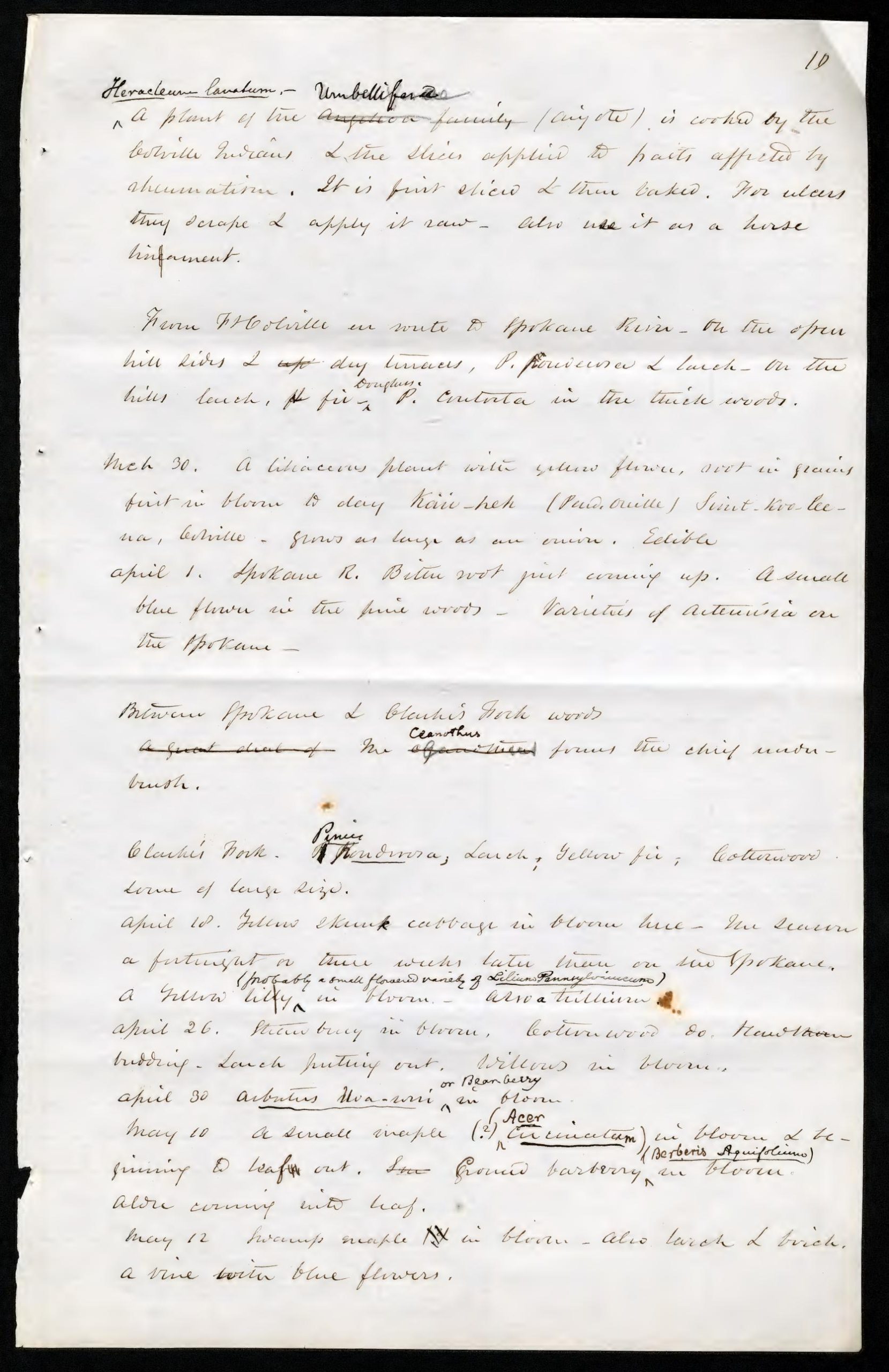
[Page number "10" upper right]
[margin/header: Heracleum lanatum. – Umbelliferae]
A plant of the [struck: Angelica] family (Anisote[?]) is cooked by the Colville Indians & the slices applied to parts affected by rheumatism. It is first sliced & then baked. For ulcers they scrape & apply it raw – Also use it as a horse liniment.
From Ft Colville en route to Spokane River – On the open hill sides & [struck: up] dry terraces, P. Ponderosa & larch – On the hills larch, & fir [interlined: Douglasii] P. Contorta in the thick woods.
Mch 30. A liliaceous plant with yellow flower, root in grains first in bloom to day Kaü-keh (Pend. Oreille) Siint-koo-leena, Colville – grows as large as an onion. Edible April 1. Spokane R. Bitter root just coming up. A small blue flower in the pine woods – Varieties of Artemisia on the Spokane –
Between Spokane & Clarke's Fork woods [struck: A great deal of] The [interlined: Ceanothus] [struck: Ceanothus] forms the chief underbrush.
Clarke's Fork. [interlined: Pinus] Ponderosa, Larch, Yellow fir, Cottonwood some of large size. April 18. Yellow skunk cabbage in bloom here – The season a fortnight or three weeks later than on the Spokane. [interlined: (probably a small flowered variety of Lilium Pennsylvanicum)] A Yellow lilly in bloom – Also a trillium April 26. Strawberry in bloom, Cottonwood do. Hawthorn budding – Larch putting out. Willows in bloom. April 30 Arbutus Uva-ursi [interlined: or Bearberry] in bloom. May 10 A small maple (?) [interlined: Acer] circinatum) in bloom & beginning to leaf out. [struck: See] Ground barberry [interlined: (Berberis Aquifolium)] in bloom. Alder coming into leaf. May 12 Swamp maple in bloom – Also larch & birch. A vine with blue flowers.
Page 16
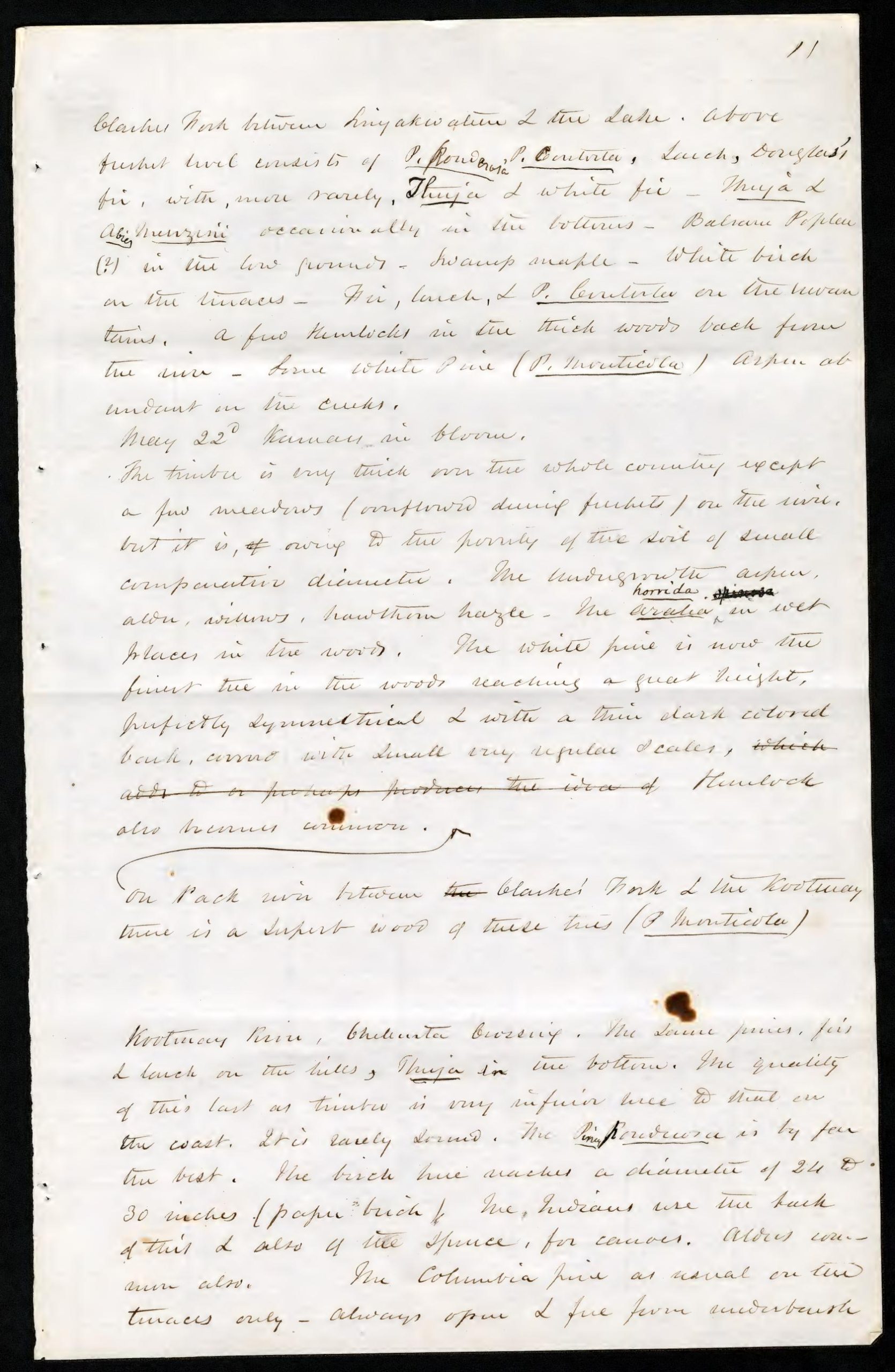
[Page number "11" upper right]
Clarke's Fork between Kiyakwatun[?] & the Lake. Above freshet level consists of P. Ponderosa [interlined: Thuja] P. Contorta, Larch, Douglass's fir, with, more rarely, Thuja & white fir – Thuja & Abies Menziesii occasionally in the bottoms – Balsam Poplar (?) in the low ground – Swamp maple – White birch on the terraces – Fir, larch, & P. Contorta on the moun tains. A few Hemlocks in the thick woods back from the river – Some White Pine (P. Monticola) Aspen ab undant in the creeks. May 22d Kamass in bloom. The timber is very thick over the whole country except a few meadows (overflowed during freshets) on the river. but it is, & owing to the poverty of the soil of small comparative diameter. The Undergrowth aspen, alder, willows, hawthorn hazle – The Aralia [interlined: horrida] [struck: horrida] in wet places in the woods. The white pine is now the finest tree in the woods reaching a great height, perfectly symmetrical & with a thin dark colored bark, covered with small very regular scales, [struck: which] [struck: adds to or perhaps produces the idea of] Hemlock also becomes common.
On Pack river between [struck: the] Clarke's Fork & the Kootenay there is a Superb wood of these trees (P. Monticola)
Kootenay River, Chelmusta[?] Crossing. The same pines, firs & larch on the hills, Thuja in the bottom. The quality of this last as timber is very inferior here to that on the coast. It is rarely sound. The Pinus Ponderosa is by far the best. The birch here reaches a diameter of 24 to 30 inches (paper birch) The Indians use the bark of this & also of the Spruce, for canoes. Alders common also. The Columbia pine as usual on the terraces only – Always open & free from underbrush
Page 17
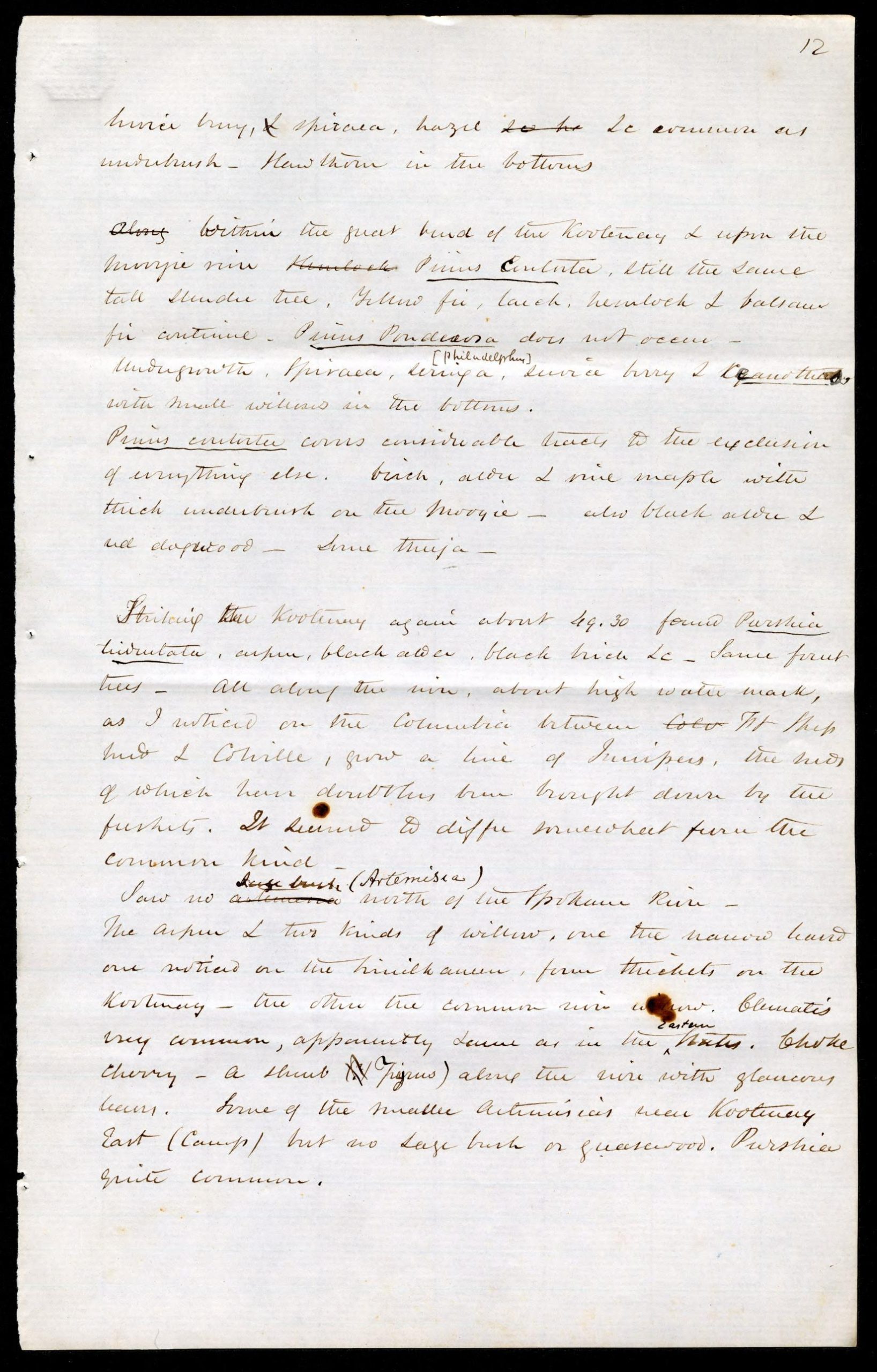
[Page number "12" upper right]
Service berry, & spiraea, hazel [struck: &c] &c common as underbrush – Hawthorn in the bottoms
[struck: Along] Within the great bend of the Kootenay & upon the Moogie[?] river [struck: Hemlock] Pinus Contorta, still the same tall slender tree, Yellow fir, larch, hemlock & balsam fir continue – Pinus Ponderosa does not occur – Undergrowth, Spiraea, Kentuga[?], service berry & Cyanothus [interlined: (Philadelphus)] with small willows in the bottoms. Pinus contorta covers considerable tracts to the exclusion of everything else. birch, alder & vine maple with thick underbrush on the Moogie – also black alder & red dogwood – Some thuja –
Striking the Kootenay again about 49.30 found Purshia tridentata, aspen, black alder, black birch &c – Same fruit trees – All along the river, about high water mark, as I noticed on the Columbia between Colo[?] Ft Shepherd & Colville, grow a line of Junipers, the seeds of which have doubtless been brought down by the freshets. It seemed to differ somewhat from the common kind – Saw no [struck: sage brush] (Artemisia) north of the Spokane River – The aspen & two kinds of willow, one the narrow leaved one noticed on the Similkameen, form thickets on the Kootenay – the other the common river willow. Clematis very common, apparently same as in the [interlined: eastern] States. Choke cherry – A shrub (? Pyrus) along the river with glaucous leaves. Some of the smaller Artemisias near Kootenay East (Camp) but no sage bush or greasewood. Purshia quite common.
Page 18
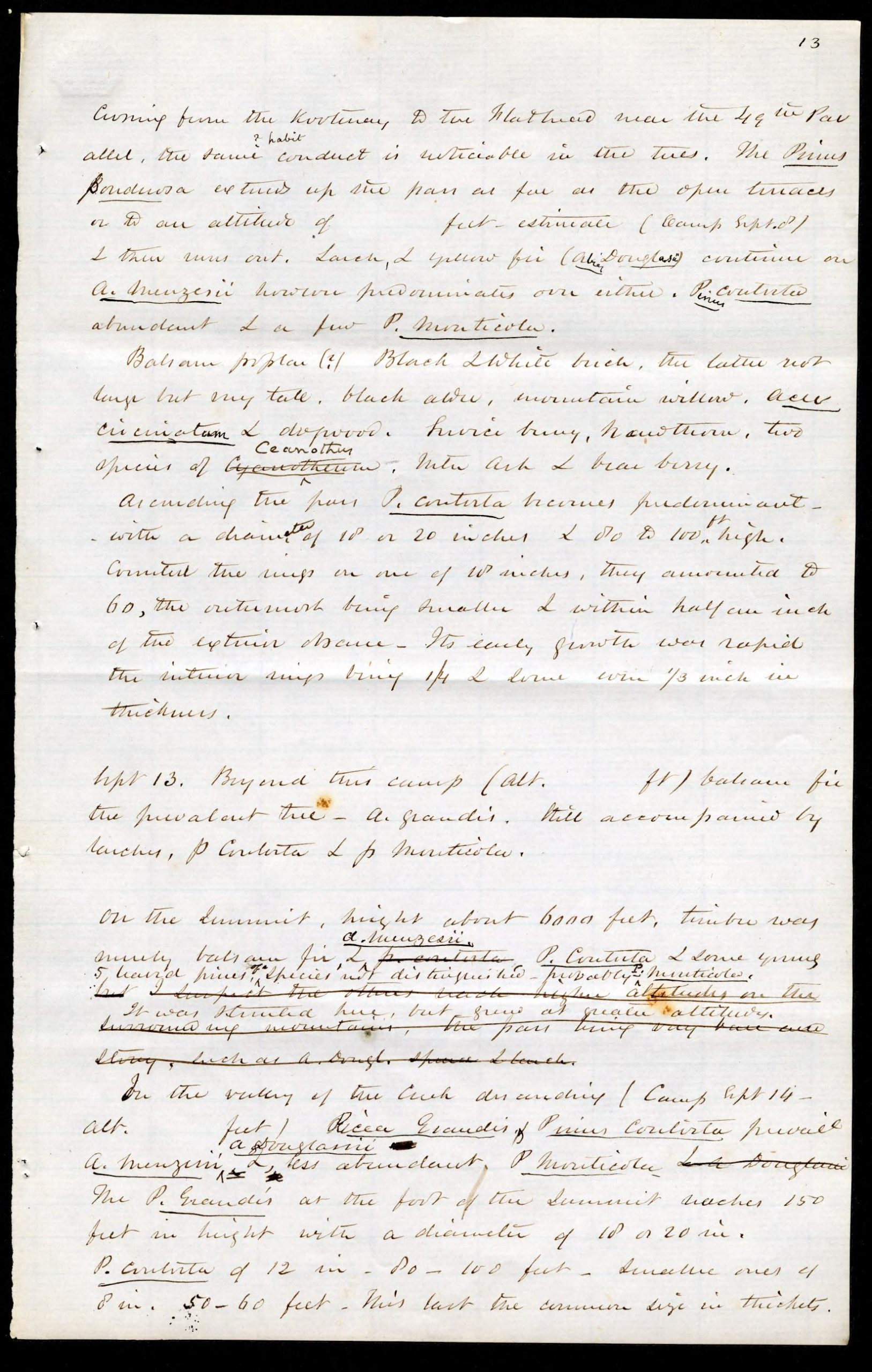
[Page number "13" upper right]
Crossing from the Kootenay to the Flathead near the 49th Parallel, the same conduct [interlined: ? habit] is noticeable in the trees. The Pinus Ponderosa extends up the pass as far as the open terraces or to an altitude of ____ feet – estimate (Camp Sept. 8) & then runs out. Larch, & yellow fir (Abies Douglasii) continue or A. Menziesii however predominates over either. Pinus Contorta abundant & a few P. Monticola.
Balsam poplar (?) Black & White birch, the latter not large but very tall. black alder, mountain willow. Acer circinatum & dogwood. Service berry, Hawthorn, two species of [struck: Cyanothtum] [interlined: Ceanothus]. Mtn Ash & bear berry.
Ascending the pass P. Contorta becomes predominant – – with a diameter of 18 or 20 inches & 80 to 100 ft high. Counted the rings on one of 18 inches, they amounted to 60, the outermost being smaller & within half an inch of the exterior surface – Its early growth was rapid the interior rings being 1/4 & some even 1/3 inch in thickness.
Sept 13. Beyond this camp (Alt. ____ ft) balsam fir the prevalent tree – A. grandis. Still accompanied by larches, P Contorta & p Monticola.
On the summit, height about 6000 feet, timber was mostly balsam fir [struck: & p. contorta] [interlined: A. Menziesii] P. Contorta & some young 5. leaved pines, species not distinguished – probably P. Monticola. [struck: but I suspect the others reach higher altitudes on the] [struck: surrounding mountains, the pass being very bare and] [struck: strong, such as A. Dougl. spruce & larch.] It was stunted here, but grew at greater altitudes.
In the valley of the Creek descending (Camp Sept 14 – Alt. ____ feet) Picea Grandis & Pinus Contorta prevail A. Menziesii [interlined: A Douglasii] &, less abundant, P. Monticola [struck: & A Dougl] The P. Grandis at the foot of the summit reaches 150 feet in height with a diameter of 18 or 20 in. P. Contorta of 12 in – 80 – 100 feet – Smaller ones of 8 in. 50 – 60 feet – This last the common size in thickets.
Page 19
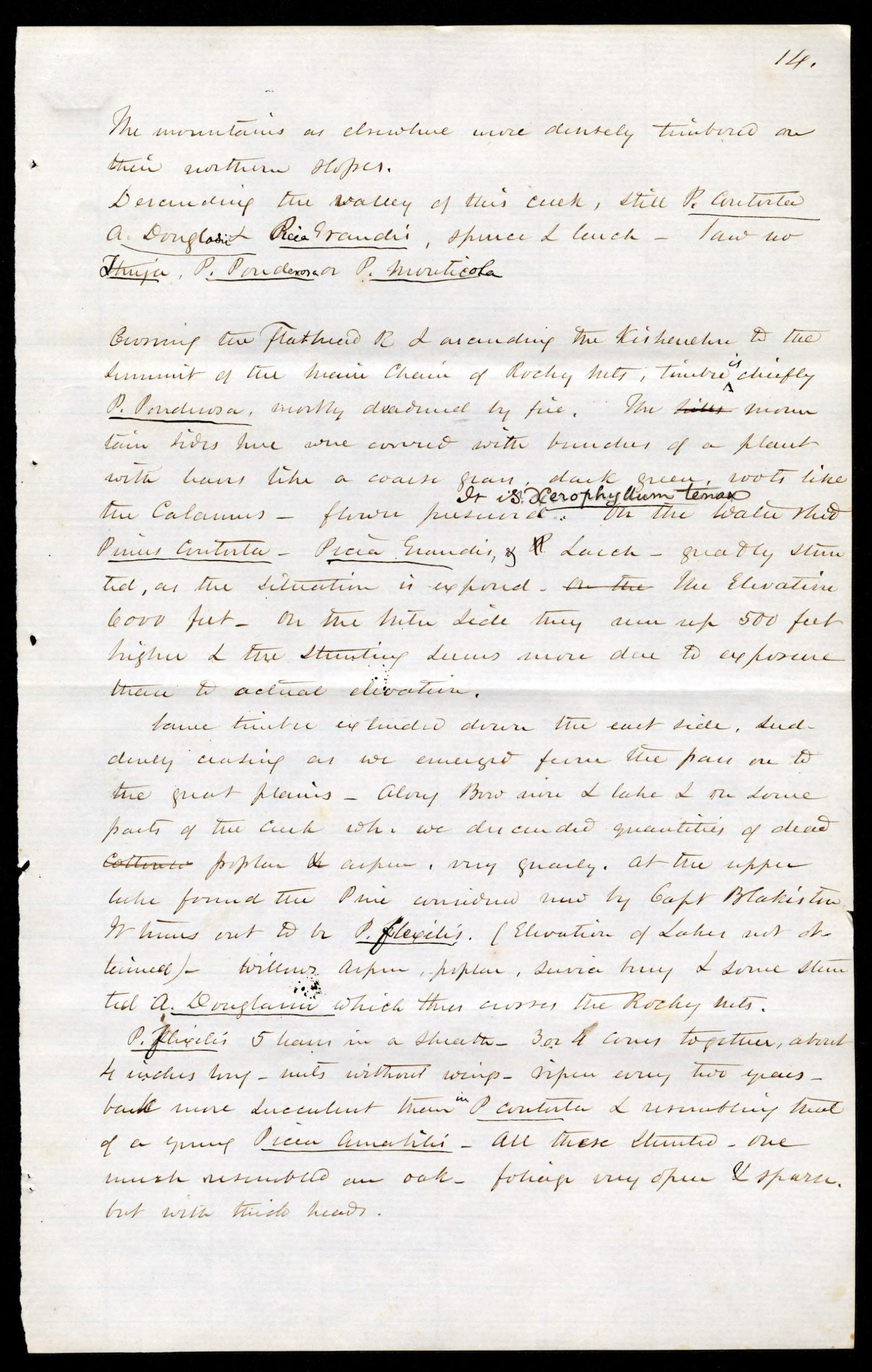
[Page number "14" upper right]
The mountains as elsewhere more densely timbered on their northern slopes. Descending the valley of this creek, still P. Contorta A. Douglasii & Picea Grandis, spruce & larch – Saw no Thuja, P. Ponderosa or P. Monticola
Crossing the Flathead R & ascending the Kishenehn to the summit of the main chain of Rocky Mts, timber [interlined: is] chiefly P. Ponderosa, mostly deadened by fire. The [struck: hills] mountain sides here were covered with bunches of a plant with leaves like a coarse grass, dark green, roots like the Calamus – flower [struck: presumed] [interlined: It is Xerophyllum tenax] On the water shed Pinus Contorta – Picea Grandis, & P. Larch – greatly stunted, as the situation is exposed – [struck: On the] The Elevation 6000 feet – On the other side they run up 500 feet higher & the stunting seems more due to exposure than to actual elevation.
Some timber extended down the east side, suddenly ceasing as we emerged from the pass on to the great plains – Along Bow river & lake & on some parts of the creek where we descended quantities of dead [struck: Cottonwood] poplar & aspen, very gnarly. At the upper lake found the Pine considered new by Capt Blakiston It turns out to be P. flexilis. (Elevation of Lakes not determined) – Willows, aspen, poplar, service berry & some stunted A. Douglasii which thus crosses the Rocky Mts.
P. flexilis 5 leaves in a sheath – 3 or 4 cones together, about 4 inches long – nuts without wings – ripen every two years – bark more succulent than [interlined: in] P. Contorta & resembling that of a young Picea Amabilis – All these stunted – one much resembled an oak – foliage very open & sparse, but with thick heads.
Page 20
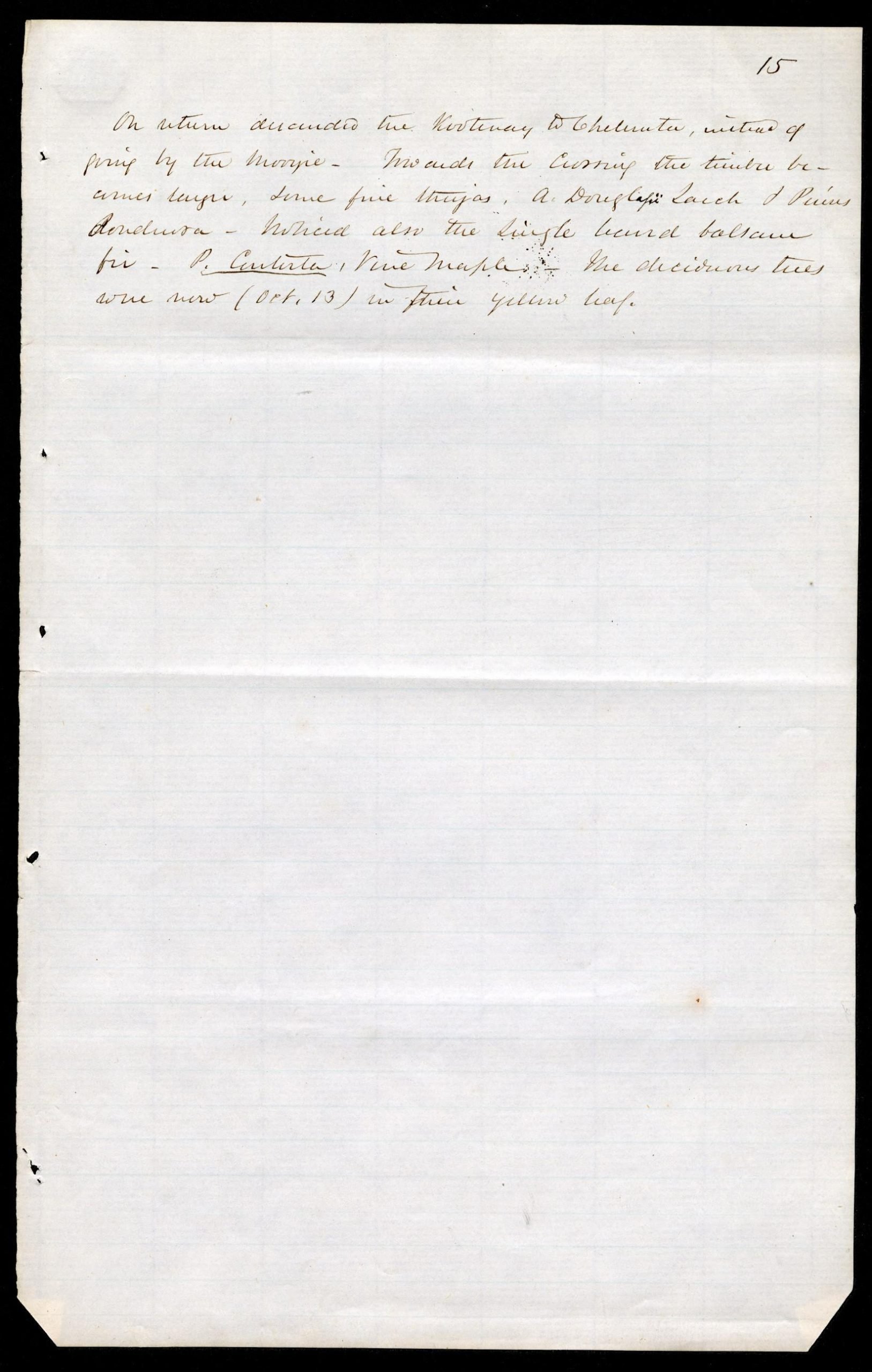
[Page number "15" upper right. Text at top; rest of page blank.]
On return descended the Kootenay to Chelmusta[?], instead of going by the Moogie – Towards the Crossing the timber becomes larger, some fine thujas, A. Douglasii Larch & Pinus Ponderosa – Noticed also the single leaved balsam fir – P. Contorta, Vine Maple. The deciduous trees were now (Oct. 13) in their yellow leaf.
Gibbs, G. (ca. 1860). Notes on forest growth in Washington Territory [Unpublished manuscript]. Smithsonian Institution Archives, Record Unit 7209, Washington, DC.
Digitized from Garland H. Green Jr.’s research copy; transcription AI-assisted, under review.
Views: 17
Explore the evidence
View this article’s connected sources and media →
About this page
This article was brought over from AlfredGibbs.com. Its preserved text, media and citations remain available for comparison.