
From Following the Guidon, by Elizabeth B. Custer (1890). Chapter XVIII. Back to Contents.
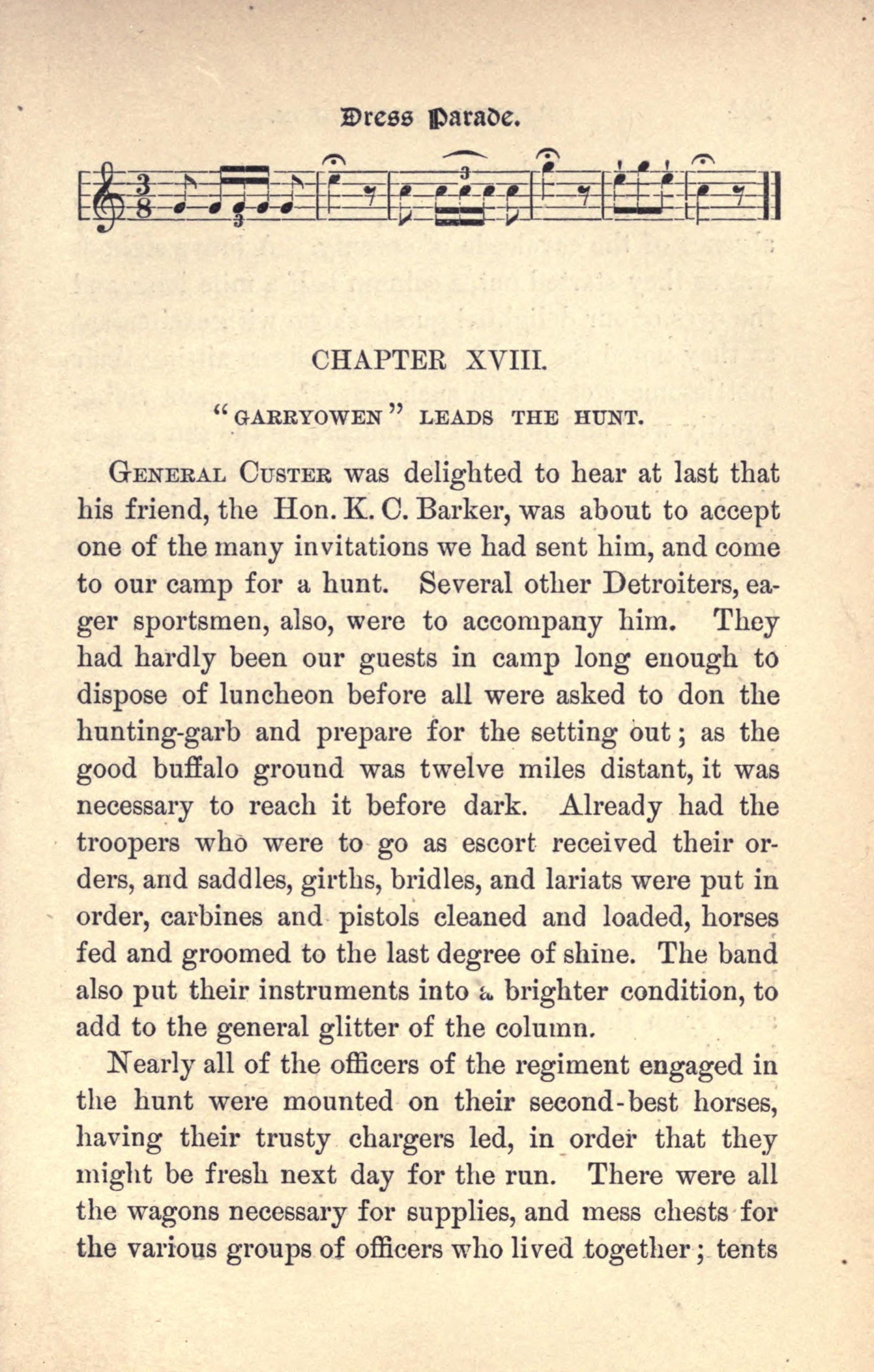
General Custer was delighted to hear at last that his friend, the Hon, K. C. Barker, was about to accept one of the many invitations we had sent him, and come to our camp for a hunt. Several other Detroiters, eager sportsmen, also, were to accompany him. They had hardly been our guests in camp long enough to dispose of luncheon before all were asked to don the hunting-garb and prepare for the setting out; as the good buffalo ground was twelve miles distant, it was necessary to reach it before dark. Already had the troopers who were to go as escort received their orders, and saddles, girths, bridles, and lariats were put in order, carbines and pistols cleaned and loaded, horses fed and groomed to the last degree of shine. The band also put their instruments into a brighter condition, to add to the general glitter of the column.
]S”early all of the officers of the regiment engaged in the hunt were mounted on their second-best horses, having their trusty chargers led, in order that they might be fresh next day for the run. There were all the wagons necessary for supplies, and mess chests for the various groups of officers who lived together; tents
were carried, and there was also a certain amount of forage, for it was necessary to prepare for several days’ absence of the cavalcade of seventy. A brave sight it was as they started out, a column half a mile long, and the eyes of our delighted guests shone with excitement as they noted the dashing cavalry oflBcers sitting their mettlesome steeds with such ease, the troopers riding equally well and brilliant in touches, as the sun caught the polished steel of their fire-arms or sent radiating lines of light from the shining bit or burnished spur — the band playing the regimental tune ” Garryowen,” as their wise and steady gray horses paced their way without guiding. The stag-hounds bounded along on their cushioned feet, spurning the soft turf in their active leaps. One of the guests, enthusiastically happy, and fearless in expression of his joy, kept turning to take in the rare sight, declaring that nothing in our prosaic nineteenth century was so like the days of chivalry, when some feudal lord went out to war or to the chase, followed by his retainers.
There were two heavy weights in the party, and they had taken the precaution to start in the ambulances, knowing that the saddle would exact some terrible penance from them next day, when, unaccustomed to riding, they pounded up and down over the rough country. The gay scene was too much for them, however; the merry voices of the officers, story telling, singing, laughing, the more subdued but none the less jubilant tones of the troopers who rejoiced at this unusual holiday, the quick happy bark of the dogs, the neigh of the
horses, delighting in the fresh, exhilarating air of the plains, made them feel themselves prisoners inside a vehicle, so a halt was made, and the men of solid flesh began at once to play cavalrymen. At the end of the twelve miles, unvaried except by some jack -rabbit chases, when by their speed the dogs enchanted Mr. Barker, who had given them to us, a camping-ground was selected and the fire for supper soon sent its cheerful gleam into the twilight shadows. The soldiers, with the ease of practice, had put up two rows of wall-tents facing each other, and near them another line of their own A tents. The wagons and ambulances were so placed at the rear of each line of tents that they formed a temporary barricade, for, even on such a pleasuring as that was, none of the usual precautions for safety were neglected.
The camp named for Mr. Barker was a noisy one for a time. The twelve-mile march had not tired the guests sufficiently to produce quiet, while to the officers and troopers it was a mere bagatelle. They smoked and told frontier tales, while the guests brought out their choicest collection of after-dinner stories from the States; it was only the consideration of the early reveille that induced them to turn in on their blankets and buffalo-robes for sleep. Reveille at dawn brought the party out again, fresh and enthusiastic for the day’s sport.
After breakfast the distribution of horses began. By that time all the best buffalo-horses in the regiment were well known, and as this was an occasion when it
was the desire of all of us to make the hunt a success, the trustworthy, experienced animals had been brought along. The only problem was the mounting of Mr. Barker and Judge Beckwith, weighing, as they did, nearly two hundred and thirty pounds each. It was always difficult for the heavier men of our regiment to get good mounts, and even if they found horses strong enough to carry them on the march, on drill, or ordinary garrison duty, it always remained a query whether these powerful animals had enough speed to join in the chase. This question was studied pretty thoroughly, and the strongest horse in the regiment with any speed had been selected for Mr. Barker, but by one of those unfortupate accidents that thwart the best laid plans, the scout sent out at daybreak to look up a buffalo herd had taken the strong horse held in reserve, and blown him so that there was no good work to be expected of him for the next twenty-four hours.
Fifty horsemen were soon in line of march, followed by wagons to bring back the meat; and, much to the guests’ distress, two ambulances brought up the rear to carry the wounded should any one be hurt. These vehicles seemed like birds of evil omen following slowly along after a thoughtless, jubilant company, and no one wanted to look backward if he hoped to keep the gloomy side of life out of his mind. When the gay cavalcade had gone a few miles the scouts sent out returned, to report the direction of the buffalo they had found. When the black specks appeared against the horizon the enthusiasm of the Eastern men knew no
bounds; each burned with a desire to take back a record to those unfortunate Detroiters who had not had the good-luck to come. The officers experienced in the chase made each guest their special care, so that there was no lack of hints regarding tlie preparations for the charge. The usual halt took place to dismount, examine bits, surcingles, spurs and fire-arms, and to discard coats, and secure hats with handkerchiefs or strings; for the thought was not of appearances at such a moment.
Finally, at the signal the fifty horsemen vaulted into saddles and were off. To the tourists the buffalo seemed huge. One of the party, describing them, after their return, said they had the grace of an elephant and the beauty of a hippopotamus. The monsters were not long in discovering the enemy coming towards them; they promptly started their cumbrous bodies into a lumbering run, and, as usual, got over the country at such a surprising rate that it took all the best riding of the old hunters, and the very best skill of the ” tenderfeet ” to keep their poise in the saddle, and let the experienced horse take them down divides, up the constantly recurring slopes, through the softened soil where the gopher and prairie-dog had undermined the earth.
The buffalo pitches down any descent in a headlong, reckless manner. He never spares himself. The Indians often drove them to a bluff, knowing that if stampeded they would leap down the steepest declivity, and plunging below on their huge heads, it became an easy affair to finish them with the knife if they were
not killed outright. This inhumanity was not a practice with the white man. In any descent, therefore, the buffalo gained on his pursuer, but in the ascent of the divide the horse was superior, and often caught up with the groaning, puffing, laboring buffalo.
The herd of thirty first seen that day was soon scattered, the hunters starting out in all directions in pursuit of the isolated animals. After a slmvp run of a few miles the riders began to return, dusty, heated, all talking at once — gesticulating, explaining why suchand-such a shot was missed, narrating narrow escapes, chronicling successes. The count was good, for twentyfour buffaloes lay scattered on all sides within a radius of three miles. The accidents were told over next. One of the guests had had his horse pushed into a creek by a buffalo, but being an old soldier, he knew how to extricate himself. The horse of a soldier had been gored, another trooper’s horse showed the long trail of a buffalo-horn where the hair had been scraped off on the side. A hole in the sleeve of one of the novices in buffalo-hunting revealed the fact that the aim of his pistol had not been quite what he intended it to be; another had evidently been equally unfortunate in his aim, for the palm of his hand was black, and smarting with powder, and he could not explain where the ball went. The party, satisfied with their success, turned back to camp, but with much anxiety regarding the missing ones. Before they reached there the lost came up, and General Custer’s description gives some idea of what a dangerous pastime buffalo-hunting was:
Mr. Barker, mounted upon an animal that Lad justly excited his suspicions from the first (for he had discovered an ugly cut on the knee, and a tendency to stumble), singled out his buffalo on the first charge, and after separating him from the main herd, began emptying his revolver into the sides of the buffalo — horse, rider, and buffalo going at breakneck pace. He must be a bold rider who, mounted upon a strange horse, is willing to strike out at full speed over a country known to be infested with prairie-dog holes, wolf dens, and quicksands. The risk of a fall is always great, but to a man of K. C. B.’s weight it is fearful. The horse proved unsteady under fire. Barker concluded to go from the right to the left side of the buffalo; in doing so he passed close to the haunches* of the latter. The buffalo at this moment concluded to give battle, and turned to intercept the horse. “Look out for him. Barker!” was the warning cry of a friend; but Barker’s eyes were directed to the front. Again is the warning repeated. This time it is heard, and Barker glances towards the buffalo, but too late. Already the horns are partly concealed by the long flowing tail of the horse, while the latter, feeling the points of the enraged animal’s horns pressing his flanks, leaps with affrighted vigor to elude the coming blow, but in doing so unsettles the rider’s seat. For a moment Barker is seen attempting to recover himself; but the horse, now unmanageable from fear, plunges madly forward, the rider loses his balance, and the next instant goes headlong to the ground. What 1 did, or what any of the half-dozen friends following closely did at the time, cannot be clearly stated. That we all realized the full extent of the danger that surrounded our comrade was certain, but how to relieve him?
As if by intuition, and without uttering a word, all headed their horses towards the buffalo, who, finding himself the object of so much undivided attention, allowed himself to be diverted from continuing his attack on Barker, now lying
perfectly helpless and insensible within three bounds of the buffalo. The latter again chose to confide in the swiftness of his legs rather than in the strength of his horns — a decision which spared to Detroit one of its most estimable citizens, and to the sporting world one of its brightest ornaments.
Seeing the buffalo well under way, our attention was next directed to ascertaining the extent of the injuries received by our friend. He was still lying insensible, breathing as if partly suffocated. By means of restoratives and fresh air — of the latter there being an abundance — we soon had him on his feet; and upon ” time being called,” in the course of a quarter of an hour he announced himself ready to mount his horse. This time a change was effected by which, although placed astride a lighter animal, it was with the assurance that he was ” sure-footed, and not afraid of buffaloes.” If timidity had been one of Mr. Barker’s characteristics, he would have been content to call it ” quits ” with the buffalo; but no, his “dander” was up, and he surprised his hearers by announcing that his late narrow escape from a possible death was ” just the thing.” To use his own expressions: ” I know now just how to take them and how to ride;” and as for the blackened eye and bruised cheek, he declared that ” no money could buy them.”
It would not do to leave a renowned hunter thus worsted on the field, so I omit portions of the letter and continue General Caster’s account of his final success:
Turning our faces towards camp, we had not proceeded far before we discovered a fine herd off to our right. Approaching as near as possible without giving the alarm, a very good start was effected. K. C. B. singled out his buffalo, wliich proved to be a fine bull about five years old, and
“gakryowen” leads the hunt. 271
very fleet. It required a good run to bring pursuer and pursued within pistol range of each other; but once accomplished, Mr. B. began to make his presence known by deliberately emptying his large Colt’s revolver, directing his shots immediately in rear of the fore-shoulder and below the middle of the body. Barrel after barrel was discharged until the revolver was empty, and still the speed seemed unslackened. Replacing this revolver in its holster and drawing another, the firing was continued. The last shot of the second revolver had been fired, making twelve in all, and still the race went on without signs of distress. An attendant handed Barker a third revolver. This in turn was emptied into the bufEalo, and all, apparently, to no purpose. A fourth revolver is supplied, from which four shots are fired, when the buffalo’s never-failmg signal of defeat, bleeding at the nose, is perceptible. Slowly decreasing his speed the buffalo soon comes to a halt, the next instant he is down on his side, and before his heart ceases to beat, or he to struggle, Barker is out of the saddle, and with hat in hand leaps upon the buffalo and gives three hearty cheers, in which he is joined by all of the party who are within hearing. The head of the animal is soon removed from the carcass, and conveyed with the party to camp, from which point it was expressed the same day to Detroit, there to be placed in the hands of the taxidermist for preservation.
After all had gathered about the camp-fire at night there was the usual vehement exchange of experiences, and the customar}^ recounting of ludicrous situations, or occasions when danger was looked in the face. Of course the tourists were much spent and very hungry, and the camp supper, with their own game for the principal dish, was ” food fit for the gods,” they said. The story-telling and merriment was somewhat sub-
dued on account of fatigue, and our guests were not aware, in a few moments after touching the blankets, that they were not sleeping on the soft beds of civilization.
General Custer continues:
The following day was the Sabbath, and although hundreds of miles from church or chapel, it was nevertheless determined to ” Remember the Sabbath-day to keep it holy,” a resolution which gave no little pleasure. At sunset the band played ” Old Hundred,” the effect of which on our little party was more powerful than if sung by a well-organized choii’ with all the accompaniments of church and congregation.
The merriest man of all these guests was a rollicking Irishman, who, though living quietly in Canada at that time, had been an extensive traveller, and in many adventures by sea and by land. His stories, his songs, Lis repartee were some things not to be forgotten. “Without pretension or the least self -consciousness he took the lead in everything, and the moment he opened his mouth the others became silent, knowing that it was “not best to miss anything that Morgan said, if a fellow cared a rap for fun.” As I remember him and his bright comrade of a wife, a vivacious Frenchwoman, my lips involuntarily form themselves into a smile, and a dozen instances of their clever wit come trooping back to amuse me. The one picture I best recall is of an occasion when Mr. Morgan was nearly drowned in the Detroit River. I was visiting at the Barkers’ on Grosse Isle, and at evening we rowed over
“gaeryowen” leads the hunt. 273
to the Morgans’, where we first heard of the narrow escape. With the merriest twinkle in his eye he gave us so amusing an account of himself while he clung to the boat, in peril of drowning, that we shouted over it exactly as if it had been the best joke in the world, instead of the story of a hair-breadth escape from a watery grave. His cries for help were heard first by his wife, who ran for the boatman, and while he was getting his oars Mrs. Morgan tore up to the house, bringing back with her a brandy-flask and waved it to the struggling man, who clung rather feebly to the upturned boat, for Mr. Morgan was not strong. Even weak and chilled as he was, the pluck of his wife, when she was so frightened, and the fun of the whole affair, took possession of him, and he shouted, ” Thank you, Tillie, I’ll be there, directly!”
The brogue added to every story he told, and we all, long after he had left us, repeated and laughed over his quick sallies and his fresh, unhackneyed dinner and camp-fire tales. Out of the fifty- three buffaloes killed on the two days’ hunt, Mr. Morgan had the best score, for, unaided, he had despatched seven. He allows me to use an extract or so from letters to his wife at that time:
The fatigue of yesterday’s hunt was too much for most of the visitors, many of whom were unfamiliar with equestrianism, and they were slow to respond to the reveille; when they did come forth from their tents it was with that peculiar gait which a pair of compasses must adopt if compelled to walk across a table. We were all willing to rest our laurels of yesterday’s running for one day, and the morn-
ing was devoted to recounting our deeds of valor and hairbreadth escapes. I had a bullet-hole though the sleeve of
my coat. Mr. L ‘s horse shied at a polecat, his plug hat
fell of, and came in for the full phials^of the beast’s wrath; the tile was subsequently recovered and made a target of.
After one of the hunts we satisfied our appetites with a glorious dinner, thanks to General Custer’s bountiful larder and our own hunting successes, not to forget a good-sized locker which we brought from the East, and which was known as the ” medicine – chest.” One of the general’s guests, who seemed to enjoy the good things with a gusto that only a hunter can feel, after getting up from dinner hastened to take possession of a large crate which was about half full of straw, and which was used for packing our earthen and glass ware. Here he stretched his aching limbs, and was soon in a deep sleep, notwithstanding that the band was playing but a short distance from him. I and one or two others asked the general to aid us in getting up a funeral, as evidently our friend had gone (in dreams) to the happy hunting-ground, or the land of Nod. The general, with rollicking glee worthy of a school-boy, entered into our plans, a procession was formed, six stalwart troopers carried the bier, the guests acted as chief mourners, the band played the ” Dead March in Saul,” and the cortege advanced across the prairie. The motion, the music, and the ringing laughter, that might almost be taken for wailing, seemed to cause our sleeping friend to dream; he then awakened, and stared around in bewilderment; it would seem that he failed to immediately take in the situation, for he asked, in the most serious tone: ” What is the matter? What has happened?” The general and his friends congratulated him on his marvellous recovery and his escape from a lonely grave.
This same crockery-crate was still to be the central object in a joke, after the return of tlie party to the
main camp. Our guests had found out by some shrewd questioning that our mess chest held only six of a kind for setting our camp table, so they had decided to bring with them a supply of dishes. The crate had served as their packing-case. One day I remember seeing the empty crate the centre of a group of softly moving figures, stealthily lifting and carefully carrying it a little distance nearer the tents. Soon it was revealed that our guests had enlisted General Custer in another practical joke. One of the citizens having dined and wined well, had thrown himself down on the ground to take a nap. His sleep was either that of one who has a light conscience, or whose senses were steeped in that oblivious dream that comes from too frequent tips of the flowing bowl. I haven’t the faintest remembrance who it was, so that if I account for his lethargy in this way I hope that I may be forgiven. A number of picket-pins were sharpened, and while the good diner slumbered the crockery- crate was carefully placed over him and tacked down to the baked earth. Then the perpetrators of this joke came under our fly to watch for the awakening. It was very funny, and quite worth the long vigil kept up while waiting the end of his sleep. The manner in which the imprisoned man partially arose and gazed at the twisted and knotted roof above him was simply convulsing to us. Then he kicked wildly in impatience, and endeavored to throw the light crate off him; still it resisted. Finally, the figure of this reputable and highly respected citizen on his knees, scrambling and pushing and struggling
to lift the crate by his bowed back, like a bucking horse, sent us into screams of laughter, and it was no longer possible to refuse to go to his assistance.
When an expedition reaches the bed of a stream which has no water, the place is marked on the map as a dry camp. There is still another application of the term, and our guests in anticipation of this had brought good cheer in the locker which they called the ” medicine-chest,” but after that day there was pretty good care taken not to visit it any oftener than would leave a man in condition to leap from sound sleep into vigilant wakefulness. This caution was necessary by way of avoiding the too marked attention of those who pined ever for a practical joke.
With all this merrymaking there was mingled in General Custer’s heart a pang of sorrow for almost an irreparable loss; but his own words will better convey his feelings:
To give our visitors an opportunity to witness the great speed of the antelope and American hare, or as it is best known on the plains, the jack-rabbit, I took with me from camp about half a dozen fine stag-hounds. Foremost among all these was Maida, my favorite dog, the companion of all my long and terrible marches of last winter; she who by day trotted by my side, and at night shared my camp-couch. In the first run after buffaloes the dogs, contrary to their usual custom, became separated from me and accompanied others of the party. They soon singled out a buffalo, and readily brought it to bay. With little forethought or prudence, several of the hunters opened fire upon the buffalo while the latter was contendinpr with the dogs. Maida had
seized hold of the buffalo, and while clinging to its throat was instantly killed by a carbine-ball fired by some one of the awkward soldiers who accompanied the party. Words fail to express the grief occasioned by the untimely death of so faithful a companion.
” Poor Maida, in life the firmest friend; The first to welcome, foremost to defend; Whose honest heart is still your master’s own, Who labors, fights, lives, breathes for him alone. But who with me shall hold thy former place, Thy image what new friendship can efface? Best of they kind, adieu! The frantic deed which laid thee low This heart shall ever rue^”
Fife.
80.- J.
•ffntantrg Call ” (To tbe Color/’
-# m-
:tz=:t:
Drum. r
;E=^le^^^
T T F
*— ^— «— ^
■V — 1<^-
,b=ti:
:f=l;:5:
EfcM
-i—y—’yi
^^^jg^gi^p^i
:C=5=?:
^ — ^ — «
lltl
Views: 3
Explore the evidence
View this article’s connected sources and media →
About this page
This article was brought over from AlfredGibbs.com. Its preserved text, media and citations remain available for comparison.