BIOGRAPHY: Lorenzo D. Straight (1844–1907)
Private, Company E, 1st New York Dragoons
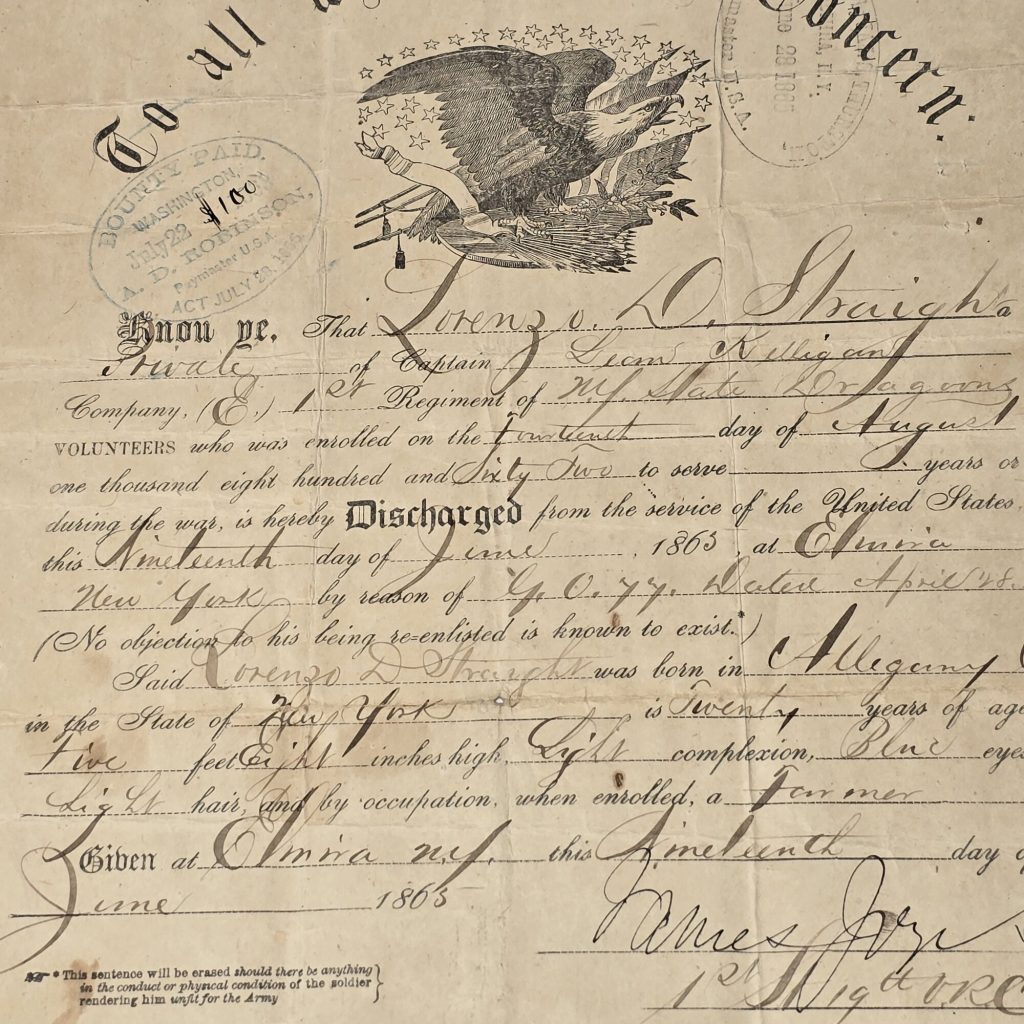
Lorenzo D. Straight was born in Allegany County, New York, and enlisted as a young man in the Union Army during the height of the Civil War. At just 18 years old, he enrolled at Elmira and mustered in on August 16, 1862, as a Private in Company E, 130th New York Volunteer Infantry.
Within a year his regiment underwent a dramatic shift—first redesignated the 19th New York Cavalry, and then, on September 10, 1863, assuming its final form as the 1st New York Dragoons, one of the most highly regarded mounted regiments in Sheridan’s command. Straight served through the regiment’s major campaigns in 1863–1865, including the operations in central Virginia and the Shenandoah Valley.
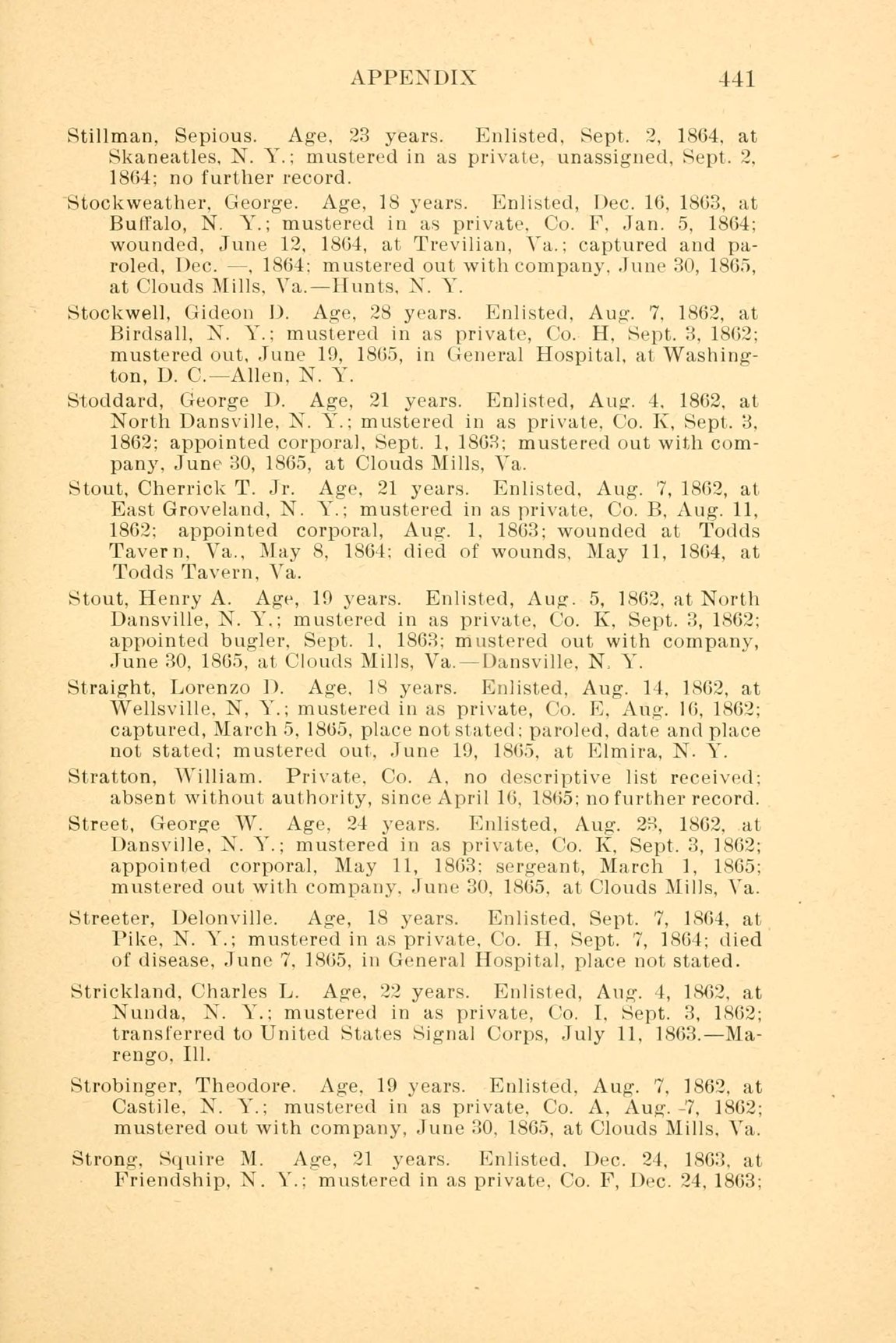
On March 5, 1865, records state that Straight was captured, though no official location was recorded. He was later paroled—again with no surviving date or location—and returned to the regiment before mustering out at Elmira on June 19, 1865.
His surviving discharge document, remarkably found in Oregon more than 150 years later, describes him as twenty years old at muster-out, with blue eyes, light hair, a fair complexion, and by trade, a farmer.
NARRATIVE: The Capture of Lorenzo D. Straight — March 5, 1865
(A historically grounded reconstruction based on known movements of the 1st New York Dragoons)
In early March 1865, Sheridan launched one of the final sweeping cavalry raids of the war. His column, Torbert’s and Devin’s divisions, including the 1st New York Dragoons, drove hard into central Virginia, pushing toward the James River Canal with orders to destroy Confederate infrastructure and cripple Lee’s remaining supply lines.
March 3, 1865 — Charlottesville Falls
On March 3, Sheridan occupied Charlottesville, a symbolic and logistical blow to the Confederacy so late in the war. The Dragoons were heavily engaged in burning depots, mills, bridges, ironworks, and vast quantities of Confederate stores accumulated around the University and along the rail lines.
March 4–5 — Scattered Skirmishes on the Roads South of Charlottesville
Sheridan then pushed his regiments south and west toward Scottsville, following the James River Canal. The 1st New York Dragoons sent out numerous small detachments—often 10 to 40 men—to:
These detachments operated miles apart, often beyond supporting distance, on narrow country roads, in farm lanes, and near canal locks.
March 5 — A Dangerous Day for Stragglers and Detached Men
The regimental history records multiple small losses on March 5—men separated during the destruction parties or cut off by local militia and remnants of regular Confederate cavalry shadowing Sheridan’s flanks.
This was not a large battle day, but rather a day of:
ambushes by local home guard,
sniper fire,
surprise charges by small Confederate cavalry detachments,
men captured while working in mills, barns, or canal sites,
troopers taken while watering horses, or
stragglers picked up in the wooded countryside between Scottsville and Palmyra Road.
These captures were common in this phase of the war, especially for men like Straight—enlisted cavalrymen assigned to destruction parties far from the main column.
Most Likely Capture Location
Given the route of Sheridan’s march, the documented detachments, and the timing:
Lorenzo Straight was almost certainly captured near the James River Canal line, between Charlottesville and Scottsville, Virginia, on March 5, 1865.
This would place him:
in the vicinity of Scottsville Road,
working with a foraging or destruction detail,
isolated from his company,
when struck by Confederate militia or a small cavalry patrol.
What Happened Next?
The records note that he was later paroled—which tells us a lot.
By March 1865:
Confederate prisons were collapsing,
the rail system was failing,
and local authorities often paroled captured Union soldiers immediately rather than attempt transport.
This suggests Straight was captured not by regular cavalry, but by a local home guard or militia, who ended the matter with a quick parole rather than a long detention.
He then rejoined the regiment (likely within days or weeks) and safely made it to the regiment’s muster-out point in Elmira by June 19, 1865.