
Table of Contents
During the American Civil War, the Union cavalry played a vital role in reconnaissance, raiding, screening infantry movements, and disrupting enemy supply lines. While much attention is given to famous generals and high-ranking officers, the effectiveness of these cavalry units depended heavily on the enlisted men who filled their ranks and, crucially, on the system that promoted them through the non-commissioned officer (NCO) hierarchy. The rank insignia, (particularly the yellow chevrons worn by cavalry NCOs) marked not just position but also experience, reliability, and responsibility. This article explores how these ranks were structured and, more importantly, how they were earned.
Structure of Enlisted Ranks in the Union Cavalry
The enlisted structure in Union cavalry units followed a tiered system similar to that of infantry and artillery, though distinguished by the yellow color of the chevrons. The basic progression for an enlisted cavalryman began with the private and moved up through corporal, sergeant, first sergeant, and several specialty roles such as quartermaster sergeants and ordnance sergeants, culminating in the rank of sergeant major (War Department, 1861).
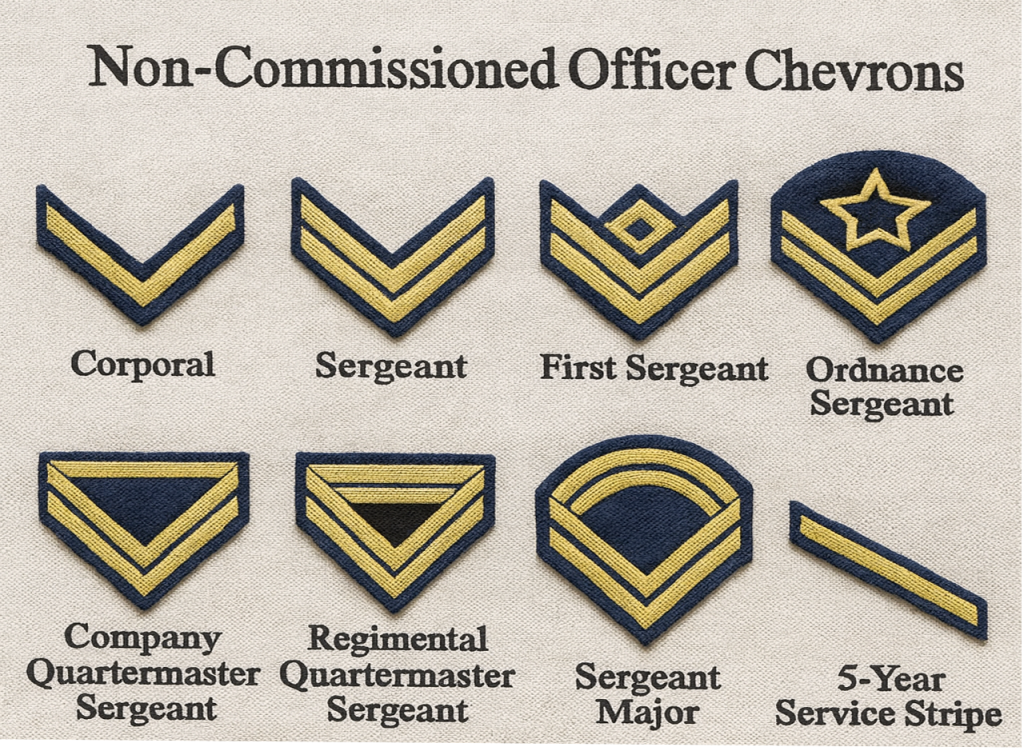
Each chevron in the image provided corresponds to a specific rank:
Corporal: Two yellow chevrons.
Sergeant: Three chevrons.
First Sergeant: Three chevrons with a diamond in the middle.
Company Quartermaster Sergeant: Three chevrons topped with a horizontal bar and a darkened center.
Regimental Quartermaster Sergeant: Similar but with an additional stripe and triangular fill.
Sergeant Major: Three upward chevrons surmounted by three arcs.
Ordnance Sergeant: Three chevrons and a star above.
Additionally, a 5-Year Service Stripe was worn as a diagonal indicator of longevity, though it was not tied to rank.
Promotion Criteria: More Than Just Time in Grade
Unlike modern military systems that rely on strict timelines and structured testing, Civil War-era promotions were largely influenced by battlefield necessity, personal reputation, and the discretion of commanding officers. Promotions were not guaranteed with time served; instead, they were earned through a combination of performance, seniority, and connections.
1. Battlefield Performance and Bravery
Acts of valor and composure under fire often accelerated promotion. A cavalryman who demonstrated leadership during a skirmish or pursuit might be nominated for corporal or sergeant, even if he had limited time in service. The War Department’s regulations allowed for field promotions, and commanding officers routinely used this discretion to reward competence in action (U.S. War Dept., 1863).
2. Literacy and Clerical Skills
As soldiers advanced into the quartermaster or ordnance branches, literacy and organizational ability became vital. Quartermaster sergeants were responsible for tracking supplies, mounts, equipment, and rations. In many cases, soldiers with prior civilian experience as clerks, accountants, or tradesmen were selected for these positions (Bowen, 1900). A regimental quartermaster sergeant, in particular, needed to maintain communication with both the supply depots and the men under arms.
3. Seniority and Time in Service
Although time in service wasn’t the only determinant, it carried weight. Units often preferred to promote from within to preserve cohesion. A trooper who had weathered multiple campaigns without disciplinary infractions and had earned the respect of his peers was a prime candidate for advancement.
4. Recommendations and Patronage
The human element of promotions cannot be overstated. Commanding officers often promoted men they trusted personally. Letters of recommendation, performance reports from company commanders, and even appeals from comrades could influence a soldier’s chances. In some units, such as the First New York Dragoons, promotions were tracked in regimental books and often included personal commendations (Bowen, 1900).
From Bowen: “Quartermaster Lawrence, who had been promoted from the ranks, was ever alert and painstaking in looking after the wants of the men. He was always ready and cheerful, and was beloved by all who knew him.” (Bowen, 1900, p. 289)
The Role of the First Sergeant
Often regarded as the backbone of a company, the First Sergeant had duties that combined administration with discipline. He was responsible for maintaining the duty roster, recording company rolls, and serving as a liaison between the enlisted men and the officers. The distinctive diamond in the chevron signified authority over other sergeants, and promotion to this role indicated trustworthiness, leadership, and often seniority within the company (U.S. War Dept., 1861).
Quartermaster Sergeants: Logistics in Motion
Quartermaster Sergeants served in two forms: Company and Regimental. These roles required a level of logistical oversight uncommon in today’s view of cavalry warfare. At the company level, the quartermaster sergeant ensured horses were fit, saddles were intact, and soldiers had what they needed. At the regimental level, responsibilities expanded to procuring weapons, overseeing wagons, and maintaining communication with headquarters. Promotions into these roles were rarely made on the basis of combat performance alone, they required planning skills and an ability to manage men and inventory (Robertson, 1991).
Ordnance Sergeants and the Custodians of Firepower
Ordnance Sergeants, (denoted by a star above the chevrons), were caretakers of weapons and ammunition stores. They did not often ride into battle but were essential in ensuring that the regiment remained armed and operational. Their appointment was usually a result of technical aptitude and a clean service record.
Sergeant Major: The Apex of Enlisted Leadership
The Sergeant Major was the highest enlisted rank in a cavalry regiment. Distinguished by three upward chevrons and three downward arcs, this individual acted as the senior enlisted advisor to the regimental commander. He did not typically command troops in battle but had immense influence over training, discipline, and daily operations. Advancement to this role required both seniority and a solid relationship with the officer corps (War Department, 1861).
Demotion and Discipline
Promotion could be swift, but demotion was always looming. Drunkenness, dereliction of duty, or insubordination could strip a man of his stripes in an instant. NCOs were expected to model behavior for the entire troop, and failure in this regard often led to reassignment to the ranks or even discharge (U.S. War Dept., 1863).
Final Thoughts
The chevrons worn by enlisted cavalrymen during the Civil War were more than decorative, they represented hard-earned trust, capability, and responsibility. Promotions were granted through demonstrated leadership, clerical skill, battlefield valor, and personal reputation. Unlike today’s structured promotion pathways, Civil War-era advancement reflected the volatile and improvisational nature of wartime command. The men who rose through these ranks—from private to sergeant major—carried not only stripes on their sleeves but the weight of their comrades’ trust and the mission’s success.
References
Bowen, J. R. (1900). Regimental History of the First New York Dragoons. [Self-published].
Robertson, J. I. (1991). Soldiers Blue and Gray. University of South Carolina Press.
Views: 2218
Explore the evidence
View this article’s connected sources and media →
About this page
This article was brought over from AlfredGibbs.com. Its preserved text, media and citations remain available for comparison.