
Table of Contents
A Regimental History from the Personal Perspective
“Prepared based on J. R. Bowen’s Regimental History”
Introduction
The First New York Dragoons, originally mustered as the 130th New York Volunteer Infantry, represents more than just a military unit that served during the American Civil War. Behind the regimental history lies a deeply human story of ordinary citizens who transformed into soldiers, experiencing the full spectrum of human emotion and adaptation during one of America’s most turbulent periods. This document explores the human perspective of the regiment’s service, examining not just what these men did, but how they felt, what they experienced, and how they changed throughout their military journey.
The regiment’s story begins in the summer of 1862 in Portage, New York, where men from Allegany, Wyoming, and Livingston counties answered President Lincoln’s call for volunteers. Their transformation from civilians to soldiers, and later from infantry to cavalry, provides a compelling narrative of human adaptation and resilience. Through personal accounts, anecdotes, and observations recorded in the regimental history, we can glimpse the emotional reality of Civil War service beyond the mere chronology of battles and campaigns.
This examination focuses on the human elements of military service: the emotional farewells to loved ones, the physical discomforts of camp life, the camaraderie that sustained morale, the humor that provided essential psychological relief, and the profound ways in which ordinary men responded to extraordinary circumstances. By centering the human experience rather than just military operations, we gain insight into how the war was lived and felt by those who served in the First New York Dragoons.
Chapter 1: From Civilians to Soldiers
Formation and Enlistment
In the summer of 1862, as the Civil War entered its second year with no end in sight, President Lincoln issued a call for 300,000 additional volunteers. Across the northern states, communities mobilized to meet their quotas, and among them were the citizens of Allegany, Wyoming, and Livingston counties in western New York. The formation of what would eventually become the First New York Dragoons began not with military precision but with deeply personal decisions made by individual men from all walks of life (Bowen, 1900).
The human dimension of these enlistments is captured in the regimental history’s description of the motivations that drove these men to volunteer: “The patriotic young men of these counties needed no urging, but promptly responded to the call, and in a few days the requisite number had enrolled their names” (Bowen, 1900, p. 9). Behind this simple statement lies a complex reality of individual choices made in living rooms and town squares across these rural counties, as men weighed their duty to country against family obligations and personal safety.
The physical examination process provides a particularly vivid window into the human experience of becoming a soldier. As one recruit recalled, “None of us will ever forget our thorough medical examination by Surgeon Kneeland; how he stripped, pounded, pinched, and pulled us, examining every limb, bone, muscle, and tooth, tested our hearts and lungs, accepting only those he could pronounce ‘sound as a new silver dollar'” (Bowen, 1900, p. 9). This intimate and somewhat humiliating process marked the first step in the transformation from civilian to soldier, as private bodies became, in a sense, public property subject to inspection and evaluation.
The irony of this rigorous screening process was not lost on veterans who later applied for pensions after their health had been broken by the war. The regimental history notes with a touch of bitterness that “strange as it may seem, when application is made for a pension, they are required to search from Dan to Beersheba for evidence to prove that they were not invalids and cripples at the time of their enlistment” (Bowen, 1900, p. 9). This observation reveals the bureaucratic contradictions that framed military service from beginning to end, as men who had been certified perfectly healthy at enlistment later struggled to prove their war-related disabilities to a skeptical government.
Departure and Separation
The departure from home represented a profound emotional watershed for the newly formed regiment. The regimental history captures this moment with poignant detail: “At last the eventful day (Sept. 6, 1862) came, and with it the order to break camp and go to the front. With knapsacks in place, a thousand newly made soldiers were in line of march for the railway station at Portage Bridge. Not less than ten thousand visitors were present to witness our departure” (Bowen, 1900, p. 9). The scale of this gathering (ten civilians for every departing soldier) underscores the communal nature of this sacrifice and the deep connections between the regiment and the communities they were leaving behind.
The emotional intensity of these partings is vividly conveyed: “Who, present upon that occasion, will ever forget the touching scene, when for a short time the regiment broke ranks, that the boys might speak their last good-by, or receive the parting embrace or kiss from fathers, mothers, wives, or sweethearts!” (Bowen, 1900, p. 10). This brief interlude of intimacy amid military formality highlights the human cost of war, as family bonds were temporarily, and in many cases permanently, severed by military necessity.
The departure scene concludes with a powerful juxtaposition of sound and emotion: “‘Attention!’ ‘All aboard!’ rings out in stentorian tones from our young commander. The locomotive shrieks, and the cars move out midst cheers from men and the waving of a thousand handkerchiefs from the sad-faced women, who watched us as we passed out of sight” (Bowen, 1900, p. 10). This description captures the gendered experience of war, with men performing enthusiasm through cheers while women’s grief is silently expressed through waving handkerchiefs and sad faces. The mechanical shriek of the locomotive provides an appropriate soundtrack to this emotional rupture, as the industrial machinery of war began to carry these men away from the familiar world of home.
Chapter 2: Journey to Suffolk and First Experiences
The Journey South
The physical journey from Portage to Suffolk mirrored the psychological journey from civilian to military life, with each mile taking the men further from the familiar comforts of home and deeper into the realities of war. The regiment’s travel conditions provided a harsh introduction to military life, as described in the regimental history: “Few of us will forget that night of torture as we moved out from Elmira, crowded into offensive-smelling cattle cars, seated with rough hemlock boards, without backs, affording us accommodations far removed from the luxurious Pullman and Wagner cars in which soldiers of to-day are carried” (Bowen, 1900, p. 10). This vivid description of physical discomfort underscores how quickly these men were forced to adjust their expectations and endure conditions they would have found unacceptable in civilian life.
The journey also provided the regiment with its first exposure to the divided sentiments of a nation at war. In Baltimore, the men encountered both hostility and support: “Public sentiment was divided; while some scowled and manifested extreme hatred, we found others intensely outspoken in their loyalty” (Bowen, 1900, p. 11). This experience introduced the soldiers to the complex political landscape they would navigate throughout their service, where the line between friend and foe was not always clearly drawn by geography.
The regiment’s first experience with army food at the “Soldiers’ Rest” in Washington revealed another dimension of the adjustment to military life: “Many of the boys, just from homes of plenty, turned away in disgust, and ate nothing that night” (Bowen, 1900, p. 11). This initial rejection of unfamiliar and unappetizing food would give way to pragmatic adaptation as the war continued, with the history noting that “A year or two later, however, less palatable food was devoured with avidity” (Bowen, 1900, p. 11). This transformation in attitude toward food symbolizes the broader process of adaptation that would occur across all aspects of military life.
Arrival at Suffolk
The regiment reached Suffolk, Virginia on September 13, 1862, just a week after leaving Portage. This small town, described as “a sleepy though somewhat aristocratic place of less than two thousand people” (Bowen, 1900, p. 14), would become their home for the next nine months. The strategic importance of Suffolk was not immediately apparent to the new recruits, but as the regimental history explains, its “geographical location at the junction of two railroads, together with its access by water to the seaboard, and covering the landward approaches to Norfolk, virtually commanding all that portion of Virginia and North Carolina east of the Black Water and Chowan Rivers” (Bowen, 1900, p. 15) made it a valuable military position.
The human environment of Suffolk proved as challenging as the physical one. The local population was “intensely disloyal in sentiment” with “Almost without exception the white population were of a sour countenance and not disposed to be social with our soldiers” (Bowen, 1900, p. 14). This hostility created a psychological burden for the soldiers, who found themselves stationed among people who viewed them as enemies rather than protectors.
The regiment’s encounters with Southern civilians revealed the bitter personal animosities generated by the war. One particularly vivid anecdote describes a confrontation with local women who approached the soldiers to offer insults: “‘What a horrid lot of dirty creatures they are; nothing but the dregs of society,'” one woman remarked within earshot of the troops. A quick-witted soldier replied, “‘We’ll be all right, madam, when we get washed up,'” to which she retorted, “‘Yes, but that won’t make gentlemen of you. Our Southern soldiers are all gentlemen'” (Bowen, 1900, p. 13). This exchange illustrates how the war was fought not just on battlefields but in daily social interactions charged with class prejudice and regional antagonism.
Training and Transformation
Suffolk served as “our training school for the severe and trying ordeals we were to pass through later on” (Bowen, 1900, p. 14). The transformation from “raw recruits” to “a well-disciplined and effective regiment” occurred through a combination of formal training and the shared hardships of camp life. The regiment’s first task upon arrival was “the clearing up of a camp ground, removing old logs and stumps, grubbing out laurel bushes, and leveling up the surface” (Bowen, 1900, p. 15). This physical labor provided an immediate immersion into the realities of military life, where comfort took a distant second place to necessity.
Nature itself seemed to conspire against the new soldiers, as “During our first week at this work occurred our first experience with a Virginia rainstorm, with no shelter but small ‘pup tents,’ and not even a rubber blanket” (Bowen, 1900, p. 15). The biblical scale of this downpour is captured in the soldiers’ comparison to “the days of Noah, when the ‘foundations of the great deep were broken up, and the windows of heaven were opened'” (Bowen, 1900, p. 15). The resulting conditions tested both body and spirit: “The newly dug-over camp was soon churned to a deep mud, and the men were literally daubed from head to foot” (Bowen, 1900, p. 15).
The varied emotional responses to this misery reveal the different coping mechanisms employed by the men: “Some swore, the homesick ones almost cried, while the more philosophical ones tried to put on a cheerful face, and jokingly inquired, ‘Who wouldn’t be a soldier, and die for his country?'” (Bowen, 1900, p. 15). This range of reactions, from profanity to tears to gallows humor, illustrates how individuals within the collective experience of the regiment processed hardship in distinctly personal ways.
Chapter 3: Life in Camp
Daily Existence and Adaptation
The daily life of soldiers in the First New York Dragoons at Suffolk revealed the profound ways in which military service transformed ordinary men. Far from the romanticized visions of glory that may have inspired their enlistment, the reality of camp life consisted of mundane routines punctuated by moments of hardship, camaraderie, and occasional humor. The regiment’s camp was eventually established as “the model regimental home of the department” (Bowen, 1900, p. 21), but this achievement came only after considerable struggle and adaptation.
The physical layout of the camp imposed a new spatial order on the men’s lives. As described in the regimental history, “Each of the ten companies had a short company street of its own, about two rods in width, with a row of tents on either side facing the street” (Bowen, 1900, p. 21). This rigid organization reflected the military hierarchy and discipline that now governed every aspect of the soldiers’ existence. The color line that marked “the line of our parade ground, where the regiment formed for dress parade, and where guard mounting and various drills were held” (Bowen, 1900, p. 21) served as a visible reminder of their transformation from civilians to members of a military unit with its own rituals and traditions.
The regiment’s daily duties encompassed a wide range of activities: “Daily drills of the severest kind, picket guard, and various camp duties, interspersed with long and tedious tramps to the Blackwater or a grand review” (Bowen, 1900, p. 20). These routines were governed by exacting standards, as “The camp streets and parade grounds must be kept as clean as a parlor floor. Arms and accouterments must be furbished and kept bright” (Bowen, 1900, p. 20). Colonel Gibbs, having “brought with him the rigid requirements of West Point,” instilled in the men the understanding “that no excuse would be accepted for dirt, disorder, or disobedience” (Bowen, 1900, p. 20). This strict discipline represented another dimension of the civilian-to-soldier transformation, as men accustomed to the relative autonomy of civilian life adjusted to the constant scrutiny and regulation of military existence.
Health Challenges and Medical Care
The health challenges faced by the regiment at Suffolk constituted one of the most significant human dimensions of their military experience. The location of their first camp, “in the immediate vicinity of the Great Dismal Swamp” (Bowen, 1900, p. 14), proved disastrous for the men’s health. The regimental history describes how “Almost immediately sickness began to prevail, owing to the use of wretchedly poor surface water and the deadly miasma floating in the atmosphere” (Bowen, 1900, p. 15). The severity of these conditions is captured in the doctor’s observation that “the noxious effluvia was so dense it could be sliced off with a knife” (Bowen, 1900, p. 15).
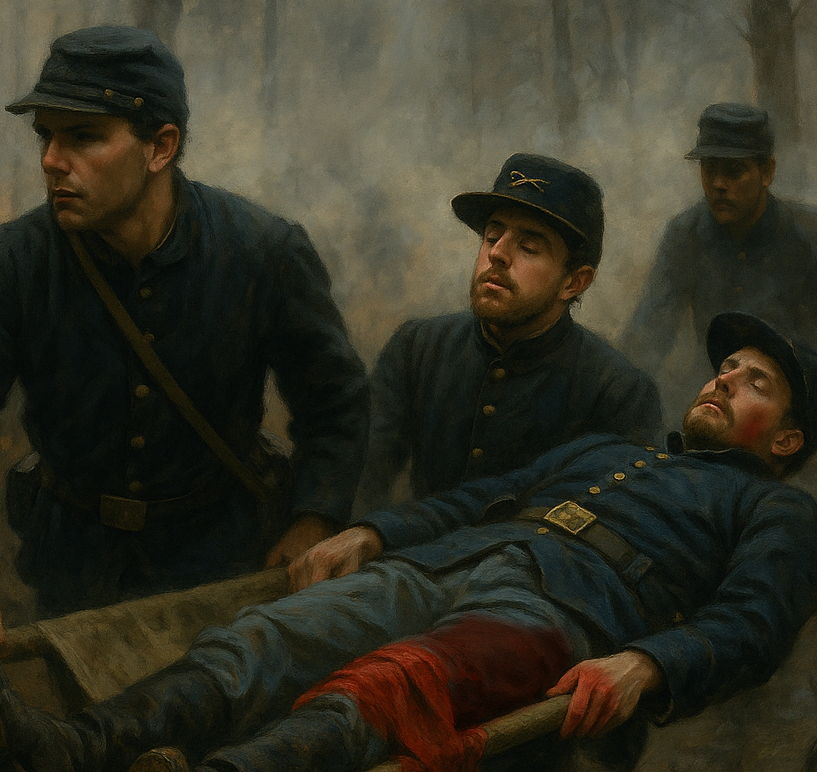
The human cost of these unhealthy conditions was measured in suffering and death: “The improvised hospitals were quickly filled, and notwithstanding the most skillful medical aid, the grim messenger gathered his harvest of victims” (Bowen, 1900, p. 19). The regimental history conveys the emotional impact of these losses through the description of funeral processions: “Almost daily the death march and muffled drums were heard, as some poor boy was borne by loving comrades to his last earthly resting place, until the muster roll of every company bore the legend, ‘Died in hospital at Suffolk'” (Bowen, 1900, p. 19). This poignant description reveals how death became a regular feature of camp life, with each loss felt personally by the tight-knit community of soldiers.
The primitive nature of medical facilities added to the suffering of the sick: “Our first hospital accommodations were very meager indeed, an old barn being utilized for that purpose, in which from fifty to a hundred of the poor, sick boys were confined, with cornstalks for bedding” (Bowen, 1900, p. 20). The regiment’s surgeon “chafed under this condition of affairs, and did all in his power to correct matters,” but found that “his every step was blocked by red tape and the bullheadedness of certain officials” (Bowen, 1900, p. 20). This frustration with bureaucratic obstacles reveals the human cost of administrative inefficiency, as soldiers suffered and died while officers struggled with regulations and limited resources.
The situation was further complicated by the hostility of local civilians, as illustrated by an anecdote about a “rich and very aristocratic old secesh” who lived near the camp. The regimental history expresses indignation that sick soldiers were kept “in the old leaky barn” while this “insolent old traitor and his family” remained in their comfortable home, “not only freely express[ing] their rebel sentiments, but constantly heap[ing] insult and abuse upon us” (Bowen, 1900, p. 20). The class dimensions of this conflict are highlighted by the reported comment from the Southern household that “the old barn was too good for such low-born Yankee trash” (Bowen, 1900, p. 20). This incident illustrates how the war created a complex intersection of regional, political, and class antagonisms that affected even the care of the sick and dying.
Camaraderie and Human Connections
Amid the hardships of camp life, the bonds formed between soldiers provided essential emotional sustenance. The regimental history records numerous instances of kindness and mutual support that helped the men endure difficult conditions. One soldier recalls “an act of kindness that has never been forgotten” when, “While sitting in the little tent, shivering and trying to satisfy hunger with a piece of pork and hardtack,” he was approached by a soldier from another regiment who invited him to “Come and get warm” by his fire (Bowen, 1900, p. 19). This simple gesture of compassion made a lasting impression: “Never was an invitation more gladly accepted. Not only did the fire dry the wet clothing, but a cup of hot coffee and a dish of beans and soft bread gladdened the appetite” (Bowen, 1900, p. 19).
The leadership of the regiment also played a crucial role in fostering morale and cohesion. Colonel Alfred Gibbs, who took command shortly after the regiment’s arrival at Suffolk, initially appeared as “a rigid disciplinarian” but soon revealed that “his kindness of heart soon drew the regiment to him in a strong bond of confidence and respect” (Bowen, 1900, p. 20). The emotional connection between the colonel and his men endured throughout their service, as “After his promotion to brigadier and brevet major-general, he always referred to the Dragoons as ‘my boys'” (Bowen, 1900, p. 20). This paternal relationship between officers and enlisted men created a sense of belonging and purpose that helped sustain morale through difficult times.
The regiment’s surgeon, Dr. Benjamin T. Kneeland, similarly earned the deep respect and affection of the men through his dedicated care. The regimental history expresses “a sentiment which doubtless is in harmony with the view of every dragoon, that no regiment had a more faithful surgeon, or our boys, all through their trying experiences, a better friend, than Dr. Benjamin T. Kneeland” (Bowen, 1900, p. 19). This tribute highlights how the human connections formed within the regiment transcended formal military hierarchies, creating a community bound by mutual respect and shared hardship.
Final Thoughts
The story of the First New York Dragoons, as revealed through their regimental history, offers profound insights into the human experience of war that transcend the specific historical events of the Civil War. Through examining the personal accounts, anecdotes, and observations recorded in the regiment’s history, we gain a deeper understanding of how ordinary men responded to the extraordinary circumstances of military service during America’s most divisive conflict.
The transformation these men underwent, from civilians to infantry soldiers and eventually to cavalry, represents more than just a change in military designation. It reflects a fundamental reshaping of identity, as farmers, merchants, teachers, and laborers from western New York adapted to the rigors, disciplines, and dangers of military life. Their journey from the initial enthusiasm of enlistment through the harsh realities of camp life reveals the complex emotional landscape navigated by Civil War soldiers.
The human bonds formed within the regiment proved essential to survival and morale. From the leadership of officers like Colonel Gibbs and the medical care of Dr. Kneeland to the simple acts of kindness between soldiers sharing fire and food, these connections created a community that helped sustain men through physical hardship, homesickness, and the ever-present specter of death. The regiment’s encounters with hostile Southern civilians also highlight how the war created new social dynamics and conflicts that affected soldiers’ daily experiences beyond the battlefield.
Perhaps most striking in the regimental history is the evidence of psychological resilience and adaptation. The men’s initial disgust at army rations gave way to pragmatic acceptance; their discomfort with primitive shelters led to ingenious improvements; their fear in the face of danger transformed into disciplined courage. Through humor, camaraderie, and shared purpose, they found ways to maintain their humanity amid the dehumanizing aspects of war.
The legacy of the First New York Dragoons extends beyond their military accomplishments to encompass this human story of transformation and endurance. Their experiences, recorded in the regimental history and examined through a human perspective, remind us that wars are fought not by faceless armies but by individuals with hopes, fears, and the capacity for both suffering and remarkable resilience. In understanding their human journey, we gain insight into not just a historical military unit, but the timeless human experience of war itself.
References
Bowen, J. R. (1900). *Regimental history of the First New York Dragoons (originally the 130th N.Y. Vol. Infantry) during three years of active service in the great Civil War*. Retrieved from https://archive.org/stream/regimentalhistor00bowe/regimentalhistor00bowe_djvu.txt
Views: 68
Explore the evidence
View this article’s connected sources and media →
About this page
This article was brought over from AlfredGibbs.com. Its preserved text, media and citations remain available for comparison.