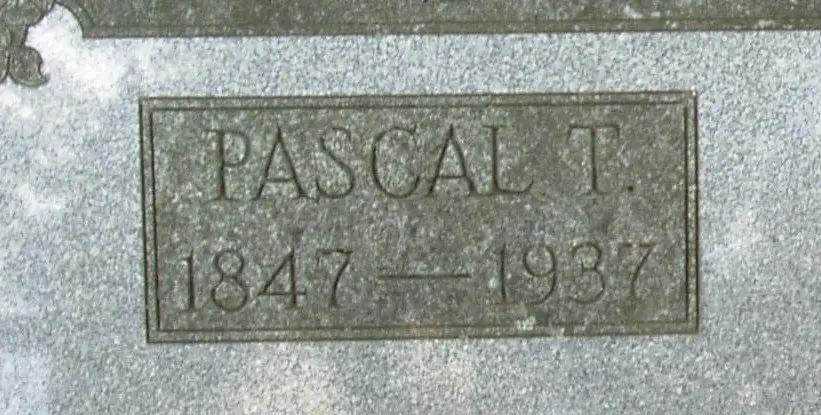
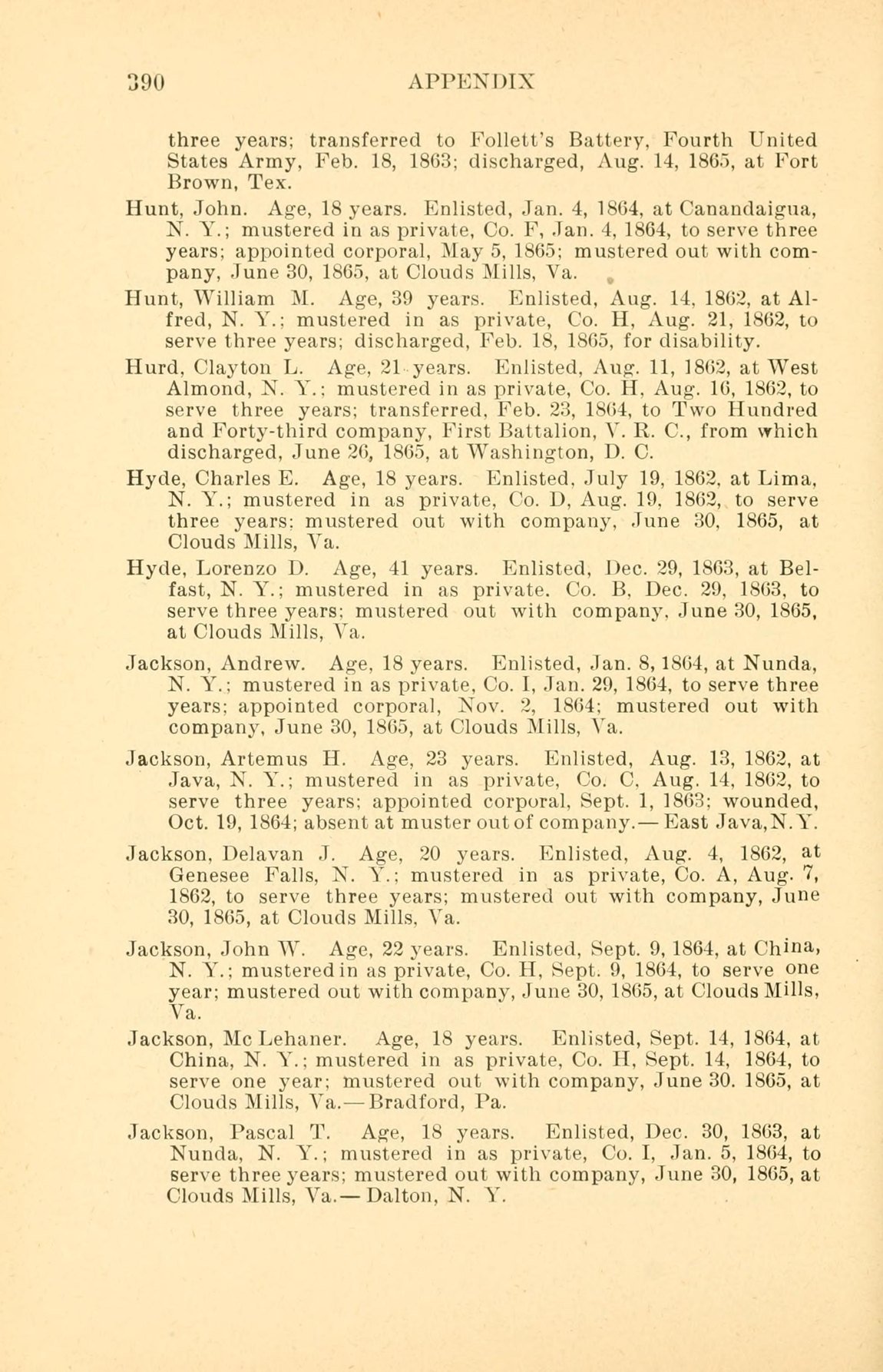
When Pascal Theodore Jackson enlisted in the Union Army on December 30, 1863, he was just 16 years old—though records often show him as 18. Born in Nunda, Livingston County, New York, on December 3, 1847, Pascal was one of the youngest men from his town to join the First New York Dragoons, a regiment born from the transformation of the 130th New York Infantry into a more agile cavalry unit. Nunda, a patriotic farming community, had already contributed heavily to the Union cause, and Pascal’s decision to enlist underscored the spirit of duty that ran deep in the town’s youth.
Pascal was mustered in as a private in Company I on January 5, 1864. Like many of Nunda’s sons, he would see the harsh and heroic realities of war in Virginia’s brutal campaigns. Fortunately, Pascal survived battles like Todd’s Tavern, where other Nunda soldiers, including William Black and Hiram C. Roff, were killed in action. He served until June 30, 1865, when he was honorably discharged at Cloud’s Mills, Virginia, just weeks after the war’s official end. Unlike many of his comrades, Pascal made it home—not unscarred, but alive.
The years that followed were not without struggle. As a young veteran, Pascal filed for an invalid pension in 1879—evidence that his wartime service left lasting physical impacts. His application (No. 333,967) was approved under Act J, and he was issued Certificate No. 381,679. These dry bureaucratic numbers only hint at the price he paid for his service.
Pascal returned to Dalton, New York, not far from where he was raised, and built a life. He married Bertha M. Smith, who was more than two decades his junior, and together they raised three children: a son, Theodore, and two daughters, Mrs. Allen Barney and Mrs. Florence Havens. The couple’s long union came to a poignant end in 1937, when Pascal died at age 89 on February 22. His funeral was held just days later—but the grief would deepen when, on the very evening of his services, Bertha passed away from pneumonia. Their deaths, just hours apart, drew the attention of the local paper, the Genesee County Express, which solemnly reported on the couple’s nearly simultaneous passing.
Pascal was buried in Oakwood Cemetery in Nunda, the same community that had seen him grow from a boy to a soldier, and then into a husband, father, and Civil War veteran. His life stands in contrast to that of fellow Nunda enlistee Corydon Lovejoy, who died in the horrors of Andersonville Prison. While Corydon’s memory is tied to sacrifice and youth cut short, Pascal’s legacy is one of endurance, a life lived in full, shaped but not ended by the war.
Pascal’s story is one thread in the rich tapestry of Nunda’s Civil War history. His name joins others like Barker, Bowen, and Batterson, men who led, healed, or played music across battlefields. The Jackson family itself was no stranger to sacrifice; Pascal’s father, Leonard Jackson, lived until 1912, and must have borne quiet pride in the path his son had taken.
Today, the presence of Pascal Jackson in local memory serves as a reminder of those who not only fought for their country but came back to rebuild it. In many ways, that’s the story of the Civil War veteran, marked by conflict but defined by what came after. Nunda remembers both kinds of heroes: those who fell, and those who stood again.