
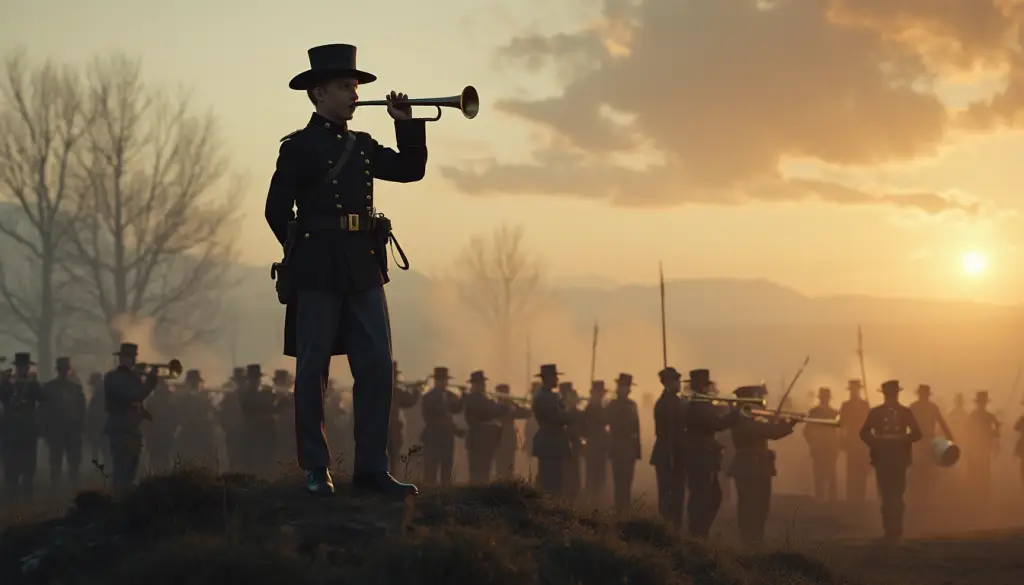
During the American Civil War (1861-1865), music was not merely entertainment, it was integral to the operations, morale, and cultural landscape of both the Union and Confederate armies. Military musicians served critical roles, both symbolic and practical, profoundly impacting the experiences of soldiers and civilians alike. Their duties ranged from ceremonial performances to pivotal battlefield communication, reflecting their indispensable contributions during the conflict.
The tradition of military bands and musicians dates back centuries, with roots traceable to Roman legions, who utilized instruments like the cornu and buccina for communication and morale purposes (Keating, 1993). By the Civil War era, musicians were classified mainly as bandsmen or field musicians, each category fulfilling distinct duties. Bandsmen generally performed for parades and formal gatherings, while field musicians, comprising buglers, drummers, and fifers, were essential for battlefield commands and daily camp life management (Murphy, 1983).
Military bands were vital morale boosters. Union and Confederate troops alike frequently noted how music enhanced their spirits during arduous campaigns and lengthy encampments. General Robert E. Lee famously stated that an army could scarcely function without music, emphasizing its psychological significance (Nelson, 2006). This sentiment was mirrored in the North by General Philip Sheridan, who, despite once sarcastically dismissing musicians as “tooters,” leveraged their abilities strategically during his Valley Campaign to overwhelm enemy morale (Nelson, 2006).
Initially, Union regulations allowed each regiment its own brass band, which typically numbered around 24 musicians, although exact figures varied considerably. Confederate bands, constrained by resource shortages, were smaller and faced logistical hurdles, yet their presence remained meaningful and influential (Manjerovic & Budds, 2002). Notably, prominent civilian bands and their leaders, including Patrick Gilmore and Harvey Dodworth, enlisted with entire ensembles, highlighting the cultural bridge between civilian music and military tradition (Manjerovic & Budds, 2002).
Field musicians were crucial in military operations. Buglers and drummers performed standardized tunes that signaled troop movements, changes in camp routines, and tactical orders in battle (Keating, 1993). The bugle, specifically, served as an essential tool for battlefield communication, capable of delivering clear and distinct messages over the chaotic noise of combat. The absence of valves on the standard bugle restricted it to a limited set of notes, yet these notes were enough to relay vital commands such as “charge,” “retreat,” or “halt” (Coddington, 2006).
Young musicians, often minors, were an iconic and poignant element of the Civil War. Drummers and buglers as young as ten years old were not uncommon; their youth was intended to exempt them from combat duties, but inevitably many found themselves under fire (Murphy, 1983). The legendary story of Charles King, a 13-year-old drummer killed at Antietam, poignantly highlights the stark realities faced by these young musicians (Murphy, 1983).
The equipment and instrumentation of military musicians evolved significantly by the mid-19th century. Innovations such as the keyed bugle, ophicleide, and eventually piston-valved brass instruments enhanced musical capabilities and allowed military bands to become louder, more diverse, and more impactful in open-air environments (Gleason, 2006). Cavalry bands particularly favored “wrap-around” brass instruments designed to be played one-handed, accommodating the practicalities of mounted performance (Gleason, 2006).
Moreover, musicians’ responsibilities extended beyond their musical roles. Often reassigned during combat, musicians acted as stretcher bearers, medical assistants, and couriers, placing them directly in danger despite their non-combatant status. Several musicians demonstrated exceptional bravery, earning recognition such as the Medal of Honor for extraordinary valor on the battlefield. Notably, 28 Union musicians received this highest military commendation, reflecting their courage and critical contributions under fire (Davis, 2014).
The Civil War’s conclusion did not end the influence of military musicians. The legacy of Civil War bands directly inspired the burgeoning community band movement across the United States, which later fostered the growth of public school music education programs. The instruments and musical traditions forged during this turbulent period set precedents for future American band culture, influencing musical developments well into the 20th century (Nelson, 2006).
In summary, Civil War musicians played indispensable roles in army life, from ceremonial and morale-boosting performances to crucial battlefield communication. Their bravery under fire, cultural significance, and musical legacy marked a profound chapter in American military and musical history, reminding contemporary audiences of music’s power even amid conflict.
The Dragoons’ Own Musicians
The scholarship above describes the role that fell to musicians across the Union army generally. The 1st New York Dragoons — the regiment this archive documents — furnished its own, and its own regimental historian happened to be one of them.
James R. Bowen, the Regiment’s Own Chief Musician
The regiment’s history — the source behind most of this archive — was written by one of its own bandsmen. James R. Bowen mustered in as a Musician in Company I on September 3, 1862, and was appointed chief musician on November 10, 1862. When the regiment was converted from infantry to cavalry, he was appointed bugler and transferred back to Company I; he was wounded at Newtown, Va., on August 11, 1864, and mustered out with the company on June 30, 1865, at Clouds Mills, Va. (Bowen, 1900, roster appendix). Writing decades later, Bowen described his own duties plainly: “The writer, as chief musician, was also required to drill the band” during the two hours of daily battalion drill (Bowen, 1900, p. 39).
Source. Bowen, J. R. (1900). Regimental History of the First New York Dragoons (originally the 130th N.Y. Vol. Infantry). Internet Archive. archive.org/details/regimentalhistor00bowe
A Day Announced and Closed by the Bugle
Bowen’s regimental history gives an eyewitness, hour-by-hour account of how the calls he and the other company buglers played actually governed camp life:
On reveille: “In the ordinary routine of camp duties reveille was sounded at daybreak. It consisted of several quick and slow tunes played alternately by the drum corps, sometimes preceded by the trumpeter. It was the signal for all the men to assemble in their company streets for roll call… The men soon learned to spring to their feet at the first toot of the bugle or tap of drum.” (Bowen, 1900, p. 36–37)
On guard mounting: “Half an hour after surgeon’s call the drummer gave the warning for guard mounting, calling the guard detail to collect in their company streets. In the meantime the drum corps assembled on the parade ground and played a quickstep, to which the guards marched out and into line… the adjutant gave the commands, ‘Parade rest!’ ‘Troop, beat off!’ when the band wheeled, and playing a slow-time tune, marched down the line in front of the guards… giving at each end of the line the ‘three cheers’ on the fifes and drums.” (Bowen, 1900, p. 38–39)
On tattoo and taps: “‘Tattoo,’ usually occurring about nine o’clock in winter and later in the summer, was the signal for all soldiers to repair to their quarters for the night. This consisted of several quick and slow tunes by the band, ending up with a lively double-quick. Half an hour after tattoo, ‘taps’ was sounded, when all lights were put out, and loud talking ceased.” (Bowen, 1900, p. 42)
Source. Bowen, J. R. (1900). Regimental History of the First New York Dragoons (originally the 130th N.Y. Vol. Infantry), ch. iii, “Everyday Life in Camp.” Internet Archive. archive.org/details/regimentalhistor00bowe
The Company Buglers
Unlike an infantry regiment with a single centralized band, a cavalry regiment signaled through a bugler attached to each company. The regimental roster names at least twenty men who served the 1st New York Dragoons this way, most a company’s own private promoted to bugler in the field rather than enlisted as a musician:
- Henry C. Hollenbeck, Co. D (age 16 at enlistment) — mustered in as bugler at age 16; mustered out
- Allen E. Shaw, Co. B (age 18 at enlistment) — appointed Musician; mustered out
- Peter Gilley, Co. C (age 18 at enlistment) — appointed bugler Sept. 1, 1863; mustered out
- Charles M. Fuller, Co. F (age 18 at enlistment) — appointed bugler; mustered out
- Thomas S. Tefft, Co. H (age 18 at enlistment) — appointed bugler; mustered out
- Gilbert I. Freer, Co. I (age 18 at enlistment) — appointed bugler Sept. 1, 1863, later Corporal; mustered out
- Adelbert S. Brown, Co. E (age 19 at enlistment) — appointed bugler; mustered out
- Henry A. Stout, Co. K (age 19 at enlistment) — appointed bugler; mustered out
- James L. Wade, Co. A (age 21 at enlistment) — mustered out
- Charles D. Chilson, Co. B (age 21 at enlistment) — appointed Musician; mustered out
- Sidney J. Richardson, Co. C (age 21 at enlistment) — appointed bugler Sept. 1, 1863; mustered out
- Barber O. Burdick, Co. G (age 21 at enlistment) — mustered in as Musician; appointed bugler; mustered out
- Walter H. Jackson, Co. C (age 22 at enlistment) — appointed bugler, then chief bugler Sept. 1, 1863; mustered out
- John Welda, Co. G (age 22 at enlistment) — appointed bugler; mustered out
- Joseph Newton, Co. K (age 22 at enlistment) — mustered in as Corporal; appointed bugler Sept. 11, 1863; mustered out
- Curtis L. Burdick, Co. G (age 23 at enlistment) — mustered in as Musician; appointed bugler; died of disease, April 7, at Mitchell’s Station, Va.
- Amos W. Austin, Co. D (age 25 at enlistment) — appointed bugler; mustered out
- Francis M. Bassett, Co. E (age 25 at enlistment) — appointed Musician; mustered out at Finley Hospital, Washington, D.C.
- Francis J. Kuneman, Co. H (age 27 at enlistment) — appointed bugler; mustered out
- James R. Bowen, Co. I (age 27 at enlistment) — mustered in as Musician; appointed chief Musician, Nov. 10, 1862; wounded at Newtown, Va., Aug. 11, 1864; mustered out
- William W. Marchant, Co. F (age 30 at enlistment) — appointed bugler; mustered out
The youngest, Henry C. Hollenbeck of Company D, mustered in as bugler at sixteen. The regiment’s only fatality among its musicians was Curtis L. Burdick of Company G, who died of disease at Mitchell’s Station, Va.; his brother, Barber O. Burdick, served as bugler in the same company and survived the war.
Source. Bowen, J. R. (1900). Regimental History of the First New York Dragoons, roster appendix. Internet Archive. archive.org/details/regimentalhistor00bowe.
References
Coddington, R. S. (2006). Buglers and Trumpeters. Military Images, 28(1), 26-33.
Davis, J. A. (2014). Union Musicians and the Medal of Honor During the American Civil War. College Music Symposium, 54.
Gleason, B. P. (2006). U.S. Mounted Bands and Cavalry Field Musicians in the Union Army during the Civil War—Background, Duties, and Training. Journal of Historical Research in Music Education, 27(2), 102-119.
Keating, G. (1993). Buglers and Bugle Calls in the U.S. Army. Army History, 27, 16-18.
Manjerovic, M., & Budds, M. J. (2002). More Than A Drummer Boy’s War: A Historical View of Musicians in the American Civil War. College Music Symposium, 42, 118-130.
Murphy, D. (1983). The Shrill of Fifes, The Beat of Drums: Images of American Military Musicians. Military Images, 5(3), 4-15.
Nelson, C. (2006). U.S. Military Bands and Bandsmen 1861-1918. Military Images, 28(1), 4-7.
Here are the document titles along with their corresponding URLs as hyperlinks:
U.S. Mounted Bands and Cavalry Field Musicians in the Union Army during the Civil War—Background, Duties, and Training
https://www.jstor.org/stable/25597924The Shrill of Fifes, The Beat of Drums: Images of American Military Musicians
https://www.jstor.org/stable/44031622Buglers and Trumpeters
https://www.jstor.org/stable/44034461More Than A Drummer Boy’s War: A Historical View of Musicians in the American Civil War
https://www.jstor.org/stable/40374427Union Musicians and the Medal of Honor During the American Civil War
https://www.jstor.org/stable/10.2307/26574367Civil War Vet Recognized
https://www.jstor.org/stable/10.2307/27042795U.S. Military Bands and Bandsmen 1861-1918
https://www.jstor.org/stable/44034458Buglers and Bugle Calls in the U.S. Army
https://www.jstor.org/stable/26304103
Views: 196
Explore the evidence
View this article’s connected sources and media →
About this page
This article was brought over from AlfredGibbs.com. Its preserved text, media and citations remain available for comparison.