
Table of Contents
Andersonville Prison Part 2: Life Behind the Gates
Introduction
The operational phase of Andersonville Prison Camp between February 1864 and April 1865 revealed the stark realities of Civil War imprisonment. With an initial capacity of 10,000 inmates, Andersonville soon became overwhelmed, housing over 30,000 prisoners at its peak. Daily life in the camp was defined by overcrowding, inadequate shelter, and meager rations. These conditions, combined with poor sanitation and a lack of medical care, led to the rapid spread of disease and a devastating death toll.
This report examines the living conditions that prisoners endured, the diseases that ravaged the camp, and the psychological effects of confinement. Through firsthand accounts and historical analysis, the harrowing experiences of those imprisoned at Andersonville come to light. Additionally, the resilience and survival strategies of the prisoners offer insight into their humanity amid one of the darkest chapters of the Civil War.
Living Conditions
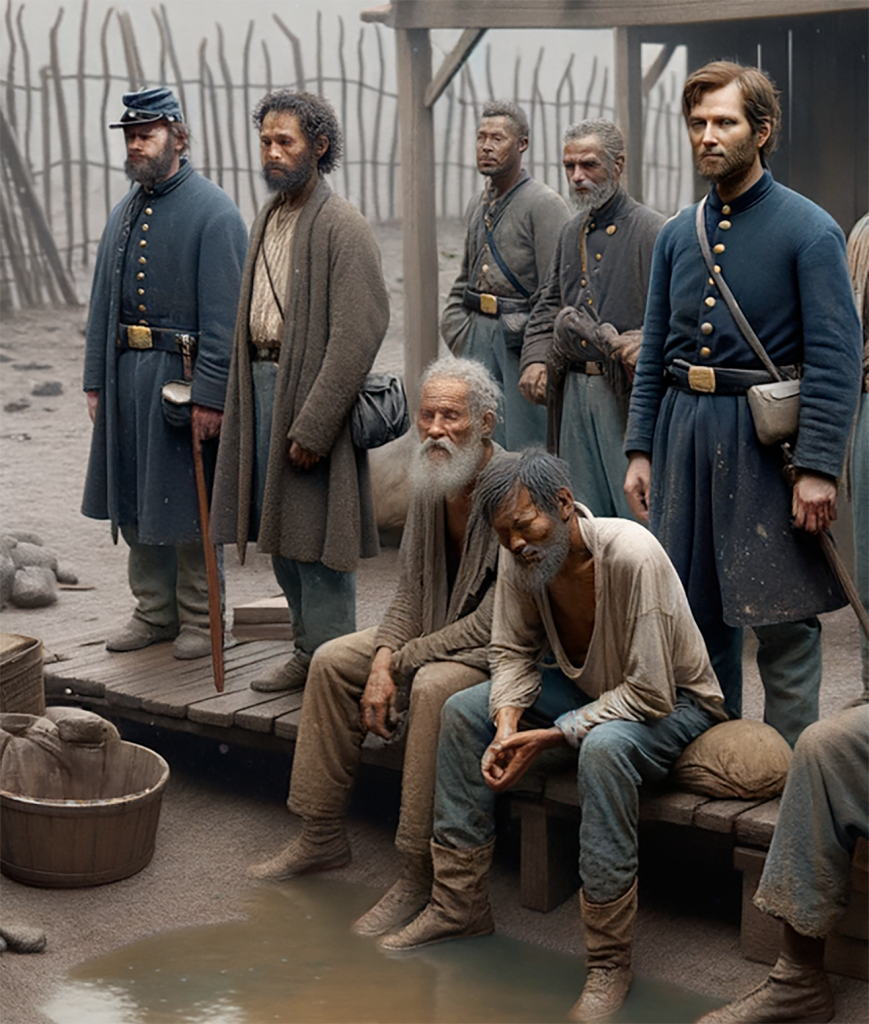
Overcrowding was one of the most pressing issues at Andersonville. Initially designed to hold 10,000 prisoners, the stockade housed over 26,000 inmates by June 1864 and peaked at more than 30,000 in August of the same year (Percoco, 1993). This dramatic overcrowding not only strained the limited resources but also exacerbated the already dire living conditions. Prisoners were crammed into the enclosed 16.5-acre space, resulting in unsanitary and inhumane conditions that intensified the spread of disease.
Housing was virtually nonexistent when the first prisoners arrived. With no barracks or proper shelters, inmates had to create makeshift accommodations using scraps of wood, cloth, and any other available materials. Many prisoners dug holes in the ground to protect themselves from the elements, but these “shebangs” offered little defense against the scorching summer heat or the cold, damp winters (Percoco, 1993; Hesseltine, 1949). The lack of adequate shelter left prisoners exposed to harsh weather, further weakening their already fragile health.
Rations were another major concern. Confederate regulations stipulated that prisoners receive the same rations as soldiers, but shortages meant that inmates often went hungry. Meals typically consisted of cornmeal, occasional bacon, and beans, but the quantities were insufficient, and the quality was poor (Hesseltine, 1949). Spoiled meat, unbolted cornmeal, and infested bread became staples of the prisoners’ diets, leading to widespread malnutrition and starvation. Prisoners frequently complained about the inadequacy of their rations, describing them as “poison to the debilitated” (Percoco, 1993).
The scarcity of resources also affected the camp’s sanitation and hygiene. The small stream running through the camp, initially intended to provide drinking water and waste disposal, quickly became contaminated with human excrement. This polluted water source contributed to the rampant spread of disease and made daily survival an uphill battle for the inmates (Percoco, 1993).
Disease and Mortality
The prevalence of disease at Andersonville was both a symptom and a cause of the camp’s high mortality rate. Dysentery, scurvy, and gangrene were the most common illnesses, claiming thousands of lives. The camp’s unsanitary conditions and overcrowding created an environment where diseases could spread unchecked (Percoco, 1993). Dysentery, caused by the consumption of contaminated water, led to severe dehydration and death for many prisoners. Scurvy, resulting from a lack of fresh fruits and vegetables, further weakened inmates, making them more susceptible to other illnesses (Percoco, 1993).
Gangrene was perhaps the most feared affliction among prisoners. Even minor wounds could become infected, leading to rapid tissue decay and, in many cases, death. Confederate doctors, constrained by limited medical supplies and a rudimentary understanding of disease, were ill-equipped to address the scale of the medical crisis (Hesseltine, 1949). Amputations, often performed without proper sterilization or anesthesia, were common but rarely successful. As Dr. Joseph Jones, a Confederate surgeon, noted in a letter, “In almost every case of amputation for gangrene, the disease returned, and a large proportion of the cases terminated fatally” (Percoco, 1993).
Letters and records from prisoners and their families paint a vivid picture of the suffering within the camp. William Willson, a Union soldier, described his deteriorating health and the hopelessness of his situation in a letter to his family, written just weeks before his death from dysentery (King, 1954). Another prisoner, John C. Collier, wrote of his desperation to hear from his loved ones, even as he battled illness in the camp’s squalid conditions (King, 1954). These personal accounts underscore the profound human cost of Andersonville’s failures.
The death toll at Andersonville was staggering. Of the 45,000 prisoners held during the camp’s operation, nearly 13,000 died, with an average of over 100 deaths per day during the summer of 1864 (Percoco, 1993). The camp’s cemetery, now a national historic site, serves as a solemn reminder of the lives lost in one of the Civil War’s darkest tragedies.
Psychological and Social Dynamics
Beyond the physical suffering, Andersonville inflicted profound psychological trauma on its prisoners. The monotony of confinement, combined with the constant threat of disease and death, led to widespread depression and despair. Some prisoners succumbed to psychosis, while others turned to violence as a means of coping (Hesseltine, 1949). The psychological toll was exacerbated by the lack of hope for escape or exchange, as Union and Confederate policies on prisoner exchanges had largely ceased by mid-1864.
Despite these hardships, prisoners found ways to foster camaraderie and maintain their humanity. Inmates formed small social groups to share resources and provide mutual support. These networks, while informal, offered a sense of solidarity that helped many endure the camp’s hardships (Percoco, 1993). Stories of prisoners sharing their meager rations or caring for the sick highlight the resilience of the human spirit even in the face of unimaginable suffering.
However, not all social interactions within the camp were positive. The rise of the “Andersonville Raiders,” a group of prisoners who preyed on their fellow inmates by stealing food and valuables, created additional turmoil. Their actions prompted the formation of a group of prisoner-led “Regulators,” who sought to restore order within the camp. After a makeshift trial, several Raiders were executed by their peers, demonstrating the desperate lengths to which prisoners went to impose some semblance of justice (Percoco, 1993).
This self-governance highlighted both the resourcefulness and the fractured social dynamics within Andersonville. While the Regulators’ actions brought temporary relief, the broader conditions of the camp continued to erode the physical and mental well-being of its inhabitants.
Final Thoughts
The daily life of prisoners at Andersonville was defined by overcrowding, disease, and psychological torment. From inadequate shelter and contaminated water to the constant threat of illness and violence, the conditions within the camp were a grim testament to the failures of the Confederate prison system. Yet, amid the suffering, stories of resilience and camaraderie emerged, offering a glimpse of hope in an otherwise bleak environment.
The legacy of Andersonville lies not only in the staggering death toll but also in the profound lessons it offers about the human capacity for endurance. These lessons set the stage for the final report, which will explore the postwar legacy of Andersonville and its place in American memory.
References
- Hesseltine, W. B. (1949). Andersonville. The Georgia Review, 3(1), 103–114.
- King, S. B. Jr. (1954). Yankee Letters from Andersonville Prison. The Georgia Historical Quarterly, 38(4), 394–398.
- Percoco, J. A. (1993). The Space Beyond the Gates: Andersonville Prison. OAH Magazine of History, 8(1), 37–43.
List of Dragoons Interned at Andersonville
| Last Name | First Name | Company Assigned | Rank | Other Details |
|---|---|---|---|---|
| Christy | James | I | Private | Mustered in as Private, Co. I, Jan. 5, to serve three years: captured, May 7, 1864; died, Sept. 5, at Andersonville, Ga. |
| Cline | Samuel L | H | Private | Mustered in as Private, Co. H, Sept. 3, to serve three years; captured, May 7, 1864; died, date Not Stated, at Andersonville, Ga.; also borne as Samuel M. Kline. |
| Dalrymple | Manning F | NaN | Private | Mustered in as Private, company unassigned, Oct. 6, to serve three years; no further record. Asa Manning Dalrymple, Male 1845-1864; Birth 1845 Place of Birth: Mount Morris, Livingston, New York, United States; Date of Death: October 1864; Place of Death: Andersonville, Sumter, Georgia, United States. Parents: Thomas Dalrymple (Male, 1803-1890), Euphemia Weller (Female, 1814-1887). |
| Foland | James H | I | Private | Mustered in as Private, Co. I, Sept. 3, to serve three years; captured, May 7, 1864; died, Sept. 15, at Andersonville, Ga. |
| Flint | Josiah H | I | Private | Mustered in as Private, Co. I, Sept. 3, to serve three years; captured, May 7, 1864; died, May 26, at Andersonville, Ga. |
| Green | Levi D | E | Private | Mustered in as Private, Co. E, Aug. 20, to serve three years; captured, June 23, 1864; absent at muster out of the company. Captured June 23, 1864; initially sent to Andersonville, GA, and later died at Lawton/Millen, GA as POW. He was transported via train to CAMP SUMPTER, better known as ANDERSONVILLE prison in Georgia. He was there from late June or early July 1864 until he was transported on the first or second train to CAMP LAWTON in Millen, GA. That camp was only in use for six weeks but during this time Levi Green died of starvation and scurvy. |
| Langs | William W | K | Private | Mustered in as Private, Co. K, Aug. 20, 1862; captured, Oct. 26, at Manassas Va.; died in prison, at Andersonville, Ga., April 1, 1864. |
| Lovejoy | Corydon | I | Private | Mustered in as Private, Co. I, Dec. 18, 1863; captured, May 7, at Wilderness, Va.; died, at Andersonville, Ga., date Not Stated. |
| Orton | Horace C | I | Private | Mustered in as Private, Co. I, Sept. 3, 1862; captured, May 7, at Wilderness, Va.; died, date Not Stated, at Andersonville Prison, Ga. |
| Parshall | Lyman | D | Private | Mustered in as Private, Co. D, Aug. 15, 1862; captured, June 23, 1864; paroled, Nov. 26, at Andersonville, Ga.; mustered out with company, June 30, at Clouds Mills, Va.—Hartland, Mich. |
| Seeley | James C | C | Private | Mustered in as Private, Co. C, Aug. 19, 1862; captured, June 12, 1864; escaped, April 17, from Andersonville, Ga.; mustered out with company, June 30, at Clouds Mills, Va.—Belfast, N.Y. |
| Snyder | William | E | Private | Mustered in as Private, Co. E, Oct. 17, 1863; captured, May 7, 1864; died, Sept. 20, at Andersonville, Ga. |
| Woodward | Hiram J | I | Private | Mustered in as Private, Co. I, Sept. 3, 1862; appointed Corporal, April 1, 1864; captured, May 7, 1864; died, Sept. 19, at Andersonville, Ga. |
Views: 24
Explore the evidence
View this article’s connected sources and media →
About this page
This article was brought over from AlfredGibbs.com. Its preserved text, media and citations remain available for comparison.