
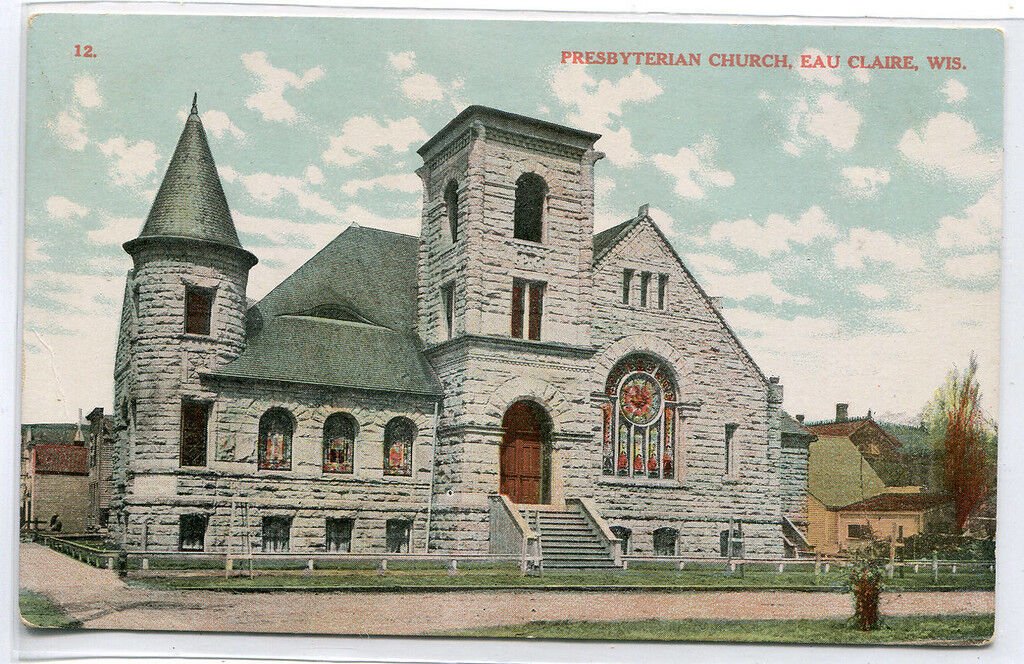
First Presbyterian Church
Background
The First Presbyterian Church in Eau Claire claims its origins in the 1870s. Like other Protestant denominations, Presbyterianism emerged from the Reformation of the 1500s, closely aligning with Calvinist theology. Calvinism shares similarities with Lutheranism but emphasizes stricter adherence to certain doctrines. Scottish immigrants primarily spread Presbyterianism to the United States, where, during the Civil War, it split into Northern and Southern branches. By 1900, Presbyterian churches were common across towns and cities in the United States (Melton, 1967).
The Eau Claire Congregation
The First Presbyterian Church in Eau Claire reflected a typical Presbyterian community of its era. Its congregation comprised approximately 121 members in the 1890s, though its records were notably incomplete. The most significant information included a list of pastors and basic member registries, which recorded baptisms, weddings, and deaths (First Presbyterian Church, 1857–1899).
Reverend L.F. Grant served as the pastor throughout much of the decade. The records list male members’ occupations, primarily laborers and farm workers. For instance, Andrew Gilbert, born in Eau Claire in 1867, was identified as a laborer by 1895, reflecting the working-class nature of the church’s congregation. Ages of members ranged from 19 to 72 years (First Presbyterian Church, 1857–1899).
The church membership displayed a strong Scots-Irish majority, with 43 individuals identifying as such. Additionally, Scottish and German members contributed to the church’s diversity. While Eau Claire’s general population comprised Germans, Irish, and Scandinavians, the Presbyterian Church attracted a predominantly Scottish and English heritage congregation, consistent with Presbyterianism’s historical ties to Scotland and England (First Presbyterian Church, 1857–1899).
Record-Keeping and Trends
Unlike Methodist records, which tracked extensive details such as birth numbers and family trees, the First Presbyterian Church records focused on major life events. They included baptisms, weddings, and deaths but lacked comprehensive birth data or family connections. The church’s record-keeping notably improved under Reverend Grant, with earlier records being even less complete. The leadership shift may explain discrepancies in the church’s administrative practices (First Presbyterian Church, 1857–1899).
References
Damico, N. (2011). The Eau Claire area had a number of churches in the community around 1900 [PDF]. Minds@UW. https://minds.wisconsin.edu/bitstream/handle/1793/54270/DamicoSpring2011.pdf
First Presbyterian Church. (1857–1899). Church and Cemetery Records: Eau Claire County, Wisconsin, 1857-1982 [Microfilm, reel 4, item 5]. Special Collections and Archives, McIntyre Library, University of Wisconsin-Eau Claire, Eau Claire, WI.
Melton, J. (1967). Presbyterian Worship in America: Changing Patterns Since 1787. John Knox Press.
Views: 44
Explore the evidence
View this article’s connected sources and media →
About this page
This article was brought over from AlfredGibbs.com. Its preserved text, media and citations remain available for comparison.