
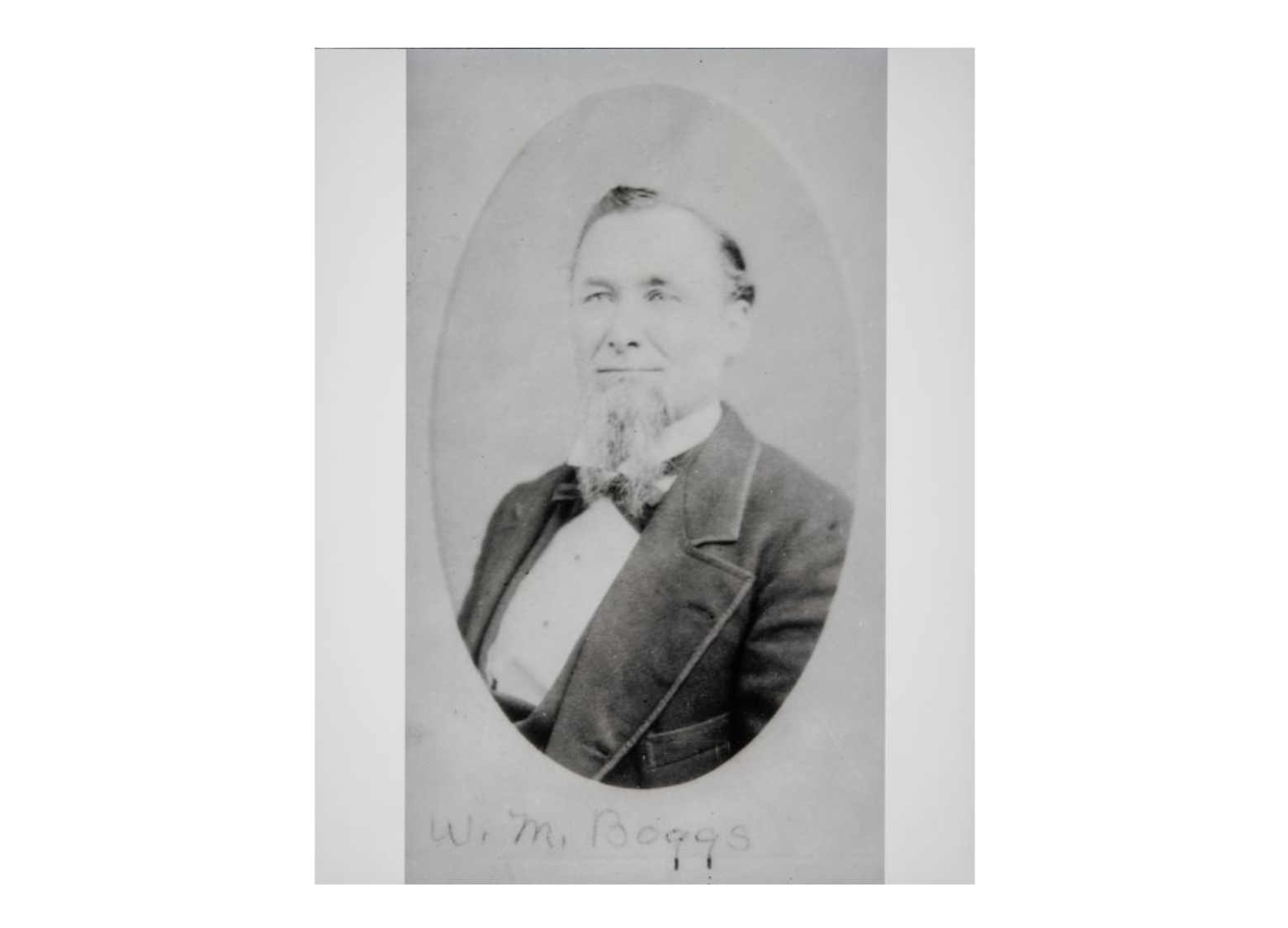
William Montgomery Boggs (1826–1911) was a significant figure in the early development of California, particularly in Sonoma and Napa counties. His life journey from Missouri to California, his military service, and his contributions to the state’s growth reflect the experiences of many American pioneers during the mid-19th century.
Early Life and Family Background
Born on October 21, 1826, near Fort Osage in Jackson County, Missouri, William Montgomery Boggs was the son of Lilburn W. Boggs and Panthea Grant Boone. His father, Lilburn, served as the sixth Governor of Missouri from 1836 to 1840 and was a prominent political figure. His mother, Panthea, was the granddaughter of the renowned frontiersman Daniel Boone, linking William to a legacy of American exploration and settlement (WikiTree, n.d.).
Migration to California
In 1846, amid the westward expansion and the allure of new opportunities, the Boggs family embarked on a journey to California. William, at the age of 20, played a pivotal role in this expedition, acting as the captain of the emigrant train for most of the journey. Notably, the ill-fated Donner Party traveled with his group for a significant portion of the trek. However, the Donner Party separated from Boggs’s group and faced tragic circumstances, while Boggs and his family successfully crossed the Sierra Nevada approximately two weeks ahead, reaching the valley in time to secure shelter (Find a Grave, n.d.).
Military Service
Upon arriving in California, William Boggs enlisted in the military during the Mexican-American War. He served as a non-commissioned officer in a battalion of mounted riflemen, which he co-recruited with A. F. Grayson. This battalion was attached to the command of Lieutenant Maddox of the Marine Corps under Commodore Stockton and was honorably discharged at Monterey after three months of service (Find a Grave, n.d.).
Settlement in Sonoma
After his military service, Boggs settled in Sonoma, California, where he resided for seventeen years. He became a significant real estate dealer, owning and managing some of the finest properties in the valley. His eldest son, born in Sonoma, was reportedly the first American born in California under the national flag, marking a notable point in the state’s history (Find a Grave, n.d.).
Later Life in Napa
In 1863, William Boggs moved to Napa, California, where he continued his involvement in real estate and agriculture. He remained an active and respected member of the community until his death on April 22, 1911, in Bakersfield, Kern County, California. He was buried in Tulocay Cemetery in Napa, alongside his family members (Find a Grave, n.d.).
Legacy
William Montgomery Boggs’s life reflects the experiences of early American settlers in California, marked by military service, real estate ventures, and contributions to the development of Sonoma and Napa counties. His leadership during the migration westward, his service in the Mexican-American War, and his entrepreneurial activities in California’s early statehood period underscore his role in the state’s history.
References
Find a Grave. (n.d.). William Montgomery Boggs (1826-1911) – Find a Grave Memorial. Retrieved from https://www.findagrave.com/memorial/121063697/william_montgomery-boggs
WikiTree. (n.d.). William Montgomery Boggs (1826 – 1911). Retrieved from https://www.wikitree.com/wiki/Boggs-356
Read an article on the sail of land between Edmund Randolph (1819–1861) an American jurist and politician in Sonoma and Napa counties California and William Montgomery Boggs (1826–1911).
Views: 58
Explore the evidence
View this article’s connected sources and media →
About this page
This article was brought over from AlfredGibbs.com. Its preserved text, media and citations remain available for comparison.