
Background
Blacksmiths played an indispensable role in the U.S. Civil War by providing critical support to military operations. They maintained and repaired vital equipment, crafted weaponry, and shoed horses, ensuring that troops remained mobile and well-supplied. According to the National Park Service, blacksmiths were among the essential tradesmen of any military unit, often seen as a one-stop shop for any item made from metal. Their services extended from making weapons and equipment for soldiers to forging everyday tools and household items (NPS, n.d.). The ability to create and repair a diverse array of metal items made blacksmiths integral to the success of the armies on both sides of the conflict.
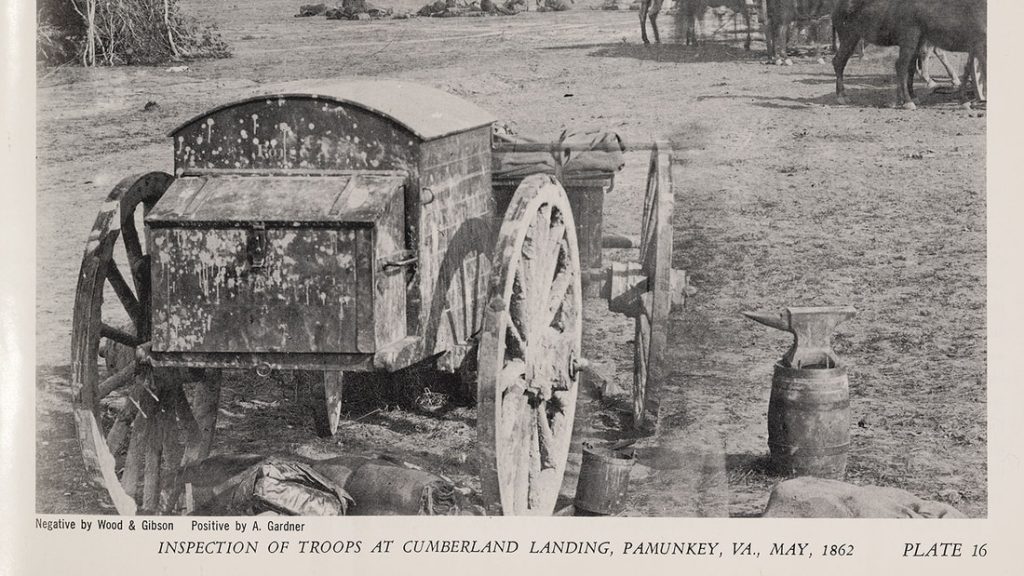
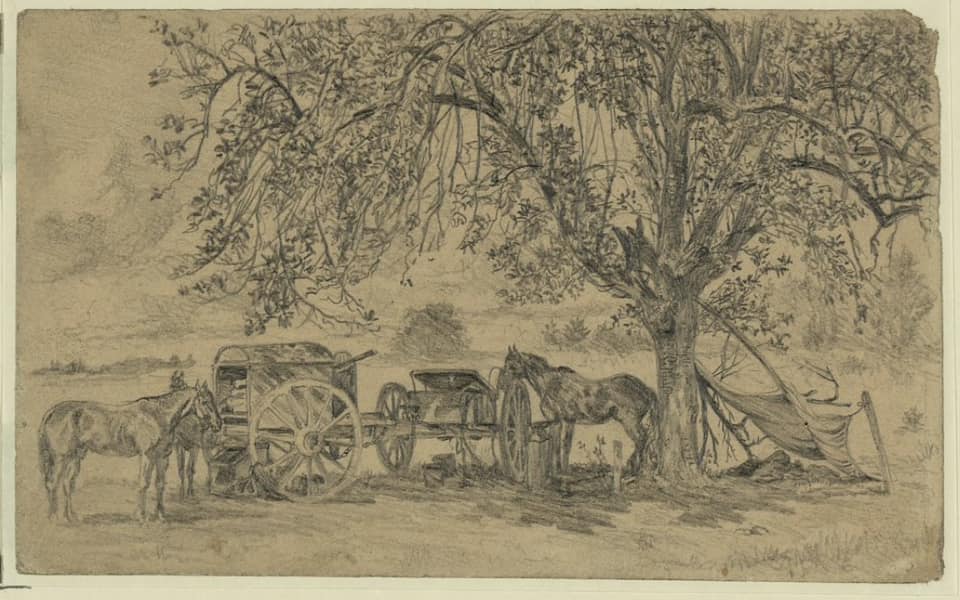
The blacksmiths’ responsibilities also included working with the “traveling forge,” a mobile workshop equipped with tools, coal, and an anvil, which allowed blacksmiths to perform their duties on the battlefield. This mobile capability was crucial for maintaining equipment in the field, as it allowed blacksmiths to follow the troops and provide on-the-spot repairs, especially for artillery and wagon equipment (Wikipedia, n.d.). The mobility offered by the traveling forge significantly enhanced the operational readiness of the Union and Confederate forces.
RESEARCHER’S NOTE: Take some time to visit the article “The Traveling Forge” (linked) from the Starkville Civil War Arsenal. Their page related to this technology is amazing and the video they have created is one of the best views of the use of the forge I have found.
Requirements to Become a Blacksmith in the Civil War
Becoming a blacksmith required a lengthy apprenticeship that typically began during adolescence. The apprenticeship process started with simple tasks, such as sweeping floors and managing the bellows, but as the apprentice progressed, they moved on to more complex tasks, eventually learning how to create and repair intricate metal objects (NPS, n.d.). Aspiring blacksmiths were required to develop proficiency in handling various tools, shaping metal under intense heat, and maintaining precise control over their work. As the apprentice’s skills advanced, they took on more challenging tasks, such as crafting axe heads and other tools essential to military and civilian life.
During the Civil War, blacksmithing was considered a highly specialized and respected profession due to the extensive training required to master the craft. In addition to learning the physical skills of blacksmithing, apprentices were also taught how to understand the properties of different metals and the impact of heat on their durability and strength. The rigorous training process ensured that Civil War blacksmiths were well-prepared to handle the diverse and demanding tasks required of them in the field, from repairing weapons to maintaining the structural integrity of wagons and artillery.
Responsibilities of a Blacksmith During the Civil War
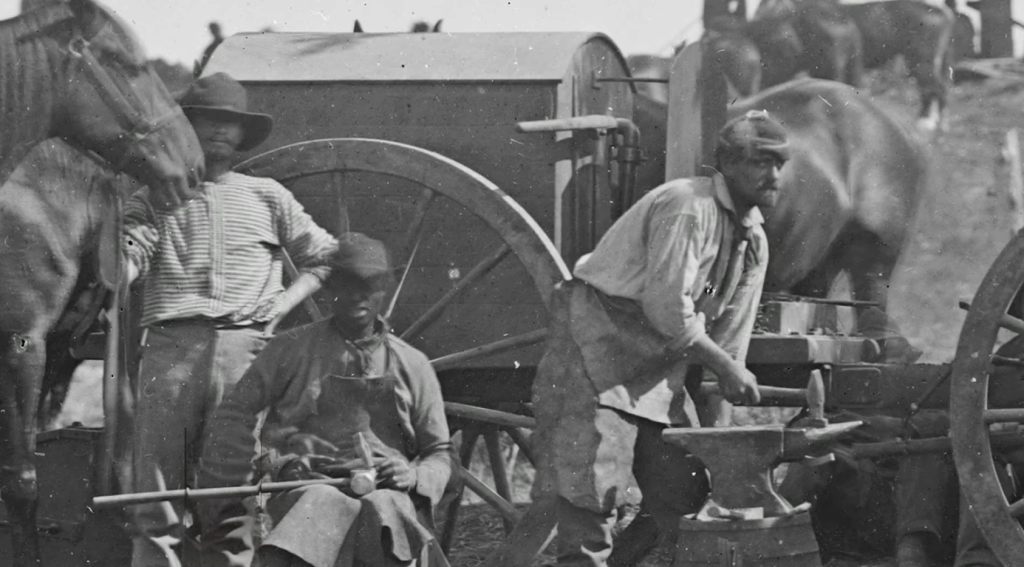
The duties of a blacksmith in the Civil War were varied and essential to military operations. Blacksmiths were responsible for shoeing horses, repairing and constructing wagon parts, and forging artillery components. A typical traveling forge was equipped with 1,200 pounds of tools, including an anvil, bellows, vise, and a supply of coal, which allowed blacksmiths to work in harsh conditions and provide immediate support to troops on the move (Wikipedia, n.d.). This setup enabled blacksmiths to keep equipment operational despite the wear and tear of constant movement and combat, which was crucial to the army’s ability to sustain long campaigns.
The versatility of blacksmiths extended beyond maintenance; they also crafted specialized tools and weapons for soldiers. They forged swords, knives, and repair parts for rifles, providing troops with a steady supply of essential combat tools. Blacksmiths often worked directly with soldiers and officers, adapting their creations to meet specific tactical needs. This close working relationship enabled blacksmiths to gain a unique understanding of the soldiers’ equipment requirements, allowing them to make modifications that enhanced functionality and durability.
Moreover, blacksmiths contributed to the logistical aspect of military operations by ensuring that supply wagons remained functional. Broken axles, wheel spokes, and other critical parts were common due to the rough terrain and heavy loads carried by supply wagons. Blacksmiths’ ability to quickly repair these components kept the supply lines moving, directly impacting the army’s ability to continue operations without significant delays (Atack & Margo, 2017). The maintenance of supply wagons, coupled with the repair of artillery carriages and other equipment, underscored the importance of blacksmiths in maintaining the operational efficiency of Civil War armies.
The Federal Record: Government Documentation
The account above draws on the National Park Service and Wikipedia. The same facts, the traveling forge and the blacksmith-farrier’s established place in a company, are set down in the federal government’s own publications of the war years. Two are reproduced here.
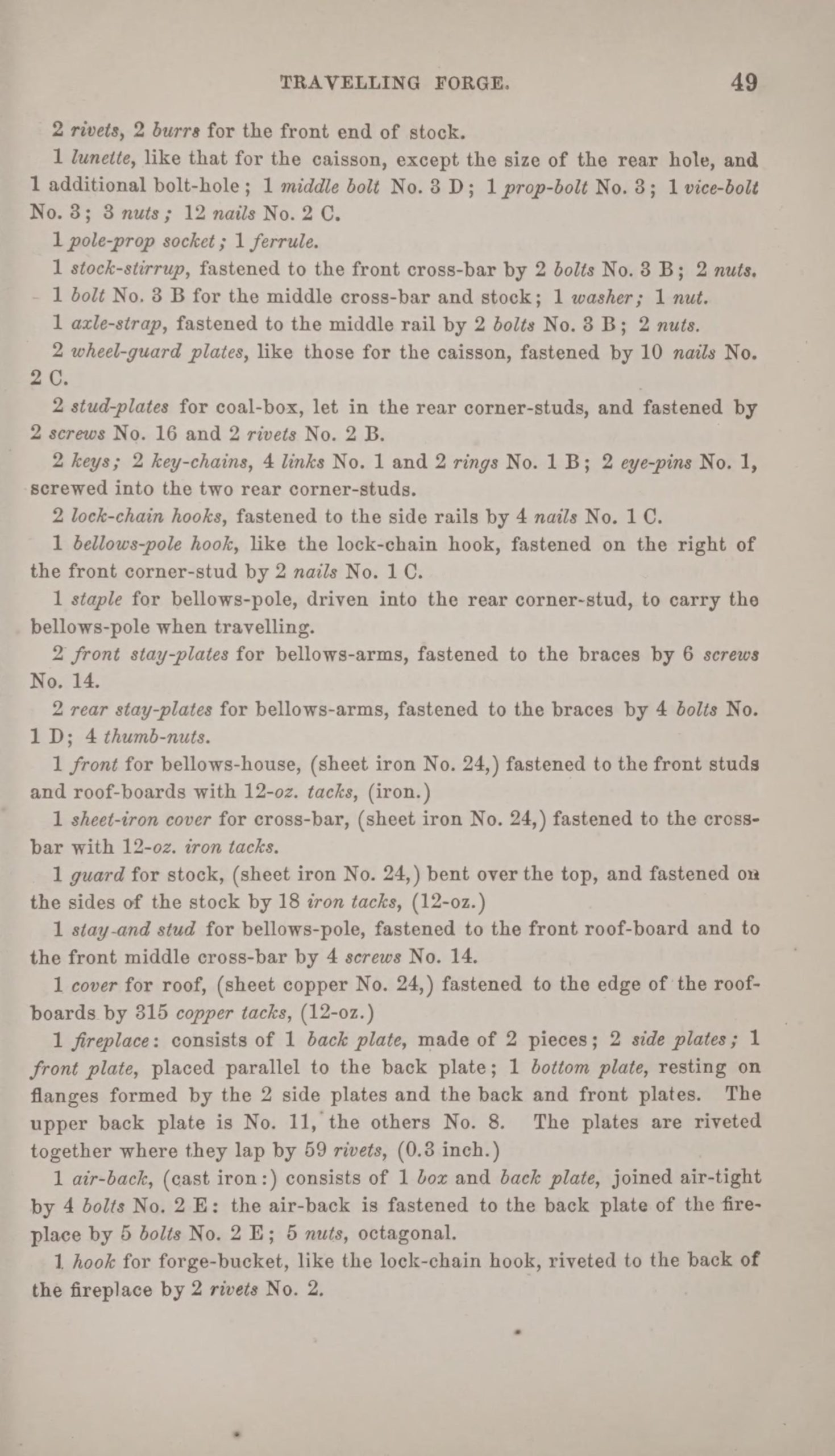
2 rivets, 2 burrs for the front end of stock. 1 lunette, like that for the caisson, except the size of the rear hole, and 1 additional bolt-hole; 1 middle bolt No. 3 D; 1 prop-bolt No. 3; 1 vice-bolt No. 3; 3 nuts; 12 nails No. 2 C. 1 pole-prop socket; 1 ferrule. 1 stock-stirrup, fastened to the front cross-bar by 2 bolts No. 3 B; 2 nuts. 1 bolt No. 3 B for the middle cross-bar and stock; 1 washer; 1 nut. 1 axle-strap, fastened to the middle rail by 2 bolts No. 3 B; 2 nuts. 2 wheel-guard plates, like those for the caisson, fastened by 10 nails No. 2 C. 2 stud-plates for coal-box, let in the rear corner-studs, and fastened by 2 screws No. 16 and 2 rivets No. 2 B. 2 keys; 2 key-chains, 4 links No. 1 and 2 rings No. 1 B; 2 eye-pins No. 1, screwed into the two rear corner-studs. 2 lock-chain hooks, fastened to the side rails by 4 nails No. 1 C. 1 bellows-pole hook, like the lock-chain hook, fastened on the right of the front corner-stud by 2 nails No. 1 C. 1 staple for bellows-pole, driven into the rear corner-stud, to carry the bellows-pole when travelling. 2 front stay-plates for bellows-arms, fastened to the braces by 6 screws No. 14. 2 rear stay-plates for bellows-arms, fastened to the braces by 4 bolts No. 1 D; 4 thumb-nuts. 1 front for bellows-house, (sheet iron No. 24,) fastened to the front studs and roof-boards with 12-oz. tacks, (iron.) 1 sheet-iron cover for cross-bar, (sheet iron No. 24,) fastened to the cross-bar with 12-oz. iron tacks. 1 guard for stock, (sheet iron No. 24,) bent over the top, and fastened on the sides of the stock by 18 iron tacks, (12-oz.) 1 stay and stud for bellows-pole, fastened to the front roof-board and to the front middle cross-bar by 4 screws No. 14. 1 cover for roof, (sheet copper No. 24,) fastened to the edge of the roof-boards by 315 copper tacks, (12-oz.) 1 fireplace: consists of 1 back plate, made of 2 pieces; 2 side plates; 1 front plate, placed parallel to the back plate; 1 bottom plate, resting on flanges formed by the 2 side plates and the back and front plates. The upper back plate is No. 11, the others No. 8. The plates are riveted together where they lap by 59 rivets, (0.3 inch.) 1 air-back, (cast iron:) consists of 1 box and back plate, joined air-tight by 4 bolts No. 2 E: the air-back is fastened to the back plate of the fireplace by 5 bolts No. 2 E; 5 nuts, octagonal. 1 hook for forge-bucket, like the lock-chain hook, riveted to the back of the fireplace by 2 rivets No. 2.
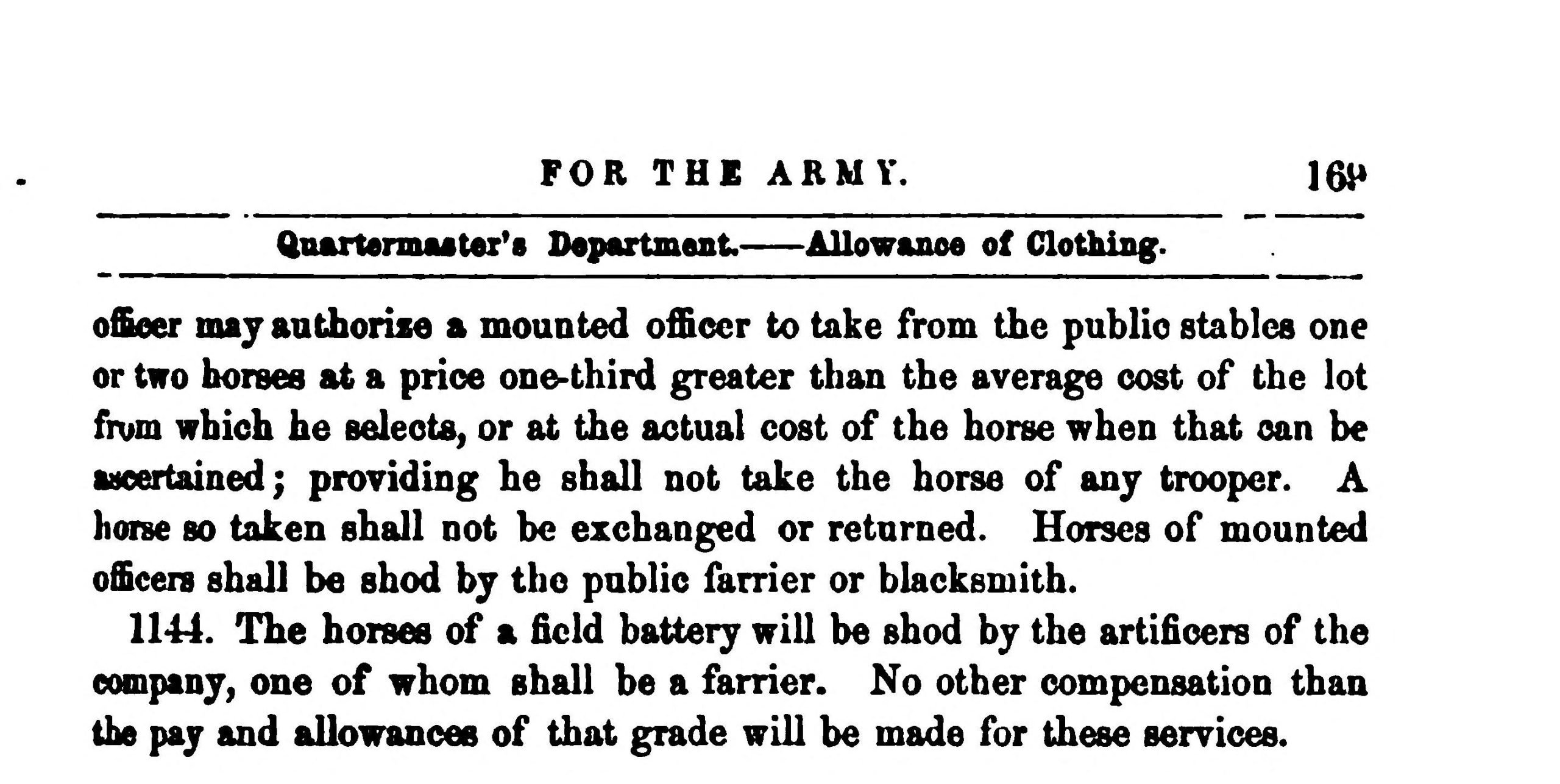
[…continued] Horses of mounted officers shall be shod by the public farrier or blacksmith. 1144. The horses of a field battery will be shod by the artificers of the company, one of whom shall be a farrier. No other compensation than the pay and allowances of that grade will be made for these services.
“The horses of a field battery will be shod by the artificers of the company, one of whom shall be a farrier.”
Revised Regulations for the Army of the United States, 1861, ¶1144, p. 169.
What these documents show. The traveling forge was not improvised; it was a standard ordnance vehicle, specified by the federal government down to the last rivet, bellows-plank, and coal-box. And the blacksmith was not an informal helper: Army Regulations required that a field battery’s horses be shod by its own artificers, one of whom “shall be a farrier” (¶1144), and named the blacksmith among those who could be mustered as an “artificer” at all (¶84). These confirm, in the government’s own words, the roles described above and recorded in the First New York Dragoons roster below.
References
National Park Service. (n.d.). A Blacksmith Displays his Tools. Retrieved from https://www.nps.gov/mocr/learn/historyculture/sbtb.htm
Wikipedia. (n.d.). Traveling forge. In Wikipedia, The Free Encyclopedia. Retrieved from https://en.wikipedia.org/wiki/Traveling_forge
Atack, J., & Margo, R. A. (2017). Gallman Revisited: Blacksmithing and American Manufacturing, 1850-1880. Retrieved from internal document.
United States Army Ordnance Department. (1861). The ordnance manual for the use of the officers of the United States Army. Lippincott. (Travelling forge, p. 49.) https://archive.org/details/ordnancemanualfo00unit_0
United States War Department. (1861). Revised regulations for the Army of the United States, 1861. J. G. L. Brown. (Shoeing of field-battery horses, para. 1144, p. 169; artificers, para. 84.) https://archive.org/details/revisedregulati00deptgoog
Editorial note. Updated 24 July 2026: added a “Federal Record” section reproducing two U.S. government documents with full transcriptions, the Ordnance Manual (1861) travelling-forge specification and Army Regulations (1861) ¶1144 on the field-battery farrier, and added both to the References. The original article text, audio, video, images, and the First New York Dragoons roster were retained.
Views: 785
Explore the evidence
View this article’s connected sources and media →
About this page
This article was brought over from AlfredGibbs.com. Its preserved text, media and citations remain available for comparison.