
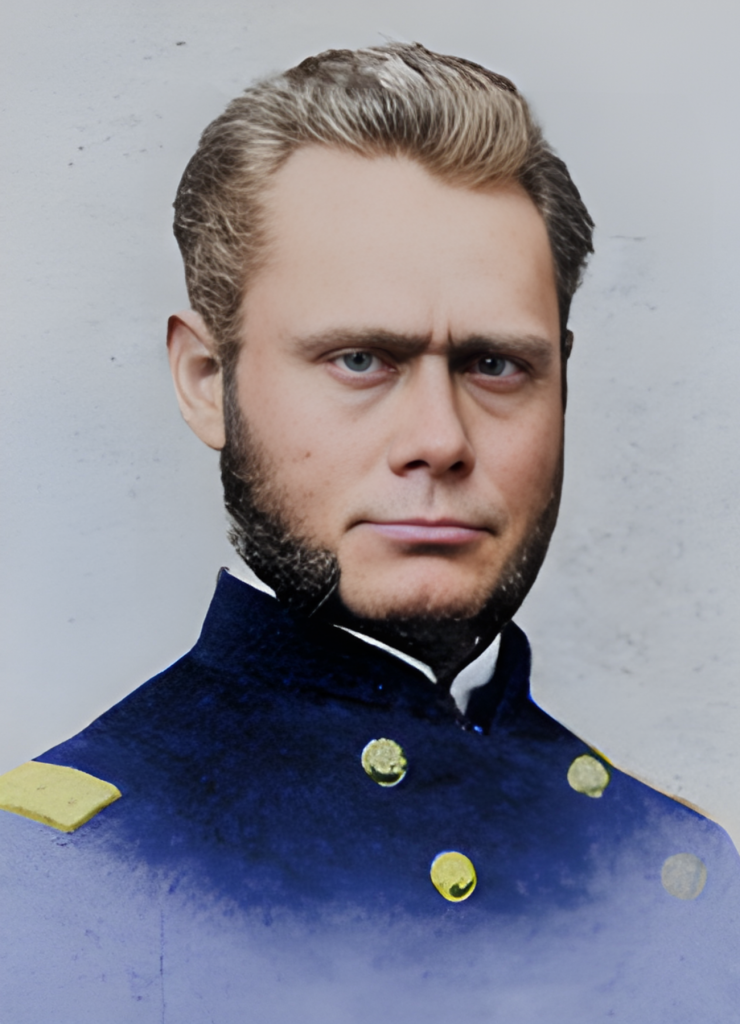
Early Life and Education
Benjamin Trumbull Kneeland, known as Dr. Kneeland, was born on June 3, 1825, in Onondaga County, New York, as one of twelve children. His father, Amasa Kneeland, was born in 1776 and was the son of a Continental soldier, tracing the family’s lineage back to King James of Scotland. Dr. Kneeland worked his way through Homer Academy and the Geneva Medical School, where he gained practical experience during a smallpox epidemic, managing around 150 cases. He graduated on June 23, 1851, and began his medical practice in Oakland, New York.
Marriage and Early Career
Dr. Kneeland married Harriet Niles of Cortland County on June 14, 1852. The couple lived in Oakland until 1855 before moving to various towns, including Lima and Geneseo, eventually settling in Nunda. In 1862, amidst the Civil War, Dr. Kneeland enlisted as a surgeon with the 1st New York Dragoons, a regiment that trained in what is now Letchworth State Park.
Civil War Service
During his three years with the 1st New York Dragoons, Dr. Kneeland served through 128 battles, including those in General Sheridan’s Shenandoah campaign and the concluding events at Appomattox. Recognized for his “assiduous and unwearied services to the wounded while in the skirmish line,” he was appointed brevet colonel. He became the first Civil War surgeon to successfully perform a hip amputation. Despite an offer from General Sheridan to join his staff, Dr. Kneeland chose to remain with his regiment.
Acts of Courage and Compassion
One memorable incident showcased Dr. Kneeland’s courage and compassion. When a soldier was wounded on the skirmish line, Dr. Kneeland rode his horse, “McCausland,” under enemy fire to reach the soldier. Facing the enemy, he raised his hand and asked them to “Hold on, boys, till I see how badly this boy is hurt.” The firing ceased, and he safely removed the wounded soldier. Dr. Kneeland’s bravery earned him the respect and admiration of both his regiment and the Confederate soldiers.
Medical Philosophy and Professional Influence
Dr. Kneeland remained devoted to traditional medical practices despite the rise of homeopathy and other medical schools. Known for his diagnostic skills and treatment methods, he frequently consulted with fellow practitioners who respected his expertise. He held a strong disdain for “quacks” and was recognized for his integrity and professionalism, traits that would have established him as a leader in any field.
Community Engagement and Intellectual Pursuits
An active community figure, Dr. Kneeland was a skilled public speaker, particularly during Lincoln’s first presidential campaign. He was an avid reader of poetry, fiction, philosophy, and science, often quoting Shakespeare, Burns, Scott, Lowell, and Emerson. His family continued this intellectual legacy; his daughter, Mary, became the first librarian of Bell Memorial Library, and his sons, George and John, distinguished themselves in Oklahoma and Kansas.
Post-War Career and Later Life
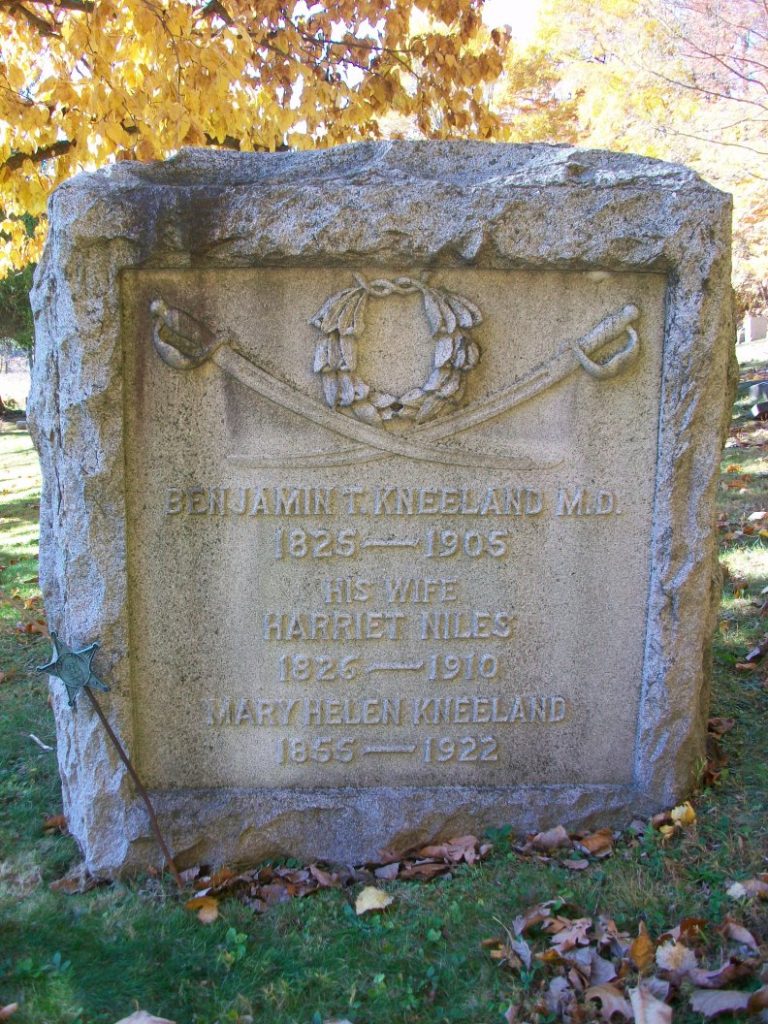
After the war, Dr. Kneeland settled on a farm near Dalton, where he practiced medicine until his health declined. In June 1905, he moved to Nunda, where he passed away on September 3, 1905, at the age of 80. He was buried in Hunt’s Hollow, near the township where he had begun his medical career. His name is remembered with respect in the region he served.
Legacy as a Civil War Medical Hero
Dr. Kneeland is honored as a Civil War hero who served with the 1st Dragoons and was breveted Lieutenant Colonel and Colonel by Governor Fenton and President Johnson. His pioneering hip amputation and acts of courage solidified his legacy as a compassionate and fearless surgeon, respected by his men and fellow citizens.
References
The Nunda News. (1956, June 14). Nunda, N.Y.
The Mt. Morris Enterprise. (1952, November 26). Mt. Morris, N.Y.
Compiled Military Service Record
The index to the compiled service records confirms Benjamin T Kneeland in the 19th Cavalry (the regiment’s Fold3 designation; it is the First New York Dragoons), Company F & S, entering service as Maj. (Reg. Surg) and leaving it as Major (Surg).
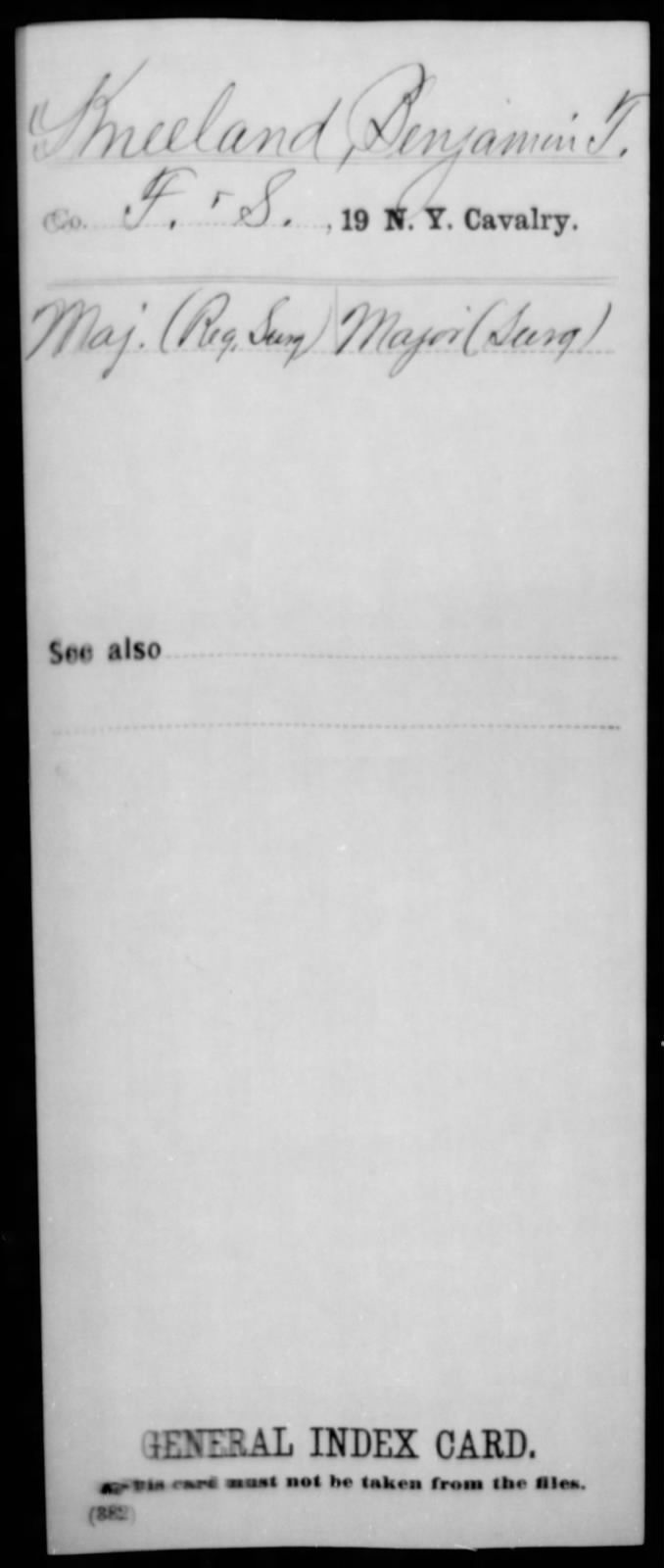
| Military unit | 19th Cavalry |
|---|---|
| Company | F & S |
| Enlistment rank | Maj. (Reg. Surg) |
| Discharge rank | Major (Surg) |
Kneeland, Benjamin T.
Co. F. & S., 19 N. Y. Cavalry.
Maj. (Reg. Surg) -        Major (Surg) -
See also [blank]
[printed footer] General Index Card. This card must not be taken from the files. (382)
Source. Compiled Military Service Record, Kneeland, Benjamin T, Co. F & S, 19th Cavalry. Indexes to the Carded Records of Soldiers Who Served in Volunteer Organizations During the Civil War (NARA microfilm publication M551), Record Group 94. Digital image, Fold3 (https://www.fold3.com/image/288566422), accessed 18 September 2026. Transcribed from the original by sight.
Primary Sources & Records
Original documents located in federal and state archives that name this soldier. Each is shown with its full transcription and citation.
The Regimental Register (Bowen, 1900)
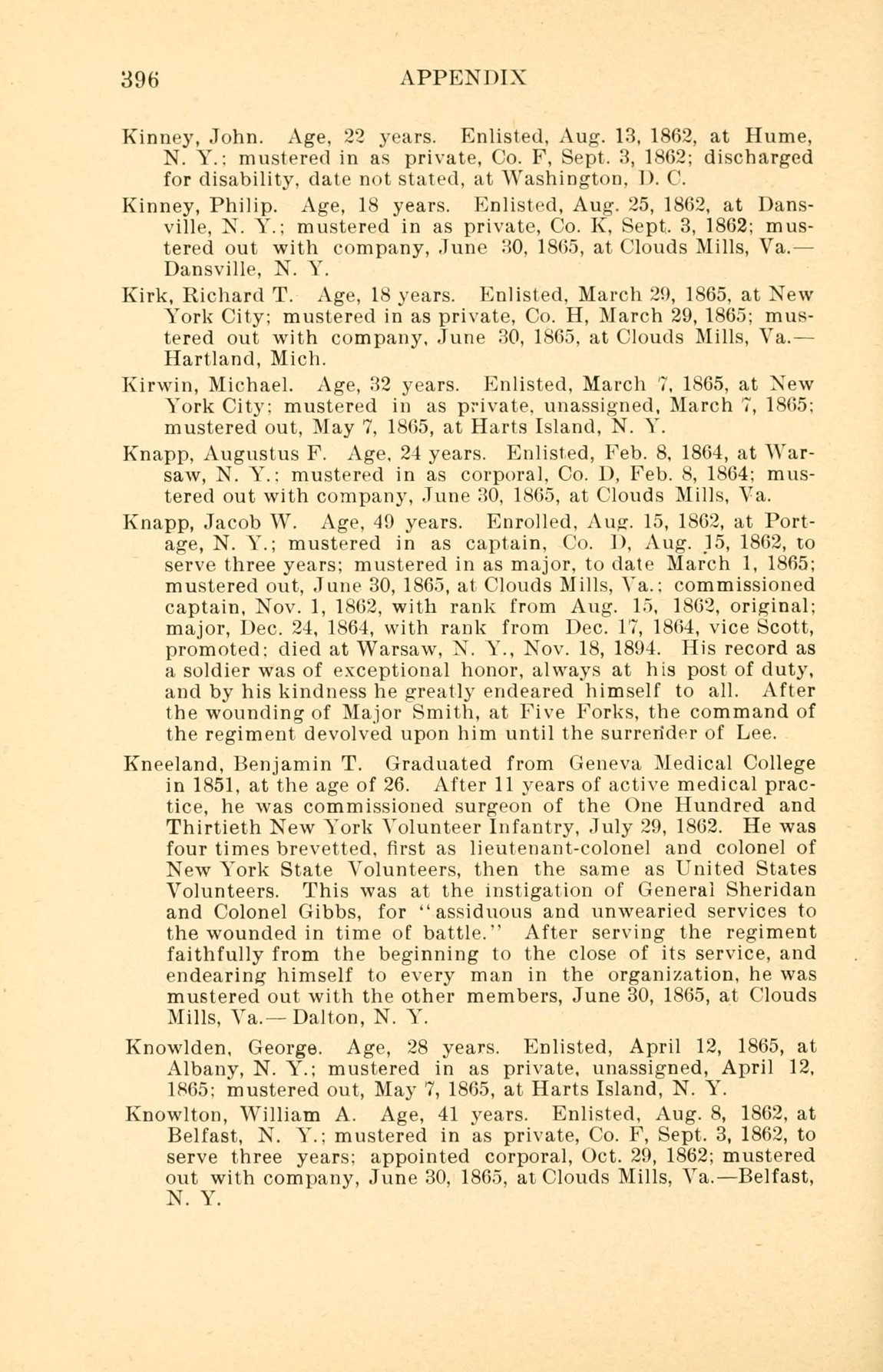
“Benjamin T Kneeland. Graduated from Geneva Medical College in at the age of 26; he wascommissioned Surgeon of the One Hundred and Thirtieth New York Volunteer Infantry, July 29, 1862 He was four times brevetted; first as Lieutenant-Colonel and colonel of New York State Volunteers, then the same as United States Volunteers. This was at the instigation of General Sheridan and Colonel Gibbs, for “assiduous and unwearied services to the wounded in time of battle. ” After serving the regiment faithfully from the beginning to the close of its service, and endearing himself to every man in the organization, he was mustered out with the other members, June 30, at Clouds Mills, Va. — Dalton, N. Y.”
Source. Bowen, J. R. (1900). Regimental History of the First New York Dragoons (originally the 130th N.Y. Vol. Infantry) (p. 396). Internet Archive. archive.org/details/regimentalhistor00bowe
Views: 28
Explore the evidence
View this article’s connected sources and media →
About this page
This article was brought over from AlfredGibbs.com. Its preserved text, media and citations remain available for comparison.