
Jefferson Barracks, located just outside St. Louis, Missouri, was a vital military post from its founding in 1826 through the mid‑19th century. Established in response to growing needs for military presence and training on the western frontier, the barracks played a crucial role in U.S. military operations, especially in the trans‑Mississippi region. The history of Jefferson Barracks during its early years provides insight into its strategic importance and the daily lives of the soldiers stationed there.
Table of Contents
The Rise and Legacy of the Brave Rifles
Origins of the Regiment of Mounted Riflemen
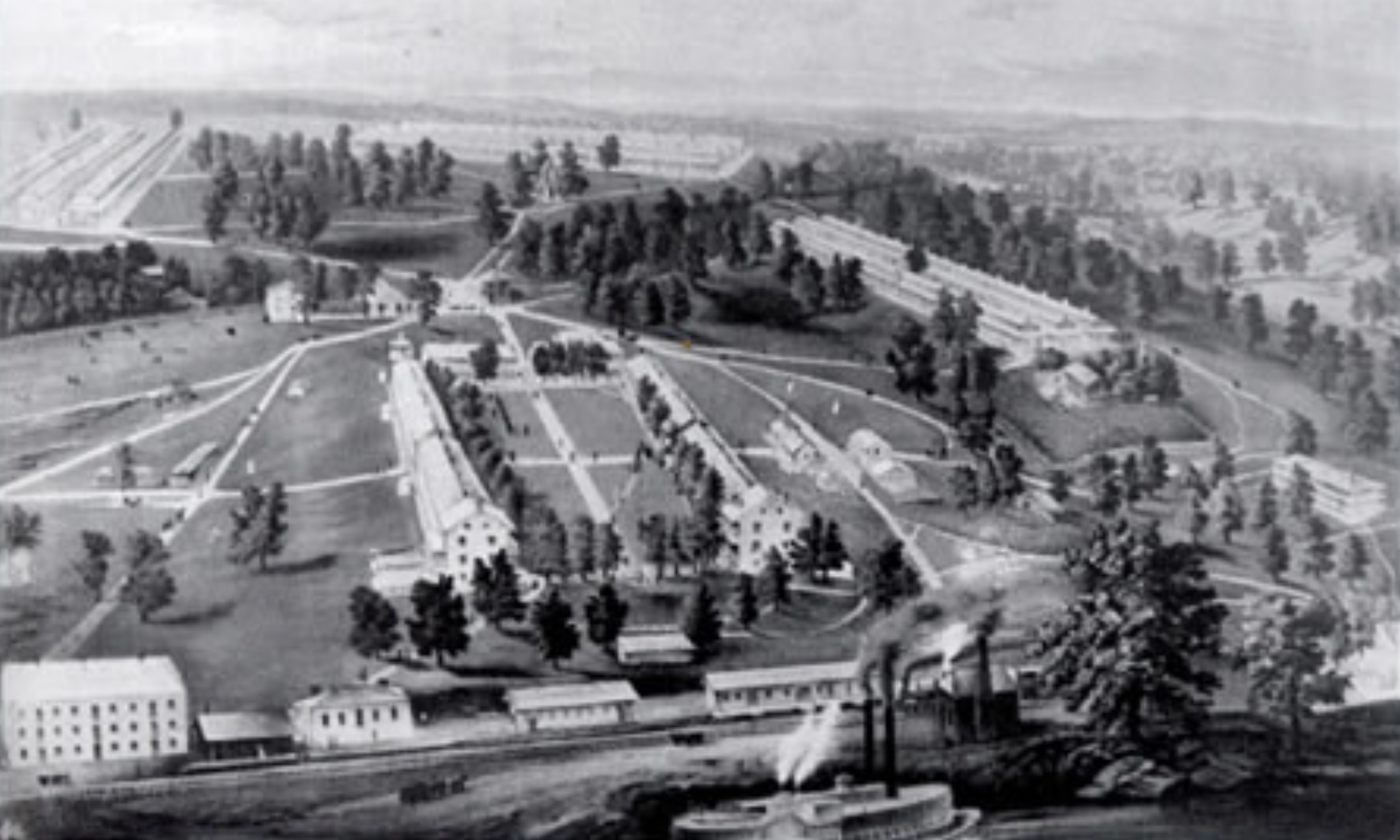
Founding of Jefferson Barracks
The establishment of Jefferson Barracks was part of a broader effort by the U.S. Army to create a military infrastructure that could support operations across the expanding nation. The site was selected by Generals Edmund P. Gaines and Henry Atkinson in June 1826. They were tasked with finding a location near the mouth of the Missouri River for a new infantry school of instruction. The site they chose, ten miles south of St. Louis, offered easy access to the Mississippi River, which facilitated the movement of troops and supplies (Banta, 1981, p. 1).
Atkinson’s experience in western military operations, including his command of the Yellowstone Expedition, made him a logical choice to oversee the development of the new post (Banta, 1981, p. 7). His leadership, however, soon led to friction with other officers, including Colonel Henry Leavenworth, which hindered progress in the early stages of construction (Banta, 1981, p. 21).
The construction of the barracks was completed by the end of 1826, though additional structures and improvements were continually added over the following years. By the start of 1827, Jefferson Barracks had become a key point in the U.S. military’s western defense strategy (Banta, 1981, p. 18).
From the National Archives
The Army’s Own Record of the Founding
Behind the histories written since stands the paper the Army kept at the time. In its register Historical Information Relating to Military Posts, the Adjutant General’s office copied out, by hand, what the returns and orders recorded of each post as it was raised. Two leaves describe Jefferson Barracks — and between them they name the founding in a detail no secondary account matches: the companies, the officer who led them, the post’s forgotten first name, and the plain fact that the soldiers built the place with their own hands.
“Established July 10, 1826 … and called Camp Miller”
Adjutant General’s register of military posts — entry for Jefferson Barracks, p. 102
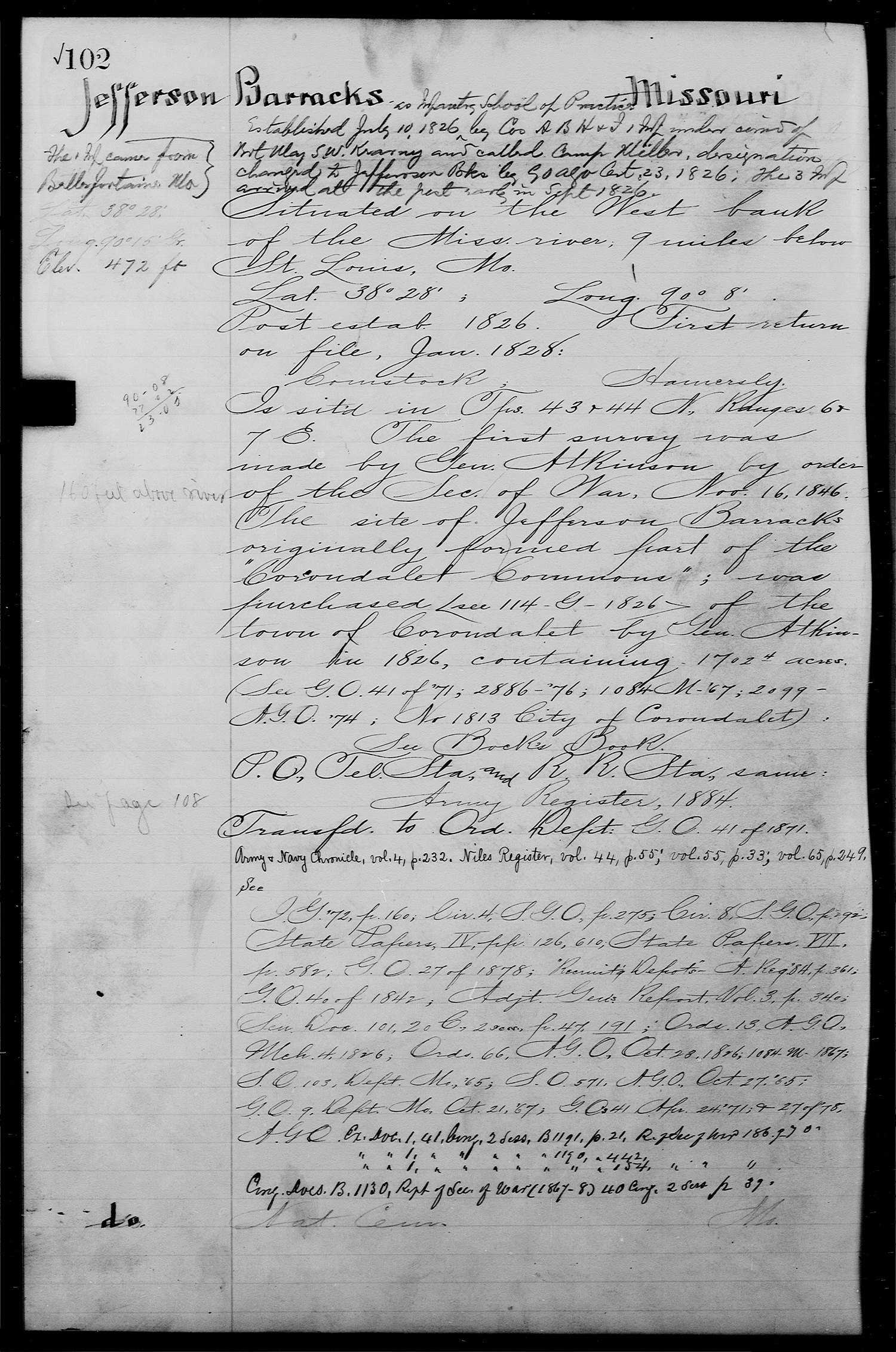
Verbatim transcription
Jefferson Barracks [as Infantry School of Practice] — Missouri
Established July 10, 1826, by Cos. A, B, H & I, 1st Inf. under com’d of Bvt. Maj. S. W. Kearny and called Camp Miller; designation changed to Jefferson B’ks by G.O. 40, Oct. 23, 1826. The 3rd Inf. arrived at the post in Sept. 1826.
Situated on the West bank of the Miss. river, 9 miles below St. Louis, Mo. Lat. 38° 28’; Long. 90° 8’. Post estab. 1826. First return on file, Jan. 1828. Comstock; Hamersly.
Is sit’d in Tps. 43 & 44 N., Ranges 6 & 7 E. The first survey was made by Gen. Atkinson by order of the Sec. of War, Nov. 16, 1846 [sic]. The site of Jefferson Barracks originally formed part of the “Carondelet Common”; was purchased <see 114–G–1826> of the town of Carondelet by Gen. Atkinson in 1826, containing 1702¼ acres. (See G.O. 41 of ’71; 2886–’76; 1084 M–67; 2099–A.G.O. ’74; No. 1813 City of Carondelet.) See Books, Bx. K. P.O., Tel. Sta. and R.R. Sta., same. Army Register, 1884. Transf’d to Ord. Dept. G.O. 41 of 1871.
[Left margin:] The 1st Inf. came from Bellefontaine, Mo. — Lat. 38° 28’, Long. 90° 15’ Gr., Elev. 472 ft. — 160 feet above river. [Bottom margin:] do. [Mo.]
[Authorities noted on the leaf — transcribed in full:] Army & Navy Chronicle, vol. 4, p. 232. Niles’ Register, vol. 44, p. 55; vol. 55, p. 33; vol. 65, p. 249. See — I.G. ’72, p. 160; Cir. 4 S.G.O., p. 275; Cir. 8 S.G.O., p. 92; State Papers, IV, pp. 126, 610; State Papers VII, p. 582; G.O. 27 of 1878; “Recruit’g Depots,” A. Reg. 84, p. 361; G.O. 40 of 1842; Adjt. Gen’s Report, Vol. 3, p. 340; Sen. Doc. 101, 20 C., 2 sess., pp. 47, 191; Ords. 13 A.G.O., Mch. 4, 1826; Ords. 66, A.G.O., Oct. 28, 1826; 1084 M–1867; S.O. 103, Dept. Mo., ’65; S.O. 571, A.G.O., Oct. 27, ’65; G.O. 9, Dept. Mo., Oct. 21, ’67; G.O. 41 A.G.O. Apr. 24, ’71, & 27 of ’78; A.G.O. Ex. Doc. 1, 41 Cong. 2 sess., B.1191, p. 21; [the same repeated in ditto marks:] ″ ″ 1, ″ ″ ″ ″ ″ 1190, ″ 442; ″ ″ ″ 157, ″ ″ ″; Cong. Docs. B.1130, Rep’t of Sec. of War (1867–8), 40 Cong. 2 sess., p. 39. Nat. Cem. [National Cemetery] — Mo. [A few of the order-numbers in this closing citation block are written faintly; the readings above are given as far as the hand is legible.]
National Archives Microfilm Publication M661, Historical Information Relating to Military Posts and Other Installations, 1700–1900, Roll 4 (posts I–L), frame 99 [register p. 102]. Record Group 64, Records of the National Archives and Records Administration. National Archives Catalog file unit “I THRU L,” NAID 651230581.
“The greater part of the barracks were erected in 1827, by soldiers’ labor”
Adjutant General’s register of military posts — descriptive entry, p. 108
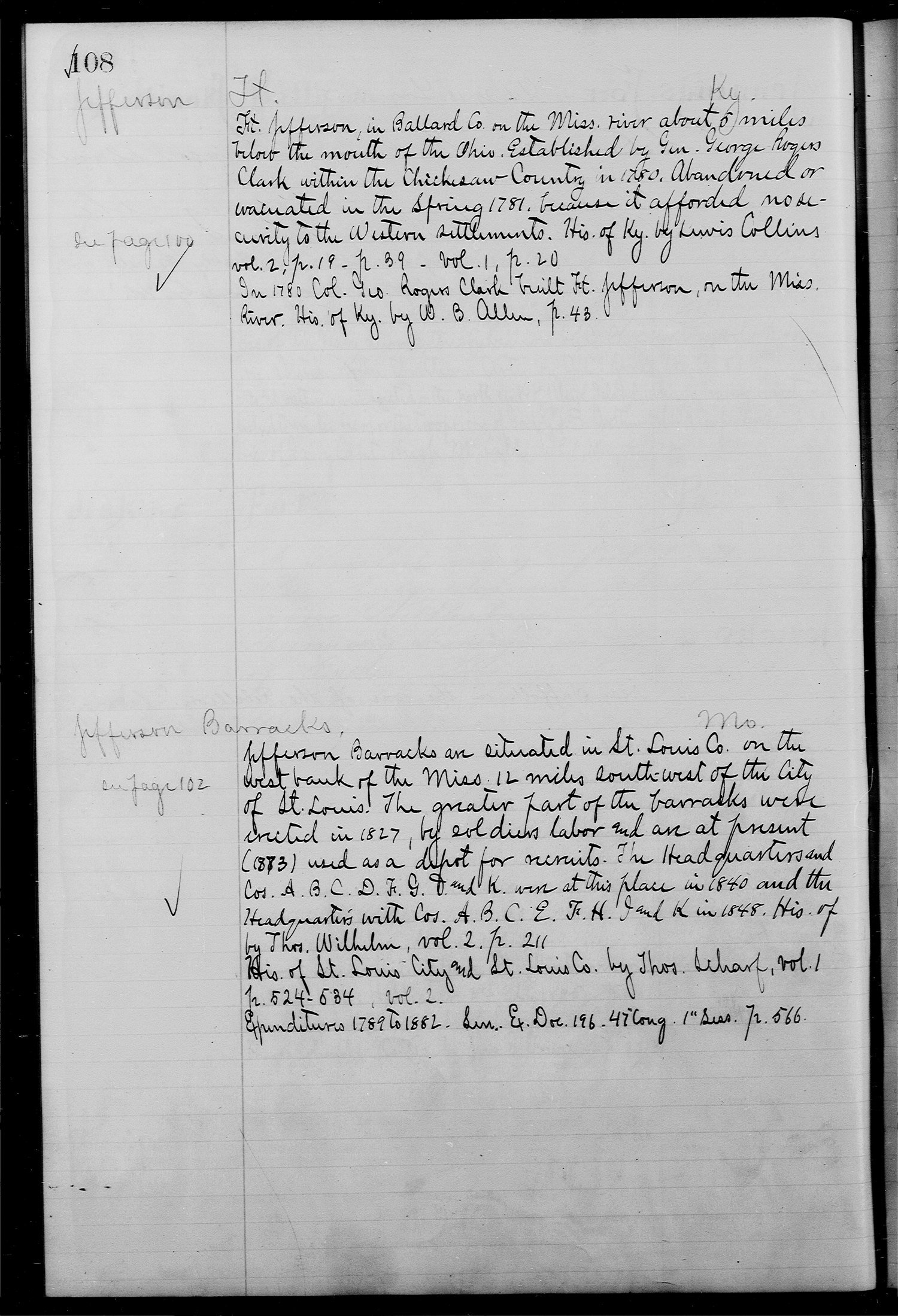
Verbatim transcription
Jefferson Barracks — Mo.
Jefferson Barracks are situated in St. Louis Co. on the west bank of the Miss., 12 miles south-west of the City of St. Louis. The greater part of the barracks were erected in 1827, by soldiers’ labor, and are at present (1873) used as a depot for recruits. The Head-quarters and Cos. A, B, C, D, F, G, I and K were at this place in 1840, and the Head-quarters with Cos. A, B, C, E, F, H, I and K in 1848.
[Authorities cited on the leaf:] Hist. by Thos. Wilhelm, vol. 2, p. 211; Hist. of St. Louis City and St. Louis Co. by Thos. Scharf, vol. 1, pp. 524–684, vol. 2; Expenditures 1789 to 1882 — Sen. Ex. Doc. 196, 47 Cong. 1st Sess., p. 566.
National Archives Microfilm Publication M661, Historical Information Relating to Military Posts and Other Installations, 1700–1900, Roll 4 (posts I–L), frame 105 [register p. 108]. Record Group 64, Records of the National Archives and Records Administration. NAID 651230581.
Read together, the two leaves correct and enrich the printed histories. The garrison did not simply arrive at a finished post: Kearny’s four companies of the 1st Infantry marched up from Fort Bellefontaine in the summer of 1826, pitched “Camp Miller,” and over the next year raised the limestone barracks themselves. The name Jefferson Barracks was not fixed until General Order 40 of October 23, 1826 — honoring Thomas Jefferson, dead that same July.
The Post’s Own Record
The Post in Its Own Words: Return No. 1, July 1826
Every month the post’s adjutant filed a return with the Adjutant General in Washington — its strength, its officers, the men who joined or deserted, and the orders it had received. The first roll of the War Department’s post returns for Jefferson Barracks opens with the very first of them: July 1826, rendered over the signature of the founding commander, Bvt. Maj. Stephen Watts Kearny. Its face still carries the post’s original name — “Camp Miller” — and among the orders it logs is the one that set the school on this ground: “Corps of Instruction to occupy Right Bank of Miss. River.” Here is the return, both sides, transcribed in full.
“Return of Troops of the U.S. Army Commanded by Bvt. Major S. W. Kearny for the Month of July 1826. No. 1.”
Jefferson Barracks (entered as “Camp Miller”) — monthly post return, July 1826, the earliest on file
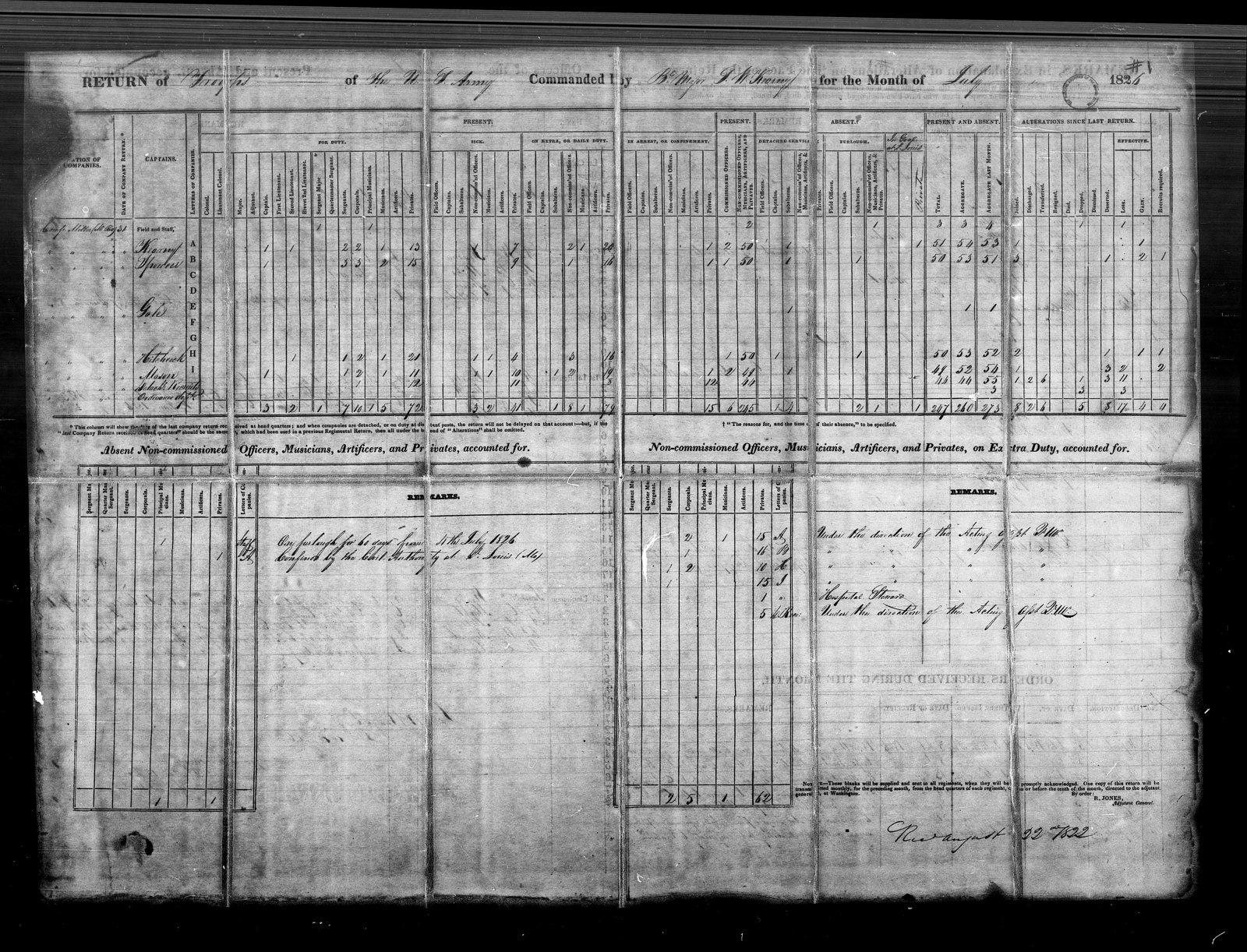
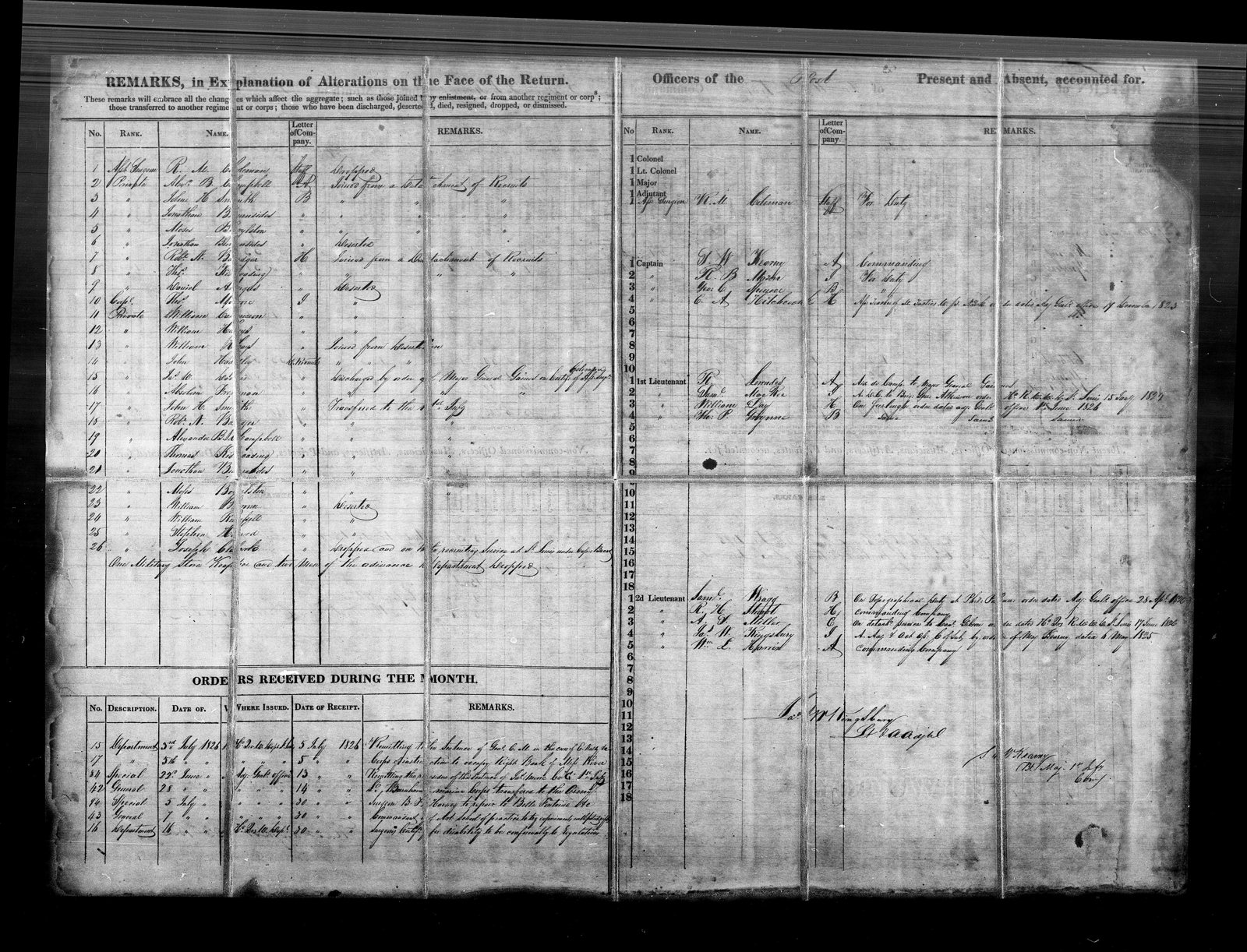
Verbatim transcription
Heading (face of the return)
RETURN of Troops of the U.S. Army Commanded by Bvt. Major S. W. Kearny for the Month of July 1826. [No.] 1. 1826.
[Designation of companies, left margin:] Camp Miller. [Date of company return:] Aug. 31.
Strength present (face)
Privates for duty, by company (the full multi-column strength grid is on the scan):
- Field & Staff — Sergeant Major 1; Principal Musician 1.
- Co. A, Capt. Kearny — 1 captain, 1 first lieutenant, 2 sergeants, 2 corporals, 1 musician, 13 privates for duty; 7 sick; 20 on extra duty.
- Co. B, Capt. Spencer — 1 captain, 3 sergeants, 3 corporals, 2 musicians, 15 privates for duty; 9 sick; 16.
- Capt. Gale’s company — [no strength entered; detached].
- Co. H, Capt. Hitchcock — 1 first lieutenant, 1 sergeant, 2 corporals, 1 musician, 21 privates for duty; 4 sick; 3 extra; 16.
- Co. I, Capt. Mason — 1 captain, 1 sergeant, 2 corporals, 1 musician, 11 privates for duty; 10 sick; 19.
- Detachment of Recruits — 12 privates for duty; 11 sick; 8.
- Ordnance Department — [1].
- Totals — 3 captains, 2 first lieutenants, 1 second lieutenant, 7 sergeants, 10 corporals, 5 musicians, 72 privates for duty; 41 privates sick; aggregate present and absent, 273.
Absent, accounted for (face)
“One furlough for 60 days from 4th July 1826.” “Confined by the Civil Authority at St. Louis (Mo.).”
On extra duty (face)
Companies A, B, and C — “Under the direction of the Acting Asst. Q.M.” “Hospital Steward.”
Endorsement (face)
“Rec’d August 22, 182[6].” “Notice.—These blanks will be supplied … One copy of this return will be transmitted monthly … By order: R. Jones, Adjutant General.”
Officers of the Post — Present and Absent (back)
- Colonel, Lieut. Colonel, Major, Adjutant — [none present].
- Asst. Surgeon W. M. Coleman (Staff) — “For duty.”
- Captain S. W. Kearny (A) — “Commanding.”
- Captain R. B. Mason (I) — “For duty.”
- Captain Geo. C. Spencer (B) — “For duty.”
- Captain E. A. Hitchcock (H) — “Asst. Teacher of the Tactics … as per orders Adjt. Genl’s office 19 November 1825.”
- 1st Lieut. [Th.] Cornude[s?] (A) — “Aid-de-Camp to Major General Gaines.”
- 1st Lieut. Sam’l MacRae (I) — “A.D.C. to Brig. Genl. Atkinson, order Hd Qrs W. Dept., St. Louis, 15 Jan’y 1827.”
- 1st Lieut. William Day (H) — “On furlough, order dated Adj. Genl’s office 4 June 1826.”
- 1st Lieut. Th. P. Gwynne (B) — “Same / Same / Same.”
- 2nd Lieut. Sam’l Wragg (B) — “On Topographical duty at Phila., Pa., order dated Adj. Genl’s office 28 Ap’l 1826.”
- 2nd Lieut. R. H. [Stuart?] (H) — “Commanding Company.”
- 2nd Lieut. A. E. Miller (E) — “On detached service to Cantonment Gibson, order dated Hd Qrs W. Dept. … 17 June 1826.”
- 2nd Lieut. Jas. W. Kingsbury (I) — “A. Asst. & Act. Asst. Comsy. of Subs. by order of Maj. Kearny dated 6 May 1825.”
- 2nd Lieut. Wm. L. Harris (A) — “Commanding Company.”
Remarks, in Explanation of Alterations on the Face of the Return (back)
- 1. Asst. Surgeon R. M. Coleman (Staff) — “Dropped.”
- 2–5. Privates Alex’r B. Campbell, John H. Smith, Jonathan Burnsides, Moses Boylston — “Joined from a detachment of Recruits.”
- 6. Private Jonathan Burnsides — “Deserted.”
- 7–8. Privates Rob’t N. Badger, Thomas [Kisleading?] (H) — “Joined from a detachment of Recruits.”
- 9–10. Private Daniel Arnolds; Corp’l Thomas Moone (I) — “Deserted.”
- 11–14. Privates William Cameron, William [Harys?], William [Roberts?] (“Joined from Desertion”), John Headley.
- 15–16. Privates Jas. M. [Robins?], Absolom Freeman — “Discharged by order of Major General Gaines on certificate of the Asst. Surgeon.”
- 17. Private John H. Smith — “Transferred to the [6th] Inf’y.”
- 18–25. Privates Rob’t N. Badger, Alexander B. M. Campbell, Thomas [Kisleading?], Jonathan Burnsides, Moses Boylston, William Browne (“Deserted”), William Russell, Stephen Howard.
- 26. Private Joseph Clark — “Dropped, and on the Recruiting Service at St. Louis under [Capt. Brant?].”
- “One Military Store Keeper and two Men of the Ordnance Department dropped.”
Orders Received During the Month (back)
- No. 15, Department, dated 3 July 1826 (Hd Qrs W. Dept.), rec’d 5 July 1826 — “Remitting the sentence of a General Court Martial in the case of E. Nutt &c.”
- No. 17, Department, 5 July 1826, rec’d 5 July — “Corps of Instruction to occupy Right Bank of Miss. River.”
- No. 84, Special, 22 June 1826 (Adj. Genl’s office), rec’d 13 July — “Remitting the residue of the sentence of a General Court Martial … Co. C, 1st Inf’y.”
- No. 42, General, 28 June 1826, rec’d 14 July — “Lieut. [Barnhour?], Marine Corps, transferred to the Army.”
- No. 94, Special, 5 July 1826, rec’d 30 July — “Surgeon B. F. Harney to repair to Bellefontaine &c.”
- No. 43, General, 7 July 1826, rec’d 30 July — “Commandant of Artillery School of Practice to try experiments with [patent] rifles.”
- No. 16, Department, 16 July 1826, rec’d 30 July — “Surgeon’s Certificate for disability to be [given] conformably to Regulations.”
Uncertain readings are marked [?]; the numeric strength grid on the face is summarized above by its company and total lines, and the full multi-column table is legible on the enlargeable scan.
National Archives Microfilm Publication M617, Returns from U.S. Military Posts, 1800–1916, Roll 545 (Jefferson Barracks, Mo., Jul 1826–Dec 1839), the July 1826 return. Record Group 94, Records of the Adjutant General’s Office. Digital images via FamilySearch, film 008407386 (DGS 8407386), images 8–9.
Role in Early Military Operations
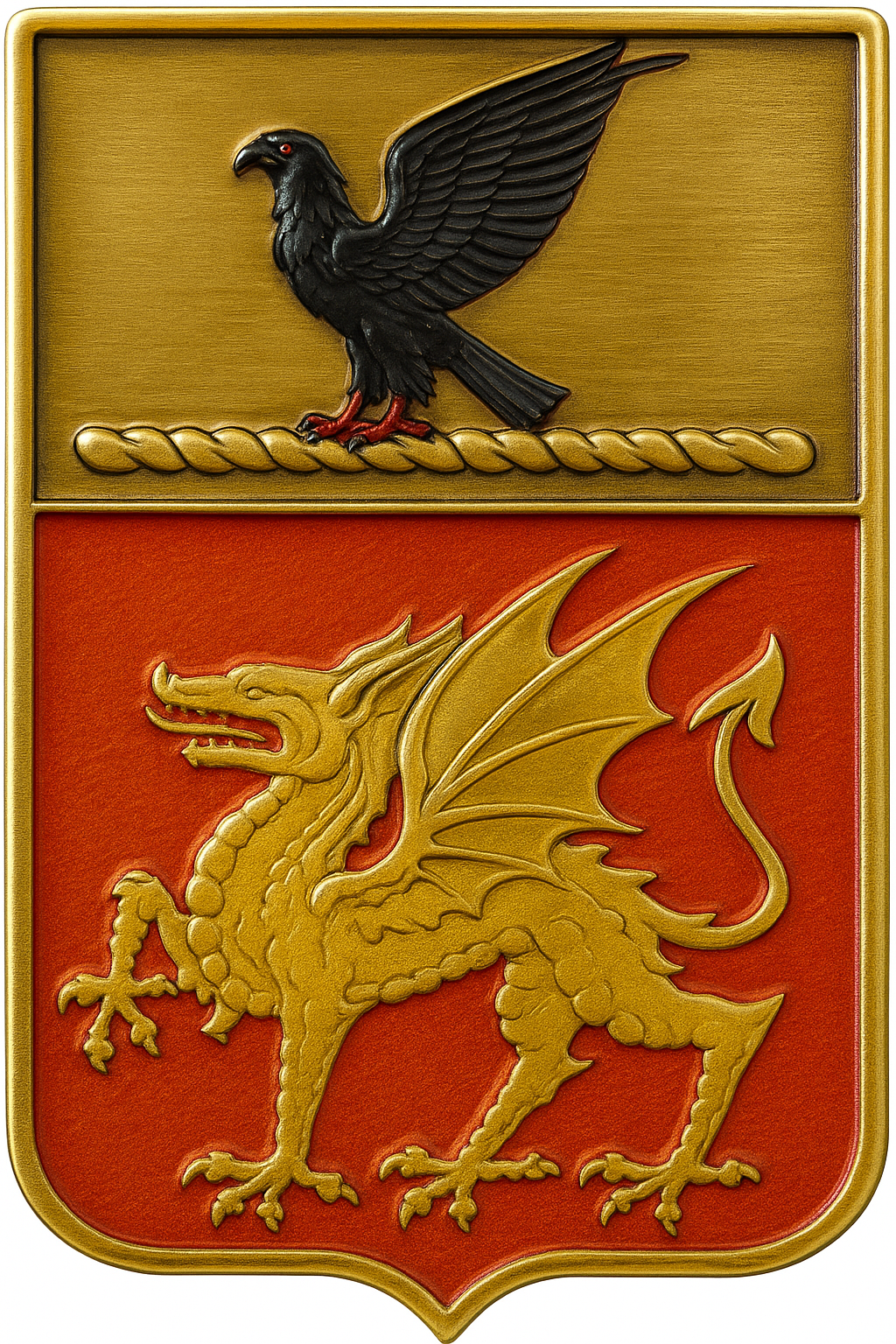
One of the primary roles of Jefferson Barracks in its early years was to serve as a training and staging ground for military operations against Native American tribes and other threats to U.S. territorial interests. The barracks housed the First Dragoons, the U.S. Army’s first regiment of mounted troops, created by the “Act for the More Perfect Defense of the Frontier” of March 2, 1833 (Banta, 1981, p. 109). The soldiers stationed at Jefferson Barracks were regularly dispatched to various parts of the country to participate in military actions, including the Black Hawk War of 1832 and the Second Seminole War in Florida (Banta, 1981, pp. 55, 146).
In addition to its military role, Jefferson Barracks contributed to the economic development of the St. Louis region. The barracks provided employment for local civilians, and area farmers benefited from contracts to supply food and materials to the garrison (Banta, 1981, p. 320). This economic relationship between the barracks and the surrounding community helped to strengthen the post’s position as a regional asset.
Mexican-American War
Jefferson Barracks gained further prominence during the Mexican‑American War (1846–1848). In the summer of 1846 it became the headquarters of the Army’s Western Division, when Brevet Brigadier General George M. Brooke moved to the post and assumed that command (Banta, 1981, pp. 146, 174). Through the war the Barracks served as a mustering, staging, and supply point for troops and officers moving to and from the theater — among them Lieutenant Joseph LaMotte, transferred to St. Louis in 1846 to recover from wounds received at the Battle of Monterrey (Banta, 1981, p. 183).
The post’s ties to the war ran personal as well as institutional. General Stephen Watts Kearny — the same officer who had established the Barracks as “Camp Miller” twenty years before — returned there in June 1848 to recover from the yellow fever he had contracted while stationed at Vera Cruz, and died in St. Louis that October (Banta, 1981, p. 198).
Post-War Period and Expansion
Following the Mexican‑American War, Jefferson Barracks continued to function as an important military post. The post was expanded during the 1850s to accommodate additional troops and to improve its facilities. One of the major improvements during this period was the construction of the St. Louis and Iron Mountain Railroad, which linked Jefferson Barracks with other parts of the country and made it easier to transport troops and supplies (Banta, 1981, p. 248).
Through these years the Barracks continued to garrison and forward troops for service on the western frontier. The clearest example came in 1857, when elements of the Fifth Infantry were assembled at Jefferson Barracks before marching for Utah Territory as part of the Utah (Mormon) Expedition (Banta, 1981, pp. 295–298).
Decline and Legacy
By 1860 — where Banta’s study closes — Jefferson Barracks had begun to yield primacy to newer posts farther west, even as it remained an active and important installation (Banta, 1981). What came after — its long service through the Civil War and beyond — lies outside the scope of that history; the post’s own monthly returns carry the record forward (National Archives Microfilm Publication M617, Roll 547, 1852–1869).
The legacy of Jefferson Barracks as a key military post in the early history of the United States is significant. Its role in training soldiers, providing logistical support for military operations, and contributing to the economic development of the St. Louis region marked it as one of the most important military installations of the period (Banta, 1981). Jefferson Barracks’ contribution to U.S. expansion and its ability to project military power across the western frontier made it a cornerstone of American military strategy during its early years.
Final Thoughts
From its establishment in 1826 to its decline in importance by the Civil War, Jefferson Barracks played a central role in the military history of the United States. Its strategic location, its function as a training and supply center, and its involvement in key military operations all contributed to its historical significance. Though often overshadowed by other military installations of the era, Jefferson Barracks was a critical component of the U.S. Army’s ability to maintain control over the rapidly expanding western frontier and to project military power in conflicts such as the Mexican‑American War. Its legacy endures as a testament to the importance of military infrastructure in the development of the United States during the 19th century.
References
Banta, B. B., Jr. (1981). A History of Jefferson Barracks, 1826–1860 [Doctoral dissertation, Louisiana State University]. LSU Scholarly Repository. https://repository.lsu.edu/gradschool_disstheses/3626
Historical information relating to Jefferson Barracks [Register entries, pp. 102, 108]. Historical Information Relating to Military Posts and Other Installations, 1700–1900 (National Archives Microfilm Publication M661, Roll 4). Record Group 64, Records of the National Archives and Records Administration. National Archives Catalog. https://catalog.archives.gov/id/651230581
Jefferson Barracks post return, July 1826 [Return No. 1]. Returns from U.S. Military Posts, 1800–1916 (National Archives Microfilm Publication M617, Roll 545). Record Group 94, Records of the Adjutant General’s Office. Digital images, FamilySearch (film 008407386).
Views: 572
Explore the evidence
View this article’s connected sources and media →
About this page
This article was brought over from AlfredGibbs.com. Its preserved text, media and citations remain available for comparison.