
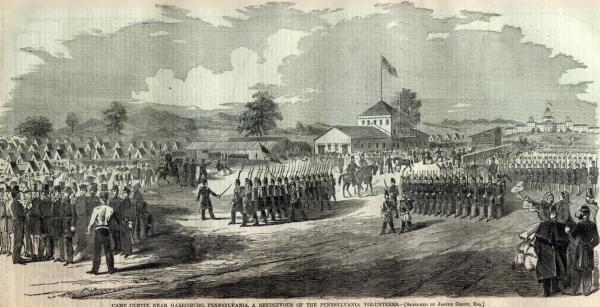
Nestled in the northern section of Harrisburg, Pennsylvania, Camp Curtin was much more than just a military training ground during the Civil War. From 1861 to 1865, it became the largest Union Army camp, playing a pivotal role in the mobilization, training, and deployment of hundreds of thousands of soldiers. In addition to being a significant historical site during the Civil War, it laid the foundation for what is now a thriving neighborhood in Harrisburg, rich in history and heritage. This article explores the history of Camp Curtin, its key contributions to the Civil War, and the legacy it left behind in the Camp Curtin neighborhood.
The Founding of Camp Curtin
The creation of Camp Curtin was born out of necessity. Following the bombardment and surrender of Fort Sumter on April 14, 1861, President Abraham Lincoln issued a call for 75,000 volunteers to defend the Union. Pennsylvania’s governor at the time, Andrew Curtin, was a fervent supporter of the Union cause and immediately mobilized Pennsylvania’s citizens to answer Lincoln’s call. Harrisburg, being the capital of Pennsylvania and situated at a major crossroads of key railroads, became an ideal location for a large military camp to process the thousands of soldiers responding to this urgent call.
Governor Curtin, recognizing the strategic importance of Harrisburg, instructed Brigadier General Edward Williams of the state militia to establish a military camp on the grounds of the Dauphin County Agricultural Society, just north of Harrisburg’s main city limits. Officially opened on April 18, 1861, and named Camp Curtin in honor of Governor Curtin, the camp quickly grew in size and scope, eventually processing over 300,000 Union soldiers throughout the course of the Civil War.
A Hub of Activity
From the moment Camp Curtin was established, it became a hub of military activity. Soldiers from Pennsylvania were the first to arrive, but they were soon followed by troops from other states, including Maryland, Michigan, Minnesota, New Jersey, New York, Ohio, and Wisconsin. Its location at the intersection of major railroad lines made Camp Curtin a critical point for moving troops and supplies quickly to the front lines, particularly to Washington, D.C., and other key battle sites.
In addition to training soldiers, Camp Curtin also served multiple other purposes during the war:
- Supply Depot: The camp stored and distributed vital supplies for Union troops, including weapons, ammunition, food, and medical supplies.
- Hospital: Injured soldiers were treated in makeshift hospitals at the camp before being transported to larger medical facilities.
- Prisoner of War Camp: Confederate prisoners of war were temporarily housed at Camp Curtin before being sent to more permanent prison camps.
The importance of Camp Curtin was underscored during two major Confederate campaigns—the Antietam Campaign of 1862 and the Gettysburg Campaign of 1863—when Confederate forces attempted to threaten Harrisburg. Although the city was never captured, Camp Curtin’s strategic role in fortifying the region and preparing Union troops for battle was vital in preventing Confederate advances into Pennsylvania.
Camp Curtin’s Impact on Harrisburg
As the war dragged on, Camp Curtin’s presence had a profound impact on the local economy and the daily lives of Harrisburg’s residents. The influx of soldiers brought economic benefits, as businesses supplied goods and services to the Union Army. However, the camp also brought challenges, including overcrowding, shortages of resources, and occasional tensions between soldiers and residents.
After the Battle of Gettysburg in July 1863, Camp Curtin’s importance grew even further as it became a major muster-out point for troops returning home. Soldiers who had completed their service passed through the camp, where they were officially discharged before returning to civilian life. This process continued even after the war ended, with Camp Curtin officially closing its doors on November 11, 1865.
The Post-War Years and the Development of the Camp Curtin Neighborhood
Following the closure of Camp Curtin, the land returned to its pre-war use as farmland. However, it wasn’t long before Harrisburg’s rapid urban growth began to transform the area. In the decades following the Civil War, the once-sprawling military camp became a vibrant residential neighborhood. Streets were laid out, homes were built, and businesses began to move into the area, changing the landscape entirely.
One of the most significant developments during this period was the construction of the Camp Curtin Memorial Methodist Episcopal Church in 1890. Erected on part of the original campgrounds, the church served as a monument to the soldiers who had trained at Camp Curtin. By 1895, a larger facility replaced the original church after a fire, and by 1915, the church had expanded to include a gymnasium, library, and other community services. It became a social center for the neighborhood, welcoming all residents regardless of religious affiliation.
The Camp Curtin Fire Station, built between 1910 and 1911, further marked the neighborhood’s development. This building, along with the church, became landmarks in the community and were later listed on the National Register of Historic Places.
Preserving the Legacy of Camp Curtin
In the 20th and 21st centuries, efforts to preserve the legacy of Camp Curtin intensified. The Camp Curtin neighborhood remained an integral part of Harrisburg, and its historical significance was increasingly recognized. In 1920, a statue of Andrew Curtin was erected in front of the Camp Curtin Memorial Church to honor the Pennsylvania governor’s critical role in supporting the Union Army during the war.
Throughout the 1970s, more facilities and services were added to the neighborhood, including the Camp Curtin Community Park and the Camp Curtin Early Childhood Center, both of which provided recreational and educational opportunities for residents.
In more recent years, the neighborhood has continued to foster a sense of community pride, thanks in part to the formation of the Camp Curtin Community Neighborhood United (CCCNU) project. Established in the early 2010s, this initiative aimed to bring residents and business owners together to work on community revitalization and public safety efforts. Under the leadership of civic leaders like the Rev. Willie Dixon and Joyce V. Gamble, CCCNU formed working groups focused on improving educational opportunities, combating blight, and reducing crime. These efforts have helped strengthen the neighborhood and celebrate its historical roots.
The Camp Curtin Historical Society
A significant player in preserving the memory of Camp Curtin is the Camp Curtin Historical Society. Founded to honor the history of the camp and the soldiers who trained there, the organization works to promote Harrisburg’s rich Civil War history. The society has spearheaded efforts to install historical markers around the area, which help educate visitors and locals about the critical role that Camp Curtin played during the war.
In 2019, the Camp Curtin Historical Society re-dedicated the restored 17th Pennsylvania Cavalry Monument, further cementing the neighborhood’s connection to Civil War history. The society also offers educational programs, public events, and publications that focus on the broader Civil War context as well as Harrisburg’s specific contributions to the Union cause.
A Final Thought: A Lasting Legacy
The story of Camp Curtin is one of transformation; from a key Civil War military installation to a bustling neighborhood in modern Harrisburg. Over 300,000 Union soldiers passed through the camp’s gates, making it the largest of its kind during the war. Today, the legacy of Camp Curtin lives on through the neighborhood that bears its name, the memorials that have been erected in honor of its history, and the ongoing efforts of the Camp Curtin Historical Society to preserve the memory of this important chapter in American history.
While the physical landscape of Camp Curtin has changed dramatically over the last 150 years, the neighborhood remains a testament to the important role Harrisburg played in the Civil War and the efforts of its citizens to preserve that history for future generations.
Views: 103
Explore the evidence
View this article’s connected sources and media →
About this page
This article was brought over from AlfredGibbs.com. Its preserved text, media and citations remain available for comparison.