
The Pattern 1853 Enfield was the 130th New York’s own first weapon. Bowen records the regiment drawing its Enfields at Elmira in 1862 (ch. I), and carrying them until the 1863 cavalry conversion, when the men “exchanged everything pertaining to infantry, our Enfield rifles, together with all accouterments and clothing, for the carbine, saber, and revolver” (the conversion, documented).
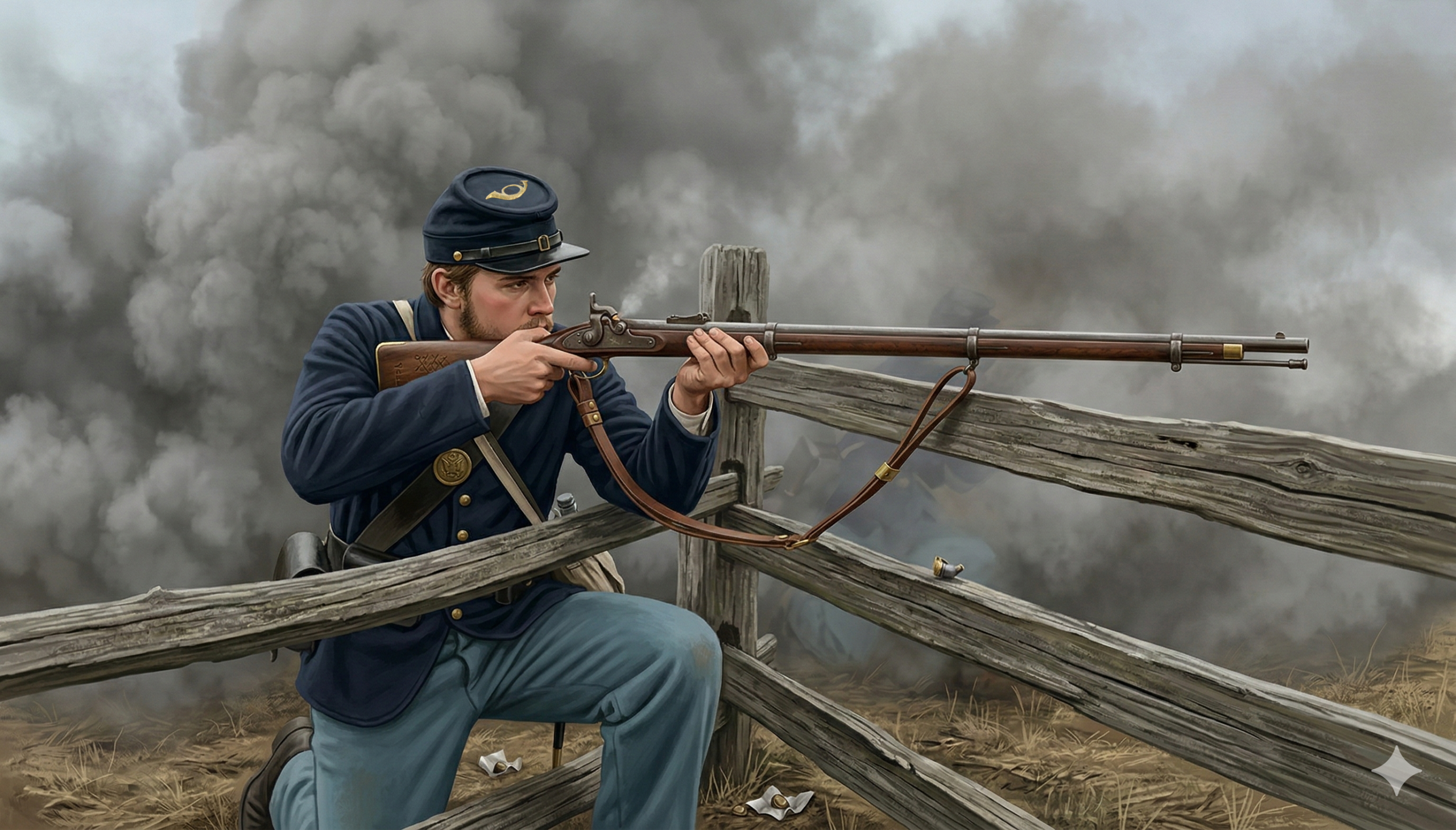
Table of Contents
Introduction
The Pattern 1853 Enfield rifle-musket stands as one of the most significant firearms of the mid-19th century. Manufactured at the Royal Small Arms Factory in Enfield Lock, England, it became the British Empire’s standard-issue rifle and was extensively used worldwide. Its advanced design, featuring rifling and the use of the Minié ball, marked a pivotal evolution in military small arms technology. Notably, the Enfield played a crucial role in the American Civil War (1861–1865), becoming one of the most widely used rifles by both Union and Confederate forces. This report delves into the development, design, specifications, and historical impact of the Pattern 1853 Enfield, with a particular focus on its role in the American Civil War.
Development and Design
Historical Context
Prior to the 1850s, military forces predominantly used smoothbore muskets like the Brown Bess. These firearms lacked accuracy beyond 100 yards due to the absence of rifling, which stabilizes the bullet’s flight. The Crimean War (1853–1856) highlighted the need for more accurate and longer-range firearms, as battles increasingly involved engagements at extended distances. The introduction of rifling technology and the Minié ball—a conical bullet that expanded upon firing to engage the rifling grooves—revolutionized firearm accuracy and range.
Design Features
Caliber: The Enfield was chambered for a .577-inch (14.7 mm) Minié ball, striking a balance between stopping power and manageable recoil.
Barrel: It featured a 39-inch (991 mm) barrel with three-groove rifling and a twist rate of 1 turn in 78 inches. This design enhanced projectile stability and accuracy, allowing soldiers to engage targets effectively at greater distances.
Sights: Equipped with adjustable rear sights, including a ladder sight graduated up to 1,250 yards (1,143 meters). This allowed for precise aiming at varying distances, a significant improvement over fixed-sight muskets.
Firing Mechanism: Utilized a percussion lock system, which was more reliable and less susceptible to weather conditions compared to flintlock mechanisms. The percussion cap ignited the gunpowder charge more consistently, improving firing rates and reliability.
Stock and Furniture: Constructed from high-quality walnut wood, offering durability and a comfortable grip. Brass fittings provided additional strength and aesthetic appeal.
Bayonet Compatibility: Designed to accept a 17-inch (432 mm) triangular socket bayonet, extending the rifle’s utility in close combat situations.
Specifications
Overall Length: Approximately 55 inches (1,397 mm)
Weight: Around 9.5 pounds (4.3 kg)
Muzzle Velocity: Approximately 900 feet per second (274 meters per second)
Effective Range: Effective up to 600 yards (549 meters); maximum range exceeding 1,200 yards (1,097 meters)
Rate of Fire: Skilled soldiers could fire two to three aimed shots per minute
Ammunition: Used paper cartridges containing the Minié ball and a measured gunpowder charge
Production and Distribution
The Royal Small Arms Factory in Enfield Lock began mass production of the rifle in 1853. To meet high demand, contracts were also awarded to private manufacturers in Britain and abroad. The standardization of parts facilitated large-scale production and easier maintenance in the field.
Usage in Conflicts
Crimean War (1853–1856)
Although introduced during the Crimean War, the Enfield saw limited action due to its late arrival. However, its superior range and accuracy compared to Russian smoothbore muskets were noted by British forces, influencing future military strategies and firearm development.
Indian Rebellion of 1857
The Enfield rifle-musket played a controversial role in the Indian Rebellion. The cartridges were rumored to be greased with cow and pig fat, offending Hindu and Muslim soldiers (sepoys) who had to bite the cartridges open to load the rifle. This religious offense contributed to widespread unrest and was a significant catalyst for the rebellion. The incident underscored the importance of cultural sensitivity in military practices.
American Civil War (1861–1865)
The Pattern 1853 Enfield was extensively used by both Union and Confederate forces during the American Civil War.
Background
At the war’s outset, both sides faced a shortage of standard-issue rifles. The industrial capacity of the United States, particularly in the Confederacy, was insufficient to meet the sudden demand for military firearms. European arms manufacturers, especially in Britain, filled this gap.
Confederate Use
Imports: The Confederacy imported large quantities of Enfield rifles through blockade runners. Estimates suggest that between 300,000 to 400,000 Enfields were brought into the Confederacy during the war.
Advantages: The Enfield’s reliability and accuracy made it highly valued among Confederate soldiers. It became the second most widely used rifle after the Springfield Model 1861.
Regimental Adoption: Many Confederate regiments, particularly those from Virginia and North Carolina, were equipped with Enfields, enhancing their combat effectiveness.
Union Use
Supplementing Supplies: While the Union had greater industrial capabilities, they also imported Enfields to supplement their armories. Approximately 500,000 Enfields were purchased by the Union during the war.
Distribution: Enfields were issued to various regiments, including those in the Western theaters where supply lines were stretched.
Impact on Tactics
Increased Engagement Range: The effective range of the Enfield allowed infantry engagements at distances previously unattainable, changing battlefield tactics.
Sharpshooting Units: Both sides formed specialized units of sharpshooters who utilized the Enfield’s accuracy to target enemy officers and artillery crews.
Standardization Challenges: The widespread use of Enfields helped mitigate issues arising from the variety of firearms in use, as ammunition and maintenance practices could be more uniformly applied.
Other Conflicts
The Enfield saw service in various colonial wars and was used by forces in Canada, Australia, and New Zealand. Its reliability and effectiveness made it a preferred choice in diverse combat situations.
Impact and Legacy
Technological Advancements
Rifling and Minié Ball: The combination of rifled barrels and the Minié ball significantly improved the accuracy and range of infantry firearms, setting a new standard for military rifles.
Percussion Cap System: The reliable percussion lock mechanism influenced the design of future firearms, phasing out the flintlock system.
Influence on Military Tactics
Extended Engagement Distances: The Enfield’s effective range led to changes in infantry tactics, including the use of extended skirmish lines and cover.
Reduction of Massed Formations: The increased lethality at range made traditional massed formations vulnerable, prompting a shift towards trench warfare and dispersed troop movements.
Cultural and Historical Significance
Catalyst for Rebellion: In India, the Enfield became a symbol of colonial insensitivity, contributing to the Indian Rebellion of 1857.
Symbol in the American Civil War: The rifle is emblematic of the international dimensions of the Civil War, illustrating how global trade impacted the conflict.
Collectibility: Today, the Enfield rifle-musket is a sought-after collector’s item and holds a place of honor in military museums worldwide.
Evolution of Military Firearms
Successor Models: The Enfield’s design influenced subsequent British rifles, including the Snider-Enfield and Martini-Henry, which incorporated breech-loading mechanisms and metallic cartridges.
Global Influence: The principles demonstrated by the Enfield’s success were adopted by other nations, accelerating the global shift towards rifled firearms.
Final Thouhts
The Pattern 1853 Enfield rifle-musket was more than just a firearm; it was a technological marvel of its time that left a lasting impact on military history. Its advanced design improved the effectiveness of infantry units and reshaped battlefield tactics. The rifle’s extensive use in the American Civil War underscores its importance and the interconnectedness of 19th-century global affairs. The Enfield not only altered the course of military engagements but also played a role in significant historical events, such as the Indian Rebellion of 1857. Its legacy is evident in the evolution of military small arms and its enduring presence in historical discourse.
References
Books:
- British Military Long Arms 1815-1865 by D.W. Bailey
- The English Connection by Pritchard and Huey
- Small Arms of the World by W.H.B. Smith
- The Civil War: A Narrative by Shelby Foote
- Arming the Sultans: European Arms Trade and Gunpowder Empires by N.R. Farooqi
Articles and Journals:
- “The Impact of the Rifle-Musket in the Civil War” – The Journal of Military History
- “Importing Arms: The Role of European Weapons in the American Civil War” – Civil War Times
Websites:
- Royal Armouries Museum [https://royalarmouries.org]
- National Park Service – Civil War Weapons [https://www.nps.gov]
Views: 1089
Explore the evidence
View this article’s connected sources and media →
About this page
This article was brought over from AlfredGibbs.com. Its preserved text, media and citations remain available for comparison.