
Update, July 14, 2026: a transcription gap in this chapter dropped the words “First New York Dragoons, Sixth Pennsylvania Cavalry,” from Bowen’s list of the Reserve Brigade’s regiments (p. 104 of the original). The line has been restored against the book.
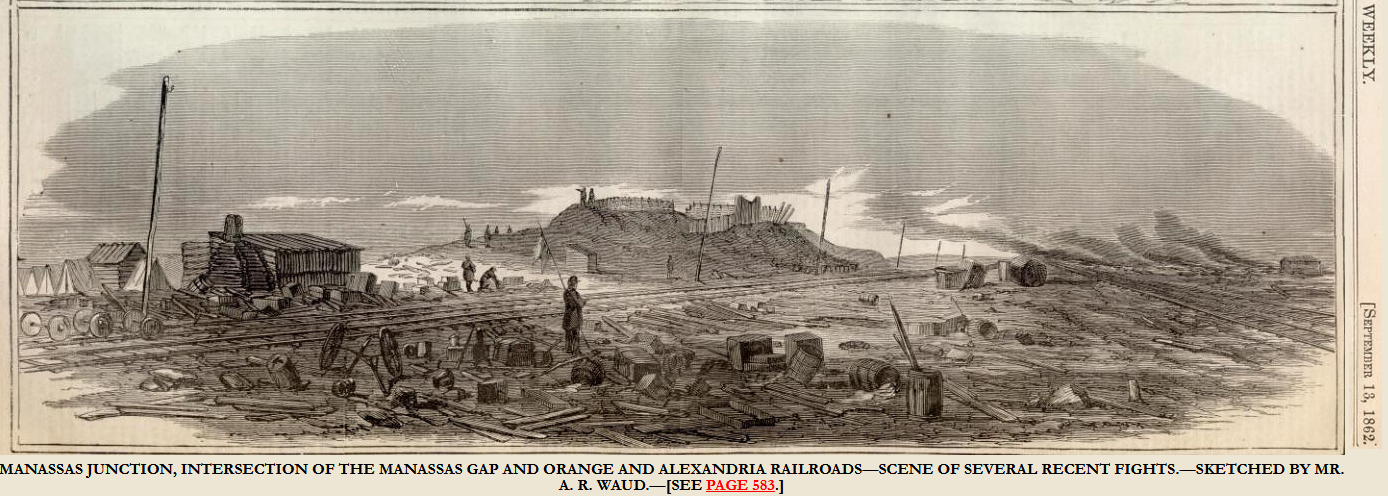
Our first camp at Manassas was in a grove about a mile from the Junction. The location had its advantages, and disadvantages as well. One of its disadvantages was its isolated and exposed condition, and it is remarkable that we suffered no worse than we did from the predatory excursions of Mosby’s guerrillas and dashing raids of rebel cavalry, who we learned from rebel reports, had planned our capture. Every man, woman, and child thereabouts was either a spy or a guerrilla. 1

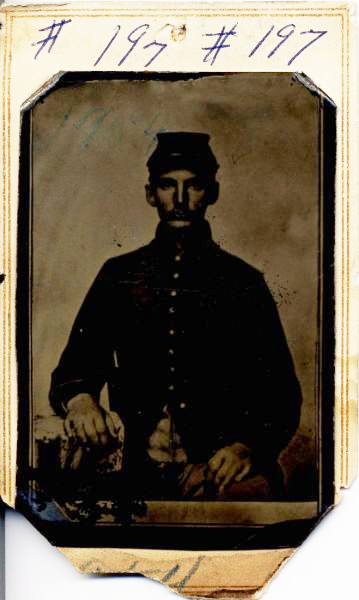
After a day or two spent in getting settled in camp and establishing picket lines, the work of drilling in cavalry tactics began. Colonel Gibbs was now in his element. During our year of infantry service he had brought his regiment up to as high a condition of perfection as possible to be attained in that length of time. Now his ambition was to make it equally proficient as a cavalry organization, and to this end he bent all his energies. His twenty years of service as a cavalry officer had eminently fitted him for the work he so enthusiastically and successfully carried forward. The most devoted father could scarcely have taken more pride and interest in the welfare and advancement of his sons than did our colonel in the perfecting of his regiment.
Our drill exercise was far from being boy-play; on the contrary, it was a severe tax upon both our physical and our mental energies. Often eight hours a day would be given to it, while nightly recitations from the tactics were
Often eight hours a day would be given to it, while nightly recitations from the tactics were required of officers and non-commissioned officers alike.
required of officers and non-commissioned officers alike. The drill was also more varied and comprehensive than that of the infantry. We had not only to familiarize ourselves with the various evolutions performed on foot, or dismounted, but were expected to become even more proficient in all the maneuverings required of ‘the trooper mounted.” Our practice being progressive, new features were introduced at nearly every drill.
The saber being an important weapon in this branch of the service, much attention was given to perfecting the men in its use, and we acquired considerable proficiency in executing the commands as given. We became familiar with the,“ left moulinet” and ‘right moulinet,” until our ‘wrists were almost twisted out of joint. With an imaginary enemy before us, we vigorously executed the ‘right cut,” ‘left cut,” ‘front cut,” and ‘‘rear cut ” against both infantry and cavalry; also the right, left, front, and rear “points,” or ‘‘thrusts.” Then there were the ‘parry ” movements, and numerous others liable to be brouglit into use in combat with a real enemy.
Then we were thoroughly trained in all that pertained to the use and management of our horses. Most of us had a lingering idea that we knew about all necessary to be known on the subject; but all who had plumed themselves on the possession of such knowledge, soon had the conceit taken out of them.
Most of the farmer boys thought that to mount a horse was to climb on its back in any manner that suited their notion; but after we had been given lessons by the hour in mounting and dismounting, we began to realize that there was a right way and a wrong way of doing it, and
we had much to learn before becoming expert and skillful as horsemen.
Our country manner of guiding a horse was to use both hands, but we were taught to hold the bridle reins and guide the animal entirely with the left hand, leaving the right free to use the saber or other weapons. We were also instructed how to correctly bridle and saddle the horse; how to properly pack the overcoat, blanket, and other effects for the march.
Another lesson we had to learn was that never, under any circumstances, were we to control the horse by speaking to him; this must always be done by bit and spur. No ‘¢Get up,” “*‘ go-long,” or clucking to start, or ‘‘ Whoa,’ to stop, was allowed. If the colonel heard anything of the kind, he would savagely yell to the culprit, ‘‘ Here, you old market woman, stop that.” At first some flopped their elbows when riding on the trot, but one calling down by the colonel was usually enough. The elbowfloppers were dubbed ‘‘ pump-handle lubbers.” At first some were given to circus antics with the horses, but no monkeyism was tolerated. Even a man who thought it cute to ride side-saddle style, had all such notions dispelled by a night in the guardhouse.
Almost daily we had our dress parades, characterized by the same rigid requirements as in infantry; but it was distinctively a cavalry affair. Many of the men had good infantry pants, but they were not admissible; the doubleseated, or re-enforced, cavalry style must be worn.
Our horses reached us September 13, just a month before breaking camp; but it was a month of intense activity, and we made surprising advancement in our | preparation for the mounted service. Though our mounted drills were long and tiresome, they nevertheless had a strange fascination which made them welcome rather than dreaded, and the boys took to the ‘‘critter-back.” service as eagerly as ducks to water.
For a short period after our transfer, the regiment was known as the Nineteenth New York Cavalry, and our mail matter was so directed. But a more distinctive or special designation was desired. Several names were proposed, but the one suggested by Quartermaster Lawrence, and under which the regiment became famous, —‘* First New York Dragoons,” — was adopted, and the same confirmed by the governor of New York. The order announcing this change was read on dress parade October 10. It is noticeable, however, that in the ‘‘ Official Records of the War,” the organization is more frequently designated by its cavalry number, Nineteenth New York.
During our two-months’ sojourn im camp of instruction at Manassas, we were almost incessantly annoyed by the notorious guerrilla, Mosby, and his band of thieving cut-throats, who were always prowling about the outskirts of our camp, like a pack of hungry wolves, ready to pounce upon and capture or kill our men and horses. Notwithstanding our strong picket line and the exercise of vigilance, we suffered from his depredations. ‘If suppressed on one side of the camp, he bobbed up serenely on the other. He was the new version of Paddy’s flea— ‘* Put yer hand where he is, and he ain’t there.”
One morning an officer’s fine horse was missing, and two officers and fifteen men started out to hunt it up. They failed to find the horse, but the alert guerrillas found ¢hem, and swooping down like a hawk upon a flock of chickens, gobbled up five men with their horses, and were off in a jiffy, before our boys could realize what had taken place. The regiment, under Major Scott, started in hot pursuit, but with no success. This was only one of similar instances.
~ One circumstance connected with this last expedition, those present have doubtless never forgotten—the ghastly spectacle we witnessed while passing over the war-swept field of Bull Run. There were the bleaching bones of hundreds that had been slain, and ghastly skulls seemed glaring at us from their so-called graves. I quote in part from the little book, ‘‘ With the First Dragoons in Virginia,” by Lieutenant Lewis, who was with us upon the occasion:—
‘‘Why, the very graves of the dead—if you may call them graves—seemed to have disgorged their silent tenants, and the fleshless- bones of dismembered skeletons were scattered broadcast over the land. Except in the more open and exposed places, the bodies had not been buried at all. Atrocious as this may seem, in a Christian age, and in Puritan America, I grieve to know from my own observation that it is true. About as much dirt as would cover a moderate-sized hill of potatoes marked the only exception of the more favored ones! The others, like Adam, were covered only with leaves. Nothing could mitigate or palliate this most appalling example of abominable neglect.”
Just before breaking camp the writer, as regimental letterer, was instructed to put the following motto upon our banner: ‘‘Semper FParatus” (Always ready), a motto the regiment thereafter retained and never belied.
The following letter, written four days after the battle of Manassas Junction, contains perhaps as full and correct on account of our transactions after taking the field
as now obtainable:— BRISTOL STATION, VA., Oct. 21, 1863. Dear wife ani all friends of cur regiment. We have been so incessantly. on the move that this is my first opportunity to write, and I will now briefly narrate our recent trans-
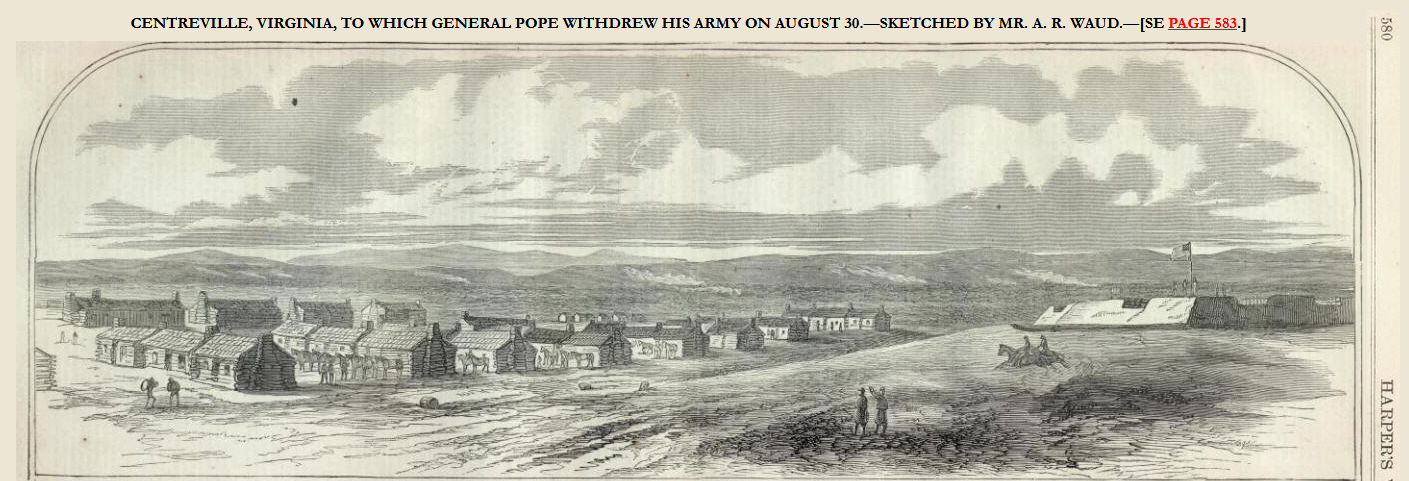
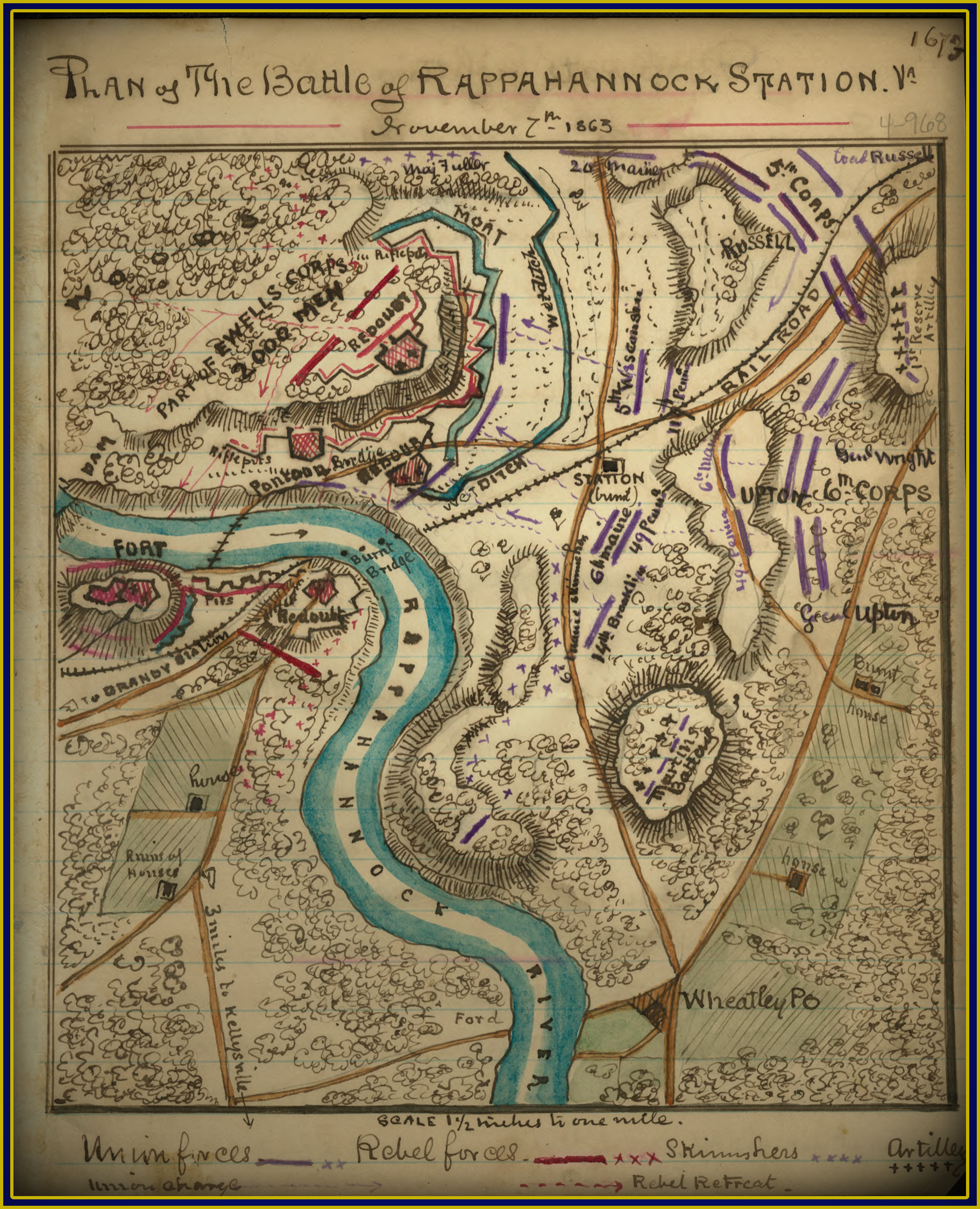
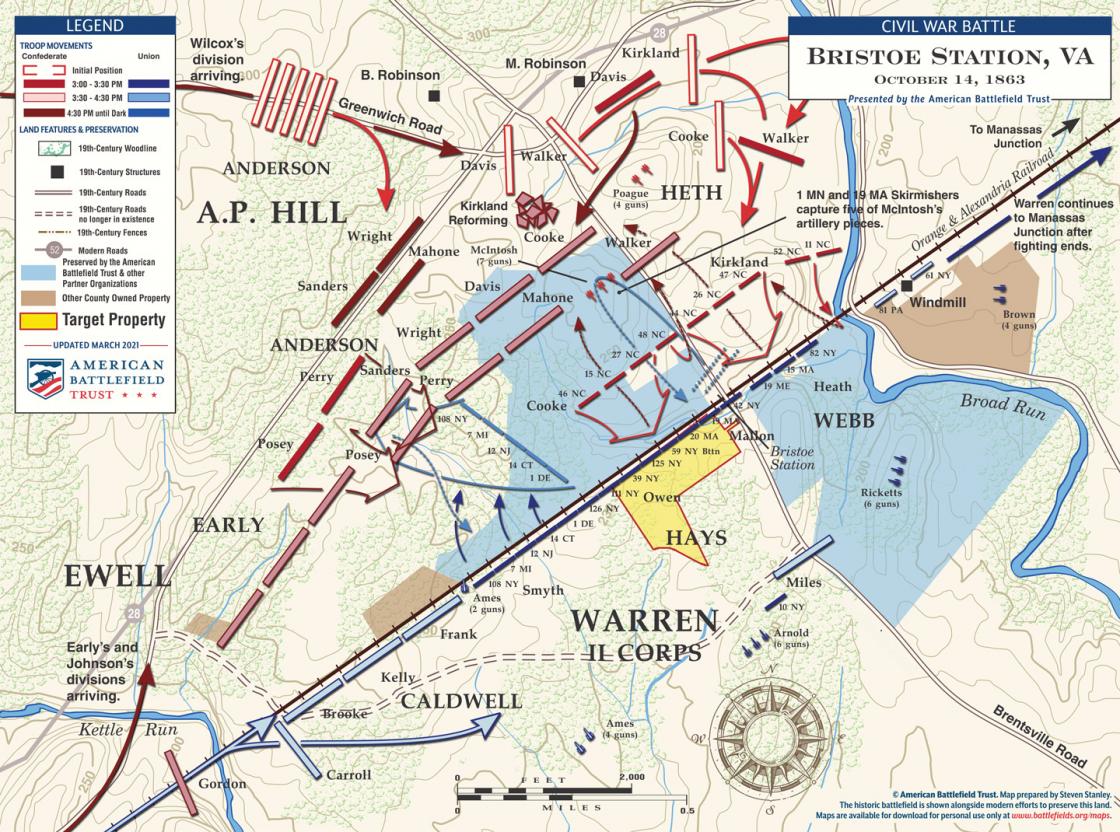
actions. Nine days ago, at midnight of the 13th, we were aroused, and received orders to break camp and be in readiness to move for the front at daylight. However, before proceeding ten miles we met the “front’’ coming to us on the trot; in other words, Meade’s army was in full retreat toward Manassas, closely pursued by Lee, who it appears had outflanked and outgeneraled him; and the two armies were making a desperate race for Centreville Heights, ours coming in ahead. )
Last Wednesday the enemy madea dash at Bristol Station, tocut off Meade’s rear guard, composed of the Second Corps. They had a hard fight, but General Warren thrashed them, capturing a battery and a large number of prisoners. We saw part of the fight, from a distance. Our brigade also turned back to Centreville.
As the vast army passed over our late tramping ground at Manassas Plains, it was the grandest scene I ever witnessed. Line after line of infantry and artillery were moving in parallel columns as far as the eye could reach, all forging ahead as if old Lee was prodding them with a bayonet. Thenthere were thousands of army wagons, sutlers’ outfits, and ambulances, with excited teamsters yelling and cracking their long whips to urge the jaded horses and mules forward.
As for us, we are now fully in the: field, and since breaking camp have been in our saddles from fifteen to twenty hours every day, not stopping two nights in the same place. One night we rode for hours in a terrific storm; in fact, it was a rainstorm and hurricane combined, as we were almost blown off our horses. For three days we have traveled in our water-soaked clothing, but to-day, by sun and fire, we have dried off somewhat. Most of the time we have subsisted on hardtack and raw pork, not having opportunity to cook or make coffee.
Want of time and space preclude details, but our brigade has been off across the Bull Run battle ground toward Thoroughfare Gap, thence back to Centreville, from which place we made a reconnoissance, crossing Bull Run Creek at Blackburn’s ford. Found the enemy in force, and returned to Centreville without an engagement. However, in the afternoon of the following day, the 17th, we moved over the same route, our regiment leading the advance;. and it seems a remarkable coincidence that on the very drill ground where we so recently had received our training and had sportively charged upon imaginary foes, we should meet a real enemy and fight our first cavalry battle, achieving a glorious victory.
After crossing Bull Run we proceeded slowly, with part of Co. I, under Lieutenant Lewis, as advance guard. On reaching the vicinity of our late hospital, the enemy was discovered in line of battle just beyond those forts you! saw when visiting us last month. No sooner did we come within range than they opened upon us with lively volleys, and the bullets flew about us savagely. As the leaden missiles began to whistle and hiss, our green horses commenced dancing and the men dodging, when Colonel Gibbs called out, ‘‘Here, you men, stop that ducking.’’ Lieutenant Lewis and his squad dashed ahead for the first fort, and had started for the next when he was knocked off his horse by a“rebel bullet through the groin. The boys turned back, bringing him off with them, probably fatally wounded, though the doctor says he may possibly pull through.
‘ About this time the rebels began yelling as if about to charge. Though in command of the brigade, Colonel Gibbs kept with us, havigg ordered the two regiments of United States regulars to form in lige with us. The command was given, ‘‘ Forward,— guide right, charge!’’ Our boys set up a tremendous yell, and led by the colonel in person, rushed upon the enemy, causing the line of gray to fall., back, both sides fighting furiously. The rattle and crack of carbines ” was deafening, as volley after volley was delivered by the contending ranks. It was getting pitchy dark, and we could only aim as guided by the flash of their guns. Finally we charged with drawn sabers, cutting and slashing whenever we came upon them, driving them nearly to Bristol Station. We then fell back and held the Junction until re-enforcements came up.
The cowardly regulars, instead of supporting us in the charge, fell back as soon as the firing began, leaving the dragoons to contend all alone with three times their number, while those miserable paltroons went into camp without firing a shot. From what we have seen of these regulars they are a foul-mouthed set of blackguards, and our boys are disgusted at being brigaded with such trash.
Our casualties were three enlisted men killed, and one officer and two men wounded. Sergt. Nathan Bradley, of Co. H, getting misled in the darkness, was captured. Besides these, several received severe injuries from falling horses, and a number of horses were killed. Colonel Gibbs is so proud of his boys, he can hardly contain himself.
1 Mrs. Kneeland and Mrs. Buwen.
It is reported we are to remain here a day or two to guard the laborers in repairing the railroad destroyed by the rebels. All the others are writing home, so that what I have overlooked’ you will get from them. | J. R. B.
P. S. Lieutenant Adams has just detailed me to go as bugler with a squad going to Alexandria with horses, and I will mail this from Washington.
Although thirty-six years have passed since the above letter was written, the writer distinctly recalls an incident in connection with the trip to Washington referred to in the postscript, and as it beautifully illustrates the willingness of soldiers to assist one another it is here given: —
We started out from Manassas with but three days’ rations, which had served us for ten days. Usually the cavalry could subsist by foraging, but we had been over that portion made desolate by war, and could get no food, and were actually almost starved.
There were about one hundred in our detail, and we were hurried off without opportunity to draw rations. Stopping overnight at Fairfax Courthouse, we pushed on for Washington. When about five miles out from Long Bridge we came upon some pickets, who kindly emptied their haversacks to the hungry boys. A sergeant said, ‘‘Bugler, our reserve is about a mile ahead, and it is about dinner time; if you’ll ride ahead and tell them — your condition, they ll feed you.” I stated the facts to the officer in command, who in turn laid the matter before his men. A large kettle of beans were ready to be dished out, but they all said, ‘‘Feed the hungry men first.” Never was a high-toned dinner at Delmonico’s eaten with a keener relish than was this humble repast of pork, beans, soft bread, and coffee by the half-famished troopers. After three cheers for our kind hosts we pushed forward.
After leaving Manassas, October 13, and taking the
field, we were attached to Gen. Wesley Merritt’s brigade (known as the reserve, or regular, brigade), Buford’s division of the cavalry corps, commanded by Maj.-Gen. Alfred Pleasanton. The brigade was composed of the First New York Dragoons, Sixth Pennsylvania Cavalry, and First, Second, and Fifth United States Regulars.
As before intimated, there existed no spirit of con-‘ geniality between the volunteers and regulars of the brigade. From the first they began chafting us at every opportunity, sometimes leading to an exchange of blows, not only with the fist but with the saber. On one occasion a regular deliberately backed his horse against our moving column. One of our boys kicked his horse, when a regular sang out, ‘‘ Gib de bloke a swat in the gob.” As the fellow rode up to do the swatting, he received a fist blow that knocked him off his horse. A year later, while in the valley, the same fellows were marching on a cross road at right angles with the one we were on. We had the right of way, but instead of waiting for us to pass they began shouting, ‘‘ Cut the d—d volunteers in two,” and suiting actions to their words, rode into the center of our column, when a lively clash of sabers took place, our boys coming out decidedly ahead.
It is not deemed advisable to follow in detail all the zigzaggery of our wanderings for the two months or more from October 20 to December 27, at which date we went into winter quarters at Mitchell’s Station. During all that time we were so unceasingly in the saddle that we seldom stayed two nights in the same place. We rode in all sorts of weather and over all kinds of Virginia roads; climbed mountains, crossed rivers, and traveled on highways and byways; did picket and scout duty, guarded trains, chased guerrillas, and hunted bigger game.
Some one once asked a Yankee peddler what he had for sale. ‘‘ Better ax me what I hain’t got,” was his reply. So it will be nearly as easy to tell where we did n’t go, and what we didn’t do, as to tell where we went and what we did.
Though participating in no severe battle we had ‘several sharp skirmishes, and almost daily slight encounters, with enough of the spice of danger to keep us constantly on the gue vive. Often we were for days so far in advance, or within the enemy’s lines, that we knew nothing of what was going on in the Potomac army.
A few extracts from letters and diaries loaned me will complete this chapter: —
BgEa.Lton, Va., Nov. 6, 1863.
We reached here last night, and are to remain long enough to get our horses shod, and give them, as well as their riders, a little rest, having been on the march for a week, with but two or three hours’ rest and sleep out of the twenty-four.
Of late the guerrillas have been very bold and annoying, and our boys are constantly in danger of being captured or shot. Within the last three days we have lost seven men, but some were lost through the bullheadedness of our general, who, like an old fool, persists in sending out safeguards to protect the houses of bushwhackers. Sergeant-Major Allen went out to post a safeguard, less than halfa mile from camp, at the house of a notorious old guerrilla, who showed his appreciation by running him off to the mountain. Pity it hadn’t been the stupid, rebel-sympathizing official who persists in protecting every old reb, even if he loses half his men through their treachery.
CULPEPPER, VA., Nov. 12, 1863.
We left White Sulpur Springs before daylight last Sunday, crossed the Rappahannock, and going south crossed other streams. Our force consisted of three brigades of cavalry under Buford. Nearing Culpepper we found the enemy, who retired before our advance. Suddenly we were startled by heavy volleys of small arms and the roar of artillery. Our advance was attacked, and we were ordered forward at a gallop to their support. We were not
engaged, but sat upon our horses in plain view of the enemy, who commenced pouring the shells about us, cutting trees and tearing up the ground near by. We moved out of their range just as the shells began to fall where we had been standing. Had we remained five minutes longer they would have made havoc with us. Next morning. the dragoons took the advance to Culpepper, and thence to Brandy Station, where we found the Potomac army. Next day we were pushed out on a reconnoissance, going as far as Cedar Mountain, where we remained twenty-four hours.
Meade, stung by the audacious manner in which Lee had outwitted him, decided to make an advance upon the enemy to try and regain lost prestige; so on the 26th of November a general movement was begun. Of course the cavalry took a conspicuous part, but no attempt will here be made to describe the movements of the army. Only one or two incidents will here be given.
We moved in the direction of Ely’s Ford, reaching Stevensburg at one o’clock in the morning. Lieutenant Flint in a recent letter reminds.me of that night’s experience. It was severely cold, and the ground frozen, but we were not only forbidden to build fires, for fear of precipitating an attack, but were not permitted to break ranks or unsaddle. As we held our horses hour after hour in the darkness, we could only keep from freezing by drumming our feet upon the frozen ground.
On the 28th we crossed the Rapidan at Ely’s Ford. A dragoon furnishes this reminiscence, just as he racily described it at the time:—
Evy’s Forp, Nov. 30, 1863.
During the past two days we have crossed and recrossed the Rapidan three times, and are now camped in a nice pine grove near the ford. We have for some days been on half rations, so far as the government is concerned, but are by no means in a starving condition, having put the confiscation act into full force; and, gee whew! how the secesh stores have suffered!
Not far from our bivouac is a rich old planter’s mansion. Fortunately some of our boys got to the house before a safeguard had been placed there. They were met by the typical old Virginian with assurances of great loyalty to the Union, claiming for that reason exemption from disturbance.
‘‘Dat’s all righd, mishter,’’ said our Dutch corporal, Chris, ‘‘but den veel shoost look around a leedle.’’
Everything was satisfactory until we came to a locked closet.
‘*Vat haf you in dair, olt man?’’ inquired Chris.
‘‘O nothing but my wife’s and daughter’s clothing,’’ said he.
‘* Vell, open de toor unt let’s see dair fine fixin’s.’’
But the old man protested.
‘‘Smash’er in, you vellers’’ said the corporal. And in she went; when, lo, a perfect arsenal was revealed—guns, sabers, and revolvers by the score, besides a lot of United States saddles.
‘*See here, olt man, your vimen folks vairs very queer clodings,”’ picking up a gun. ‘‘Dis musht pe von of de olt vooman’s night shurds, unt dis (a revolver) ish von of de gal’s sheemies.’’
The house was a regular guerrilla’s nest, and the old chap the leader. AH the weapons were destroyed, and the oJd chap arrested as 4 guerrilla. Everything now became free plunder; the pantry, cellar, corn-cribs, and barns were stripped. That night the boys feasted on ham and eggs, chickens, honey, home-made bread, cookies, and boiled potatoes, washed down with choice wine and apple-jack.
Meade’s fiasco over, we recrossed the Rapidan December 2, and returned to Culpepper, performing picket and scout duty. The following extract gives a fair sample
of our work:— CULPEPPER, Dec. 9, 1863.
We have had mighty little rest of late. Here’s the way we rest: Sunday we were in the saddle all day, riding not less than fifty miles. We took breakfast before daylight, and got nothing more, except what we ate riding, until nearly midnight. The Major (Scott) remarked: ‘‘ Pretty tough, boys; but we are not out here for our health, or for fun.”’
Although the day was cool and rather disagreeable for riding, we enjoyed the trip exceedingly, as we had such magnificent views of mountain scenery along the Blue Ridge. It was sublime beyond description. We went to Thoroughfare Mountain, and to a shabby
little burg called James City, where we had a regular circus running down and capturing seceshers. Yesterday we returned by the same route, but did not get started until after dark; and when within about five miles from our camp, we were attacked by guerrillas, who came upon the rear guard in one of the worst places on the road. Although they had every advantage, and poured a lively volley into us, not a manor a horse was hurt. Sid Morris and Chet (Bowen) were in the extreme rear, and both returned the fire with good effect, we judge, by the howls of pain they set up.
On the 14th and 15th we had another long and tiresome chase after Mosby, who had run off an infantry wagon and the mules. Starting at sundown we rode rapidly all night, scarcely stopping until we had made nearly forty miles; but nary a Mosby did we get, he having twelve hours the start. As we followed the trail, the tracks became fresher and more distinct until ‘the prize seemed almost within our grasp, when suddenly, as if the earth had opened and swallowed it up, in some inexplicable and mysterious manner all traces were lost. Even Major Scott, who had the sagacity of an Indian, was completely nonplussed.
About the middle of December some sixty or more recruits, of a very good class, came to the regiment. Many of the old boys seized the opportunity to have considerable fun at their expense, and so played all sorts of jokes upon them. Some were put on guard the second day, in the rain, and were told by a joker to go down to that big feller’s tent and get their umbrellas. In his. simplicity, one of them inquired, as he had been told, for ‘‘Alf. Gibbs;” but fortunately an orderly told him it was a joke. The Colonel, however, heard of it, and had ahearty laugh. Some of the younger ones were badly frightened by being taken to the blacksmith to have the ‘‘U. S.” brand put on their backs with a hot iron.
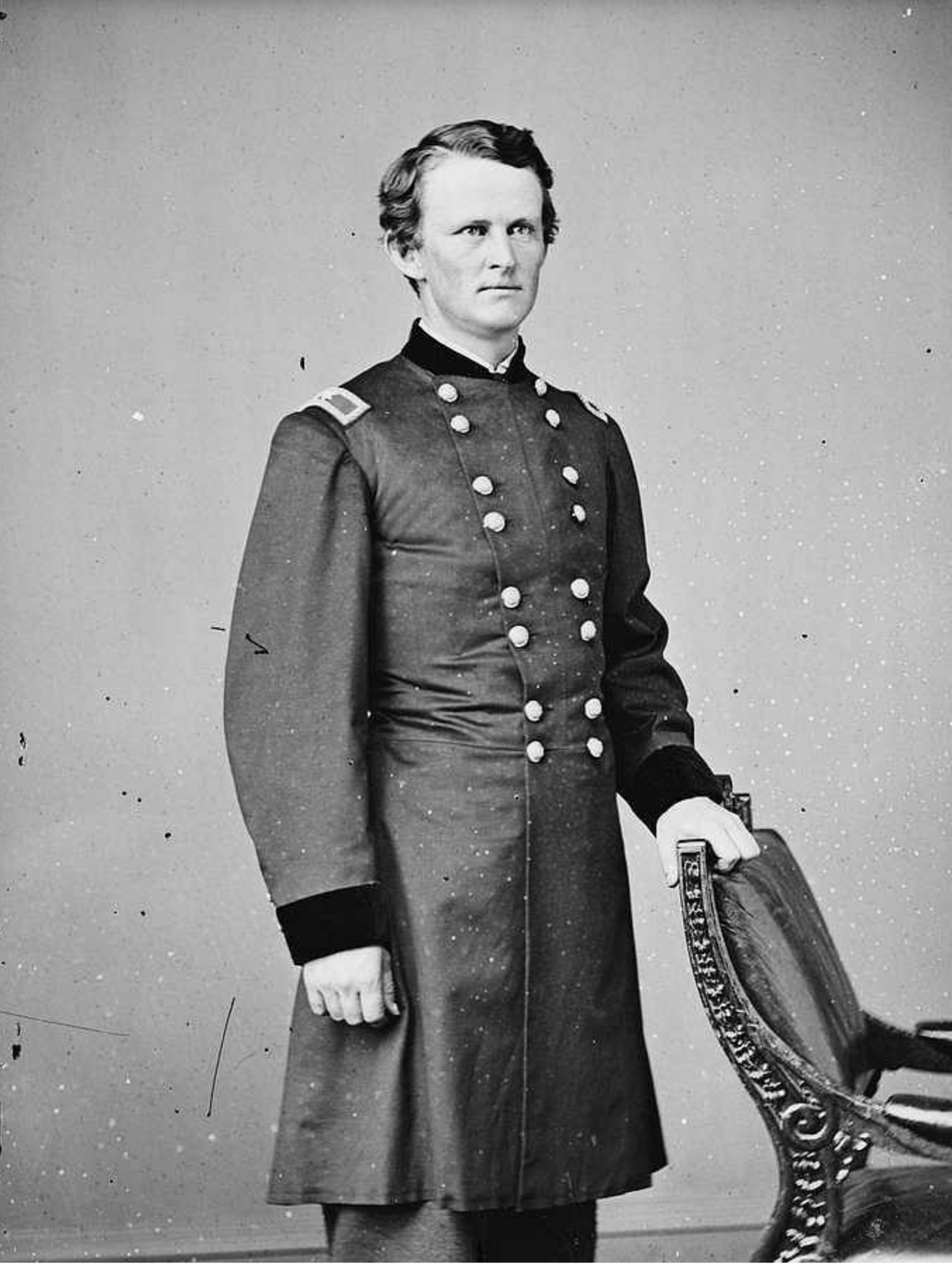
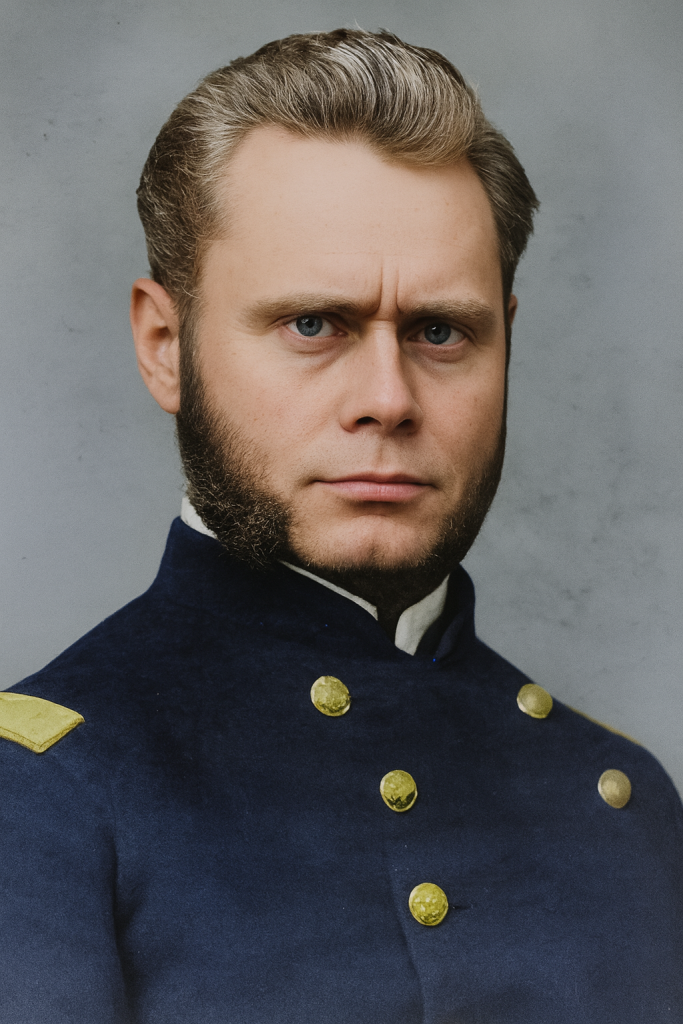
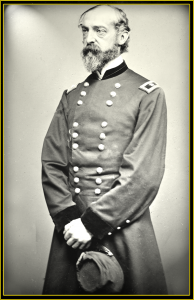
GEN. WESLEY MERRITT GEN. THOMAS C. DEviN
GEN. PHILIP H. SHERIDAN SURGEON BENJAMIN T. KNEELAND All from war-time photographs
Others were required to take some nonsensical oath. But all these ‘‘fresh fish” soon “ caught on” to army ways, and proved good soldiers.
About December 20 we were directed to construct winter quarters near Culpepper, and after a week of hard labor ‘‘ toting” poles and mixing mud, a nicely laid-out log city had arisen for our winter home. But lo, the order came, ‘‘pack up.” To say that there was no grumbling, or even profanity, indulged in, would be such a stretching of the trath that no old soldier would believe the statement.
We were pushed out five miles nearer the front, at Mitchell’s Station, on the Orange & Alexandria R. R., and on the 27th began anew to prepare for winter. What occurred while in winter quarters will be recorded in the next chapter.
Notes
- Text transcribed from James R. Bowen, Regimental History of the First New York Dragoons, Chapter VII. ↑
Views: 52
Explore the evidence
View this article’s connected sources and media →
About this page
This article was brought over from AlfredGibbs.com. Its preserved text, media and citations remain available for comparison.