
Notes and Documents W. G. Freeman’s Report on the Eight Military Department
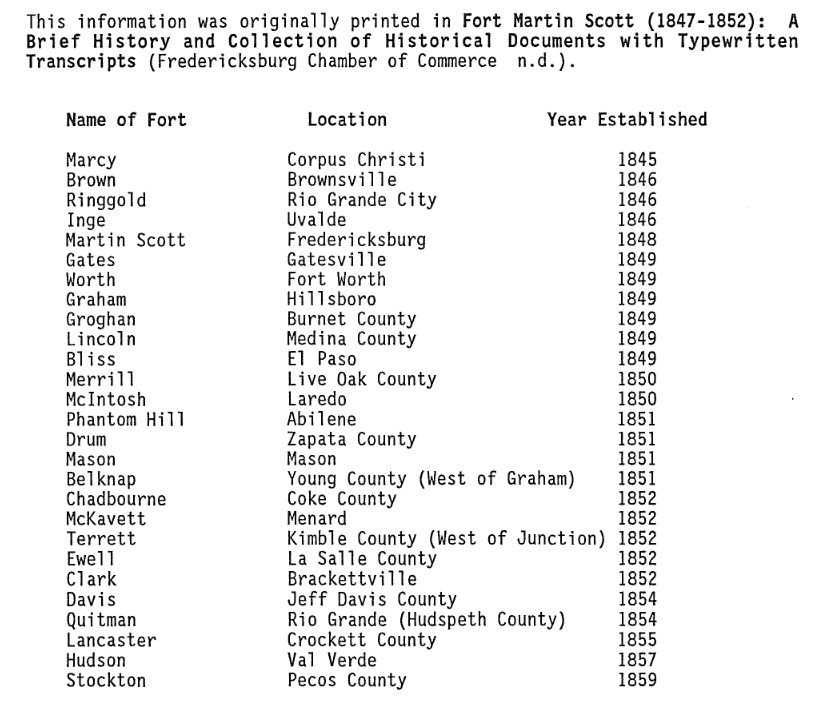
List of Forts
| Name of Fort | Location | Year Established |
|---|---|---|
| Marcy | Corpus Christi | 1845 |
| Brown | Brownsville | 1846 |
| Ringgold | Rio Grande City | 1846 |
| Inge | Uvalde | 1846 |
| Martin Scott | Fredericksburg | 1848 |
| Gates | Gatesville | 1849 |
| Worth | Fort Worth | 1849 |
| Graham | Hillsboro | 1849 |
| Groghan | Burnet County | 1849 |
| Lincoln | Medina County | 1849 |
| Bliss | El Paso | 1849 |
| Merrill | Live Oak County | 1849 |
| McIntosh | Laredo | 1850 |
| Phantom Hill | Abilene | 1851 |
| Drum | Zapata County | 1851 |
| Mason | Mason | 1851 |
| Belknap | Young County (West of Graham) | 1851 |
| Chadbourn | Coke County | 1852 |
| McKavett | Menard | 1852 |
| Terrett | Kimble County (West of Junction) | 1852 |
| Ewell | La Salle County | 1852 |
| Clark | Brackettville | 1852 |
| Davis | Jeff Davis County | 1854 |
| Quitman | Rio Grande (Hudspeth County) | 1854 |
| Lancaster | Crockett County | 1855 |
| Hudson | Val Verde | 1857 |
| Stockton | Pecos County | 1859 |
Notes and Documents W. G. Freeman’s Report on the Eight Military Department Corpus CHRISTI DEPOT- (Inspected June 24 and 25, 1853.)
READ ORIGINAL SOURCE DOCUMENT HERE
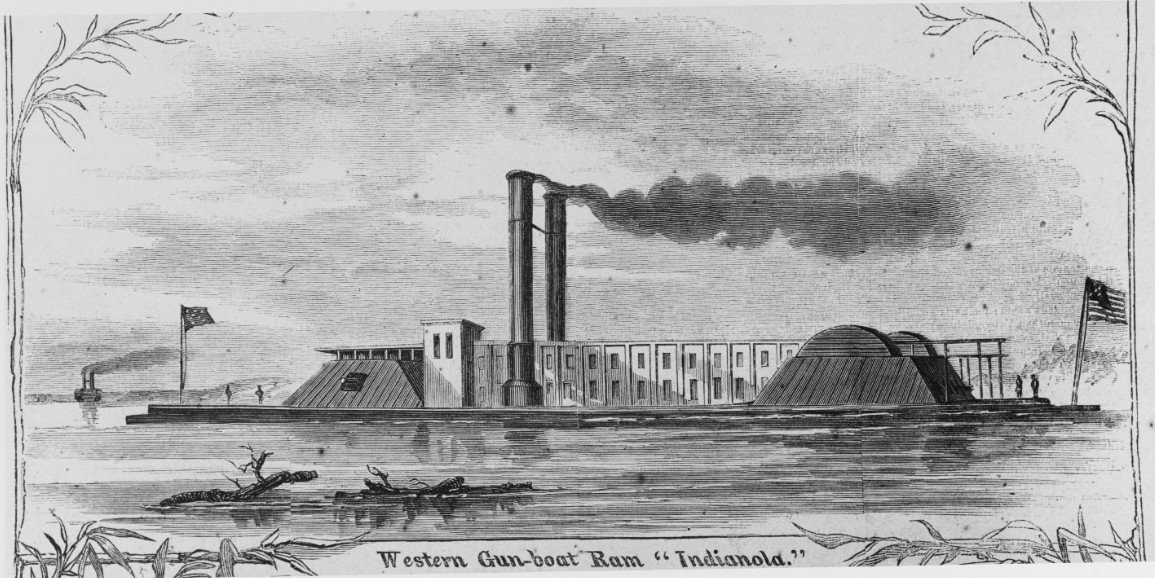
At this place, in addition to its being a depot for Quartermaster’s and Subsistence stores, the Head Quarters of the 8th Department are now established. The town is situated on the bay of the same name, in latitude, about 27° 40′ North, longitude 97° 30′ West. There is a regular mail communication weekly, by steamer from Indianola, with New Orleans, and a mail is sent weekly to the posts on the Rio Grande and to San Antonio.
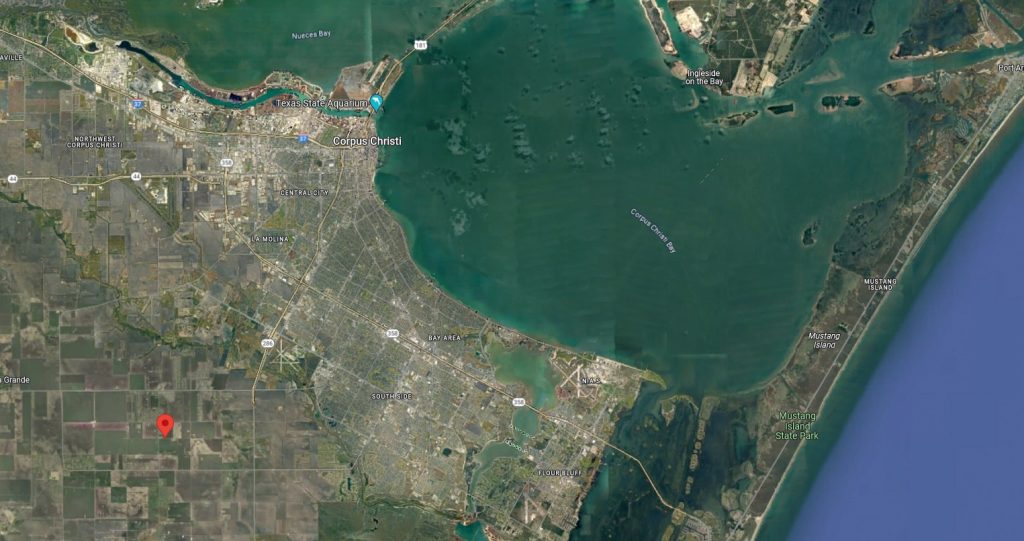
The town is built on a plain, eight or ten feet above high tide, and also on a bluff immediately in rear of the plain, and some forty feet more elevated, and contains, probably, 1,000 inhabitants. The plain which is composed of coarse shell and sand, affording one of the best and most convenient materials for building that can be imagined-is about 3½ miles in length, 2½ miles wide at its northern extremity and one fourth of a mile at its southern. The bay is nearly a circle of about 15 miles diameter, and has two outlets into the Mexican Gulf, the north called “Aransas Pass,” 25 miles distant, and the
south-“Corpus Christi Pass,” 18 miles. Between these two passes lies Mustang Island, 30 miles long, by 2 wide. Accounts vary materially as to the depth of water that can be carried at high tide over the bars of the two passes, but from the best information within my reach
I do not think it would be prudent to risk more than 7½ feet over
Aransas, and 5½ over Corpus Christi bar. I have seen a letter from Bvt. Capt. McClelland 32 of the Engineers, who surveyed this last, in which he says “Government stores should never be sent to Corpus Christi Pass in vessels drawing more than s½ to 6 feet scant-and in no event when it is possible to send them to Aransas, bad as the
latter is.” After getting inside these passes there are intervening flats which prevent vessels of more than 4 feet water coming up to the town. I understand that at an expense trifling in comparison to the advantages to be derived, a channel could be opened giving 7 feet to Corpus Christi.
The chief drawback to Corpus Christi as a residence, is the want of good drinking water, which it is necessary to haul from a distance of many miles for the use of those whose houses are not furnished with cisterns; and even where cisterns are provided, serious inconvenience is frequently experienced from droughts that are often of long continuance. Nothing can exceed the delicious freshness of the atmosphere. The air is almost constantly in motion, a brisk breeze prevailing from the South East with the regularity of a trade wind nearly throughout the entire twenty-four hours. It combines more advantages of position and salubrity for a General Hospital than any other point on the Gulf or Southern Atlantic coast; and I am of opinion that the establishment of such a hospital is called for by the
wants of the service in this Department. I learn that Surgeon Jarvis,33 Medical Director, made a recommendation to this effect in November
last, accompanied by an estimate of the cost of a suitable building, and that these papers were forwarded by General Smith to Washington.
The officers on duty at the Head Quarters of Bvt. Major General Smith, Comdg. the 8th Department, are Bvt. Major D. C. Buell, 34
32George Brinton McClellan graduated from the Military Academy in 1846. He was breveted lieutenant on August 20, 1847, for gallantry at Contreras and Churubusco, promoted to captain September 13, 1847, for gallantry at Chapultcpec, and was made a major general of the Ohio volunteers April 23, 1861. He became a major general of the United States Army on May 14, 1861, and was commander in chief of the army from November 1, 1861, to March u, 1862. He was given formal thanks by Congress July 16, 1861. He resigned his commission on November 8, 1864, and died October 29, 1885. Heitman, Historical Register of the United States Army, I, 656.
Major Surgeon Nathan Jarvis died May 12, 1862. Ibid., 571.
34Don Carlos Buell graduated from the Military Academy in 1841. He was breveted captain for gallantry at Monterrey and major for gallantry at Contreras
Asst. Adjt. Genl., Bvt. Capt. A. Gibbs,35 Mounted Rifles, Aid de Camp, Bvt. Maj. W. W. Chapman,36 Asst. Quartermaster, Capt. W.
B. Blair,87 commissary of Subsistence (now absent on tour of inspection of his Department), Surgeon N. S. Jarvis, Medical Director, Paymaster Henry Hill38 (now absent in New Orleans for funds), and Bvt. Capt. T. G. Rhett, Mounted Rifles, Acting Asst. Commissary of Subsistence.
I examined the records of the Asst. Adjutant General’s Office, and found them in good condition. Major Buell is attentive to his duties, and his books are kept with neatness and system. A like remark is applicable to the office of the Medical Director.
QUARTERMASTER’S DEPARTMENT.
Bvt. Maj. W. W. Chapman39 is the Assistant Quartermaster of the station, but when I made my inspection he was at Galveston, to which place he had been summoned as a witness in a civil suit, his duties being performed during his absence by Bvt. Capt. T. G. Rhett, Mounted Riflemen.
For the transaction of its own business and that of the other branches of the Staff serving at the Corpus Christi Depot, the Quartermaster’s Department rents a large brick building with the premises
and Churubusco. He became brigadier general of Volunteers on May 17, 1861, and major general of Volunteers on March 21, 1862. Ibid., 259.
As Alfred Gibbs graduated from the Military Academy in 1846. He was com missioned colonel in the 130 New York Infantry on September 6, 1862, and brigadier general of Volunteers on October 19, 1864. He was breveted first lieu tenant for gallantry at Cerro Gordo; captain for gallantry at Carita de Belen; major for gallantry at Trevilian Station; lieutenant colonel for gallantry at Winchester; colonel for gallantry at Five Forks; brigadier general March 13, 1865, for gallant service in the field and major general for gallant and meritorious service during the war. Ibid., 452.
36William Chapman graduated from the Military Academy in 1831. He became lieutenant colonel in the 3rd Infantry on February 20, 1862; was breveted major on August 20, 1847, for gallantry at Contreras and Churubusco; lieutenant colonel on September 8, 1847, for gallantry at Molino Del Rey; colonel on August 30, 1862, for gallantry at Bull Run. Ibid., 296.
37Captain William B. Blair graduated from the Military Academy in 1838. He was breveted captain on April 18, 1847, for gallantry at Cerro Gordo. He resigned from the United States Army on June 14, 1861, and served as major in the quartermaster department of the Confederate States Army from 1861 to 1865. Ibid., 222.
38Henry Hill resigned from the United States Army. June 14, 1861. He served as a major in the Quartermaster Department of the Confederate States Army from 1861 to 1865. Ibid., 530.
39William Warren Chapman graduated from the Military Academy in 1837. He was breveted major at Buenavista on February 23, 1847, and died September 27, 1859. Ibid., 296.
attached, at the rate of $180 per month. This building and premises are occupied as Quartermaster’s and Commissary’s storerooms and offices, Paymaster’s Office, Asst. Adjt. Genl.’s Office, Dispensary, Chief Commissary’s (8th Dept.) office, saddler’s shop, wharf and yard. An adjoining house of three rooms is also rented, at $20 per month, and used as a wheelwright’s shop, and quarters and cook house for four teen soldiers employed on extra duty at the Depot. The blacksmith’s shop, owned by the United States, stands on a City lot, and is liable to be removed at any time, besides being at an inconvenient distance from the other buildings.
All supplies for this depot, and for most of the posts dependent on it, are furnished from New Orleans. They are generally sent by sailing vessels to Aransas, subject to lighterage to the depot at the expense of the carrier. Steamers have occasionally brought freight to Aransas, but the liability to detention, owing to a scarcity of lighter age, makes this an expensive mode of conveyance. A Government steamer might, possibly, be employed in this service to advantage if a warehouse were constructed on St. Joseph’s Island [as they did when the Morgan Line was started] as in that case expensive delays, awaiting lighterage, would be avoided.
The supplies forwarded hence to the interior consist principally of subsistence and hospital stores and clothing, Fort Merrill being the only post to which forage is sent. The posts thus supplied are Forts Merrill, Ewell, McIntosh, Duncan and Clark. Thirty-two wagons (six mule teams each) belonging to the depot, aided by the post transportation (viz. Fort Ewell, 10 wagons-McIntosh, 5-Duncan, 11, and Clark, 7) are constantly employed in this service. I have only travelled over limited portions of the roads from Corpus Christi to Forts McIntosh, Duncan and Clark-the roads to Forts Merrill and Ewell have been already described-and my information of the country traversed is derived from others. The road to Fort McIntosh is said to be 140 miles long, and generally good, direction nearly west, water and grazing sufficient, average trip of wagons 7 days. There are two roads to Fort Duncan-one, direct, the other through Fort McIntosh. The latter is that usually travelled, there being no certainty of water on the other. If the route via Fort McIntosh (from which Fort Duncan is distant 110 miles N. N. W.) be followed, the journey occupies 14 days, with a sufficiency of water and grazing for the animals. The direct road is some 205 miles, and the distance can be accomplished in ten days. The road to Fort Clark passes by Fort Duncan, and is fifty-five miles longer, being three days travel for wagons. It is said to be very rough, though practicable. The posts have all been supplied during the present year by the public wagons without calling in the aid of hired transportation.
The citizens employed are one clerk at $85 per month, one wheel wright at $50, one saddler at $45, one blacksmith at $43, one express man at $35, two acting wagon masters at $30 each, thirty-three teamsters at $20 each, two men in charge of stables at $20 each, and three Ambulance drivers at $20 each. One of these ambulances is used by the Department commander, one by the Paymaster of the District (Maj. Hill) in his tours of payment, and the other is now in use by Capt. Blair, Chief Commissary, absent on a tour of inspection of the Subsistence Department in Texas.
A Sergeant and twelve privates drawn from the Infantry companies at Forts McIntosh, Duncan and Clark, are serving on extra duty in this depot. Besides being lost to their companies, the Quartermaster reports that great inconvenience is incurred by the arrangement, it being impossible to preserve with these men the same discipline as at a military post; and consequently the actual service rendered is not in any degree commensurate with the number of the detail. He is of opinion, which my own experience confirms, that a less number of citizens, employed by the Department and liable to be discharged at any moment, on account of misconduct, or for other reasons, would render much more efficient service, and be at least equally economical to the Government.
The only supplies procured by purchase at the depot, are-corn (quantity small and uncertain) at New Orleans price and cost of transportation at time of delivery, average cost 85 cents per bushel hay, $8.50 per ton, and mules from $35 to $50 each.
The established rate of commutation for quarters is $10 per month
per room. The cost of wood is $3.50 per cord.
I received every facility from Mr. Patterson, Clerk to Bvt. Maj. Chapman, to enable me to make a thorough inspection of the Quartermaster’s Department, and I found its affairs, in every branch of the establishment, faithfully and economically administered.
SUBSISTENCE DEPARTMENT.
Capt. W. B. Blair, Chief Commissary of the 8th Dept. was on a tour of inspection, and Bvt. Capt. Rhett, the acting commissary of the Depot, was temporarily discharging his office duties. The Chief Commissary is on the Staff of the Commanding General of the Department and acts under his special instructions and those of the Commissary General of Subsistence. His principal duties appear to be to regulate the quantity of supplies at each post, and to supervise the estimates of expenditures. All estimates for funds are forwarded to his office, and if approved, drafts are then given on the Commissary of Subsistence in New Orleans. The business of the office appeared to be conducted with regularity.
Five posts, viz. Forts Merrill, Ewell, McIntosh, Duncan and Clark, receive their subsistence stores through this depot. Provisions for the first two, are usually shipped from Baltimore; for the other three, and the depot itself, from New Orleans. The issues made by the Asst. Commissary of Subsistence and to quartermaster’s men, soldiers on extra duty in the Quartermaster’s Department, and to detachments, express men, & c. The number varies from 100 to 150 per month. One soldier is employed in the office of the depot Commissary as a clerk. The expenditures are from $75 to·$150 per month. The cost of the ration is 14½ cents. If purchased in the market here (according to the memorandum given me by the Commissary) , its price would be 28 cents. The provisions are securely stored and are generally of good quality. Bvt. Capt. Rhett is an efficient officer, and his books and accounts exhibited accuracy and method.
At the time of my inspection Capt. Rhett was acting both in the Quartermaster’s and Subsistence Departments, and his time was then fully engrossed; but here, as at Indianola and San Antonio, I should not think the duties of depot Commissary would, ordinarily, be sufficient to require the services of a separate officer; and I, therefore, feel bound to recommend (as in Lt. Barton’s case) that they be devolved upon the Asst. Quartermaster of the station, or the Chief Commissary be required to perform them.
PAY DEPARTMENT.
Paymaster Henry Hill, who pays the Rio Grande District-his station being at Corpus Christi-was absent in New Orleans for funds, but his clerk, Mr. Sommerville, was in charge of the office, and exhibited to me the books and accounts. They were regularly kept and appeared to be correct. Maj. Hill subsequently joined me at Fort Brown and availed himself of my escort (on a tour of payment) as far as Fort McIntosh. The Major entered on duty in Texas, March 29, 1851, and has served most of the time on the Rio Grande. His district embraces, at present, eight posts, viz. Corpus Christi, Fort Brown, Camp at Edinburg, Ringgold Barracks, Camp at Redmand’s Ranche, Forts McIntosh, Ewell, and Merrill. In visiting these posts he is required to make a circuit of 66 miles. His quarterly payments amount usually to $30,000.
Views: 19
Explore the evidence
View this article’s connected sources and media →
About this page
This article was brought over from AlfredGibbs.com. Its preserved text, media and citations remain available for comparison.