

George Gibbs to His Dearest Mother
Fort Vancouver, April 29th, 1853
My Dearest Mother,
The steamer arrived yesterday, but without letters except one from Alfred, and to my surprise without Mr. Adair, so that I remain in office. I presume, however, that the next arrival will settle that matter, and in fact, as it is so soon to be, I am rather anxious than otherwise to get clear, for I want to go over to the Sound as soon as the weather is settled, and may perhaps cross to Vancouver’s Island, as the trip will cost me little or nothing.
I was obliged to finish my last letter very abruptly for the Fremont returned the day before she was expected, on her way back. I have written to Frank about coming to this country to go into business. You think that he is not mature enough for California. I do not believe that if he remains in New York he will ever come to anything, for even if employed there he would still be in the way of all the foppery of his school of youngsters and he will not resist the temptation. Towns in this country are much less attractive to him, and I do not think that the grosser kinds of dissipation are in his way. If he can contrive to create a business on this side, by all means let him come. The longer he remains unemployed at home, the less chance there is for employment of any kind, for the very people who invite him about will therefore not trust him with business. Besides all this, there is no prospect for young men rising in New York except under very favorable circumstances. With any industry, he might make a fortune in trade here, while there he would be making a step at the desk. I would not, of course, advise him to come out naked and without something on hand, but if he exerts himself, he may get up something on account of others which will start him here.
All Oregon except Astoria is busy with politics. We Whigs are very much rejoiced to hear of Pratt’s rejection as Chief Justice and have some small hopes of defeating Lane, who has pretended to resign as Governor in order to run again for Congress.
Love to the girls.
George
RESEARCHER’S NOTE: The “Frank” mentioned in this letter is not explicitly identified, and no surviving family correspondence found to date clarifies the reference directly. However, the contextual evidence strongly suggests that “Frank” refers to Francis Sarason Gibbs (1831–1882), the younger brother of George Gibbs. In mid-19th-century usage, “Frank” was a standard diminutive for “Francis,” and the timing aligns precisely with Francis’s movements and prospects: in 1853 he was abroad in the service of Wolcott, Bates & Company and had only recently passed through San Francisco and the Pacific Northwest after visiting George. The language of the letter — urging “Frank” to come to the country and enter into business — matches both the family’s commercial networks and George’s own interest in trade and development opportunities in Oregon and California at that moment. While it cannot be demonstrated with absolute certainty that “Frank” was Francis, there is no alternative family member or associate in the Gibbs circle who plausibly fits the reference. The identification with Francis should therefore be regarded as the most credible and historically reasonable conclusion.
RESEARCHER’S NOTE: The “Frank” whom George urges to “come to this country” and enter into business is best understood as his younger brother, Francis Sarason Gibbs (1831–1882). Although the letter does not name Francis outright, the biographical record shows that Francis in fact did what George was advocating: he tied his fortunes to the Pacific world and to California. At age twenty he sailed from New York in March 1851, arrived in San Francisco via Panama on May 5, and then went on to Portland, Oregon, to meet George before continuing on to China as resident agent for Wolcott, Bates & Company. Later, after his marriage to Eliza Gay Hosmer, the family’s life again turned westward: their children spent two years in California, receiving their early education in Santa Barbara, where Eliza lived for her health. Taken together, these movements show that Francis did in fact follow the path George was sketching—linking family, commerce, and opportunity along the Pacific coast—even if we cannot prove that any single decision was made in direct response to this particular letter.
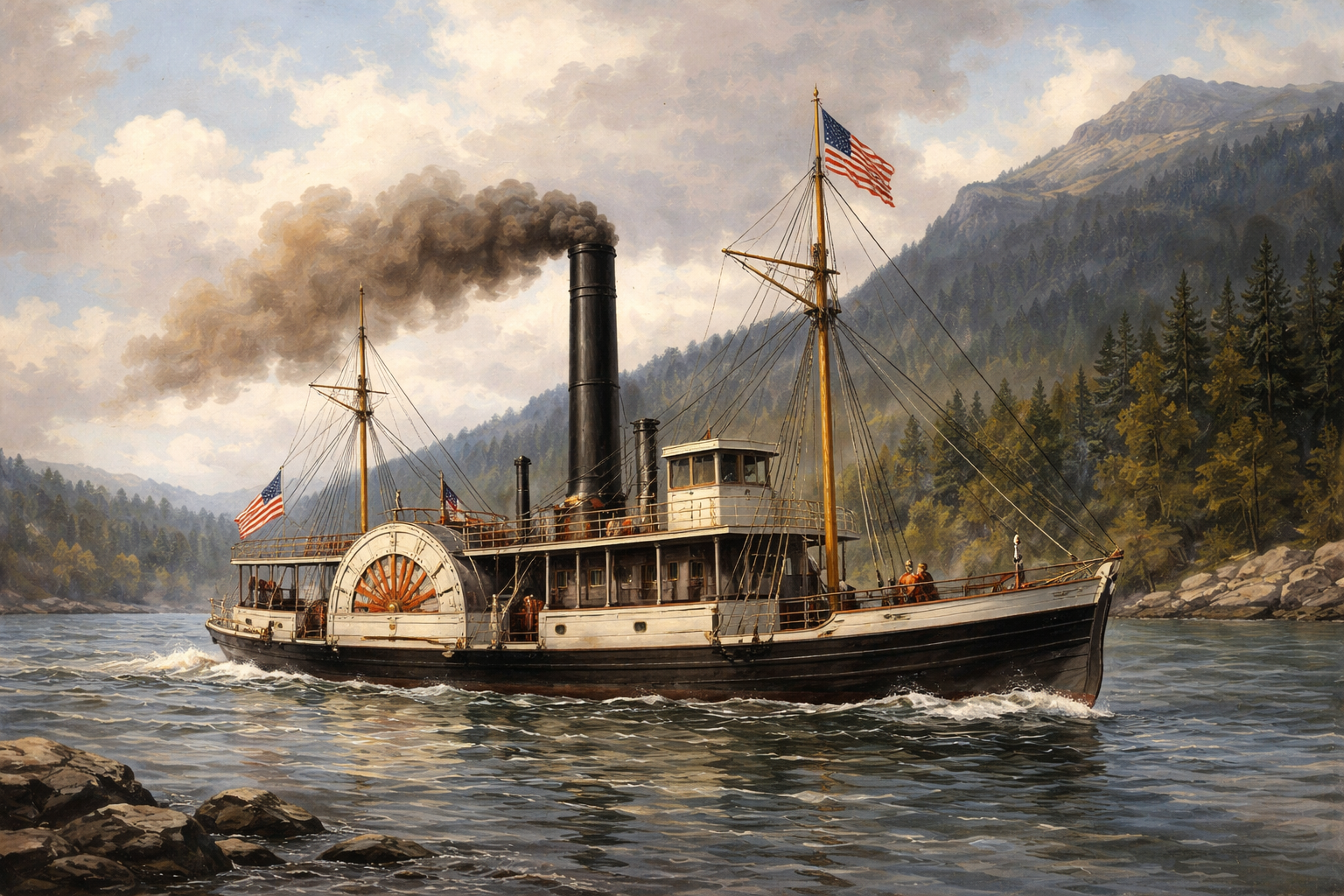
Researcher’s Note: The Steamer Fremont, referenced to by George Gibbs in this April 29, 1853 letter from Fort Vancouver was a regional side-wheel steam vessel operating in the Pacific Northwest and was not part of the fleet of the Pacific Mail Steamship Company. Pacific Mail, founded in 1848, dominated long-distance steamship travel along the Pacific Coast, particularly on the Panama–San Francisco route, using large, ocean-capable vessels that were extensively documented in company records and federal mail contracts. No ship named Fremont appears in those lists, and the operating pattern described in Gibbs’s letter does not match Pacific Mail service. Instead, the Fremont belonged to a secondary network of locally operated or chartered steamers that served the Columbia River, Fort Vancouver, Puget Sound, and nearby coastal routes. These vessels were light-draft, utilitarian craft that ran on irregular schedules governed by weather, cargo, and mechanical reliability, and they carried mail, officials, and passengers on the final northern leg of journeys that often began aboard Pacific Mail steamers in San Francisco. In practical terms, Pacific Mail provided the long-haul backbone of Pacific transportation, while vessels like the Fremont functioned as connectors, extending federal communication and administration into Oregon Territory. The absence of any known photograph of the Fremont is consistent with this role, as small regional steamers operating in the early 1850s Pacific Northwest were rarely photographed and are typically known only through written references or period engravings. The Fremont should therefore be understood as a local workhorse of frontier logistics rather than a named vessel of the Pacific Mail Steamship Company.
RESEARCHER’S NOTE: George Gibbs’s brief political comment reflects the tense and factional nature of Oregon Territory politics in the early 1850s, a period when national party struggles were being played out on a frontier stage. By 1853, Oregon was overwhelmingly Democratic, and the Whig Party existed largely as a frustrated minority outside of a few commercial centers, most notably Astoria, whose mercantile and maritime connections made it more receptive to Whig economic views. Gibbs’s remark that “all Oregon except Astoria is busy with politics” underscores how isolated Whig influence had become in the territory. His satisfaction at the rejection of Pratt as Chief Justice reflects a rare moment of political relief for Whigs, who often saw federal appointments go to Democratic loyalists regardless of local opposition. Even more revealing is his reference to Joseph Lane, the dominant Democratic figure in Oregon, who had resigned as territorial governor in order to position himself for election to Congress, only to maneuver for continued political advantage. To Whigs like Gibbs, Lane’s actions epitomized Democratic opportunism and the consolidation of one-party control in the territory. This passage captures a Whig worldview shaped by disappointment but not resignation: a belief in orderly governance, suspicion of populist political tactics, and a lingering hope that Democratic dominance might yet be checked. In this sense, Gibbs’s letter offers a valuable snapshot of how national party divisions (Whig versus Democrat) were experienced personally and intensely in Oregon Territory on the eve of Washington Territory’s creation later that same year.
Views: 32
Explore the evidence
View this article’s connected sources and media →
About this page
This article was brought over from AlfredGibbs.com. Its preserved text, media and citations remain available for comparison.