
George Gibbs to His Dearest Mother
Forks of the Salmon, July 17, 1852
My Dearest Mother,
It is about six weeks since I wrote Wolcott, and it is high time that I gave an account of myself, though I suppose that Austin Stevens showed you a letter I sent him on my return from the mountains as I requested. Something has again detained yours to me, for I have received none since the batch that came in June and which were of no later dates than March. I need not tell you how anxious I have become to hear of yourself and the family. I have written down to Mr. Moore and George Wm. to inquire as to their fates. Mr. Moore is very kind. I received the other day a large package with papers N. Lond. [New London] News and magazines from him, a great treat in these wilds, and which, after I had done with them, were duly scattered among the miners’ camps of the Salmon.
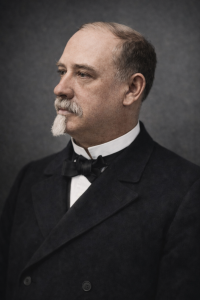
RESEARCHER’S NOTE: Austin Stevens, specifically John Austin Stevens Jr., appears in the context of George Gibbs’ letters as a long-standing friend of Gibbs. Stevens is noted for having prepared a memorial statement for the New York Historical Society about George Gibbs, which was printed in the annual report of the Smithsonian Institution. In this memorial, Stevens described Gibbs as a man of “plain, outspoken, manly, and unvarnished speech” and characterized his faults as those of a large and generous nature.
Stevens also commented on the volume and nature of Gibbs’ correspondence during the years Gibbs lived in the West. He asserted that Gibbs wrote to his family once or twice a week, and that his letters were full of vivid descriptions of life and nature. Stevens believed these letters should be published because they would make a valuable contribution to the history of the early days of the settlements in the Pacific Northwest. Although Stevens overestimated the number of letters, there were originally many more than the nineteen printed in the collection. These letters were written between 1850 and 1853 and included correspondence to Stevens himself, as well as to Gibbs’ mother and brothers. They provide an insightful picture of the Pacific Northwest, especially regarding politics and mining, as seen through the eyes of an informed, thoughtful, sensitive, and articulate observer.
One of the letters from George Gibbs to John Austin Stevens Jr. dated September 4, 1852, from the Salmon River, shows a personal connection and ongoing communication between them, with Gibbs discussing his mining experiences and challenges.
In summary, John Austin Stevens Jr. was a close friend and correspondent of George Gibbs, who valued Gibbs’ letters highly for their historical and descriptive content and took an active role in memorializing Gibbs after his death. The letters to Stevens are part of the important collection that sheds light on the early history of the American West through Gibbs’ experiences and observations.
This information is drawn from the memorial statement and the letters themselves as presented in the collection of George Gibbs’ Pacific Northwest letters on AlfredGibbs.com.
Since the date of my letter to Austin, I ascended the South Fork of the river to near its source in the hope of finding better diggings in the “gulches” as they are called, than I would get here, and generally to satisfy myself about the country. Not meeting with anything satisfactory, I have returned here and, unless something unforeseen happens, shall remain here for the winter. Next week I think of knocking up a small log cabin where I shall be by myself and can during the rainy days employ the time in writing. The fact is that since I left home, I never have had a place to myself except the woods, and there one cannot very well feel stationary. The expansive ideas formed under the blue canopy and which made a view of fifteen or twenty miles the matter of perhaps five minutes consideration, are very inconsistent with sedentary pursuits. At this place, I shall have some company for the winter of very good men and with a hole of my own can manage to live. The diggings, to be sure, are not very good, but I have not found much better by prospecting, and as this takes money as well as time, I must quit it. As yet, I have laid up nothing of consequence, though I have avoided getting in debt. In the spring, I think I shall abandon this part of the country and strike for some other rivers.
Do not make yourself unhappy at any dull prospects. I have patience and resolution, good health, and hope for the future withal and shall try and profit by the experience of former mistakes. As for the rest, have no fears. I never touch liquor and do not gamble. I find myself generally both liked and respected, and there are many men around laboring like myself who are intelligent, moderately well-educated, and are both pleasant companions and very obliging good friends. The only trouble upon my mind is that I cannot discharge my debts at home as I hoped long since to have done. I left none in Oregon except a mortgage for a few hundred dollars on some land, and I have written to my friend [Amory] Holbrook to sell out and pay that off. If hereafter I can realize a few thousand dollars, and that not many, I shall come back to you again, but I cannot do so poorer than when I left.
I have given a note of introduction to a Mr. Liscom, a sensible, honest, and every way worthy man, who is going home to bring out his family. He has been very obliging to me in various ways, and I should like to have you ask him to a family dinner and get Laura to play on the piano for him. He can give Wolcott a good deal of practical information about the mines. I also gave him a note to Wm. F. Channing. Unfortunately, my sack containing a box of seeds and shrubs, etc., which I had collected for Aunt Sarah, is at my last camp, 25 or 30 miles off, waiting for an opportunity to come down by some pack train or I would send it by him. I will try and forward it to some express office, however, on its arrival.
Tell Aunt Sarah that I have made three separate collections for her and lost them all. The last one had varieties of acorns of different evergreen oaks, nuts of the bay tree or Indian olive, a superb and fragrant evergreen, etc. I have now a quantity of seeds of the great scented California mountain lily, the manzanita and other shrubs, and will try to add some sugar pine nuts, and those of the big cone or common Indian nut pine. It is, however, impossible to get anything of this sort except on happening upon them in the mountains as the Indians always cook or break them. I shall also write to a friend at Humboldt Bay to forward a dozen plants of the famous Redwood cedar, the gigantic tree so often spoken of as growing on the California coast, and a dozen more of the Salmon berry bush, a species of raspberry that grows to the height of twenty feet. The berry resembles the flesh of the fish in color, though more yellow. The Chinooks of the Columbia have many superstitious associations concerning it and the Salmon whence its English name. It blooms about the time the Salmon first appear and the fruit is ripe when they are in full season. Formerly they would not sell the fish uncooked until the berry was ripe. It is about an inch long and tart. I regret exceedingly the difficulty of making any collections here or of keeping anything. But seeds, unless the plant is very conspicuous, cannot well be obtained as when out of bloom you lose sight of it. The Redwood and the Salmon berry would I think both flourish at Newport.
Tell Aunty I am afraid she thinks me ungrateful in not writing to her direct and I ought long since to have done so. I will make up for it by a long yarn about plants and scenery soon. I am just recovering from a strange affection of the eyes. The sailors, of whom we have many through the mines, all insist that I was “moon struck.” Just after my return, I was sleeping as usual on the ground, but as it happened with my face directly exposed to the full broad moonlight. The night was cool, but I had plenty of blankets and slept very soundly. In the morning when I woke I found that I could not see with any distinctness, had a sort of double vision, and tottered in walking. In fact, I had to close one eye to see at all. This you might think rather equivocal as regards my amusements the night before, but I had drunk nothing but tea. I might have thought it a bilious attack, but there was no headache or other symptoms. I had walked fifteen or twenty miles the day before without fatigue and never felt better in my life than when I went to bed. During the day I was quite sick. The right eye squinted outwards considerably and both were inflamed and swollen. The affection did not wear off for a week, and even now the lids are inflamed, but for two or three days I could distinguish nothing clearly and felt weak and staggering. Now I have lived and slept so much in the open air that taking cold in the face seems out of the question, but what occasioned the attack otherwise is incomprehensible unless the moon did it. I leave it to Wolcott as physician and philosopher to decide whether she is guilty of such offences in reality. The sailors all swear they have seen men’s faces distorted and paralyzed by sleeping in the moon in southern latitudes.
For his satisfaction, I will revise and add to my Klamath notes this winter and send them to him with the map. What has been done about the journal at Washington? Did they order it printed, and above all, did they order it paid for? I meant to have sent him the specimens of gold alluded to in my letter, but alas they were transformed into pork and flour during my journey. I can, however, replace them, and when I get a few ounces ahead again will send them with the $100 I borrowed of you. There are some few other particulars about the mines which I must keep till my next. Give my best love to the girls and remember me as usual to my friends. Tell some of your acquaintances in Congress to send out what public documents there are of interest, especially all relating to Oregon and California. I have neither heard from Alfred nor Francis since I wrote you. I shall write to them both in a few days. Meantime abuse Alfred vehemently, for I have no letter from him since he left Panama.
Goodbye, dearest mother, from your son who wishes most of anything to see you again.
P. S. Since the above was written, I have received yours of April, May, and June in regular file but none later, also one of last November, two from Frank besides those you sent, and have one from Alfred and one from Mary, William, and Aunt Ruth. I will in a short time write to Aunt R. and Mary. Meantime thank them for these letters. Yours were a great relief to me. I must close this but will soon write again.
Hereafter direct to care of Gibbs & co. San Francisco. Love to Alfred. I will answer his letter in a few days.
In haste,
George
Views: 22
Explore the evidence
View this article’s connected sources and media →
About this page
This article was brought over from AlfredGibbs.com. Its preserved text, media and citations remain available for comparison.