
From the Army of the Potomac
CULPEPPER, VA., Dec. 14th, 1863.
MR. EDITOR—I have for some time past been trying to find leisure time to write you a letter, but when anything has occurred of much interest I have been too busy until it has become old; it will here be so, and I will now take time. It has been the fault of my life to love excitement, and a constant recurrence of something new. My present position affords abundant gratification of this propensity; for example: I will not draw on fancy when anything important occurs at the extreme front.
I start out from Washington under instructions to spare money on horses, flesh, and lodging. I myself to be beaten in time, and at the nearest railroad station—perhaps in the night—and hand my horse to a stranger with grave doubts whether I ever see him again, for there are no hotels here, and desperate responsibility for the safety, keeping of animals or baggage; and there takes the last train. This is a forage train affording only box cars empty or filled with soldiers. Fortunately I sometimes find one sufficiently empty to allow the spreading of my blankets on the floor, and then securing a few hours rest rendered quite comfortable by the necessities of the case. The next thing is to telegraph to the Washington office to hold open until my arrival, which as our trains run now days is about one o’clock A.M. Events in prospect for the morning require attention, and require the same eager haste necessary in returning, and I have only to tell the engineer to wait for me while I walk to the telegraph office and back, and then make up my bed again on a pile of sacks and grain; very close to the foot of the car and sleep overtly for miles; the road being rough enough to satisfy any reasonable man. If I was fortunate enough to have anything to eat in my haversack all right, if not, the faithful Railroad Commissary will give me a cup of coffee while the change of trains is being effected at Alexandria; provided I have time to get the benefits of his kindness. Kind heart, he keeps his coffee and beef steak warm all night for the benefit of night workers. A repetition of this or a similar round whenever important matters about which to write are on hand, are my reasons for not sooner redeeming my promise to write occasionally.
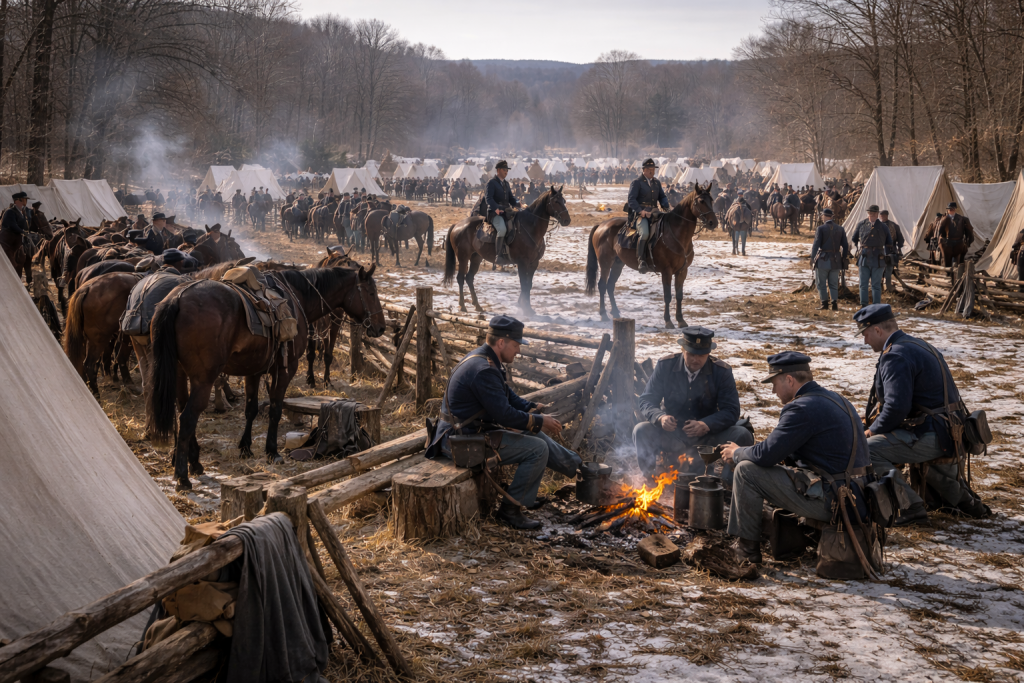
Having been sent here to spend a few days with the cavalry, I happened to drop right into the camp of our old friends and neighbors of the 1st New York Dragoons. If a man has yet to learn the full value of a meeting with familiar faces, let him come to the army, far away from the “loved ones at home,” and wander over poor desolate Virginia a few months, with a daily change of faces new and strange, and I think one visit will set him right on that score.
The 1st. New York Dragoons, formerly 130th N. Y. Infantry, are now brigaded with four regiments of Regular Cavalry and a regiment of Pennsylvania volunteers, in Gen. Buford’s division, and are guarding the front between this point and the rebel lines on the Rapidan river near the railroad crossing; the difference between picketing and scouting. This position is one of the utmost importance, as will be readily seen by a glance at the position of the two armies.
I have enjoyed a two days ride with them much indeed. It is rough, but exciting, and a little spice of danger makes it the more interesting. I will describe one trip which will give you a very good idea of the duties of this branch of the service, latterly of so much importance to our army: Four companies of the 1st. were on picket, and one squadron consisting of the companies of Captains Culbertson and Leach, under command of Capt. Leach, with another squadron under Capt. Lemen, when about noon the order came for a scout to James City and Thoroughfare Mountain, distant eighteen miles from the picket post and twelve from the camp near the town. It was a beautiful day for such a ride, clear and cold,
[Continued from page 1]
night—and hand my horse to a stranger with grave doubts whether I ever see him again for there are no hotels here, and desperate responsibility for the safety keeping of animals or baggage; and there takes the last train. This is a forage train affording only box cars empty or filled with soldiers. Fortunately I sometimes find one sufficiently empty to allow the spreading of my blankets on the floor, and then securing a few hours rest rendered quite comfortable by the necessities of the case. The next thing is to telegraph to the Washington office to hold open until my arrival, which as our trains run now days is about one o’clock A.M. Events in prospect for the morning require attention, and require the same eager haste necessary in returning, and I have only to tell the engineer to wait for me while I walk to the telegraph office and back, and then make up my bed again on a pile of sacks and grain; very close to the foot of the car and sleep overtly for miles; the road being rough enough to satisfy any reasonable man. If I was fortunate enough to have anything to eat in my haversack all right, if not, the faithful Railroad Commissary will give me a cup of coffee while the change of trains is being effected at Alexandria; provided I have time to get the benefits of his kindness. Kind heart, he keeps his coffee and beef steak warm all night for the benefit of night workers. A repetition of this or a similar round whenever important matters about which to write are on hand, are my reasons for not sooner redeeming my promise to write occasionally.
Having been sent here to spend a few days with the cavalry, I happened to drop right into the camp of our old friends and neighbors of the 1st New York Dragoons. If a man has yet to learn the full value of a meeting with familiar faces, let him come to the army, far away from the “loved ones at home,” and wander over poor desolate Virginia a few months, with a daily change of faces new and strange, and I think one visit will set him right on that score.
The 1st. New York Dragoons, formerly 130th N. Y. Infantry, are now brigaded with four regiments of Regular Cavalry and a regiment of Pennsylvania volunteers, in Gen. Buford’s division, and are guarding the front between this point and the rebel lines on the Rapidan river near the railroad crossing; the difference between picketing and scouting. This position is one of the utmost importance, as will be readily seen by a glance at the position of the two armies.
I have enjoyed a two days ride with them much indeed. It is rough, but exciting, and a little spice of danger makes it the more interesting. I will describe one trip which will give you a very good idea of the duties of this branch of the service, latterly of so much importance to our army: Four companies of the 1st. were on picket, and one squadron consisting of the companies of Captains Culbertson and Leach, under command of Capt. Leach, with another squadron under Capt. Lemen, when about noon the order came for a scout to James City and Thoroughfare Mountain, distant eighteen miles from the picket post and twelve from the camp near the town. It was a beautiful day for such a ride, clear and cold,
Views: 18
Explore the evidence
View this article’s connected sources and media →
About this page
This article was brought over from AlfredGibbs.com. Its preserved text, media and citations remain available for comparison.