
This is the general before anyone imagined a general: First Lieutenant Alfred Gibbs of the Mounted Riflemen, thirty one years old, regimental adjutant at Corpus Christi, writing his youngest brother Frank in New York under the family system he explains in his first sentence: a letter home every fortnight, “intended equally for the benefit of the whole family.” It is why these letters survive. In three pages he gives us his sporting life on the Laguna Madre in magnificent detail, reveals that he has written it up for the press (“you will see an account I have written of the fun in the Spirit of the Times”), reports the death of Captain Van Buren, who “lived for nine days with an arrow through his body,” and announces his departure on the 2,000-mile expedition to El Paso, the road that would carry him toward New Mexico and, in time, Fort Fillmore. He closes with the line that names his bond with Frank: “Remember that we are the youngest, and have to bring up the rear of the rest of the family.”
❦The Letter
Page 1 (scan 1624, frame 000547)
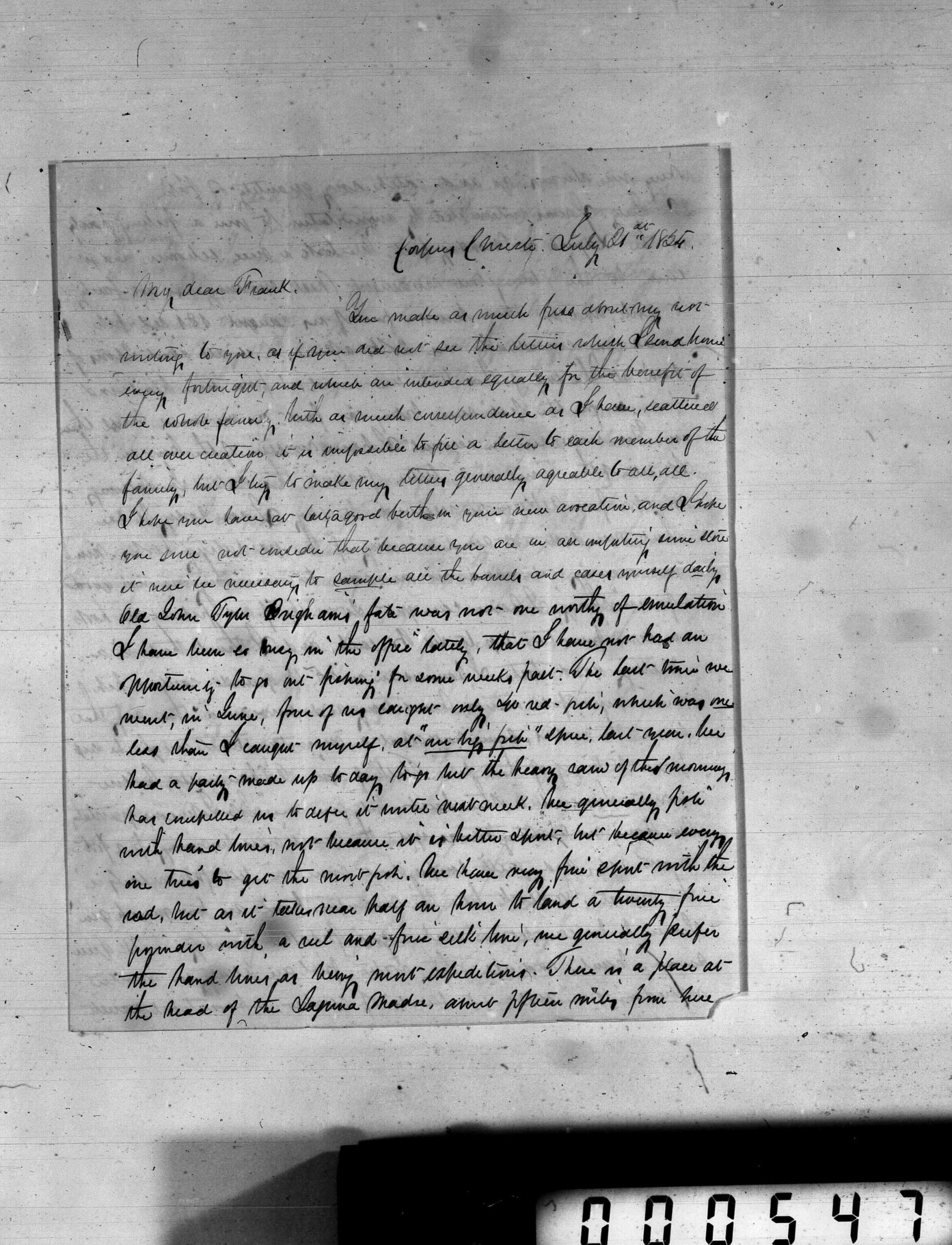
Corpus Christi. July 21st 1854.
My dear Frank,
You make as much fuss about my not writing to you, as if you did not see the letters which I send home every fortnight, and which are intended equally for the benefit of the whole family. With as much correspondence as I have, scattered all over creation it is impossible to give a letter to each member of the family, but I try to make my letters generally agreeable to all, all. I hope you have at last a good berth in your new avocation, and I hope you will not consider that because you are in an auction [?] wine store it will be necessary to sample all the barrels and cases minutely daily. Old John Tyler Brigham’s [?] fate was not one worthy of emulation. I have been so busy in the office lately, that I have not had an opportunity to go out “fishing” for some weeks past. The last tournament, in June, four of us caught only 60 red-fish, which was one less than I caught myself, at “one big fish” spree, last year. We had a party made up to day to go but the heavy rain of this morning has compelled us to defer it until next week. We generally fish with hand lines, not because it is better sport; but because every one tries to get the most fish. There may [be] fine sport with the rod, but as it takes near half an hour to land a twenty five pounder with a reel and fine silk line, we generally prefer the hand lines as being most expeditious. There is a place at the head of the Laguna Madre, about fifteen miles from here
Page 2 (scan 1626, frame 000548)
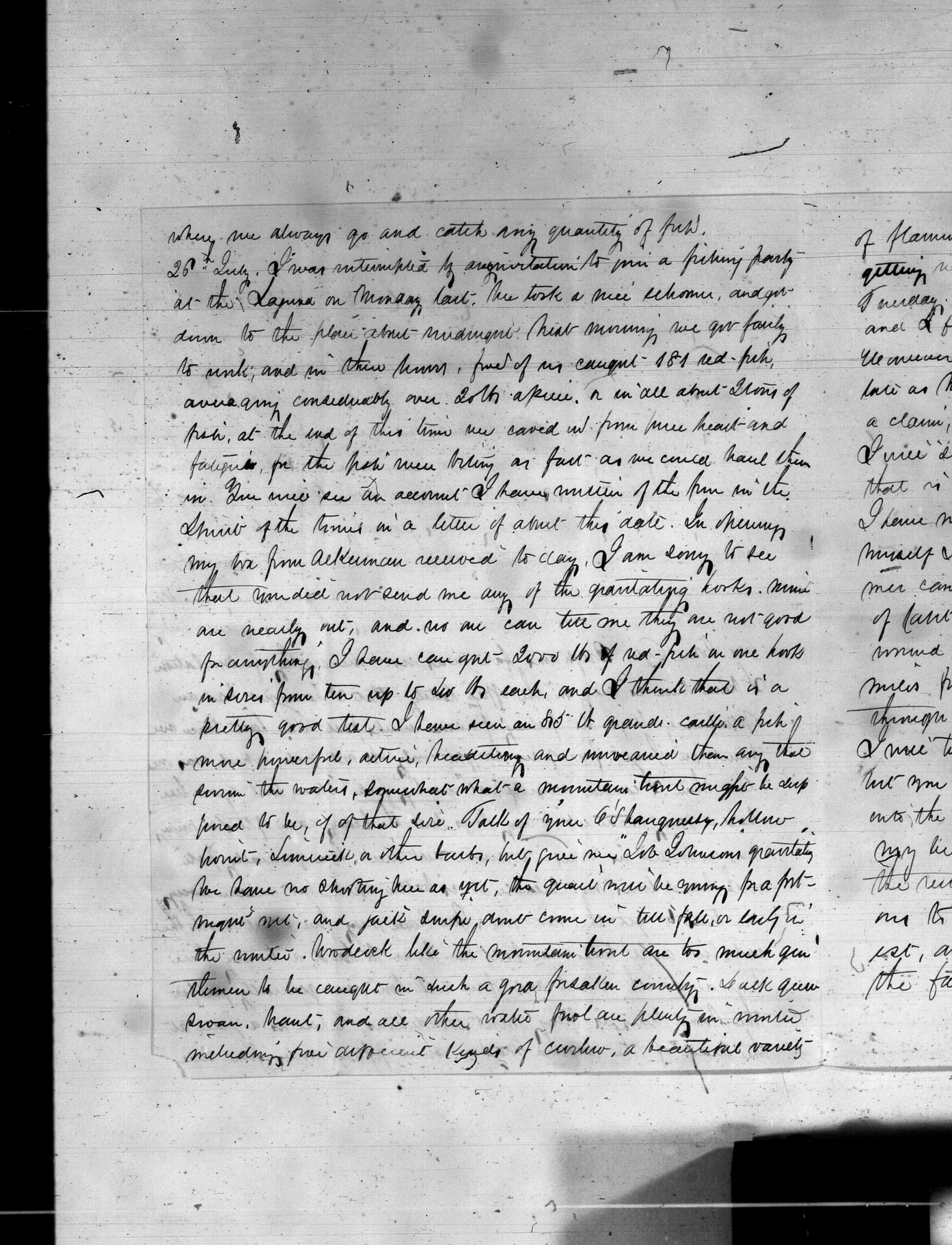
where we always go and catch any quantity of fish.
26th July. I was interrupted by an invitation to join a fishing party at the Laguna on Monday last. We took a nice schooner, and got down to the place about midnight. Next morning we got fairly to work, and in three hours, four of us caught 181 red-fish, averaging considerably over 20 lbs apiece, or in all about 2 tons of fish. At the end of this time we caved in from mere heat [?] and fatigue, for the fish were biting as fast as we could haul them in. You will see an account I have written of the fun in the Spirit of the Times in a letter of about this date. In opening my box from Ackerman received to day, I am sorry to see that [he] did not send me any of the gravitating hooks. Mine are nearly out, and no one can tell me they are not good for anything. I have caught 2000 lbs of red-fish on one [of the] hooks in sizes from ten up to six lbs each, and I think that is a pretty good test. I have seen an 85 lb [?] grande caille, a fish more powerful, active, headstrong and unwearied than any that swim the waters, somewhat what a mountain trout might be supposed to be, if of that size. Talk of your O’Shaugnessy, hollow point, Limerick or other [makes], but give me “Job Johnson’s gravitating” [?]. We have no shooting here as yet, tho quail will be coming in a fortnight or so; and jack snipe don’t come in till fall, or early in the winter. Woodcock like the mountain trout are too much gentlemen to be caught in such a god forsaken country. Duck, geese, swan, brant, and all other water fowl are plenty in winter including four different kinds of curlew, a beautiful variety
Page 3 (scan 1627, frame 000549)
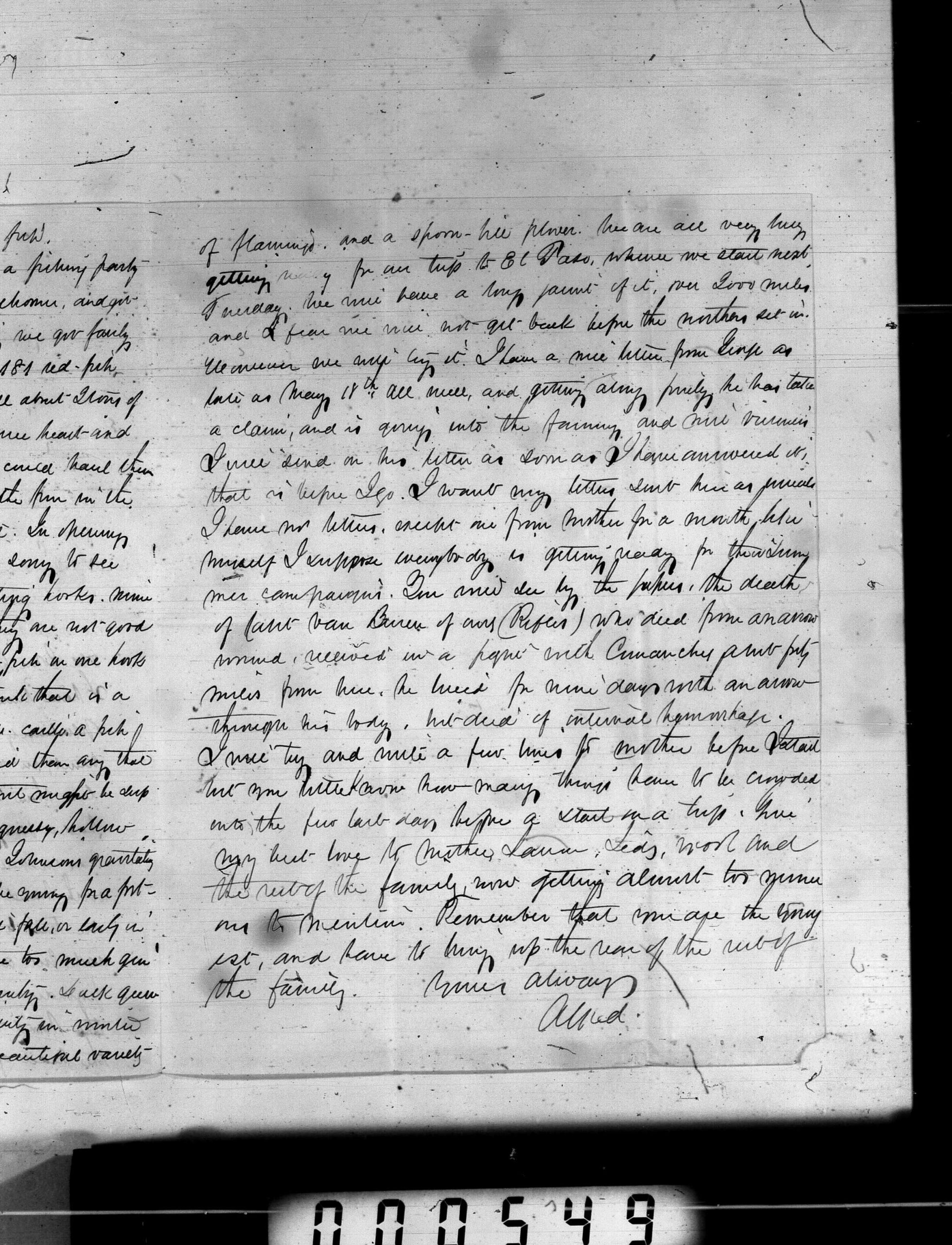
of flamingo, and a spoon-bill plover. We are all very busy getting ready for our trip to El Paso, whence we start next Tuesday. We will have a long jaunt of it, over 2000 miles, and I fear we will not get back before the northers set in. However we may [enjoy?] it. I have a nice letter from George as late as May 18th all well, and getting along finely, he has taken a claim, and is going into the farming [line?]. I will send on his letter as soon as I have answered it, that is before I go. I want my letters sent here as usual. I have no letters, except one from Mother in a month, like myself I suppose everybody is getting ready for the summer campaigns. You will see by the papers, the death of Capt Van Buren of ours (Rifles) who died from an arrow wound, received in a fight with Comanches about fifty miles from here. He lived for nine days with an arrow through his body, but died of internal hemorrhage. I will try and write a few lines to Mother before I start but you little know how many things have to be crowded into the few last days before a start on a trip. Give my best love to Mother, Laura, [Eliza?], Wolcott [?] and the rest of the family, now getting almost too numerous to mention. Remember that we are the youngest, and have to bring up the rear of the rest of the family.
Yours always
Alfred.
1. FOUND. The published account exists, exactly where this letter said it would be: the FRONT PAGE of the Spirit of the Times for August 19, 1854 – “Fishing in Texas,” datelined Corpus Christi, July 27, 1854, signed “WRY-FULL” (say it aloud: a Mounted Rifleman’s pun). It repeats this letter’s facts detail for detail. See the full exhibit: Alfred Gibbs in the Spirit of the Times. The family were readers: Alfred’s sister Laura had mailed Frank clippings from the paper in 1852 (Reel 2, scan 1452).
2. Captain Michael E. Van Buren of the Mounted Riflemen was mortally wounded in a fight with Comanches in Texas and died in July 1854; Alfred’s account, written within days and fifty miles from the fight, is contemporary testimony to the manner of his death.
3. The El Paso expedition, “over 2000 miles” there and back, is the road pointing toward Alfred’s later New Mexico service. His son would be born at Fort Fillmore in October 1856.
4. “George… has taken a claim, and is going into the farming” is his brother George Gibbs’s homestead near Fort Steilacoom, Washington Territory, described in George’s own letters elsewhere on this reel.
Archival citation
Gibbs Family Papers, 1763-1918. U.S. Mss Y; Micro 1117; Photo Lots 3696-3697. Wisconsin Historical Society, Division of Library, Archives, and Museum Collections, Madison, Wis. Digitized research copy (Green collection), Reel 2. Scans 1624-1628 (scans 1625 and 1628 are duplicate microfilm exposures); microfilm frames 000547-000549. Every page of the letter is shown above; duplicate microfilm exposures are noted in the reel index.
Suggested citation (Chicago): Alfred Gibbs to Francis S. Gibbs, July 21-26, 1854, Gibbs Family Papers, 1763-1918, U.S. Mss Y (Micro 1117, reel 2, frames 547-549), Wisconsin Historical Society, Madison. Accessed via AlfredGibbs.com.
Related in the Record
References
Gibbs, A. (1854, July 21-26). [Letter to Francis S. Gibbs]. Gibbs Family Papers, 1763-1918 (U.S. Mss Y, Micro 1117, reel 2, frames 547-549). Wisconsin Historical Society, Madison, WI.
Gibbs family. (1763-1918). Gibbs Family Papers (U.S. Mss Y; Micro 1117; Photo Lots 3696-3697) [Manuscript collection]. Wisconsin Historical Society, Madison, WI.
Accuracy review: transcription checked against the full-resolution scans, July 11, 2026. Original spelling and punctuation are preserved; editorial matter appears in square brackets and uncertain readings are marked [?] rather than guessed. Corrections are made openly; this page will be updated, never silently, if better readings are established.
Views: 4
Explore the evidence
View this article’s connected sources and media →
About this page
This article was brought over from AlfredGibbs.com. Its preserved text, media and citations remain available for comparison.